

Yes. Infant car seats usually have an expiration date set by the manufacturer. There is no single expiration period for every seat in the United States. Many seats expire about six to 10 years after the date of manufacture, but the exact limit depends on the brand and model.
You can find the date on the seat label, stamped plastic, or owner’s manual. If you cannot confirm the seat’s expiration date, crash history, or model information, replacing it is the safer choice.

Why Do Infant Car Seats Expire?
Infant car seats expire because their materials, parts, instructions, and safety features may not remain reliable forever. The expiration date is the manufacturer’s limit for using that specific seat.
A seat may look fine after years of use. However, age can affect parts that are hard to inspect, such as:


- Plastic shells and bases
- Foam used for impact protection
- Harness webbing
- Buckles and adjusters
- Recline and lock parts
- Labels and warning stickers
- Stroller or travel-system attachment parts
Heat, cold, sunlight, spills, cleaning products, and repeated use can also add wear. A seat stored in a hot vehicle may face more stress than one kept indoors.
The expiration date does not mean the seat will suddenly fail at midnight on that day. It means the manufacturer no longer supports that seat for use after its stated limit. The company may no longer have replacement parts, updated instructions, or a way to confirm that the seat meets its current requirements.
Federal rules and manufacturer limits are different
In the U.S., federal motor vehicle safety rules set performance requirements for child restraints. The National Highway Traffic Safety Administration, or NHTSA, explains that parents should follow the car seat manufacturer’s instructions for installation, use, and replacement.
Federal rules do not give every infant car seat one universal expiration date. Instead, the brand sets a useful life for each model. That is why two seats bought in the same year can have different expiration dates.
How to Find an Infant Car Seat’s Expiration Date
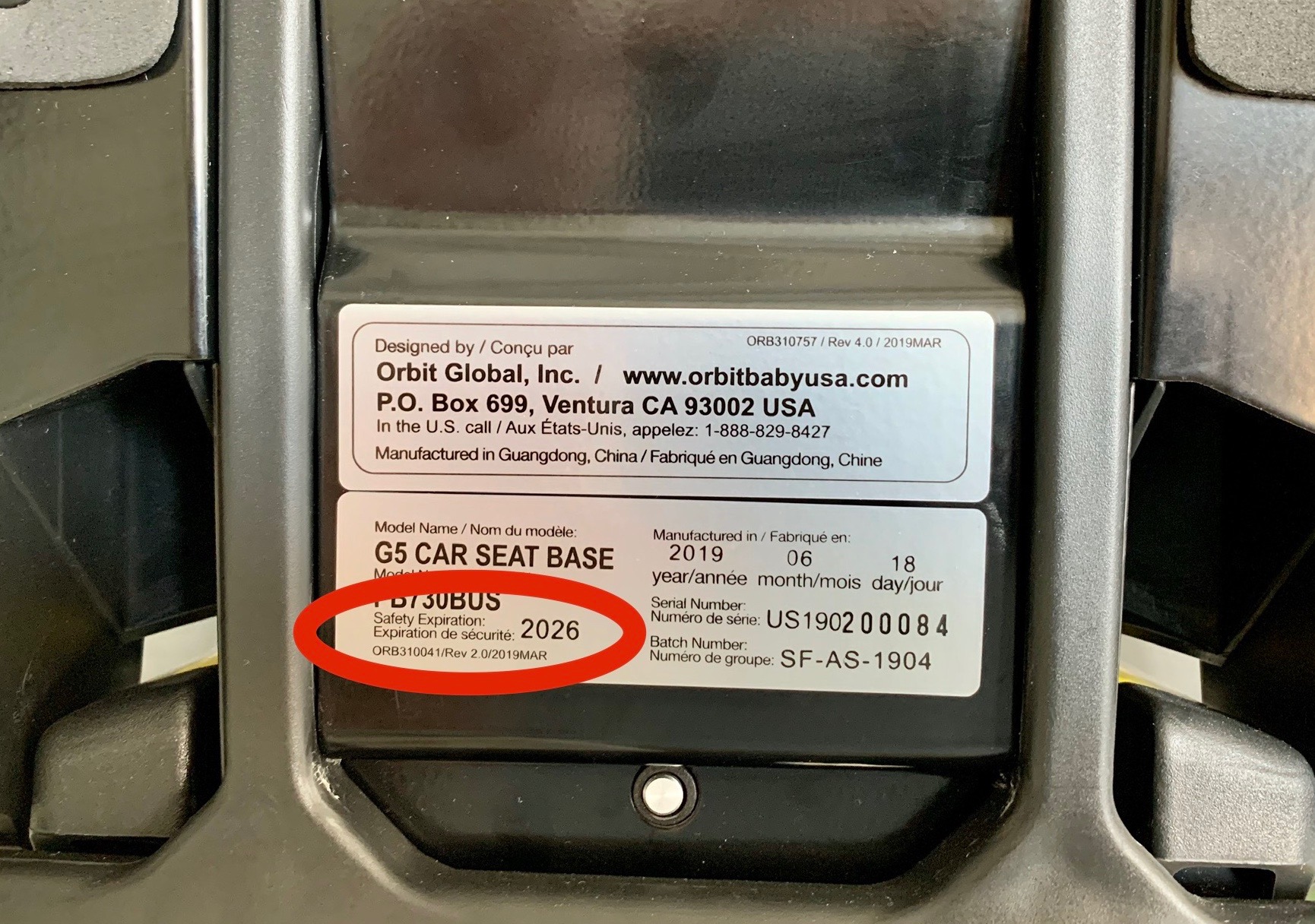
Start with the seat itself. Most manufacturers place the date on a label or molded into the plastic shell.
Check these areas:
- The back or bottom of the infant carrier
- The underside of the car seat base
- The side or rear of the plastic shell
- The registration label
- The owner’s manual
- The manufacturer’s online product page
Look for wording such as:
- “Do not use after”
- “Expiration date”
- “Manufactured on”
- “Date of manufacture”
- “Useful life”
- “Replace after”
Some seats show a clear expiration date. Others show only a manufacture date and a statement such as “do not use more than seven years after the manufacture date.”
Manufacture date versus purchase date
Expiration is usually based on the date of manufacture, not the day you bought the seat.
For example, imagine a seat was made in March 2021 and has a six-year useful life. Its expiration date would be in March 2027, even if you bought it new in July 2022.


This matters when buying a seat from a store, registry, garage sale, or online seller. A box may sit in storage for months or years before purchase.
What if the label is missing?
Do not guess. Contact the manufacturer with:
- The brand name
- The model name or number
- The serial number
- Any visible date code
- A photo of the seat, if requested
If the label is damaged or missing and the company cannot confirm the seat’s age, do not use it for travel. A seat with no readable labels may also be difficult to install or use correctly.

How Long Do Infant Car Seats Last?
Infant car seats often last about six to 10 years from the manufacture date, but this is only a general range. The actual limit can vary by manufacturer and model.
Use this table as a guide, not as a substitute for the seat’s manual:
| Seat information | What it means |
|---|---|
| A printed expiration date | Stop using the seat after that date |
| A manufacture date and useful-life rule | Count the stated number of years from manufacture |
| No date, label, or model number | Ask the manufacturer or replace the seat |
| A seat past its date but in good condition | Do not keep using it for routine travel |
| A seat with an unknown history | Treat it as unsuitable unless its history can be confirmed |
Do not add extra years because the seat was lightly used. The expiration period is based on the seat’s age and design, not only on how many trips it made.
Does the infant carrier expire separately from the base?
It can. Some travel systems include an infant carrier and a detachable base. The carrier and base may have separate labels, model numbers, or useful-life limits.
Check both parts. If either part is expired, damaged, recalled, or missing required information, do not use the complete system until the issue is resolved.
A replacement base must also be approved for that exact car seat model. Do not assume that a base from the same brand will fit safely.
When Should You Replace an Infant Car Seat?
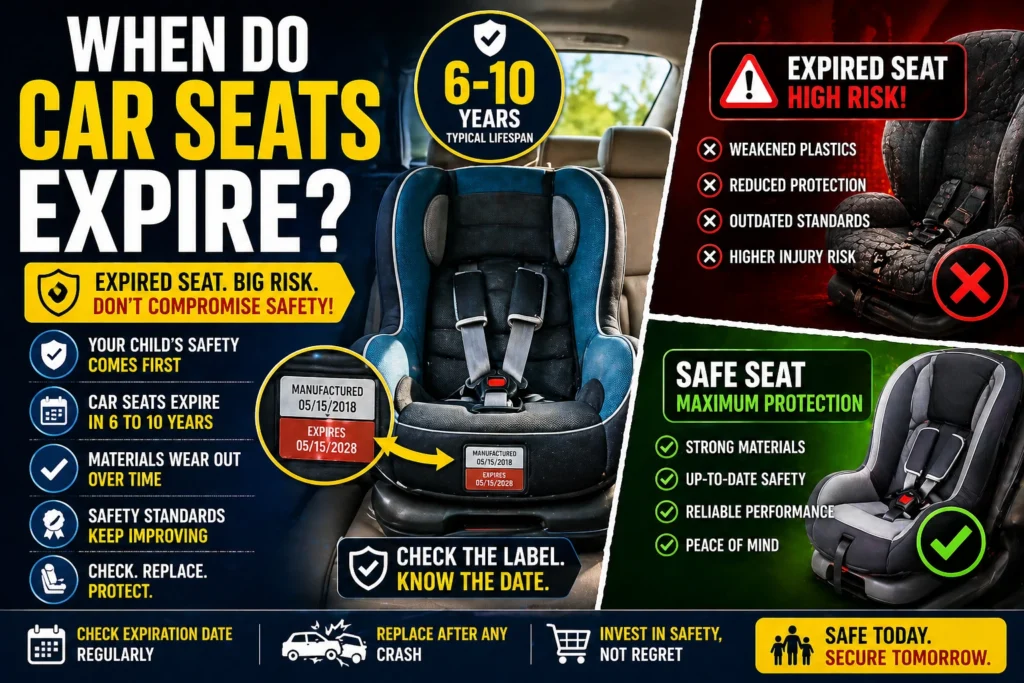
Replace an infant car seat when it is expired, damaged, recalled, or has an unknown crash or ownership history. Age is only one reason to stop using a seat.
Replace the seat after a qualifying crash
NHTSA advises replacing a car seat after a moderate or severe crash. A minor crash may not require replacement if all of the agency’s conditions are met:
- The vehicle can be driven away from the crash.
- The door nearest the child seat was not damaged.
- No one in the vehicle suffered injuries.
- The air bags did not deploy.
- There is no visible damage to the car seat.
- The manufacturer’s instructions allow continued use after a minor crash.
When in doubt, contact the car seat manufacturer. If you cannot establish that the crash was minor under these conditions, replace the seat.
Do not use a damaged seat just because the damage is hard to see. Internal damage may not be obvious after a collision.


Replace the seat after a recall
Check the seat’s model number and manufacture date against recall notices. You can search the NHTSA recalls database and register the seat with its manufacturer.
A recall does not always mean you must throw the seat away. The remedy may involve:
- A replacement part
- New instructions
- A repair kit
- A refund
- A replacement seat
Follow the official recall remedy. Do not rely on an online post or a seller’s statement.
Replace the seat when parts are missing or damaged
Stop using the seat if you notice:
- Frayed harness webbing
- A buckle that will not latch or release correctly
- Cracks in the shell or base
- Broken foam
- Missing padding required by the manual
- A loose handle or damaged carry mechanism
- Missing labels or instructions
- A base that will not lock securely
- A harness that cannot be adjusted properly
Do not repair a car seat with tape, glue, aftermarket padding, or homemade parts. Ask the manufacturer whether an approved replacement part is available.

Can You Use an Expired Infant Car Seat?
You should not use an expired infant car seat for transporting a child. The manufacturer no longer supports its use after the stated date.
An expired seat may still look clean and sturdy. That does not change the safety limit. The seat may have older materials, discontinued parts, or instructions that no longer match the vehicle or product design.
What should you do with an expired seat?
Make the seat unusable before disposal. Many communities and retailers offer child car seat recycling or trade-in events, but programs vary by location and date.
If recycling is not available:
- Remove the cover and padding.
- Cut the harness straps.
- Remove or mark the labels when practical.
- Write “EXPIRED—DO NOT USE” on the shell.
- Place the parts in accordance with local waste rules.
The goal is to prevent another person from finding the seat and using it for a child. Do not donate an expired seat or place it in a resale listing.

Can You Use a Used Infant Car Seat?
A used infant car seat can be acceptable only when you can confirm its full history and current condition. The American Academy of Pediatrics advises families to avoid seats with an unknown history.
Before using a secondhand seat, confirm all of the following:
- You know the brand, model, and manufacture date.
- The seat is not expired.
- It has not been in a crash.
- It has not been recalled.
- All parts are present.
- The harness and buckle work correctly.
- The seat has no cracks or other damage.
- The labels and instructions are readable.
- The seat has not been modified.
- The seat fits your vehicle and child according to the manual.


Be careful with seats from online marketplaces, yard sales, and informal exchanges. A seller may not know that the seat was in a crash or that a part was replaced with an unapproved item.
A low price does not make an unknown seat a good deal. The cost of a new seat is usually easier to weigh than the risk of an uncertain history.

Do Car Seats Expire if They Have Never Been Used?
Yes. An unused seat can still reach its manufacturer’s expiration date.
Storage may reduce wear, but it does not reset the clock. A seat that stayed in its box may still have an older design, older plastic, or unavailable replacement parts.
Before using a new-in-box seat, check the manufacture date. This is especially useful when:
- The seat came from an old registry.
- The box was stored for several years.
- The seat was bought from a liquidation sale.
- The seller cannot provide a recent manufacture date.
- The seat has been moved between homes or storage units.
Buy from a source that provides clear product and return information. Keep the receipt and register the seat so the manufacturer can send recall notices.

Does an Infant Car Seat Expiration Date Affect Your Baby’s Size?
Expiration and child fit are separate issues. A seat can be within its useful life but no longer fit your child.
Move to the next stage when your child reaches the seat’s height, weight, or fit limit listed in the manual. Do not move a baby forward only because the child’s legs touch the vehicle seat or because the child appears cramped.
The child’s head must remain within the limits in the instructions. The harness should sit at the correct height, lie flat, and pass the pinch test described by the manufacturer.
For most children, the American Academy of Pediatrics recommends using a rear-facing seat for as long as possible, until the child reaches the seat’s highest rear-facing height or weight limit. The seat’s manual controls the exact limits.
Never use an infant seat beyond its child size limits just because its expiration date has not arrived.

How to Check Whether an Infant Car Seat Is Safe to Use
Use this short check before every new installation or hand-me-down decision:
1. Identify the seat
Find the brand, model number, manufacture date, and expiration date. Photograph the labels for your records.
2. Check for recalls
Search the NHTSA recall database and the manufacturer’s recall page. Register the seat if you have not already done so.


3. Inspect the shell and base
Look for cracks, bending, sharp edges, missing pieces, or signs of heat damage. Inspect the carrier and base separately.
4. Test the harness and buckle
The buckle should latch and release as directed. The harness should slide through the approved path and tighten without sticking.
5. Read the current manual
Use the manual for harness height, recline angle, installation method, infant inserts, stroller use, and approved replacement parts. If you lost it, ask the manufacturer for a copy.
6. Install it in your vehicle
Use only the installation methods allowed by both the car seat manual and your vehicle owner’s manual. After installation, the seat should not move more than one inch side to side or front to back when tested at the belt path, according to NHTSA guidance.
7. Get help if needed
A certified Child Passenger Safety Technician can check the installation. The National Highway Traffic Safety Administration’s child passenger safety page can help you find inspection resources.

Common Mistakes With Expired Infant Car Seats
Several simple mistakes can lead families to keep using a seat longer than they should.
Counting from the purchase date
The useful life often starts on the manufacture date. Check the label instead of relying on the receipt.
Assuming a clean seat is safe
Clean fabric does not prove that the shell, harness, or base remains suitable. Age, crash history, and damage matter too.
Using a different brand’s base
Infant carriers and bases are not automatically interchangeable. Use only the base approved for the exact model.
Adding aftermarket padding
Extra cushions can change how the harness fits and may not have been tested with the seat. Use only inserts and padding allowed by the manual.
Relying on a general rule
“Six years” or “10 years” may be correct for one model but wrong for another. The label and manual are the final sources for that seat.
Throwing away a recalled seat without checking the remedy
Some recalled seats can be repaired. Follow the official notice before disposing of the product.

Frequently Asked Questions
Do infant car seats expire after six years?
Some do, but not all. Six years is a common limit for certain models. Check the manufacturer’s label and manual for the exact expiration date.
Is it safe to use an infant car seat after the expiration date?
No. Do not use a seat after its stated expiration date, even if it looks undamaged. Replace it and dispose of the old seat so another family cannot use it by mistake.
Does the car seat base expire too?
Usually, the base has its own manufacture date and useful-life limit. Check the carrier and base separately. Use only a base approved for that specific seat.


Can you use an expired car seat on an airplane?
No. An expired seat should not be used for air travel or in a vehicle. For an unexpired seat, check the label for aircraft approval and follow the airline’s current rules.
What if I cannot find the expiration date?
Find the model and manufacture information, then contact the manufacturer. If the seat’s identity, age, or history cannot be confirmed, replace it.
Conclusion: Check the Label Before You Use the Seat
Infant car seats do expire, but the date is not the same for every brand or model. Check the manufacture date, expiration date, recall status, condition, and crash history before using one.
The safest next step is simple: find the seat’s label today and compare it with the current manufacturer instructions. If the seat is expired, damaged, recalled without a completed remedy, or of unknown history, replace it rather than taking a chance.
