

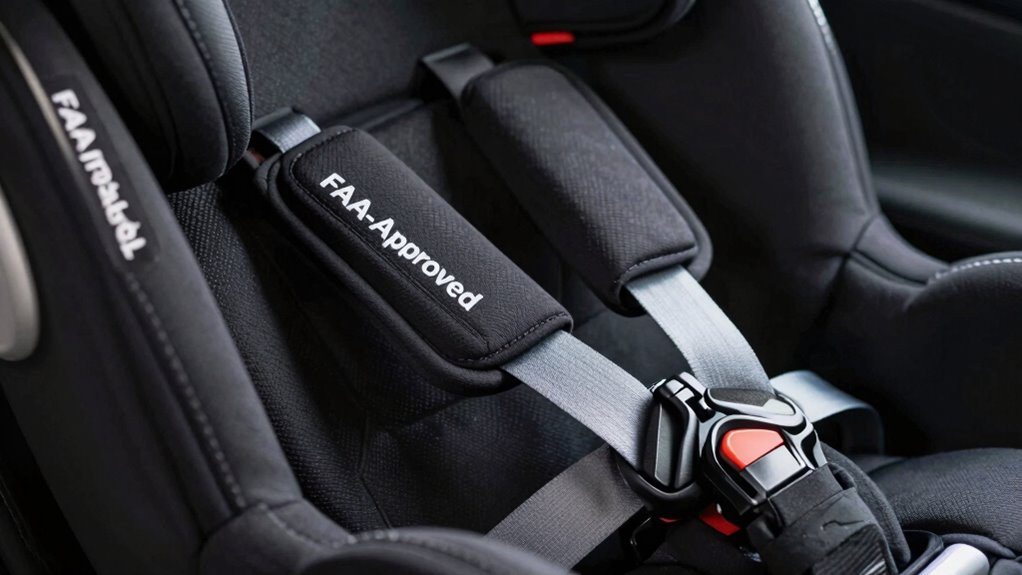
In the United States, an “FAA approved car seat” is a child restraint that can be used on an airplane as well as in a motor vehicle. The wording usually means the seat has the required certification label for use in both cars and aircraft. It does not mean that the Federal Aviation Administration has rated the seat as the safest car seat, tested every model itself, or endorsed a brand.
The correct term is FAA approved, not “FFA approved.” “FFA” is a common typo for the Federal Aviation Administration, or FAA.
Look for a label that says:
“This restraint is certified for use in motor vehicles and aircraft.”
That statement is the key. A seat may be legal for use in a car but not allowed on an airplane.

What an FAA-approved car seat means
An FAA-approved car seat meets federal child-restraint requirements for use in an aircraft cabin. It must be installed with the airplane’s passenger lap belt and used according to the seat maker’s instructions.


The seat should also meet U.S. motor vehicle safety rules. Most qualifying seats have a label showing that they comply with Federal Motor Vehicle Safety Standard (FMVSS) No. 213. The exact label wording may vary by model, but it should clearly state that the restraint is certified for use in both motor vehicles and aircraft.
This certification tells you three useful things:
- The seat is designed to be secured with an aircraft lap belt.
- The seat can be used in a passenger seat when the airline allows it.
- The manufacturer claims compliance with the applicable U.S. restraint standards.
It does not tell you that:
- The FAA has ranked the seat against other car seats.
- The seat will fit every airplane seat.
- The seat is suitable for every child.
- The seat can be used in every seating position.
- The seat is safer than a different properly installed child restraint.
The FAA recommends that children use an approved child restraint system during a flight. A child held on an adult’s lap is not protected in the same way during severe turbulence or a crash.
How to check whether a car seat is FAA approved
The fastest way to check is to inspect the physical label on the car seat. Do not rely only on an online listing, a product title, or a seller’s claim.
1. Find the certification label
Check the back, side, bottom, or shell of the seat. The label may be printed on the plastic shell or placed near the instruction label.
Look for wording similar to:
“This restraint is certified for use in motor vehicles and aircraft.”
If the label only says the seat meets motor vehicle standards, do not assume that it is approved for airplane use.
2. Read the instruction manual
The manual should explain how to install the seat on an aircraft. It should also list:
- Forward-facing and rear-facing limits
- Child height and weight limits
- Approved installation methods
- Belt-routing instructions
- Whether the seat can be used in a particular aircraft position
- Any restrictions on airplane use
If the manual does not mention aircraft use, contact the manufacturer before traveling.


3. Check the seat’s condition
An approved label does not make a damaged or expired seat safe. Do not use a seat if it has:
- Been involved in a crash when the manufacturer says it must be replaced
- Missing or damaged parts
- A broken shell
- Frayed straps
- Missing labels or instructions
- An unknown history
- An expired service life
A used seat with no labels is difficult to verify. When the history is unknown, replacing it is the safer choice.
4. Confirm the child fits the seat
A seat may be approved for aircraft use but still be wrong for your child. Check the child’s current height, weight, age, and developmental needs against the manufacturer’s limits.
A forward-facing seat should not be used for a child who still needs to ride rear-facing under the seat’s instructions. Certification covers the restraint. It does not replace proper fit.
FAA-approved car seat versus FAA-approved harness
A regular car seat and the FAA-approved CARES harness are different products.
| Child restraint | Use in a car | Use on an airplane | Main point |
|---|---|---|---|
| FAA-labeled infant car seat | Yes | Usually yes | Must have the aircraft certification label |
| FAA-labeled convertible car seat | Yes | Usually yes | Install with the aircraft lap belt |
| Belt-positioning booster | Yes, when allowed by law and instructions | Usually no | Aircraft seats do not have shoulder belts |
| CARES child aviation restraint | No | Yes | Made only for aircraft seats |
| Adult lap holding a child | Not a child-restraint method | Allowed in some cases by airline rules | Does not provide the same protection |
The CARES Child Aviation Restraint System is an FAA-approved harness for certain children. It is designed for children who weigh about 22 to 44 pounds and are less than 40 inches tall, subject to the current product instructions.
CARES is not a car seat. It cannot replace a child restraint in a motor vehicle because cars require a different type of crash protection.
A child who fits a rear-facing or forward-facing car seat may use that seat on an airplane if it has the required aircraft certification. A larger child who no longer fits a car seat may qualify for CARES, if the child meets the harness limits.
Why booster seats usually cannot be used on airplanes
Most booster seats are not approved for aircraft use because a booster needs a shoulder belt to position the vehicle belt correctly across the child’s chest and hips.
Commercial airplanes normally use lap belts. A booster cannot position an airplane lap belt safely because there is no shoulder portion to guide.
This includes many:
- Backless boosters
- High-back boosters
- Combination seats used in booster mode
- Portable travel boosters
A combination car seat may be approved for aircraft use in its harness mode but not in its booster mode. Always check the label and manual for the exact configuration.
When a child is too large for the car seat but too small for the CARES harness, ask the airline about its current policy. Do not improvise with a booster on an airplane.
How to install an FAA-approved car seat on a plane
Use the aircraft lap belt and follow the car seat manual. The installation is not the same as a typical vehicle installation.


Before boarding
- Check the certification label. Make sure the seat says it is certified for use in motor vehicles and aircraft.
- Read the manual. Review the aircraft installation section before your trip.
- Measure the seat if it is wide. Many airplane seats are narrow. A seat that is too wide may not fit between the armrests.
- Ask the airline about its policy. Airlines may have rules about seat width, seating location, and boarding.
- Plan for the child’s car ride. If you need the seat at your destination, bring it even if your child will not use it on the plane.
During installation
- Put the child restraint in the assigned passenger seat.
- Place the airplane lap belt through the correct belt path.
- Buckle the lap belt.
- Tighten it according to the car seat instructions.
- Remove slack from the belt path.
- Check that the seat does not move more than the amount allowed by the manufacturer.
- Keep the child within the seat’s height and weight limits.
- Secure the child with the seat’s internal harness.
Airplane seats generally do not have the LATCH anchors used in many cars. Do not try to attach the seat to an aircraft seat with LATCH, a top tether, a strap, or an accessory unless the manufacturer and airline specifically allow it.
A rear-facing seat may extend into the space in front of it. Tell the passenger in front of you that the seat must remain in its approved position. Do not turn the seat forward-facing just to create more legroom unless the child and seat meet the forward-facing requirements.
Where a car seat can go on an airplane
The safest practical choice is usually a window seat. A window position keeps the restraint from blocking another passenger’s path to the aisle.
The FAA generally does not allow a child restraint to block access to an aisle or emergency exit. Avoid:
- Exit-row seats
- Seats that block the aisle
- Seats where the restraint prevents another passenger from leaving
- Locations restricted by the airline or aircraft crew
A car seat may not fit beside another passenger seat because of its width. If the armrests do not lift or the restraint cannot sit correctly, ask the crew for help.
Crew members have authority over the final seating and installation decision. If a flight attendant asks you to move the restraint or change the installation, follow the instruction and show the certification label and manual if needed.
Does FAA approval mean the car seat is safe in a vehicle?
No. FAA approval only answers the aircraft-use question.
For vehicle use, you must also follow:
- The car seat manufacturer’s instructions
- The vehicle owner’s manual
- The child passenger safety laws in your state
- The seat’s rear-facing or forward-facing limits
- The correct belt path or LATCH method
- The required harness settings
A seat that is legal on an airplane can still be installed incorrectly in a car. Aircraft use does not confirm that it fits well in your vehicle.
For help with a difficult vehicle installation, use a certified child passenger safety technician. The National Highway Traffic Safety Administration provides a search tool for child passenger safety inspection stations and technicians through NHTSA.gov.
Common mistakes about FAA-approved car seats
Mistake 1: Trusting the phrase “airline friendly”
“Airline friendly” is marketing language. It is not the same as the required certification statement.


Check the actual seat label.
Mistake 2: Assuming every infant carrier is approved
Many infant car seat carriers are approved for aircraft use, but not every model is. Check the individual seat, not only the brand.
Mistake 3: Using a booster with an airplane lap belt
Most boosters need a shoulder belt. Do not use one on an airplane unless the manufacturer clearly approves that use and the airline permits it.
Mistake 4: Holding a child when a car seat is available
A child may be allowed to travel as a lap child under airline rules, often when under age 2. That does not make lap travel the same as using an approved restraint. A child restraint gives the child a dedicated seat and helps prevent dangerous movement during turbulence.
Mistake 5: Using a car seat without removing the harness
Do not remove the internal harness to make the seat fit another mode. Use only the configuration described in the manual.
Mistake 6: Buying a counterfeit or uncertified product
Some travel restraints resemble approved car seats but lack U.S. certification. Avoid products with unclear labels, missing manuals, or claims that do not match the manufacturer’s documentation.
Quick decision table
Use this table as a starting point, not as a substitute for the seat manual.
| Your situation | Likely option |
|---|---|
| Infant or toddler fits a certified infant seat | Use the infant seat on the aircraft |
| Child fits a certified convertible seat | Use the convertible seat in the approved direction |
| Child fits a combination seat’s harness | Use the harness mode if aircraft certified |
| Child only fits the booster mode | A booster is usually not suitable on an airplane |
| Child weighs 22–44 pounds and is under 40 inches | Check whether CARES fits the child |
| Seat has no aircraft certification label | Do not assume it can be used |
| Seat is too wide for the aircraft seat | Ask the airline before travel |
| Seat has missing parts or an unknown history | Replace it or verify it with the manufacturer |
What to do before your flight
Complete this checklist before leaving home:
- Confirm the seat has the aircraft certification label.
- Read the aircraft installation instructions.
- Check the child’s current height and weight.
- Check the seat’s expiration date and condition.
- Contact the airline about seat width and seating rules.
- Reserve a seat for the child if you plan to use a car seat.
- Bring the manual or a clear copy of the relevant pages.
- Arrive early enough to solve a seating or installation problem.
- Ask a flight attendant for help if the seat does not fit.
The best seat for air travel is not always the lightest seat or the one with the word “travel” in its name. The deciding factor is whether the seat is properly certified, fits the child, fits the aircraft seat, and can be installed as the instructions require.
Frequently asked questions
Is “FFA approved car seat” the same as “FAA approved car seat”?
Usually, yes. “FFA approved” is generally a typo or wording mistake. The correct agency name is the Federal Aviation Administration, or FAA.
Does an FAA-approved car seat need a special sticker?
It should have a certification label stating that the restraint is certified for use in motor vehicles and aircraft. If the label is missing or unclear, contact the manufacturer before flying.
Can I use a rear-facing car seat on an airplane?
Often, yes. A rear-facing seat can be used when the seat is certified for aircraft use, the child fits its limits, and the seat can be secured with the aircraft lap belt. Follow the manual and airline instructions.
Can I use a car seat in an exit row?
No. Child restraints cannot be used in a way that blocks an emergency exit or aisle. Airlines may also restrict child restraints in other locations.
Can I use LATCH on an airplane?
Usually, no. Aircraft seats generally do not have LATCH anchors. Install the car seat with the aircraft lap belt unless the manufacturer gives different instructions for that specific aircraft use.


Is CARES safer than a car seat?
Neither is automatically safer in every situation. CARES is made for aircraft seats and certain children. A car seat provides a different form of protection and may be appropriate when the child fits the seat. Use the restraint that matches the child, the aircraft, and the product limits.
Bottom line
An FAA-approved car seat is a child restraint certified for use in both U.S. motor vehicles and aircraft. The clearest proof is the label stating that the restraint is certified for both uses.
Before flying, check the label, manual, child-size limits, seat width, and airline rules. Remember that FAA approval covers aircraft use. It does not replace correct installation, proper vehicle use, or compliance with your state’s child passenger safety law.
