

The first car seats appeared in the United States during the 1930s, but they were not made to protect children in crashes. Early designs mainly lifted a child higher so the driver could see them. Modern child safety seats began to take shape in the 1960s, when manufacturers introduced seats with impact protection and harnesses. The United States adopted its first federal child-restraint standard in 1971.
So, the best short answer is:
Car seats were invented in the 1930s, while modern safety car seats emerged in the 1960s and became regulated in the United States in 1971.
Introduction: Why the Date Is Hard to Pin Down
The phrase “car seat” can mean two different things. Early seats were simple booster-style devices for comfort or visibility. Modern car seats are crash-tested restraints that use a harness, shell, belt path, or lower anchors to reduce injury risk.
That difference explains why sources give different invention dates. A basic child seat existed decades before the first widely recognized safety-focused designs. In the U.S., the history moved through three broad stages:


- 1930s: Raised seats helped children sit higher in the vehicle.
- 1960s: Safety-focused seats with restraint systems became available.
- 1970s onward: Federal standards and state laws pushed child restraints into common use.

When Did the First Car Seats Appear?
The earliest known child car seats in the United States appeared in the 1930s. These products were often simple seats made from metal tubing, fabric, or basic padding.
Their main purpose was not crash protection. A raised seat could help a child see out of the window and keep the child from moving around the car. Some designs also helped an adult keep track of a child during a drive.
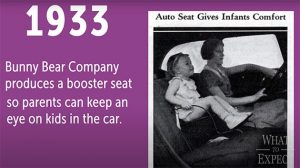
One commonly cited early example is the Bunny Bear Company child seat, introduced in the 1930s. It worked more like a booster seat than a modern child restraint. It raised the child but did not provide the protective shell and multi-point harness used in current seats.
This distinction matters. Calling a 1930s booster the first “safety car seat” would give the product more protective value than it had. It is more accurate to call it an early child vehicle seat or booster-style seat.
Who Invented the Modern Car Seat?
No single person invented the modern car seat. The design developed through several people, companies, and safety changes.
In the United States, Leonard Rivkin is often credited with creating an early safety-focused child seat in the 1960s. His design used a metal frame and a safety belt to help hold the child in place. Around the same period, British inventor Jean Ames developed a rear-facing child seat with a Y-shaped harness.
These designs were important because they treated the seat as a safety device rather than as a way to raise a child. They also reflected a growing understanding of crash forces and the value of keeping a child restrained.
Ford and General Motors later sold child restraint products in the late 1960s. Ford introduced the Tot-Guard in 1968. General Motors followed with the Love Seat in 1969. These products helped make child restraints more visible to American families, even though early designs differed greatly from today’s rear-facing seats and five-point harnesses.
The key change: from position to protection
The major shift was simple:
- Early seats focused on where the child sat.
- Newer designs focused on how the child would be protected in a crash.


That change led to stronger seat structures, better restraint systems, crash testing, and rules for installation.
When Did Car Seats Become Required in the United States?
The United States created its first federal performance standard for child restraint systems in 1971. The National Highway Traffic Safety Administration, or NHTSA, established Federal Motor Vehicle Safety Standard 213, commonly called FMVSS 213.
The standard set requirements for child restraint systems, including:
- How the restraint performed in crash tests
- How well it held a child-size test dummy
- Requirements for the seat structure
- Installation and labeling information
- Performance limits for head movement and impact forces
The first federal standard did not mean every American parent immediately used a car seat. At first, state laws varied, and enforcement was uneven. Over time, states passed child passenger safety laws, and hospitals, safety groups, and public agencies promoted correct use.
The result was a gradual change from optional equipment to an expected part of transporting children.

How Did Car Seat Design Change Over Time?
Car seats changed as safety research, vehicle design, and government rules improved. The timeline below shows the main stages in the United States.
| Period | Main design or policy change | What it meant |
|---|---|---|
| 1930s | Booster-style child seats appeared | Children sat higher, but crash protection was limited |
| 1960s | Safety-focused restraints were introduced | Harnesses and protective structures became more common |
| 1968–1969 | Ford Tot-Guard and GM Love Seat reached the market | Major automakers entered the child-seat market |
| 1971 | FMVSS 213 took effect | Federal performance rules were established |
| 1980s | Child restraint laws expanded | More families were required to use child seats |
| 1990s | Five-point harnesses and improved shells became common | Seats offered better restraint and energy management |
| 2000s | Lower anchors and top tethers became standard features | Installation became more consistent in compatible vehicles |
| Today | Rear-facing, forward-facing, and booster stages are widely used | Seats are matched to a child’s size and development |
Rear-facing seats
Rear-facing seats support a young child’s head, neck, and back during a frontal crash. The seat spreads crash forces across the child’s back instead of allowing the head to move forward sharply.
Modern guidance from the American Academy of Pediatrics recommends keeping children rear-facing as long as possible, within the limits of the specific seat. The correct limit depends on the seat’s height and weight instructions.
Forward-facing seats
A forward-facing seat uses a built-in harness to hold the child. Many seats also require a top tether, which can reduce forward movement of the seat in a crash.
A child should move to this stage only after reaching the rear-facing limits set by the seat manufacturer.
Booster seats
A booster seat does not replace the vehicle belt. It raises the child so the lap belt rests low across the upper thighs and the shoulder belt crosses the chest and shoulder.
A child may need a booster until the vehicle belt fits correctly without help. Age alone does not determine this.
Lower anchors and tethers
The LATCH system, which means Lower Anchors and Tethers for Children, became a major U.S. installation development in the early 2000s. It lets compatible child restraints connect to dedicated vehicle hardware instead of relying only on the seat belt.
LATCH does not automatically make installation safer. A seat belt installation can also be safe when the belt is routed correctly and the seat is tightly secured. The vehicle and car seat manuals control which method is allowed and which weight limits apply.


Why Were Early Car Seats Not Very Safe?
Early car seats were limited because crash protection was not yet their main purpose. Some had little or no padding, weak restraint systems, and no clear crash-test requirement.
Several conditions made the early designs less effective:
- Cars did not always have strong seat belts.
- Child restraint use was not common.
- Crash testing was less developed.
- Product instructions were limited.
- State requirements differed or did not exist.
- Many parents viewed the seat as a comfort item, not life-saving equipment.
This does not mean every early seat was useless. A restraint could help keep a child from moving around the cabin. However, a seat that raises a child without controlling crash motion should not be compared with a current, properly installed child restraint.
What Was the First U.S. Car Seat Law?
The first U.S. federal child restraint standard was FMVSS 213 in 1971, but that was a product standard, not a law requiring every parent to use a car seat.
Child passenger restraint laws developed at the state level. Tennessee passed the first child passenger safety law in the United States in 1978, according to historical accounts from child passenger safety organizations. Other states followed, and requirements became more detailed over time.
State laws still differ. They may set different rules for:
- Rear-facing use
- Forward-facing harnesses
- Booster seats
- Front-seat placement
- Child age and size
- Seat belt use
Federal standards govern the design and testing of child restraints sold in the U.S. State laws govern how families must use them on public roads. Those are separate systems.
How Did NHTSA Standards Change Car Seats?
NHTSA standards pushed manufacturers to prove that child restraints could meet set performance requirements. FMVSS 213 has been updated over time as testing methods and restraint technology changed.
A current car seat sold in the United States should include a statement that it complies with applicable federal motor vehicle safety standards. The seat should also have labels with information such as:
- Manufacturer name
- Model number
- Date of manufacture
- Use limits
- Installation instructions
- Expiration information, when provided
- Registration details for safety recalls
A federal compliance statement is not the same as a claim that one seat is safer than every other seat. It means the product is designed and certified to meet the applicable federal standard.
What Should Parents Use Today?
The safest choice depends on the child, the seat, and the vehicle. A modern seat should match all three.
Use the following general sequence:


- Keep the child rear-facing until the seat’s stated rear-facing height or weight limit is reached.
- Use a forward-facing harness after the child outgrows the rear-facing mode.
- Move to a booster after the child outgrows the forward-facing harness.
- Use the vehicle seat belt alone when it fits correctly across the body.
The American Academy of Pediatrics and NHTSA both provide current child passenger safety guidance. Their recommendations may be more protective than the minimum required by a state law.
How to tell whether the seat belt fits
A child is usually ready for a seat belt alone when all of these are true:
- The child’s back rests against the vehicle seat.
- The lap belt lies low across the hips or upper thighs.
- The shoulder belt crosses the chest and shoulder.
- The knees bend naturally at the edge of the seat.
- The child can stay seated correctly for the full ride.
If the belt touches the neck, crosses the stomach, or slips off the shoulder, the child likely still needs a booster.
Common Mistakes in Car Seat History and Use
The most common history mistake is saying that car seats were invented in one exact year for modern crash protection. The record supports a gradual development, not one single invention.
The most common use mistakes today include:
- Turning a child forward-facing too soon
- Using a seat beyond its stated limits
- Installing the seat too loosely
- Leaving bulky coats under the harness
- Using an expired or damaged seat
- Skipping the top tether when required
- Using a recalled seat
- Moving a child by age alone
- Relying on state law as the highest safety standard
Always follow the child seat manual and the vehicle owner’s manual. If the instructions conflict, contact the manufacturer or a certified Child Passenger Safety Technician.
Frequently Asked Questions
Were car seats invented in 1933?
A child car seat is often traced to the 1930s, including a Bunny Bear booster-style product. However, that early seat was not equivalent to a modern crash-protection seat. Modern safety-focused designs appeared mainly in the 1960s.
When did baby car seats become common?
Baby and child car seats became much more common in the United States during the 1970s and 1980s. Federal standards, state laws, public education, and improved product designs all contributed to wider use.
When did rear-facing car seats begin?
Rear-facing child restraint designs appeared in the 1960s. Jean Ames is often credited with an early rear-facing design, while American manufacturers later developed and sold their own versions.
When did five-point harnesses become common?
Five-point harnesses became more common as child restraint design improved during the late 20th century. They are now widely used in rear-facing and forward-facing car seats, though the exact design varies by model.
Are old car seats safe to use?
An old car seat may be unsafe if it is expired, damaged, missing parts, recalled, or lacking its instructions. Used seats also have an important history problem: you may not know whether they were in a crash. When that history is unknown, replacing the seat is the safer choice.
What is the difference between a car seat and a booster seat?
A car seat usually has its own harness and may face backward or forward. A booster seat raises a child so the vehicle’s lap-and-shoulder belt fits correctly. A booster does not replace the vehicle belt.


Key Takeaways
- The first U.S. child car seats appeared in the 1930s.
- Early seats mainly raised children and were not designed for strong crash protection.
- Modern safety-focused car seats emerged during the 1960s.
- The U.S. introduced its first federal child-restraint standard, FMVSS 213, in 1971.
- State child passenger safety laws expanded during the late 1970s and 1980s.
- Today, the correct seat depends on the child’s size, the seat’s limits, and the vehicle’s instructions.
Conclusion
Car seats were not invented in one clean moment. In the United States, early booster-style seats appeared in the 1930s, while the modern idea of a crash-tested child restraint developed in the 1960s. Federal standards in 1971 helped turn that idea into a regulated safety product.
For families today, the invention date matters less than correct use. Select a seat that fits the child, install it according to both manuals, keep the child rear-facing as long as the seat allows, and replace any seat with an unknown crash history.
