

In the United States, the safest way to recycle a car seat is to first check for a local car-seat trade-in or recycling program. If no program accepts it, separate the parts, recycle materials your local facility allows, and make the remaining seat unusable before disposal. Do not donate or give away a car seat that is expired, damaged, recalled, or has been in a crash.
Car seats contain several materials, including plastic, metal, foam, fabric, and webbing. These parts do not always belong in the same recycling bin. A little sorting can keep the seat out of a landfill, while proper disposal helps prevent someone from using an unsafe seat.
Check whether the car seat can still be used
Before recycling a car seat, decide whether it should be reused, recycled, or thrown away. Recycling is not the right first step if the seat is still safe and has useful life left.
A car seat may be suitable for reuse if all of these conditions are true:


- It has not been in a moderate or serious crash.
- It is not expired.
- It has no cracks, broken parts, burns, or severe damage.
- It has not been recalled.
- You know its full history.
- It includes the required parts, labels, and instructions.
- The cover, harness, and base are clean and in good condition.
Use the seat’s labels and instruction manual to find its model number and expiration date. The expiration period varies by manufacturer and model. Many seats expire after about six to ten years, but the label or manual is the correct source for your specific seat.
The National Highway Traffic Safety Administration advises replacing a car seat after a moderate or severe crash. A minor crash may have a different replacement standard, but you should check the manufacturer’s instructions. When the crash history is unknown, do not pass the seat to another family.
Check for a recall
Look up the seat on the manufacturer’s recall page and through the NHTSA recall database. Search by the brand, model name, model number, and date of manufacture.
A recall does not always mean the seat must be discarded. The manufacturer may offer a repair kit, replacement part, or other remedy. Follow the official recall instructions rather than trying to fix a safety problem with household materials.
Decide whether reuse is appropriate
If a seat is safe, current, complete, and has a known history, you may be able to give it to another family or a local organization. Ask the recipient or organization whether it accepts used car seats. Some groups accept only new seats because they cannot verify the history of donated equipment.
Do not donate a seat simply because it looks clean. A seat can have hidden damage, missing parts, or an expired shell that is not visible from the outside.
Find a car-seat recycling program
A dedicated recycling or trade-in program is usually the easiest option because it can handle the seat as a complete unit. Programs differ by city, county, retailer, and event, so confirm the rules before you drive to a drop-off site.
Try these sources in order:
Your city or county recycling office
Search the official government website for “car seat recycling,” “child safety seat disposal,” or “hard-to-recycle plastics.”Your local household hazardous waste or special recycling site
Some facilities accept bulky plastic items or child safety equipment. Others do not.The car-seat manufacturer
Some manufacturers run mail-back, take-back, or limited recycling programs. Check the current support page for your brand.Local child passenger safety programs
Hospitals, fire departments, police departments, and child passenger safety technicians sometimes host inspection or collection events. They may accept old seats, but participation is not universal.Retailer trade-in events
Large retailers sometimes run limited-time trade-in events. These programs can change by year, location, and store. Confirm that the event is active and that it accepts your seat type before going.
Questions to ask before drop-off
Call or check the program’s official page and ask:
- Does it accept infant seats, convertible seats, booster seats, and bases?
- Does it accept seats that are expired or damaged?
- Does it accept seats that have been in a crash?
- Must you remove the cover, foam, or harness first?
- Is there a fee?
- Does the site accept seats year-round or only during an event?
- Does it require proof of local residency?
- Must you schedule a drop-off?


Do not leave a car seat outside a closed facility. Weather can damage the seat, and an abandoned seat may be taken and reused.
What to do when no program is available
If no local program accepts the car seat, ask your recycling center whether it accepts rigid polypropylene or other marked plastics from disassembled car seats. The answer depends on the facility’s equipment and local rules.
A recycling symbol on a plastic part does not guarantee that your curbside program accepts it. The symbol identifies the plastic resin in many cases; it does not promise that the local facility can sort or process the item.

Prepare the car seat for recycling
Follow the recycling program’s instructions first. Some programs want the seat intact. Others ask you to take it apart. If you cannot confirm the rules, do not dismantle the seat until you have asked.
If the facility allows disassembly, use this process:
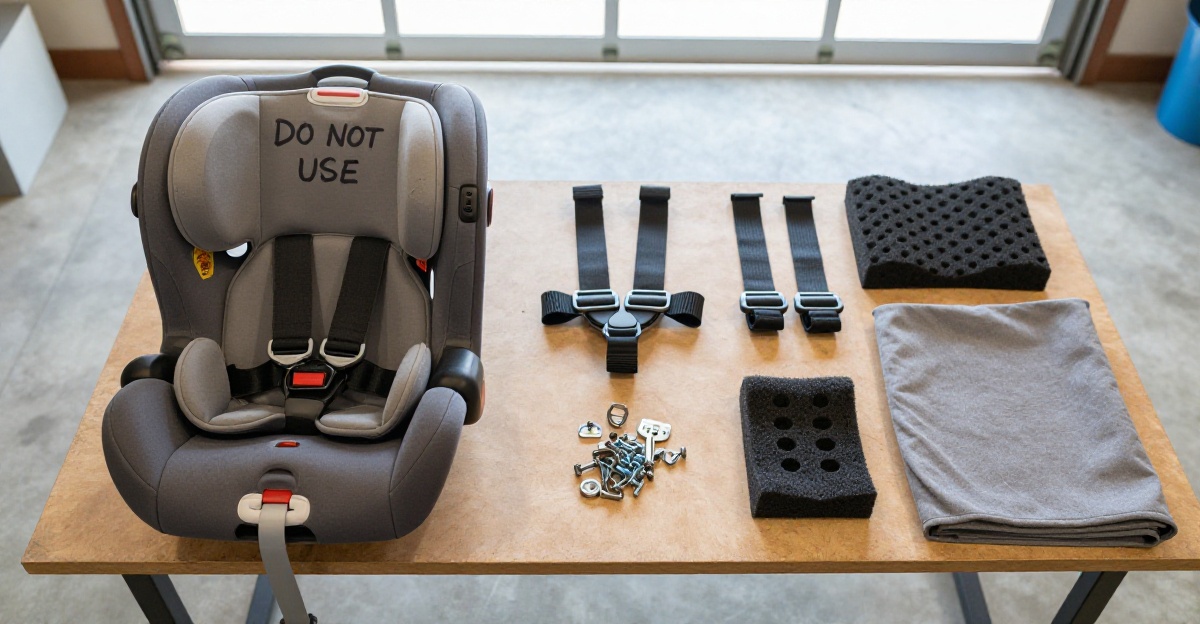
1. Remove the fabric cover
Take off the seat cover, padding, infant insert, and other soft parts. Check the manual if you need help identifying removable parts.
Some fabric covers may be accepted through textile recycling, but many curbside programs do not accept them. Do not place foam or fabric in a recycling bin unless the local program specifically allows it.
2. Remove the padding and foam
Car-seat foam may include molded energy-absorbing material or loose padding. Keep it separate from rigid plastic.
Foam should not go into a standard recycling bin unless your local program lists it as accepted. Look for a foam-recycling site or dispose of it according to local instructions.
3. Separate metal parts
Remove metal harness adjusters, buckles, screws, springs, and other metal pieces only if the program permits it and you can do so safely.
Small metal parts can damage sorting equipment or contaminate a recycling load. Ask whether the facility accepts scrap metal, mixed metal, or small metal pieces.
4. Identify the plastic
Look for a resin code on the plastic shell or base. Common codes include:
- Code 5: polypropylene
- Code 6: polystyrene
- Code 7: other or mixed plastic
The code can help the recycling center identify the material. It does not decide whether the item belongs in your curbside bin. Local acceptance rules control.
5. Keep the parts together until you confirm the destination
Place each material in a separate box or bag. Label the parts if needed. This makes the final drop-off easier and prevents you from sending an entire mixed-material seat to a facility that can process only one component.


Do not use a saw, drill, or power tool unless the program tells you to. Car-seat shells can produce sharp edges and plastic dust. Wear work gloves and eye protection if the recycling instructions require cutting or breaking parts.
Make an unsafe car seat unusable before disposal
If the seat cannot be recycled, make it clearly unusable before placing it in the trash. This step matters because people may remove items from the curb, trash area, or transfer station and try to use them.
For an expired, damaged, recalled, or crash-involved seat:
- Remove the cover and padding.
- Cut or remove the harness straps.
- Cut the lower anchors or other restraint webbing if possible.
- Mark the plastic shell with permanent ink or paint.
- Write “DO NOT USE—EXPIRED,” “CRASHED,” or “RECALLED” on the shell.
- Break or remove a nonessential part if the manufacturer or disposal site advises it.
- Put the pieces in a bag or box if your local trash rules require it.
Do not destroy a seat before a manufacturer or recycling program has confirmed that it wants the intact product. A program may need the model label or serial number to identify a recall.
Do not burn a car seat. Burning plastic, foam, fabric, and treated materials can release harmful smoke. Do not bury it, abandon it, or place it beside a public road.
Your local waste authority may have rules for large plastic items. Some communities require bulk-trash pickup, a transfer-station visit, or a fee. Follow the local instructions rather than assuming that the seat belongs in a normal curbside bin.
Can you put a car seat in the recycling bin?
Usually, you should not place a complete car seat in a curbside recycling bin. A car seat is a mixed-material product, and its size, straps, foam, and metal parts can interfere with sorting equipment.
Some local programs may accept the rigid plastic shell after you remove other materials. Others may reject all car-seat parts. The only reliable answer comes from your city, county, or recycling provider.
Use this decision guide:
| Car-seat condition | Best next step |
|---|---|
| Safe, unexpired, complete, known history | Reuse or give it to an organization that accepts used seats |
| Expired but otherwise intact | Use a dedicated recycling or trade-in program |
| Recalled | Follow the manufacturer’s recall remedy |
| Damaged or involved in a crash | Replace it; ask about recycling, then make it unusable if discarded |
| Unknown history | Do not donate; seek recycling or disposal |
| No program accepts it | Separate allowed materials and follow local trash rules |
The key distinction is between recycling the material and discarding the product. A seat that cannot be safely reused should not be passed to another person simply because some of its plastic might be recyclable.

What parts of a car seat can be recycled?
The rigid plastic shell is often the part most likely to have a recycling route, but acceptance varies. Polypropylene is common in many car-seat shells, yet a local facility may not process large molded plastic items.
Metal parts may be accepted through scrap-metal programs. Fabric and foam may require specialty recyclers. Harness webbing is often difficult to recycle through ordinary household programs because it is a blend of fibers and may have coatings or sewn components.
Here is a general material guide:
| Part | Possible route | Important limit |
|---|---|---|
| Plastic shell or base | Specialized plastic recycling | Resin code does not guarantee local acceptance |
| Metal buckles and hardware | Scrap-metal recycling | Small mixed parts may be rejected |
| Fabric cover | Textile recycling or trash | Many curbside programs do not accept it |
| EPS or other foam | Foam-recycling site or trash | Keep it out of standard recycling unless listed |
| Harness webbing | Manufacturer or specialty program | Often not accepted in household recycling |
| Labels and paper manual | Paper recycling, if clean | Remove labels from plastic when required |
Do not mix these parts back together after separating them. Keep the materials sorted until you know where each one can go.

Common mistakes to avoid
Several disposal mistakes can create a safety problem or cause an entire recycling load to be rejected.
Donating an expired seat
An expired seat may look new, but its materials and parts may no longer meet the manufacturer’s service guidance. Check the expiration date before offering it to anyone.


Giving away a seat with an unknown history
You may not know whether another owner dropped the seat, used it in a crash, replaced a part, or stored it in extreme heat. Unknown history is a strong reason not to pass it on.
Putting the whole seat in curbside recycling
Large mixed-material products can jam equipment or be removed as contamination. Ask the local program first.
Removing the recall label
Keep the model, serial, and manufacture-date labels attached until you check for recalls and confirm recycling instructions.
Cutting up a seat too early
A recycling or manufacturer program may require the complete seat. Confirm the destination before cutting the harness or breaking the shell.
Assuming a trade-in event is permanent
Retail trade-in programs may be seasonal or limited to certain stores. Check the current event details rather than relying on an old social-media post or a past promotion.
Leaving a seat beside a donation bin
A donation site may not inspect or destroy unsafe child restraints. Contact the organization and ask whether it accepts car seats before dropping one off.
Frequently asked questions
Can I donate an old car seat?
You can donate a car seat only when it is safe, unexpired, complete, undamaged, not recalled, and has a known history. Many organizations do not accept used seats because they cannot verify how the seat was stored or used. Ask the organization first.
Does Target recycle car seats?
Retailer programs can change by year, store, and location. Do not assume that a store currently accepts car seats because it hosted a trade-in event in the past. Check the retailer’s current official promotion page or call the specific store.
Can I recycle a car seat base by itself?
Sometimes. A base may contain rigid plastic and metal parts, but local recycling rules still apply. Ask whether the facility accepts the base as a separate item and whether it wants the cover, foam, harness, and hardware removed.
How do I dispose of a car seat after a crash?
Replace the seat after a moderate or severe crash, following the manufacturer’s instructions and NHTSA guidance. Ask a local recycling program or the manufacturer whether it accepts crash-involved seats. If you must use the trash, remove the cover, cut the harness, mark the seat as unsafe, and follow local waste rules.
Can I recycle car-seat foam?
Some foam types have specialty recycling routes, but standard curbside recycling usually does not accept them. Ask your local recycling office or search for a nearby foam-recycling facility. Keep foam separate from plastic and paper.
What if I cannot find the expiration date?
Look for a label on the back, bottom, side, or base. Check the instruction manual or contact the manufacturer with the model and manufacture date. If you cannot verify the seat’s age, history, or safety status, do not donate it.
Final steps for recycling a car seat
Start by checking the seat’s expiration date, recall status, crash history, and condition. Then contact your local recycling office, the manufacturer, or a current trade-in program before taking the seat apart.
If a program accepts the seat, follow its preparation rules. If no program is available, separate any materials your local facility accepts and make the remaining seat unusable before disposal. The safest choice is simple: reuse only a verified safe seat, recycle it through a confirmed route, and never pass an unsafe seat to another family.
