

If you need affordable tire installation in the United States, start by comparing the full installed price from local tire shops, auto repair centers, dealerships, warehouse clubs, and mobile tire services. Ask for a written quote that includes mounting, balancing, new valve stems, tire disposal, taxes, shop fees, and any TPMS service.
The lowest advertised installation price is not always the lowest final cost. A shop may charge a small installation fee but add separate fees for balancing, disposal, or valve stems. Call at least three nearby providers and compare the same services for the same tire size.
Use your vehicle’s tire-size label, usually found inside the driver’s door, to request accurate quotes. If a tire is damaged, severely underinflated, or unsafe to drive on, use roadside assistance instead of driving to the shop.

Where to Look for Low-Cost Tire Installation
The best place to find an affordable tire installation near you depends on your location, tire type, vehicle, and need for extra services. Compare several types of providers rather than checking only one store.


Local tire shops
Independent tire shops often compete on price and may offer flexible service. They can be a good choice if you need:
- Tire mounting and balancing
- Flat-tire repair
- Tire rotation
- TPMS diagnosis
- Used or budget tire options
- Help choosing a tire for local weather and road conditions
Ask whether the quote is for four tires or one tire. Also ask if the shop charges more for run-flat tires, large wheels, low-profile tires, or trucks.
National tire retailers
Large tire chains often provide online quotes and store pickup. Their listed price may be easy to compare, but read the service details before booking.
Check whether the quote includes:
- Mounting
- Computer balancing
- Valve stems
- Tire pressure adjustment
- TPMS relearn or sensor service
- Tire disposal
- Road-hazard coverage
- Alignment inspection
A national retailer may also offer rebates or package discounts. Confirm the final price after those discounts, since some promotions apply only to selected tire brands or require a rebate form.
Auto repair shops
Many full-service repair shops install tires, even if tires are not their main business. This can be useful when your vehicle also needs:
- Wheel alignment
- Brake work
- Suspension inspection
- A TPMS repair
- A puncture check
- Steering or vibration diagnosis
A repair shop may cost more than a discount tire store for basic installation. It may still be the better value if your tires show uneven wear or the vehicle pulls to one side.
Warehouse clubs
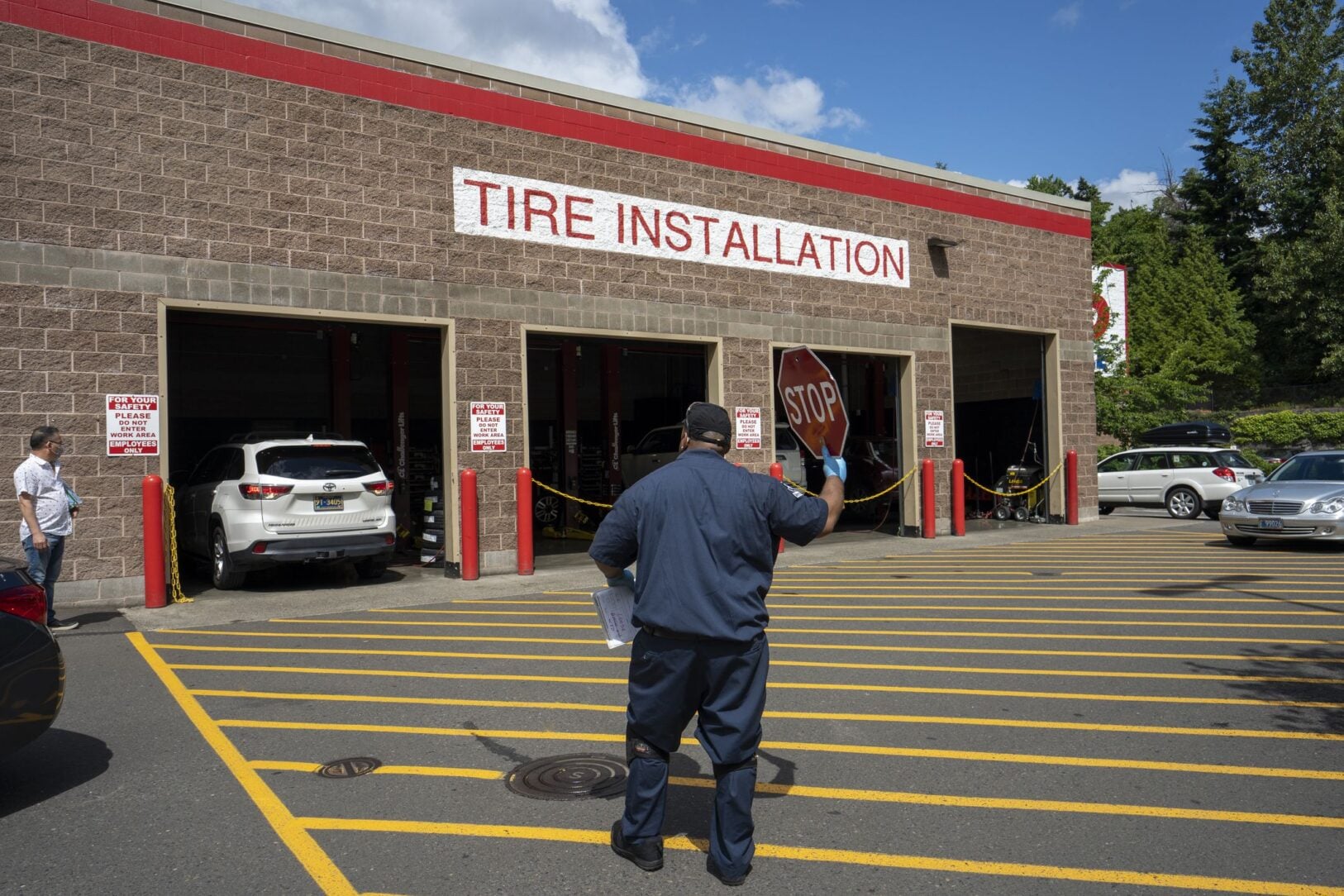
Some warehouse clubs offer tire installation to members. Membership fees, appointment availability, and included services vary by club and location.
Before choosing this option, ask:
- Is tire installation available for your vehicle?
- Does the club install tires bought elsewhere?
- What services are included?
- How long is the wait for an appointment?
- Is road-hazard protection included?
- Can the club service your TPMS sensors?


A low tire price does not help if the club cannot install the tire size or cannot provide service when you need it.
Mobile tire installation
Mobile tire services come to your home, workplace, or another safe location. They can save time and may be helpful if you cannot drive safely.
Mobile service may cost more than a shop because it includes travel and on-site labor. Compare the complete quote, including travel fees, disposal charges, balancing, and the type of equipment used.
Do not use a mobile service in an unsafe location, such as the shoulder of a busy highway, unless the provider is specifically equipped for roadside work.
How to Compare Tire Installation Prices
Compare the out-the-door price, not just the tire price or advertised installation fee. The out-the-door price is the total amount you will pay after labor, parts, fees, taxes, and discounts.
Use this simple formula:
Total cost = tire price + installation labor + balancing + parts + disposal fees + taxes − valid discounts
Here is a hypothetical example:
| Cost item | Shop A | Shop B |
|---|---|---|
| Four tires | $480 | $500 |
| Mounting and balancing | $100 | Included |
| Valve stems | $16 | Included |
| Disposal fee | $20 | $20 |
| Shop fees | $10 | $0 |
| Estimated subtotal | $626 | $520 |
Shop A appears cheaper because its tire price is lower. Shop B has the lower installed subtotal.
Prices in this example are for comparison only. Actual prices vary by tire size, vehicle, region, tire type, taxes, and shop policy.
Questions to ask before booking
Use these questions when you call or request an online quote:
- What is the total installed price for my vehicle?
- Does the price include mounting and balancing?
- Are new rubber valve stems included?
- Is TPMS service included?
- Is tire disposal included?
- Are taxes and shop fees included?
- Does the price change for run-flat or low-profile tires?
- Do you offer a price match?
- Is road-hazard coverage included or optional?
- How long will the installation take?
- What warranty comes with the labor?
Ask the shop to send the quote by text or email. Written quotes make it easier to compare providers and reduce surprises at checkout.
Check discounts carefully
Common ways to reduce the total cost include:
- Manufacturer rebates
- Store coupons
- Fleet or military discounts
- Credit-card promotions
- Seasonal sales
- Free installation offers
- Package pricing for four tires
- Local membership discounts
Read the conditions. A “free installation” offer may exclude balancing, disposal, premium valve stems, or TPMS service. Some rebates also require online submission within a limited period.

What Affordable Tire Installation Should Include
A safe tire installation is more than taking off an old tire and putting on a new one. The shop should mount the tire correctly, balance the wheel, set tire pressure, and check for problems that could affect safety.


Mounting
Mounting places the tire on the wheel. The technician should inspect the wheel and tire bead area for damage before inflating the tire.
A bent wheel, cracked wheel, damaged bead, or wrong tire size can create a serious problem. Ask the technician to explain any condition that prevents normal installation.
Balancing
Balancing uses weights to correct uneven weight around the tire and wheel. Poor balance can cause:
- Steering-wheel vibration
- Seat or floor vibration
- Uneven tread wear
- Extra stress on suspension parts
Balancing is usually included in a standard tire installation package, but you should confirm it.
Valve stems and TPMS
The valve stem holds air in the tire. A rubber valve stem is often replaced when a new tire is installed. Some vehicles use a tire-pressure monitoring system, or TPMS, with a sensor attached to the valve stem or mounted inside the wheel.
Ask whether the shop will:
- Inspect the TPMS sensor
- Replace its service parts when needed
- Reset or relearn the system
- Test for warning lights before you leave
The exact procedure depends on the vehicle. A TPMS warning light may require a manual reset, a scan tool, a relearn procedure, or sensor replacement.
Tire pressure
The technician should inflate the tires to the vehicle maker’s recommended pressure. Find that pressure on the driver-door placard or in the owner’s manual.
Do not use the maximum pressure printed on the tire sidewall as the normal setting unless the vehicle maker specifies it. The sidewall number is generally the tire’s maximum rated pressure, not the vehicle’s recommended cold pressure.
Lug-nut tightening
Lug nuts should be tightened to the vehicle manufacturer’s torque specification. Correct torque helps prevent loose lug nuts, wheel damage, and brake-rotor problems.
After installation, ask whether the shop recommends rechecking torque after driving a short distance. Follow the vehicle and shop instructions, especially if the wheels were removed for the first time in a long period.

How to Find a Reliable Tire Installer Near You
Price matters, but a poor installation can cost more later. Look for evidence that the provider performs careful work and explains the service clearly.
Read reviews for specific details
Do not focus only on a star rating. Look for recent comments about:
- Final price matching the quote
- Appointment timing
- Wheel or tire damage
- Correct balancing
- TPMS handling
- Warranty support
- Communication about unexpected repairs


Reviews are personal reports, not proof that every job will be the same. Use them to identify questions to ask.
Check the shop’s credentials and policies
Look for a clear business address, phone number, posted hours, and written service policies. Ask who performs the work and whether the shop handles your tire type.
A reputable provider should be willing to explain:
- The tire brand and model
- The tire’s size and load rating
- Installation charges
- Warranty terms
- Return or cancellation rules
- What happens if a tire arrives damaged
The Federal Trade Commission recommends comparing tire warranties and understanding what they cover before buying.
Confirm the tire matches your vehicle
Use the exact tire size shown on the vehicle placard or owner’s manual. Tire size is only one part of the match. Also verify:
- Load index
- Speed rating
- Tire type
- Seasonal rating
- Run-flat requirements
- Original-equipment specifications when relevant
A tire that fits the wheel may still be unsuitable for the vehicle if its load capacity or speed rating is too low.
Be cautious with used tires
Used tires can reduce the upfront cost, but condition is difficult to judge. Ask the seller to inspect the tire for:
- Uneven wear
- Cracks
- Bulges
- Repairs
- Exposed cords
- Damage inside the tire
- Adequate tread depth
- Age
The U.S. Tire Manufacturers Association warns that used tires may have hidden damage or an unknown history. If you buy used tires, use a qualified tire professional and avoid any tire with visible damage or an uncertain condition.

When the Cheapest Installation Is Not the Best Choice
The lowest quote may not be the safest or most useful option. Pay more attention to the service when your vehicle has special needs.
Choose a more experienced provider for special tires
Some tires need extra care, including:
- Run-flat tires
- Low-profile tires
- Oversized truck tires
- Performance tires
- Directional tires
- Tires with special noise-reducing foam
- Wheels with expensive finishes
Ask whether the shop has the proper equipment and experience. Incorrect machine setup can damage a wheel or tire.


Consider an alignment when wear is uneven
New tires will not correct an alignment problem. If the old tires have wear on one edge, feathered tread, or a repeated pull to one side, ask for an alignment inspection.
An alignment may not be needed with every tire installation. It becomes more relevant after a collision, a hard pothole impact, suspension work, or signs of uneven wear.
Do not ignore a damaged wheel
A bent or cracked wheel can cause air loss, vibration, or repeated tire damage. If a shop finds a wheel problem, ask for a clear explanation and a written price before approving repair or replacement.
Do not accept a repair simply because it is cheaper. Some wheel damage cannot be safely repaired.
Replace tires in the correct pattern
Replacing one tire can create handling or tread-depth differences. The right choice depends on the vehicle’s drivetrain, tire condition, and manufacturer guidance.
Many vehicles perform best with matching tires on the same axle. All-wheel-drive vehicles may have stricter limits on differences in tire circumference. Ask the vehicle maker or a qualified tire professional before replacing fewer than four tires.

How to Book Affordable Tire Installation Near You
Follow this process to compare providers quickly and safely.
Find your tire size.
Read the driver-door label or owner’s manual. Take a photo so you can quote the exact size.Inspect the current problem.
Look for a flat tire, low pressure, visible damage, or a TPMS warning. Do not drive on a tire with a bulge, exposed cord, or severe air loss.Search several provider types.
Check local tire shops, national retailers, auto repair centers, warehouse clubs, and mobile services.Request an itemized quote.
Ask for the total installed price, not only the tire price.Compare the same tire specification.
Match brand, model, size, load index, and speed rating when comparing prices.Confirm availability.
Ask whether the tires are in stock and whether the appointment includes balancing and TPMS service.Review the warranty.
Separate the tire manufacturer’s warranty from the shop’s labor warranty and optional road-hazard coverage.Save the paperwork.
Keep the invoice, tire model, installation date, mileage, and warranty details.Check the work before leaving.
Confirm that there are no warning lights, the tires are inflated correctly, and the vehicle does not shake during a cautious test drive.
If the steering wheel shakes, the vehicle pulls, the tire loses air, or a warning light remains on, return to the installer promptly. Stop driving if the vehicle feels unsafe.

Affordable Tire Installation Checklist
Use this checklist before you pay:
- The tire size matches the vehicle placard.
- The load index and speed rating are suitable.
- The quote includes mounting.
- The quote includes balancing.
- Valve stems or TPMS service are explained.
- Disposal fees are included.
- Taxes and shop fees are clear.
- The tire warranty is available in writing.
- Labor coverage is explained.
- Lug nuts are tightened to the vehicle specification.
- Tire pressure is set to the vehicle recommendation.
- The TPMS warning light is off.
- You received an invoice and warranty documents.
The National Highway Traffic Safety Administration provides tire safety information, including guidance on tire pressure, tread, recalls, and inspection. Check the NHTSA tire safety resources before buying or installing tires.

Frequently Asked Questions
How much does tire installation usually cost?
There is no single nationwide price. The total depends on tire size, tire type, location, labor rates, balancing, valve stems, disposal, taxes, TPMS work, and optional coverage.
Request an itemized quote from at least three providers. Compare the full installed price for the same tire model and specification.
Can I bring my own tires to a tire shop?
Some shops install customer-supplied tires, while others do not. Shops that accept them may charge a different labor rate or provide a limited labor warranty.


Ask before buying the tires. Confirm that the shop will install that tire size and type, and ask about damage inspections and return responsibility.
Is mobile tire installation cheaper than going to a shop?
Usually, mobile service is priced for convenience and may include a travel fee. It can still be a good value if you cannot safely drive to a shop or would lose work time waiting.
Compare the complete mobile quote with the complete shop quote. Confirm that the mobile technician can balance the tire and service your TPMS system.
Do I need an alignment every time I install new tires?
No. An alignment is not automatically required for every tire replacement. It is more useful when you notice uneven wear, steering pull, a crooked steering wheel, or a recent pothole or collision.
Ask for an inspection rather than approving an alignment without a reason.
Should I replace all four tires at once?
Replacing all four tires creates the most consistent tread depth, but it may not always be necessary. The right choice depends on the remaining tread, drivetrain, tire condition, and vehicle maker’s guidance.
All-wheel-drive vehicles may require closely matched tire circumference. Ask a qualified tire professional before installing only one or two tires.
How do I know if a tire is too old?
Find the DOT date code on the tire sidewall. The last four digits show the week and year of manufacture. For example, “2324” means the tire was made in the 23rd week of 2024.
Age limits vary by tire maker and vehicle use. Inspect older tires for cracks, hardening, bulges, and other damage, and follow the tire manufacturer’s replacement guidance.
Conclusion
To find affordable tire installation near you, compare three or more local providers using the same tire size and the same service list. Focus on the out-the-door price, then confirm balancing, valve stems, TPMS service, disposal, warranty terms, and correct lug-nut torque.
The best choice is the installer that gives you a clear quote, uses the right equipment, matches the tire to your vehicle, and stands behind the work. Start with your driver-door tire label, request written quotes, and avoid driving a vehicle with a visibly damaged or severely underinflated tire.
