

Introduction
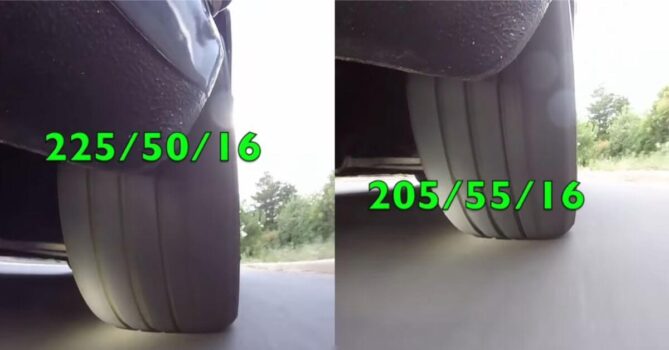
The main difference between 55R and 60R tires is sidewall height. The number is the tire’s aspect ratio, or sidewall height as a percentage of its width. A 60-series tire has a sidewall that is 5% taller than a 55-series tire of the same width.
For example, a 225/55R17 tire has a shorter sidewall than a 225/60R17 tire. The 60-series tire may provide a softer ride and more protection from potholes, while the 55-series tire may offer quicker steering response and less body movement.
In the United States, tire size changes should follow the vehicle maker’s fitment guide, door-jamb label, or owner’s manual. A size that fits the wheel may still affect speedometer readings, clearance, braking, traction systems, and load capacity.

What Do 55R and 60R Mean?
The numbers 55 and 60 describe the tire’s aspect ratio. The letter R means the tire uses radial construction.


A full tire size looks like this:
225/55R17
Each part has a job:
| Marking | Meaning |
|---|---|
| 225 | Tire width in millimeters |
| 55 | Sidewall height as 55% of tire width |
| R | Radial construction |
| 17 | Wheel diameter in inches |
A tire marked only as “55R” or “60R” does not provide enough information to identify the complete tire size. You also need the tire width, wheel diameter, load index, and speed rating.
For example:
- 225/55R17 97V
- 225/60R17 99H
The final numbers and letters matter. In these examples:
- 97 and 99 are load indexes.
- V and H are speed ratings.
The aspect ratio is not the tire’s height from the ground. It is the sidewall height compared with the tire’s section width.
How to calculate sidewall height
Use this formula:
Sidewall height = tire width × aspect ratio
For a 225/55R17 tire:
225 × 0.55 = 123.75 millimeters
For a 225/60R17 tire:
225 × 0.60 = 135 millimeters
The 60-series tire therefore has a sidewall that is 11.25 millimeters taller on one side.
55R vs. 60R: Key Differences
A 60-series tire is taller than a 55-series tire when both tires have the same width and wheel size. That change affects ride comfort, handling, ground clearance, tire diameter, and speedometer accuracy.


| Feature | 55-series tire | 60-series tire |
|---|---|---|
| Sidewall height | Lower | Higher |
| Ride feel | Firmer and more direct | Softer and more cushioned |
| Steering response | Usually quicker | Usually less sharp |
| Pothole protection | Less sidewall cushion | More sidewall cushion |
| Overall tire diameter | Smaller | Larger |
| Ground clearance | Slightly lower | Slightly higher |
| Speedometer effect | Baseline if factory size | May read low if diameter increases |
| Wheel protection | Less rubber between wheel and road | More rubber between wheel and road |
These are general effects, not guarantees. Tire design also depends on tread pattern, rubber compound, construction, inflation pressure, and the vehicle’s suspension.
Ride comfort
The taller sidewall of a 60-series tire can flex more over broken pavement. This may make roads feel smoother, especially on vehicles with firm suspension or larger wheels.
A 55-series tire has less sidewall flex. It can feel more controlled during quick steering changes, but the ride may feel firmer over sharp bumps.
Handling and steering
A shorter sidewall often responds more quickly to steering input. This can make the vehicle feel more precise on paved roads.
A taller sidewall may flex more during cornering. That can create a softer or less immediate steering feel. However, the difference depends on the tire model and the vehicle’s suspension setup.
Pothole and wheel protection
A 60-series tire places more rubber between the wheel and the road. That extra sidewall can help absorb impacts from potholes and rough pavement.
It does not make a tire immune to damage. Driving quickly into a deep pothole can damage either the tire or the wheel.
Ground clearance
Because the 60-series tire has a larger overall diameter, it raises the vehicle slightly. The increase is only half of the total diameter difference.
That small change can help reduce the chance of scraping on a steep driveway. It can also reduce clearance between the tire and the fender, strut, spring, or suspension parts.
Example: 225/55R17 vs. 225/60R17
The clearest way to compare 55R and 60R tires is to use the same width and wheel size.
225/55R17 calculation
- Width: 225 mm
- Sidewall: 225 × 0.55 = 123.75 mm
- Wheel diameter: 17 inches = 431.8 mm
- Overall diameter: 431.8 + 123.75 + 123.75 = 679.3 mm
- Approximate diameter: 26.7 inches
225/60R17 calculation
- Width: 225 mm
- Sidewall: 225 × 0.60 = 135 mm
- Wheel diameter: 17 inches = 431.8 mm
- Overall diameter: 431.8 + 135 + 135 = 701.8 mm
- Approximate diameter: 27.6 inches
What changes?
| Measurement | 225/55R17 | 225/60R17 | Difference |
|---|---|---|---|
| Sidewall height | 123.75 mm | 135 mm | +11.25 mm |
| Overall diameter | 679.3 mm | 701.8 mm | +22.5 mm |
| Approximate diameter | 26.7 in | 27.6 in | +0.9 in |
| Vehicle height | Baseline | About 11.25 mm higher | +0.44 in |
| Circumference | About 2,134 mm | About 2,205 mm | About 3.3% larger |
This means the 60-series tire turns fewer times over the same distance.
If the vehicle’s speedometer was calibrated for the 225/55R17 tire, a displayed speed of 60 mph could correspond to about 62 mph with the larger 225/60R17 tire. This is a simplified calculation. Actual results can vary because tire dimensions differ slightly by brand, model, tread wear, and inflation pressure.
Can You Replace 55R Tires With 60R Tires?
You can replace a 55-series tire with a 60-series tire only when the complete size is approved for the vehicle and the tire clears all nearby parts.


The replacement must meet several conditions:
The tire must fit the wheel.
A 225/60R17 tire fits a 17-inch wheel, but it may not be approved for every wheel width.The overall diameter must stay within an acceptable range.
A larger tire can affect the speedometer, odometer, anti-lock brakes, traction control, and stability control.The tire must clear the vehicle.
Check the fender, strut, spring, control arm, brake parts, and inner wheel well. Clearance must remain adequate when the steering is turned fully left and right and when the suspension compresses.The load index must be sufficient.
Never install a tire with a lower load index than the vehicle requires unless the vehicle maker specifically approves it.The speed rating must be suitable.
A lower speed rating may not meet the vehicle manufacturer’s requirements.All four tires should be matched correctly.
On many all-wheel-drive vehicles, large differences in tire circumference can place stress on the drivetrain or trigger system warnings.
The vehicle’s door-jamb label usually lists the original tire size and recommended cold inflation pressure. The owner’s manual may list approved alternative sizes. The U.S. National Highway Traffic Safety Administration also provides tire safety information, but it does not approve a particular size for a specific vehicle.
Why diameter matters
A 60-series tire is not simply “more tire.” It changes the distance traveled with each wheel rotation.
A larger tire can cause:
- A lower speedometer reading than the vehicle’s true speed
- A lower odometer reading over time
- Slightly slower acceleration
- Different braking and handling behavior
- Possible contact with body or suspension parts
- Electronic system concerns on some vehicles
A smaller tire creates the opposite speedometer effect. The vehicle may travel fewer miles per wheel rotation than the computer expects.
Which Is Better: 55R or 60R?
Neither size is automatically better. The right choice depends on the vehicle, the approved tire sizes, road conditions, and the driver’s priorities.
Choose a 55-series tire when:
- The vehicle maker lists it as the correct size.
- You want a firmer, more direct steering feel.
- You drive mostly on smooth roads.
- The vehicle has limited clearance around the tire.
- You want to preserve the original speedometer calibration.
Choose a 60-series tire when:
- The vehicle maker approves the size.
- You want more ride comfort on rough roads.
- You want more sidewall between the wheel and potholes.
- The larger diameter does not cause rubbing.
- The load index and speed rating meet the vehicle’s requirements.
Do not choose based on the aspect ratio alone. A 215/60R17 and a 235/55R17 may have similar overall diameters, but they differ in width, sidewall height, handling, and wheel fit.
The best replacement is usually the size listed on the vehicle label or in the owner’s manual. If you want to change sizes, compare the complete tire dimensions rather than only the 55 or 60 number.
What Other Tire Numbers Should You Check?
The aspect ratio is only one part of tire fitment. Check the full sidewall marking before buying or installing a replacement.
Tire width
The first number shows nominal width in millimeters. A wider tire may improve dry-road grip in some conditions, but it can also change steering effort, road noise, fuel use, and clearance.
Load index
The load index indicates the maximum load capacity of the tire under specified conditions. A replacement tire should meet or exceed the vehicle’s required load index.
The load index is not the same as the maximum weight printed on a tire in every context. Use the vehicle maker’s specification and the tire manufacturer’s load table when necessary.


Speed rating
The speed rating is represented by a letter, such as H, V, or W. It indicates the tire’s rated speed capability under defined test conditions.
Do not treat the speed rating as a recommended driving speed. Safe speed also depends on weather, traffic, tire condition, road surface, and local law.
Wheel width
The same tire size may be approved for a range of wheel widths. The correct range comes from the tire manufacturer’s specifications.
A tire mounted on a wheel that is too narrow or too wide may not perform as designed and may not seat correctly.
Tire construction and service description
The letter R means radial construction. Other markings can identify reinforced construction, run-flat design, winter use, or original-equipment fitment.
Read the complete marking instead of relying on a shortened description such as “60R tire.”
Common Mistakes When Comparing 55R and 60R Tires
Comparing different widths
A 225/55R17 and a 235/60R17 differ in both width and aspect ratio. You cannot calculate the effect by comparing 55 and 60 alone.
Assuming a taller tire always rides better
A taller sidewall may improve comfort, but tire pressure, tire construction, suspension condition, and road surface also matter. An incorrectly inflated tire can ride poorly in either size.
Ignoring the load index
Two tires with the same dimensions may carry different loads. A size that fits physically may still be unsuitable if its load capacity is too low.
Changing only two tires
On a two-wheel-drive vehicle, replacing only two tires may still create handling differences between the axles. On an all-wheel-drive vehicle, mismatched tire diameters can be especially problematic.
Follow the vehicle manufacturer’s replacement guidance. Tire retailers and vehicle service professionals can confirm whether a mixed setup is permitted.
Measuring only when parked
A tire may clear the fender while the vehicle is stationary but rub during a turn, under suspension compression, or with passengers and cargo. A proper fit check must consider the full range of steering and suspension movement.
Using the door-jamb pressure from the tire sidewall
The pressure on the tire sidewall is not always the vehicle’s normal inflation setting. Use the cold tire pressure shown on the vehicle information label or in the owner’s manual, unless a qualified professional provides different instructions for an approved setup.
How to Check Whether a Different Size Is Safe
Before changing from a 55-series to a 60-series tire, use this process:
Read the vehicle label.
Find the original tire size, load requirement, and cold inflation pressure.Check the owner’s manual.
Look for approved alternate sizes, temporary spare restrictions, and all-wheel-drive requirements.Compare complete dimensions.
Record width, aspect ratio, wheel diameter, load index, speed rating, and overall diameter.Check the wheel specification.
Confirm that the tire fits the wheel’s diameter and approved width range.Inspect physical clearance.
Check the tire at full steering lock and with the suspension compressed. A tire professional should handle uncertain cases.Check the electronic systems.
Consider speedometer, odometer, anti-lock brakes, traction control, and stability control effects.Match the axle and drivetrain requirements.
Keep tire sizes and wear levels within the limits set by the vehicle manufacturer.Set the correct cold pressure.
Use the vehicle’s recommended pressure, not a guess based on the old tire.


If the replacement size is not listed by the vehicle maker, ask a qualified tire professional to verify load capacity, wheel fit, clearance, and system compatibility before purchase.
Frequently Asked Questions
Is a 60R tire wider than a 55R tire?
No. The 55 and 60 numbers describe sidewall height as a percentage of tire width. Width is shown by the first number, such as 225 in 225/55R17. A 225/60R17 and a 225/55R17 have the same nominal width but different sidewall heights.
Does a 60-series tire use more fuel?
It can, but the result is not guaranteed. A larger tire may weigh more, have greater rolling resistance, or change the vehicle’s gearing slightly. Tire compound, tread design, pressure, driving style, and vehicle condition also affect fuel use.
Will a 60R tire make my car higher?
Yes, if the 60-series tire has a larger overall diameter than the original tire. The vehicle rises by roughly half of the total diameter increase. In the 225/55R17 versus 225/60R17 example, the increase is about 11 millimeters, or 0.44 inch.
Can I put 55R tires on the front and 60R tires on the rear?
Only if the vehicle manufacturer approves that staggered setup. Different tire diameters can change handling and may interfere with anti-lock brakes, stability control, or all-wheel-drive systems.
Does a 60-series tire last longer?
Not necessarily. Tread life depends on the tire compound, tread design, alignment, inflation, load, road surface, and maintenance. Aspect ratio alone does not determine how long a tire will last.
Conclusion
The difference between 55R and 60R tires is mainly the sidewall height and overall tire diameter. With the same tire width, a 60-series tire has a taller sidewall, may provide a softer ride, and may offer more pothole protection. A 55-series tire is usually shorter, more responsive, and closer to the original size when that is the factory specification.
Before changing sizes, compare the full tire marking. Confirm the approved size, load index, speed rating, wheel fit, clearance, inflation pressure, and drivetrain requirements. If the size is not listed for the vehicle, have a qualified tire professional verify it before installation.
