

Most cars are about 68 to 79 inches wide without mirrors and 80 to 90 inches wide with mirrors.
Knowing how wide is a car helps you choose a vehicle, fit into a garage, judge a narrow street, and park with confidence. The exact number depends on the body style, trim, mirrors, tires, and measuring method. This guide explains real car widths, shows common examples, and offers simple ways to measure your own vehicle.

How wide is a car on average?
Most passenger cars are 5.5 to 6.5 feet wide at the body. In inches, that equals about 66 to 78 inches. This measurement usually excludes the side mirrors.
A compact sedan may be close to 70 inches wide. A large sedan can reach 75 inches or more. SUVs and trucks often use more road space because of wider bodies, larger tires, and higher wheel arches.


Here is a simple guide:
| Vehicle type | Typical body width without mirrors | Approximate width with mirrors |
|---|---|---|
| Subcompact car | 65 to 70 inches | 78 to 84 inches |
| Compact sedan | 68 to 72 inches | 80 to 86 inches |
| Midsize sedan | 72 to 75 inches | 83 to 88 inches |
| Full-size sedan | 74 to 78 inches | 85 to 91 inches |
| Small SUV | 70 to 74 inches | 82 to 88 inches |
| Midsize SUV | 73 to 78 inches | 85 to 91 inches |
| Full-size SUV | 77 to 82 inches | 89 to 96 inches |
| Pickup truck | 75 to 82 inches | 88 to 97 inches |
These figures are useful estimates, not universal rules. Always check the manufacturer’s specifications for an exact model and trim.
The key detail is that vehicle width measurements often list the body only. Mirrors may add 8 to 18 inches to the total parked width.
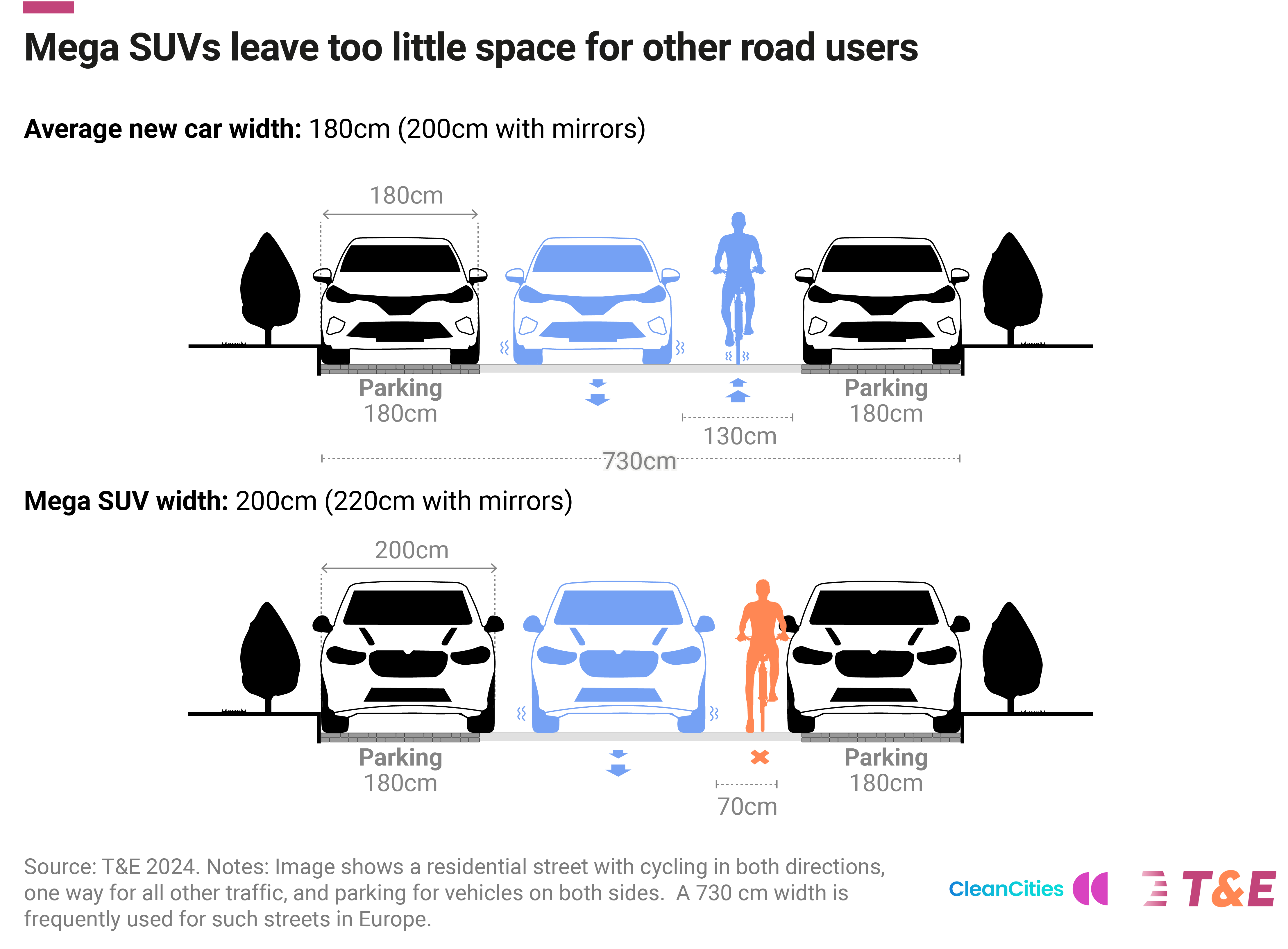
Why car width measurements can be confusing
Car width is not always measured in the same way. Two websites may list different numbers for the same vehicle because one includes mirrors and the other does not.
Manufacturers commonly publish width in one of these forms:
• Body width: The widest part of the vehicle body, usually excluding mirrors.
• Width with mirrors: The distance from the outer edge of one mirror to the outer edge of the other.
• Width with mirrors folded: The vehicle width when both mirrors are pulled inward.
• Track width: The distance between the centers of the left and right tires on the same axle.
• Wheel width: The distance between the outer wheel edges or tire sidewalls.
For parking and garage planning, body width alone is not enough. You need to consider the mirrors, doors, wall clearance, and room to walk around the vehicle.
A car listed as 72 inches wide may need close to 96 inches of practical space. The extra room is not part of the car itself. It is space for safe use.


How wide is a car with mirrors?
A typical car is about 80 to 90 inches wide with its side mirrors open. Large SUVs and pickup trucks may approach or exceed 95 inches.
Side mirrors can make a major difference in tight spaces. A sedan with a 72-inch body may be around 84 inches wide with mirrors. That adds a full foot to the vehicle’s overall width.
The mirror design also matters. Large towing mirrors on a pickup can extend much farther than normal mirrors. Some mirrors fold by hand, while others fold electronically from inside the cabin.
When comparing how wide is a car, look for a specification labeled “width including mirrors.” If that number is not available, measure the vehicle from mirror edge to mirror edge.
Remember these points:
• Mirrors are often the widest parts of a vehicle.
• Folded mirrors reduce width but do not reduce the body width.
• Mirror width affects narrow gates, car washes, and garage doors.
• A mirror can strike an object even when the main body clears it.

How wide is a car by vehicle type?
Vehicle class gives you a useful first estimate. It does not replace the official specifications, but it helps you understand the normal range.
Subcompact cars
Subcompact cars are among the easiest vehicles to fit into narrow spaces. They often measure 65 to 70 inches wide without mirrors.
Examples include small hatchbacks and city cars. Their shorter bodies also make them easier to position in compact parking spaces.
Compact cars
Compact sedans and hatchbacks usually measure 68 to 72 inches wide. They offer more cabin room than subcompacts while staying fairly easy to park.
This size is common among popular commuter cars. A compact car often fits a standard garage, but door clearance can still be tight.
Midsize sedans
Midsize sedans are often 72 to 75 inches wide. Their wider seats, larger cabins, and longer bodies make them comfortable for families.
The extra width may not feel important on the road. It becomes clear when entering a narrow garage or passing another vehicle on a small street.


SUVs and crossovers
Small and midsize SUVs often measure 70 to 78 inches wide. Their tall bodies, wide seats, and larger tires can make them feel bigger than a sedan.
Full-size SUVs may measure 77 to 82 inches wide before mirrors. They can be difficult to fit into older garages built for smaller cars.
Pickup trucks
Many modern pickups measure 75 to 82 inches wide without mirrors. Towing mirrors may add several more inches on each side.
Truck width can also change with running boards, fender flares, wide tires, and aftermarket wheels. Check the widest configuration if you use a truck for work or off-road driving.

How wide is a car in feet?
Most cars are about 5.7 to 6.5 feet wide without mirrors. With the mirrors open, many cars are about 6.7 to 7.5 feet wide.
To convert inches to feet, divide the measurement by 12.
• 68 inches equals 5 feet 8 inches.
• 72 inches equals 6 feet.
• 76 inches equals 6 feet 4 inches.
• 84 inches equals 7 feet.
• 90 inches equals 7 feet 6 inches.
For example, a car that is 72 inches wide has a 6-foot body. If its mirrors add 12 inches, its open-mirror width becomes about 84 inches, or 7 feet.
This conversion is helpful when checking a garage, storage unit, driveway, or parking entrance.

How wide should a garage be for a car?
A single-car garage is commonly 10 to 12 feet wide. However, the full garage width is not the same as the useful parking width.
A 10-foot garage measures 120 inches across. If a car body is 72 inches wide, that leaves 48 inches of total space, or about 24 inches on each side before accounting for walls and objects.
That may be enough to park. It may not be enough to open both doors comfortably.
For a practical garage layout, consider:


• Vehicle body width.
• Open mirror width.
• Door-opening space.
• Wall thickness.
• Shelves, bikes, tools, and storage bins.
• Space to walk around the vehicle.
A useful target is at least 30 inches of clearance on each side for comfortable entry and exit. Families with child seats may need more room because doors must open wider.
Before buying a vehicle, place tape on the garage floor to mark the car’s body width. Then mark the mirror width and test where you can stand and open the doors.
How wide is a parking space?
Many standard parking spaces in the United States are about 8 to 9 feet wide. That equals 96 to 108 inches.
Some spaces are narrower, especially in older garages, city lots, and crowded apartment buildings. Accessible spaces are often wider and may include a marked access aisle.
A 72-inch-wide car can fit within an 8-foot space, which is 96 inches wide. But the remaining 24 inches are shared by both sides. That leaves only about 12 inches per side if the car is centered.
This is why parking next to large SUVs can feel difficult. The neighboring vehicles reduce the usable door space even when the parking lines are standard.
When parking, center the vehicle between the lines. Avoid using the mirror as your only guide because mirrors can sit farther out than the body.
How to measure how wide is a car
You can measure car width at home with a tape measure. A second person makes the process easier and more accurate.
Follow these steps:
Park the car on level ground.
Keep the wheels straight.
Measure the widest part of the body from left to right.
Measure again from mirror edge to mirror edge with the mirrors open.
Measure with the mirrors folded if you use a narrow garage or gate.
Write down the numbers in inches and feet.
Do not measure from the inside of the doors. The correct measurement runs across the outside surfaces.
Also check whether accessories make the vehicle wider. Running boards, side steps, fender flares, wide tires, and roof equipment can change the clearance you need.


A common mistake is measuring only between the tires. That number is closer to track width, not the total vehicle width.
What affects a car’s width?
Several design features can change how wide a car feels and how much space it needs.
Body style
SUVs and trucks usually have wider bodies than small cars. A coupe may have a wide body but still feel easy to place because it has a lower seating position and good visibility.
Trim level
A performance trim may use wider wheels, tires, or fender extensions. Those parts can add width even when the basic model stays the same.
Mirrors
Mirror size varies by model. Towing mirrors are often much wider than standard mirrors.
Tires and wheels
Wide tires can extend beyond the standard body line. Incorrectly fitted wheels may also stick out farther than the factory design.
Door design
A sliding door needs less side space than a hinged door. This explains why some minivans work well in tight parking spaces even though they are fairly wide.
Suspension changes
Lift kits and custom suspension parts may change tire position and fender clearance. They can also affect how safely the vehicle passes through a narrow area.
Why car width matters for driving and safety
Width affects more than parking. It changes how you position the vehicle on the road.
A wide vehicle has less space on each side when traveling through a narrow lane. This matters near construction barriers, parked cars, bridges, and rural roads.
Width also affects:
• Passing another vehicle.
• Driving through a narrow drive-through lane.
• Using automatic car washes.
• Entering toll lanes and parking garages.
• Crossing a narrow bridge.
• Towing a trailer.
• Opening doors near another vehicle.


Modern cars may feel easy to drive because of cameras and sensors. These tools help, but they do not change the vehicle’s physical width. A camera can show an obstacle, but it cannot create more clearance.
A practical habit is to focus on the vehicle’s side position, not only the hood. In a new car, spend time learning where the mirrors and rear corners sit.
How wide is a car compared with a garage door?
A common single garage door is about 8 to 9 feet wide. That equals 96 to 108 inches.
A car that is 72 inches wide may appear to have plenty of room. Yet the usable opening is smaller than the outside frame, and the mirrors can reduce the margin.
For example:
• A 96-inch opening minus an 84-inch mirror width leaves 12 inches.
• A 108-inch opening minus an 88-inch mirror width leaves 20 inches.
That clearance is shared between both sides. It can feel tight, especially when the driver enters at an angle.
Measure the narrowest point of the opening, not just the door panel. Check the frame, tracks, posts, and weather seals. If the car has large mirrors, fold them before entering only if the vehicle and situation allow it safely.
Practical tips for fitting a wide car into tight spaces
A few simple habits can prevent scratches and mirror damage.
• Measure before you buy. Do not rely only on the vehicle class.
• Include mirrors in every garage or gate calculation.
• Leave extra space for doors and people.
• Fold mirrors before entering a narrow area when safe.
• Use a spotter when backing through a tight opening.
• Keep the wheels straight when measuring or parking.
• Check both sides of the vehicle, not just the driver’s side.
• Allow extra room for snow, ice, curbs, and uneven pavement.
• Avoid assuming that parking sensors detect every low object.
One lesson many drivers learn the hard way is that a vehicle can fit through an opening but still be impractical to use there. The goal is not merely to squeeze the car inside. The goal is to park, exit, and move around it without stress.
Common mistakes when checking car width
The most common mistake is using the advertised body width as the complete parking measurement. That number may exclude mirrors and accessories.
Another mistake is measuring a garage at its widest point. The entrance, support posts, and interior walls may create a narrower section.
Other errors include:
• Forgetting that mirrors may not fold fully.
• Ignoring aftermarket wheels or running boards.
• Measuring an empty space without considering a neighboring vehicle.
• Assuming all trims of the same model have identical dimensions.
• Using the width of the tires instead of the body.
• Forgetting space needed to open doors.
• Relying on a general internet estimate instead of the owner’s manual.
Model year can also matter. A vehicle may become wider after a redesign. Always check the specifications for the exact year, engine, trim, and body style.
Frequently Asked Questions about how wide is a car
How wide is a car without mirrors?
Most cars are about 68 to 79 inches wide without mirrors. Small cars may be narrower, while full-size SUVs and trucks can be wider than 80 inches.
How wide is a car with mirrors?
Most cars measure about 80 to 90 inches wide with the mirrors open. Large trucks with towing mirrors may be close to or above 96 inches wide.
Is a 72-inch-wide car considered wide?
A 72-inch body width is normal for many compact and midsize cars. It is not unusually wide, but the vehicle may need about 84 inches or more with mirrors.
Can a car fit in a 10-foot garage?
Many cars can fit in a 10-foot garage, but comfort depends on the vehicle and storage items. Measure the car with mirrors and leave enough space to open the doors.
Does car width include the mirrors?
Usually, published vehicle width excludes the side mirrors unless the specification says “including mirrors.” Check the manufacturer’s measurement notes before using the number for a tight space.
Are SUVs wider than cars?
Many SUVs are wider than small and midsize cars, but not every SUV is wider than every sedan. Compare the exact body-width and mirror-width specifications.
How much clearance should you leave around a car?
About 30 inches on each side is a comfortable target for entering and exiting in a garage. Less space may work, but it can make doors, child seats, and daily use difficult.
Conclusion
How wide is a car depends on the model, body style, trim, mirrors, and accessories. As a broad guide, most cars are 68 to 79 inches wide without mirrors and 80 to 90 inches wide with them.
For a safe fit, measure the exact vehicle and the narrowest part of the space. Include mirrors, doors, walls, storage items, and room to walk. A few minutes with a tape measure can prevent expensive mirror damage and daily parking frustration.
Before buying or moving a vehicle, check the official specifications and test the space when possible. If this guide helped, share your car’s width or explore more vehicle measurement tips to make your next parking decision easier.
