

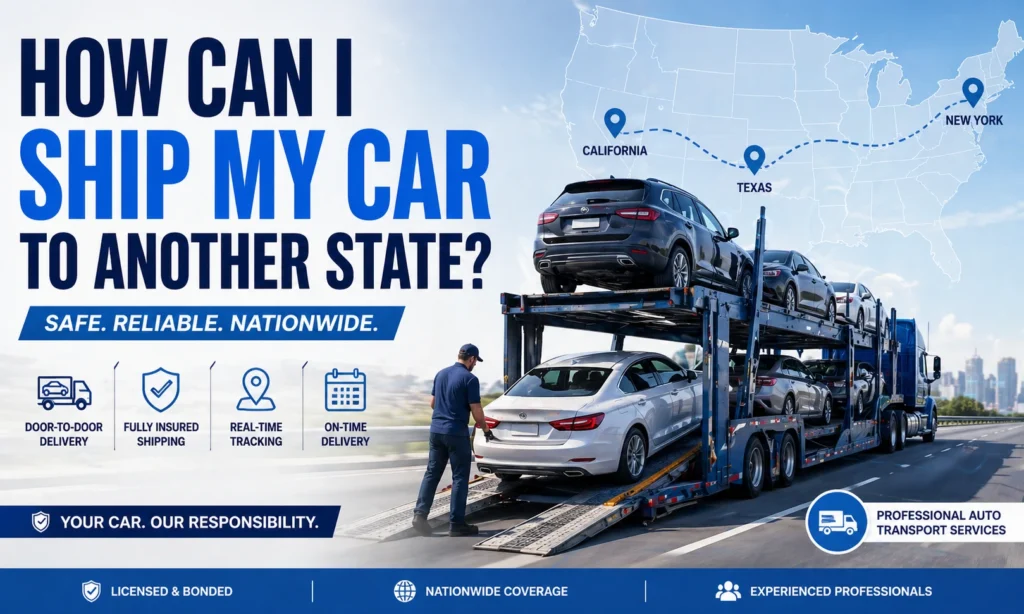
To ship a car to another state, get quotes from licensed auto transport companies, choose open or enclosed transport, prepare the vehicle, inspect it at pickup, and check it again at delivery. Most U.S. car shipments use a multi-car truck. The final price depends on distance, vehicle size, transport type, route demand, pickup access, and the car’s condition.
You can book through an auto transport broker, a motor carrier, or sometimes a moving company. A broker finds a carrier for you. A carrier moves the car with its own trucks. Before you book, check the company’s registration, insurance details, contract terms, pickup window, and cancellation policy.
This guide covers interstate vehicle shipping within the United States, including shipments to the lower 48 states. Alaska and Hawaii usually require a port or ocean shipping process.


What Does It Cost to Ship a Car to Another State?
The cost to ship a car across state lines often falls between several hundred dollars and more than $2,000, but there is no single national price. A short shipment may cost less than a long one, while a large SUV on a busy route may cost more than a small sedan traveling farther.
Treat online prices as estimates until a carrier confirms the route and pickup details. Some quotes are low because they exclude fees, use a wide pickup window, or depend on finding a carrier later.
Main factors that affect the price
| Factor | How it can affect the price |
|---|---|
| Distance | Longer routes usually require more fuel, labor, and truck time |
| Vehicle size | SUVs, trucks, vans, and oversized vehicles take more trailer space |
| Transport type | Enclosed transport usually costs more than open transport |
| Pickup location | Rural, remote, narrow, or restricted areas may cost more |
| Delivery location | Major cities often have more carrier capacity |
| Season | Demand can rise during snowbird moves, college moves, and summer relocation |
| Vehicle condition | A non-running car may need a winch or special equipment |
| Schedule | Expedited or fixed-date service may cost more |
| Route demand | A common lane may have more trucks and lower prices |
| Fuel and market changes | Carrier costs can change before pickup |
A simple planning estimate
Use this only as a planning tool:
Estimated shipping cost = route rate × transport distance + vehicle or service fees
For example, a hypothetical 1,200-mile shipment may have:
- A base route charge
- A larger-vehicle fee for an SUV
- An added charge for a non-running vehicle
- An enclosed-transport fee
- A possible rural pickup fee
The carrier or broker should explain each charge in writing. Ask whether the quote is binding, not-to-exceed, or subject to change.
Open versus enclosed transport
Open transport carries vehicles on an uncovered trailer. It is the most common option and usually costs less. Your car is exposed to normal road dust, rain, and weather during transit.
Enclosed transport places the vehicle inside a covered trailer. It costs more but offers more protection from weather and road debris. Owners often choose it for classic cars, high-value cars, show vehicles, or vehicles with custom finishes.
Neither option removes every risk. Ask about cargo insurance, loading procedures, and damage claims before booking.

How to Choose a Car Shipping Company
Choose a company that can clearly identify the business responsible for moving your car. A low quote is not useful if the company cannot explain who will transport the vehicle or how claims will work.
1. Decide whether you need a broker or a carrier
A broker arranges transport between you and a carrier. This can save time because the broker searches for available trucks. However, the broker may not be the company that picks up your car.


A carrier owns or operates the truck that moves the vehicle. Booking directly may give you a more direct contact, but the carrier may not serve every route or date.
Ask these questions:
- Are you a broker, a carrier, or both?
- Who will pick up the vehicle?
- When will I receive the carrier’s name and contact information?
- What happens if no carrier accepts the shipment?
- Can the price change after I book?
- What is the cancellation policy?
- Who handles a damage claim?
2. Check federal registration
For interstate auto transport, verify the company through the Federal Motor Carrier Safety Administration’s Company Snapshot. Search for the business name or U.S. Department of Transportation number.
The record can help you confirm:
- Whether the business is listed
- Whether it operates as a broker or motor carrier
- Its operating status
- Basic company details
- Safety and inspection information where available
Registration alone does not prove that a company will provide good service. It is one safety check, not a complete endorsement.
3. Confirm insurance and cargo coverage
Ask for written insurance information. Auto transport carriers must meet federal insurance requirements, but the amount and type of coverage can vary by operation and equipment.
Ask:
- What damage does the carrier’s cargo policy cover?
- Is there a deductible?
- Are personal items excluded?
- Are wheels, tires, roof accessories, or custom parts covered?
- Does the policy cover hail, weather, theft, and vandalism?
- How do I report damage?
- How many days do I have to file a claim?
Your personal auto policy may also have rules about transported vehicles. Call your insurer if you are unsure.
4. Read the transport agreement
The contract should state:
- Pickup and delivery locations
- Estimated pickup dates
- Delivery terms
- Total price or pricing method
- Payment schedule
- Deposit and cancellation rules
- Vehicle condition
- Transport type
- Insurance information
- Claims process
- Storage or failed-delivery charges
Be careful with companies that demand full payment before pickup, refuse to provide a written agreement, or pressure you to book at once.
5. Compare quotes fairly
Request at least three written quotes when possible. Give every company the same details:
- Pickup ZIP Code
- Delivery ZIP Code
- Vehicle year, make, model, and size
- Running or non-running status
- Open or enclosed transport
- Desired pickup dates
- Whether the car has modifications
- Whether the pickup or delivery site has access limits
A quote comparison is useful only when the services match. A cheap open-trailer quote is not directly comparable with enclosed transport or guaranteed pickup service.

How to Ship a Car to Another State Step by Step
Follow the steps below to reduce delays and avoid surprises.


Step 1: Confirm your route and timing
Choose the real pickup and delivery addresses when possible. A carrier may not be able to enter an apartment complex, gated community, narrow street, military base, or downtown loading zone.
If the truck cannot safely reach your address, the carrier may meet you at a nearby parking lot or commercial road. Choose a legal, safe location with enough room for a large truck.
Allow a pickup window rather than expecting an exact hour. Traffic, weather, mechanical problems, and earlier deliveries can affect the schedule.
Step 2: Gather vehicle information
Prepare:
- Vehicle identification number, or VIN
- Year, make, and model
- Approximate mileage
- Current condition
- Running status
- Vehicle dimensions if modified
- Pickup and delivery contact details
- Key locations
- Alarm or immobilizer instructions
Tell the company about roof racks, low ground clearance, lift kits, oversized tires, spoilers, nonstandard wheels, and other changes. These features can affect loading.
Step 3: Choose open or enclosed transport
Choose open transport when cost and availability matter most and normal weather exposure is acceptable.
Choose enclosed transport when the vehicle is valuable, fragile, restored, or difficult to replace. Ask whether the enclosed trailer can fit the vehicle’s height and width.
If the car has very low clearance, ask how the carrier loads it. A carrier may need ramps, a lift gate, or special handling.
Step 4: Confirm the booking
Do not rely only on a phone call. Get the booking details in writing.
Confirm:
- Carrier name
- Carrier phone number
- Pickup window
- Delivery estimate
- Total price
- Deposit amount
- Payment method
- Required documents
- Driver contact process
A pickup date is often an estimate, not a guaranteed appointment. If you need the car by a firm date, ask about expedited service and the company’s delivery policy.
Step 5: Prepare the car
Before pickup:
- Remove personal items and valuables.
- Leave only the fuel needed for loading and unloading, often about one-quarter of a tank or less.
- Remove toll transponders and disable tracking or alarm systems if the carrier instructs you to do so.
- Fold in mirrors and remove loose accessories.
- Check tire pressure.
- Make sure the battery is secure.
- Tell the carrier about leaks or mechanical problems.
- Keep a spare key for the ignition, doors, trunk, and any locking device.
- Photograph the car from all sides.
- Photograph existing scratches, dents, chips, and broken parts.
Do not assume that items left inside the vehicle are covered. Many carriers prohibit personal property because of weight, theft, insurance, and federal transportation rules.


Step 6: Complete the pickup inspection
The driver and customer should inspect the vehicle together. The driver records the condition on a Bill of Lading, which is the shipping document and inspection record.
Check that it lists:
- Existing damage
- Mileage
- Fuel level
- Vehicle condition
- Pickup date
- Vehicle identification details
- Any special instructions
Take time-stamped photos in good light. Make sure the images show the entire vehicle and close views of existing damage.
Do not sign a form that says the vehicle is damage-free if that is not true. If you disagree with the inspection, write a clear note on the Bill of Lading before signing.
Step 7: Track the shipment
Keep your contract, photos, payment records, and messages in one place. Contact the carrier if the pickup changes or the driver cannot reach the agreed location.
Delivery times are estimates because auto carriers may transport several vehicles on one route. Avoid booking a flight, hotel, or work deadline that depends on an exact delivery hour unless the company offers a written guarantee.
Step 8: Inspect the car before accepting delivery
Inspect the vehicle in daylight if possible. Compare it with the pickup photos and the pickup Bill of Lading.
Check:
- Bumpers and body panels
- Glass and mirrors
- Wheels and tires
- Roof and hood
- Undercarriage, when visible
- Lights
- Interior
- Odometer
- Accessories and loose parts
If you find new damage, record it on the delivery Bill of Lading before signing. Take photos and notify the carrier and broker at once. Follow the written claims procedure and keep copies of all documents.
What Documents Do You Need?
Most domestic car shipments need basic identification, vehicle information, and transport documents. Requirements can vary by company and route.
You may need:
- Government-issued photo identification
- Vehicle registration or title information
- Proof of ownership in some situations
- A signed shipping agreement
- Pickup and delivery contact information
- Keys
- Lienholder or leasing-company permission, if required
- Military or employer relocation documents, when applicable
A carrier may ask for the VIN and vehicle condition details before giving a final quote. The carrier usually needs keys to move the vehicle on and off the trailer.
If the car is leased or financed, check the lease or loan agreement. Some companies require permission before transporting the vehicle to another state or outside a defined area.

How Long Does Interstate Car Shipping Take?
Many domestic shipments take several days to about two weeks, but the actual time depends on the route and the carrier’s schedule. A short route may be completed quickly, while a cross-country shipment can take longer.
The main timing factors include:
- Total mileage
- Number of stops on the truck’s route
- Pickup and delivery location
- Weather
- Traffic and road closures
- Seasonal demand
- Carrier availability
- Vehicle loading problems
- Remote or difficult access


Ask two separate questions:
- When will the driver pick up the car?
- When should the car arrive?
The pickup date and delivery date are not always fixed. If you must meet a firm deadline, ask the company to explain what it guarantees and what happens if the shipment is late.

Can You Put Personal Items in the Car?
Many auto transport companies prohibit personal items inside the car. Some may allow a small amount of property in the trunk, but the rules vary.
Personal items can create problems because:
- They add weight
- They may shift during transport
- They may block the driver’s view
- They may not be covered by cargo insurance
- They can violate carrier or company policies
- They may be restricted during certain moves
Ask for written permission before placing anything in the vehicle. Never pack firearms, ammunition, hazardous materials, drugs, alcohol, cash, jewelry, important documents, or irreplaceable items.
If the company allows limited items, ask about the weight limit and where the items may be placed.

What If the Car Does Not Run?
A non-running vehicle can be shipped, but you must disclose that fact before booking. The carrier may need a winch, special ramps, a forklift, or extra labor.
Tell the carrier whether:
- The engine starts
- The transmission works
- The steering works
- The brakes work
- The tires hold air
- The car rolls freely
- The keys are available
A car that starts but cannot move under its own power is still a special-handling shipment. Ask whether the quoted price includes loading and unloading equipment.
Do not wait until pickup to reveal a dead battery, locked wheels, or damaged suspension. The driver may not have the right equipment, and the pickup could fail.

What Changes for Electric, Luxury, Classic, or Modified Cars?
Special vehicles need more planning because their size, weight, value, or operating systems may affect transport.
Electric vehicles
Tell the carrier that the car is electric. Ask about:
- Battery charge level
- Safe loading instructions
- Tow points
- Transport mode
- Key fob settings
- Alarm and tracking systems
- Charging needs at delivery
Do not guess about towing or disabling the vehicle. Follow the owner’s manual and the carrier’s instructions.


Classic and collector cars
Consider enclosed transport for cars that have fragile finishes, rare parts, or high replacement costs. Photograph the car in detail and document accessories before pickup.
Ask about insurance limits. A standard cargo policy may not match the car’s agreed or declared value.
Luxury cars
Ask whether the carrier has equipment suited to the vehicle’s clearance, wheel design, and size. Confirm how the company handles custom parts and electronic systems.
Modified vehicles
Report lift kits, lowered suspension, wide tires, roof boxes, spoilers, racks, and other changes. A modified vehicle may not fit standard loading equipment.

What Happens If the Car Arrives Damaged?
First, document the damage before the truck leaves. Take clear photos and write the issue on the delivery Bill of Lading.
Then:
- Notify the carrier immediately.
- Notify the broker, if a broker arranged the shipment.
- Request the carrier’s claims instructions.
- Send photos, the Bill of Lading, the contract, and repair estimates as requested.
- Keep damaged parts and receipts.
- Do not authorize major repairs until the insurer or carrier reviews the claim, unless immediate action is needed to prevent further harm.
The Bill of Lading is central to the claim because it records the vehicle’s condition before and after transport. A claim may be harder to prove if new damage is not recorded at delivery.
Insurance may have exclusions. For example, a policy may treat personal items, mechanical failure, pre-existing damage, or weather damage differently. Read the policy rather than assuming every problem is covered.

Common Mistakes to Avoid
Choosing the lowest quote without checking the terms
A low quote may not include all fees or may use a broad estimate that changes later. Compare the total service, not just the first number.
Giving a false vehicle condition
A carrier needs accurate information about whether the vehicle runs, rolls, steers, and stops. Incorrect details can cause delays or added charges.
Leaving personal items inside
Items may be prohibited, lost, damaged, or excluded from coverage. Remove them unless the company gives written permission.
Ignoring pickup and delivery access
Large car carriers need space to turn, stop, and load. Plan a nearby legal meeting point if the address is narrow, gated, crowded, or restricted.
Failing to take photos
Photos create a time-stamped record. Take them before loading and again before accepting delivery.
Signing a clean delivery report after finding damage
Write the damage on the delivery document before signing. Contact the carrier right away.
Expecting an exact delivery time
A vehicle may share a truck with several other cars. Use a delivery window unless the contract says otherwise.
Paying by an unsafe method
Be cautious with requests for payment by wire transfer, gift card, cryptocurrency, or cash sent to an unrelated person. Confirm the payee and payment terms in the written agreement.

Car Shipping Checklist
Before booking
- Compare several written quotes.
- Check the company through FMCSA resources.
- Confirm whether the company is a broker or carrier.
- Ask for insurance and claims information.
- Read the cancellation and payment terms.
- Confirm open or enclosed transport.
- Give accurate vehicle details.
Before pickup
- Remove personal items.
- Remove toll devices and loose accessories.
- Check tire pressure and battery security.
- Leave limited fuel, as instructed.
- Photograph the vehicle.
- Prepare keys and documents.
- Confirm the pickup location and contact number.
At pickup
- Inspect the car with the driver.
- Review the Bill of Lading.
- Record all existing damage.
- Note mileage and fuel level.
- Keep a copy of the signed documents.
At delivery
- Inspect the car before signing.
- Compare it with the pickup photos.
- Record new damage on the delivery document.
- Take photos.
- Contact the carrier quickly if there is a problem.
- Save all claim records.

Frequently Asked Questions
Is it cheaper to drive the car or ship it?
It depends on the trip. Compare the transport quote with fuel, lodging, meals, tolls, mileage, time away from work, and wear on the vehicle. Shipping may be more practical for a cross-country move, a second vehicle, or a car that should not be driven long distances.
Can I ship a car that is not registered?
A carrier may be able to transport an unregistered car, but you should ask about title, ownership, insurance, and destination-state rules. Registration is separate from transportation. The destination state may require you to register the vehicle within a specific period after moving.
Can someone else meet the driver?
Usually, you can name an authorized person to handle pickup or delivery. Give the company that person’s name and phone number in advance. That person should have identification and the keys and should understand the inspection process.
Do I need to be present at pickup and delivery?
You or an authorized representative should be present for both inspections. If no one can attend, ask the company about its written alternative process. Do not assume that leaving the keys or signing blank paperwork is safe.
Can I ship a car with a lien?
You may be able to ship it, but check the loan or lease agreement first. Some lenders and leasing companies have restrictions on moving a vehicle across state lines. Keep proof of ownership or permission available if the carrier requests it.
How do I ship a car to Alaska or Hawaii?
Alaska and Hawaii usually require a combination of ground transport and ocean shipping. The process may involve a port, specific terminal rules, cleaning requirements, and different documentation. Ask an ocean vehicle shipper or port-approved carrier for current instructions.
What if the car is delayed?
Contact the carrier or broker and ask for the vehicle’s last confirmed location and the updated delivery window. Check the agreement for delay terms. If the company stops responding, keep records of calls, messages, payments, and promised dates.

Official Sources and Verification
For a current shipment, verify details directly with the relevant agency and company:
- Federal Motor Carrier Safety Administration Company Snapshot
- FMCSA Consumer Information
- National Highway Traffic Safety Administration VIN information
- Your state motor vehicle agency for registration, title, and tax rules
- Your auto insurer for coverage during transport
- The carrier’s written insurance certificate and claims process
Rules and company policies can change. Confirm prices, insurance, pickup terms, and state requirements close to the date of shipment.

Final Takeaway
The safest way to ship a car to another state is to compare written quotes, verify the transporter, disclose the vehicle’s true condition, prepare the car correctly, and document its condition at pickup and delivery.
Start by collecting your pickup ZIP Code, delivery ZIP Code, vehicle details, preferred dates, and running status. Then compare companies on registration, insurance, contract terms, communication, and total price—not on the lowest quote alone.
