

Econ mode, also called Eco mode, is a driving setting that adjusts the car’s throttle, transmission, climate control, and sometimes cruise control to use less fuel or electricity. It usually makes acceleration softer and helps the vehicle avoid using more power than needed.
In the United States, Econ mode is common in gas cars, hybrids, plug-in hybrids, and electric vehicles. The exact changes depend on the make, model, engine, transmission, and software. It does not turn a regular car into a hybrid, and it cannot overcome hard acceleration, high speeds, heavy loads, or poor maintenance.
If you want the simplest answer: use Econ mode for calm city driving, commuting, and steady trips when you want efficiency. Turn it off when you need a quicker response, such as when merging onto a busy U.S. highway or towing.

How Does Econ Mode Work?
Econ mode works by changing how the car responds to your inputs. In most vehicles, the setting does not create energy by itself. Instead, it makes certain systems less eager to use fuel or battery power.


Depending on the vehicle, Econ mode may:
- Reduce accelerator-pedal sensitivity
- Delay downshifts or encourage earlier upshifts
- Limit engine power or air-conditioning output
- Reduce heating and cooling demand
- Adjust cruise-control behavior
- Change hybrid battery use or regenerative braking
- Encourage the engine to shut off during stops
- Reduce the use of accessories when possible
Throttle response
The accelerator pedal in a modern car is usually electronic. It does not directly open the throttle with a cable. Instead, sensors tell the car’s computer how much power the driver seems to want.
In Econ mode, pressing the pedal halfway may request less power than it would in Normal or Sport mode. The car may feel slower to respond, even though the engine itself has not changed.
You can still accelerate quickly by pressing the pedal farther. Econ mode usually changes the pedal map rather than placing a permanent mechanical limit on the engine.
Transmission shift points
An automatic transmission may shift into a higher gear sooner in Econ mode. Lower engine speed can reduce fuel use during light-load driving.
The transmission may also avoid frequent downshifts. This can make the car feel calmer, but it may cause a short delay when you ask for more power.
Some vehicles use a continuously variable transmission, or CVT. In those cars, Econ mode may reduce simulated engine speed or make changes in engine power feel more gradual instead of changing traditional gears.
Climate control
Heating and air conditioning can require significant energy. Econ mode may reduce compressor use, fan speed, or the speed at which the system reaches the selected temperature.
In some cars, the climate system remains fully active but works more gently. In others, Econ mode may reduce air-conditioning performance more noticeably. The owner’s manual is the best source for the exact behavior.
This matters most in very hot or cold weather. A small fuel saving may not be worth discomfort, reduced window defogging, or poor visibility.


Hybrid and electric vehicle systems
In a hybrid, Econ mode may change how the gas engine, electric motor, battery, and regenerative braking work together. It may favor smoother electric assistance and less aggressive power demand.
In an electric vehicle, Eco mode often limits acceleration and may reduce climate-system energy use. That can help extend driving range, but the size of the benefit depends on temperature, speed, terrain, traffic, and driving style.
Econ mode does not always increase regenerative braking. Some vehicles use a separate setting for that function. Do not assume that Eco, regenerative braking, and one-pedal driving mean the same thing.
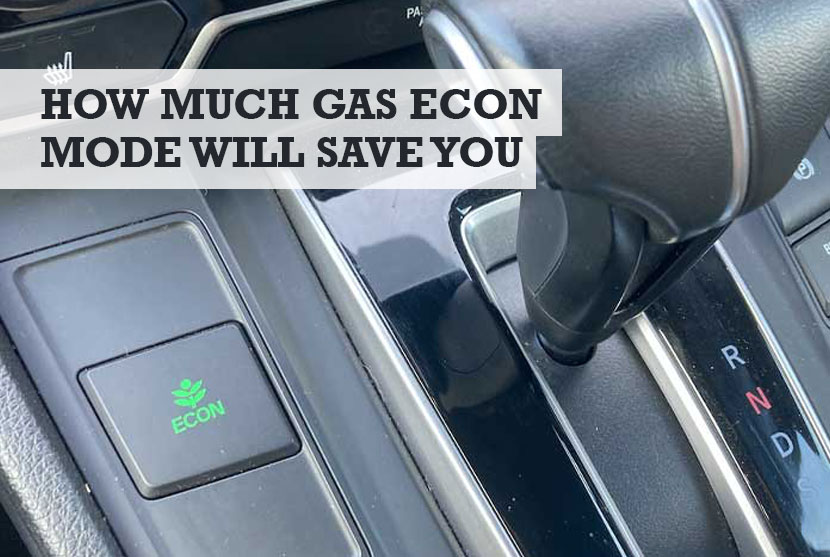
Does Econ Mode Save Gas?
Econ mode can save gas, but it does not guarantee a fixed amount of savings. The benefit comes mainly from smoother acceleration, lower engine load, fewer aggressive downshifts, and reduced climate-system demand.
The setting helps most when:
- You drive in stop-and-go traffic
- You often accelerate harder than needed
- You make short trips with frequent stops
- You use strong air conditioning
- You drive on mostly level roads
- You keep a steady speed
- You allow the car to shift early
The benefit may be small when:
- You already drive smoothly
- You travel at high highway speeds
- You drive up steep hills
- You tow or carry a heavy load
- The weather requires maximum heating or cooling
- You need frequent hard acceleration
- The car’s system mainly changes pedal feel
A simple fuel-use example
Suppose a car normally gets 30 miles per gallon and travels 300 miles.
[
300 \div 30 = 10 \text{ gallons}
]
If smoother driving helped that same car reach 32 mpg, the trip would use:
[
300 \div 32 = 9.375 \text{ gallons}
]
That difference is about 0.625 gallon for the trip. This is a hypothetical example, not a promise of what Econ mode will deliver.
Real fuel economy depends on many factors. The U.S. Environmental Protection Agency explains that EPA fuel-economy ratings are laboratory estimates, while real-world results can vary with speed, weather, traffic, terrain, vehicle condition, and driving habits. Econ mode is only one part of that result.
Econ mode versus fuel-saving driving habits
Econ mode cannot fix habits that waste fuel. The largest gains often come from:
- Accelerating smoothly.
- Looking ahead to avoid needless braking.
- Keeping tires properly inflated.
- Removing unnecessary weight.
- Avoiding very high speeds.
- Combining short errands.
- Maintaining the vehicle according to its schedule.
The U.S. Department of Energy’s fueleconomy.gov also identifies aggressive driving, excessive speed, idling, and poor tire inflation as common causes of lower fuel economy.


When Should You Use Econ Mode?
Use Econ mode when you want a gentle power response and do not need maximum acceleration. It is often a good choice for daily commuting, suburban roads, flat city streets, and relaxed highway travel.
Good situations for Econ mode
- Normal city driving
- Stop-and-go traffic
- A level road with light traffic
- Long commutes
- Smooth highway cruising
- Low-speed parking areas
- Hybrid driving when efficiency is the priority
- Electric driving when you want to reduce power demand
Econ mode can be especially useful if you tend to press the accelerator too sharply. The softer response acts like a reminder to use less power.
When to turn Econ mode off
Turn it off when the slower response could make a driving task harder or less safe. Examples include:
- Merging into fast traffic
- Passing another vehicle
- Entering a freeway from a short ramp
- Climbing a steep hill
- Driving with a full passenger or cargo load
- Towing a trailer
- Driving on a slippery surface when your vehicle’s manual recommends another mode
- Defogging windows in cold or humid weather
Turning Econ mode off does not make the car unsafe by itself. The point is to select the response that fits the situation. You should still obey posted speed limits, leave space, and avoid sudden maneuvers.
For towing, follow the vehicle manufacturer’s instructions. Some vehicles have a separate Tow/Haul mode. That mode may be more suitable than Econ mode because it changes shift behavior and engine braking for the added load.

Is Econ Mode Bad for Your Car?
Econ mode is generally not bad for a car when the manufacturer provides it as a normal driving setting. It is built into the vehicle’s control software and should not damage the engine, transmission, or electric motor during ordinary use.
However, Econ mode may not be the best setting for every condition. A car still needs enough power and climate control for the task at hand.
Common concerns
“Will Econ mode damage the engine?”
Normal use should not damage the engine. The vehicle’s computer still controls fuel delivery, ignition, temperatures, and emissions within its designed limits.
The car may feel less powerful because it requests power more gradually. That feeling does not mean the engine is being harmed.
“Will Econ mode wear out the transmission?”
Econ mode may encourage early upshifts and fewer downshifts. That is a normal operating strategy for many automatic transmissions.
Transmission wear is affected by many factors, including fluid condition, heat, towing, load, driving style, and maintenance. Econ mode alone is not a reason to expect unusual wear.
“Can Econ mode cause sluggish acceleration?”
Yes. Slower response is often the main trade-off. The engine may still have power available, but the car may take longer to deliver it after a light pedal press.
If the car does not respond as expected, press the accelerator firmly when safe or switch to Normal mode. If power remains weak in every mode, the issue may be mechanical and needs diagnosis.


“Does Econ mode reduce air conditioning?”
It can. Some cars lower compressor output or fan speed to reduce energy use. This may be noticeable on a hot day.
Do not sacrifice clear windows for fuel economy. Use the defroster or defogger as needed, and follow the instructions in the owner’s manual.

Econ Mode vs. Normal, Sport, and EV Modes
These driving modes are not identical. Their names can vary, but the general differences are useful.
| Driving mode | Main goal | Typical effect | Best use |
|---|---|---|---|
| Econ or Eco | Reduce fuel or electricity use | Softer throttle, earlier shifts, lower climate demand | Calm daily driving |
| Normal | Balanced response | Standard throttle and transmission behavior | Most conditions |
| Sport | Faster response or stronger performance | Sharper throttle, later shifts, higher engine speed | Passing, winding roads, driver preference |
| EV | Use electric power when available | Keeps the gas engine off when conditions allow | Low-speed or short electric driving in hybrids |
| Tow/Haul | Manage added weight | Changes shifting and sometimes braking behavior | Trailer towing or heavy loads |
The actual functions vary by vehicle. A Honda Econ setting, Toyota Eco mode, Ford Eco mode, and an electric vehicle’s Eco setting may not behave in the same way.
Econ mode is not the same as EV mode
Econ mode can be used in a gas-powered car. EV mode requires a vehicle with an electric drive system and enough battery charge.
A hybrid may allow both modes, but they serve different purposes:
- Econ mode changes how the vehicle responds to reduce energy demand.
- EV mode attempts to use electric power without starting the gas engine, when operating conditions allow.
A hybrid may leave EV mode because of speed, battery charge, temperature, acceleration, or heating demand. That is usually normal.
Econ mode is not the same as cruise control
Cruise control holds a target speed. Econ mode changes how the car uses power. Some vehicles combine both systems, but one does not replace the other.
Adaptive cruise control may also accelerate and brake differently from a human driver. Read the manual before relying on it in heavy traffic, poor weather, or complex road conditions.

How to Turn Econ Mode On or Off
Most cars activate Econ mode with a button marked ECON, ECO, or a similar symbol. The button may be on the dashboard, center console, steering wheel, or touchscreen.
A typical process is:
- Start the vehicle.
- Find the Econ or Eco button.
- Press it once.
- Check the instrument cluster for an indicator.
- Drive normally and note the change in response.
- Press the button again when you want the standard mode.
Some vehicles remember the last setting. Others return to Normal mode after each restart. Some also disable or limit Econ mode when the battery is low, the engine is cold, the vehicle is towing, or another drive mode is selected.
Check the owner’s manual for your exact model. The manual may explain whether Econ mode affects:
- Engine output
- Transmission shifting
- Climate control
- Cruise control
- Idle-stop
- Regenerative braking
- Hybrid battery operation


How to know it is working
Signs may include:
- An ECO or ECON light on the instrument panel
- A different accelerator response
- Earlier transmission shifts
- A dashboard efficiency display
- Reduced air-conditioning intensity
- A change in hybrid power-flow graphics
An indicator light only confirms that the mode is selected. It does not prove that the car is saving a specific amount of fuel at that moment.

What If Econ Mode Does Not Work?
Start with simple checks before assuming there is a fault.
Symptom: The Econ light does not appear
Possible causes include:
- The button was not pressed fully
- The vehicle is in another drive mode
- A system condition temporarily prevents Econ mode
- The indicator is displayed in a menu rather than as a separate light
- The vehicle does not have the feature you expected
Check the instrument cluster and owner’s manual. Do not rely on a generic description from another model.
Symptom: The car feels the same
Some Econ systems make only a small change. You may not feel a difference during gentle driving because the car is already using little power.
Test only in a safe setting. Compare the response during light acceleration on the same road, but do not make rapid mode changes while handling a difficult traffic situation.
Symptom: The car feels weak in every mode
This may point to a separate problem, such as:
- A check-engine warning
- A failing sensor
- Restricted airflow
- Low fuel pressure
- Transmission trouble
- A hybrid-system warning
- A weak battery
- A problem with the accelerator system
If warning lights appear, power drops sharply, the engine runs roughly, or the vehicle enters limp mode, stop in a safe place and consult the manual or a qualified technician. Do not continue driving if the vehicle cannot safely keep up with traffic.
Symptom: Fuel economy did not improve
That does not automatically mean Econ mode failed. A single tank can be affected by weather, tire pressure, traffic, short trips, fuel blend, payload, and driving speed.
For a useful comparison, track several fill-ups under similar conditions. Reset the trip meter at each fill-up, record gallons used, and calculate:
[
\text{Miles per gallon} = \frac{\text{miles driven}}{\text{gallons added}}
]


Do not compare one winter tank with one summer tank and treat the difference as the effect of Econ mode.

Common Econ Mode Mistakes
The most common mistake is assuming that Econ mode guarantees better fuel economy. It only changes the vehicle’s controls. The driver and road conditions still have a major effect.
Other mistakes include:
- Using Econ mode while expecting Sport-mode acceleration
- Assuming every car’s Econ button works the same way
- Ignoring reduced air-conditioning performance
- Treating EV mode and Econ mode as the same feature
- Using the mode while towing without checking the manual
- Blaming Econ mode for a mechanical power problem
- Driving too slowly during a merge because the response feels softer
- Ignoring tire pressure and routine maintenance
- Expecting a large range increase in an electric vehicle during extreme cold
The safest rule is simple: choose efficiency when conditions allow it, but choose control and visibility first.

Frequently Asked Questions
Does Econ mode make a car slower?
It can make the accelerator feel less sensitive and may delay downshifts. The engine may still produce its normal maximum power when you press the pedal far enough, although some vehicles apply a more direct power limit.
Should I leave Econ mode on all the time?
You can leave it on for ordinary driving if you like the softer response. Turn it off when you need faster acceleration, stronger climate performance, or a mode required by the vehicle manufacturer for towing or another special condition.
Does Econ mode save gas on the highway?
It may help during steady cruising, but the improvement can be small. Highway speed, wind, hills, traffic, tires, and cargo often matter more than the mode itself.
Does Econ mode help an electric car go farther?
It can reduce power demand by limiting acceleration and climate-system use. The actual range change varies with temperature, speed, terrain, battery condition, and how aggressively the vehicle is driven.
Can I switch Econ mode while driving?
Many vehicles allow it, but follow the owner’s manual. Change modes only when you can do so without taking attention from traffic. Never use a mode change to compensate for unsafe speed or a poor merge.
Key Takeaways
- Econ mode changes the car’s response to reduce fuel or electricity use.
- It may soften acceleration, shift earlier, and reduce climate-system demand.
- The savings are real only when the setting changes driving behavior or energy use.
- There is no universal fuel-economy percentage for Econ mode.
- Use it for relaxed daily driving, but turn it off when you need quick response.
- Econ mode is different from EV, Sport, Normal, and Tow/Haul modes.
- Check the owner’s manual because features differ by make and model.
- If the car lacks power in every mode or shows warning lights, have it checked.
Conclusion
Econ mode is best understood as a group of efficiency settings, not a magic fuel-saving switch. It helps the car use power more gently by changing throttle response, shifting, climate control, and—on some hybrids and EVs—electric power management.
For most drivers in the United States, the practical approach is to use Econ mode during calm commutes and routine trips. Turn it off when merging, passing, towing, climbing steep grades, or managing poor visibility. Your owner’s manual remains the final authority because the feature’s behavior differs across vehicles.
Sources used for general guidance
- U.S. Department of Energy — Fuel Economy
- U.S. Environmental Protection Agency — Fuel Economy and Environment Labels
- The vehicle owner’s manual for the specific make, model, model year, and powertrain
- Manufacturer documentation for the vehicle’s drive-mode, hybrid, EV, climate-control, and towing systems
