

If your car is burning oil, the engine is either using oil inside the cylinders or leaking it outside the engine. A small drop may come from normal oil use, but a fast loss, blue smoke, oil spots, or a low-oil warning can point to a repair that should not wait.
For drivers in the United States, the best first step is to check the oil level correctly, review the owner’s manual, and look for signs of a leak or exhaust smoke. Do not keep driving with the oil-pressure warning light on. Low oil pressure can damage an engine in minutes.
What Does “Burning Oil” Mean?
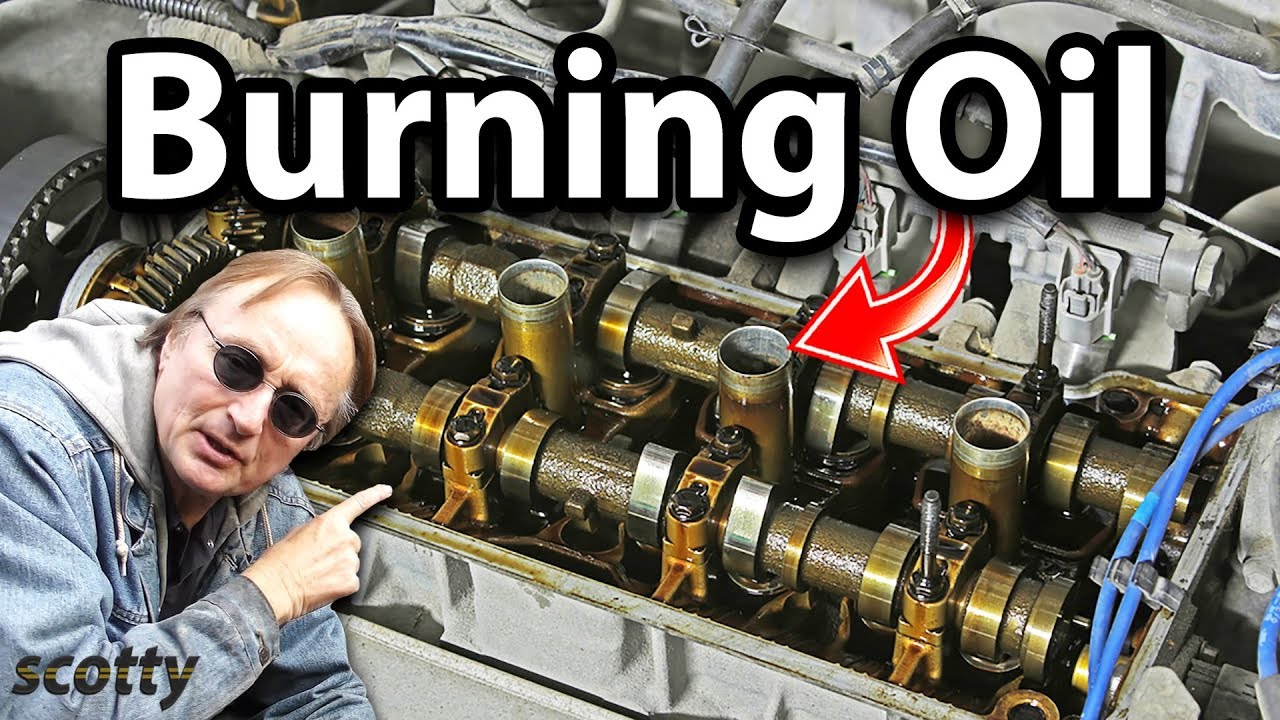
“Burning oil” means engine oil is entering the combustion chamber and burning with the fuel. Oil can also escape through a gasket or seal and drip onto the ground or hot engine parts. People often call both problems “burning oil,” but the repair is different.
Engine oil should stay in the crankcase. It lubricates moving parts such as the pistons, crankshaft, camshafts, and bearings. If oil passes the piston rings or valve seals, it can reach the combustion chamber.
The spark plug then ignites the oil along with the fuel.

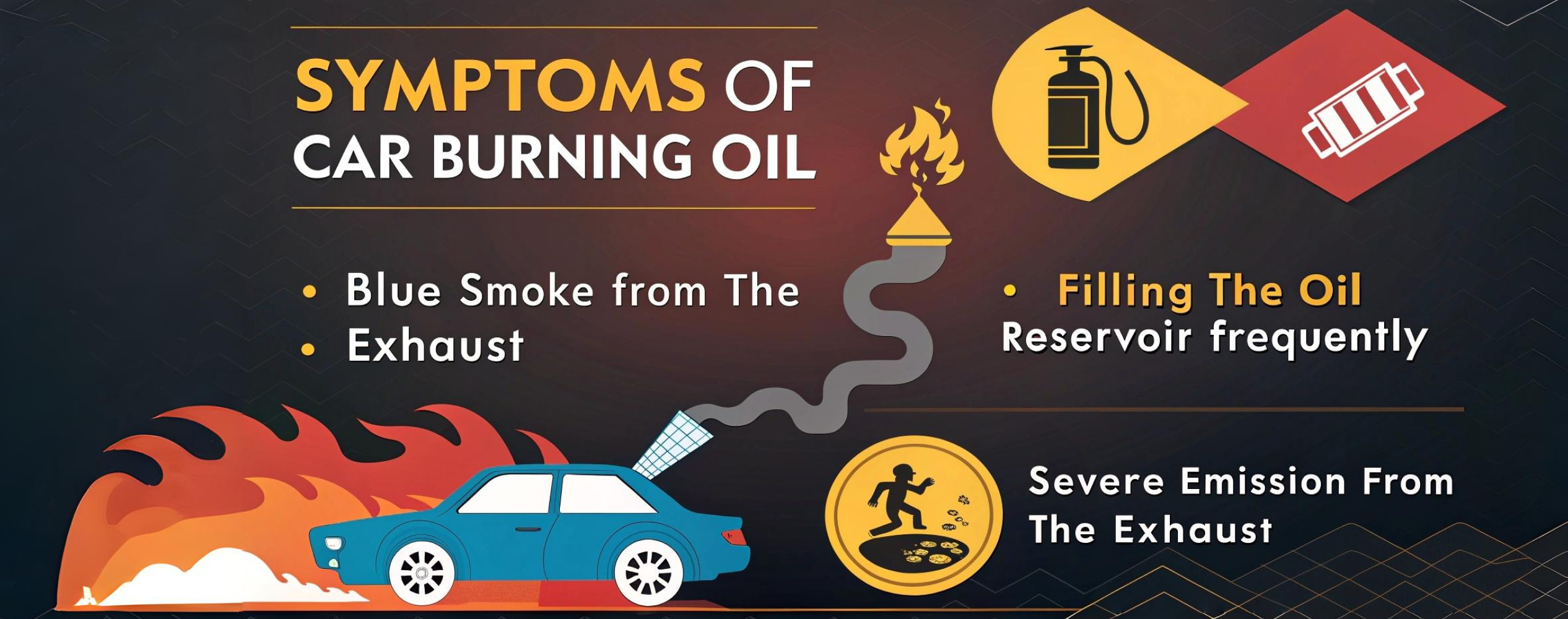
A car that burns oil may show one or more of these signs:
- The oil level drops between oil changes.
- Blue or blue-gray smoke comes from the exhaust.
- Blue smoke appears after idling or starting the engine.
- The engine smells like hot oil.
- Oil drips onto the driveway.
- Oil covers the engine or underbody.
- The check-engine light turns on.
- The oil-pressure warning light appears.
- The exhaust system or spark plugs become oil-fouled.
Some engines use a small amount of oil between services. The acceptable amount depends on the engine design, age, mileage, driving conditions, and the manufacturer’s stated limit. There is no single oil-use level that applies to every vehicle.

The Most Common Reasons a Car Burns Oil
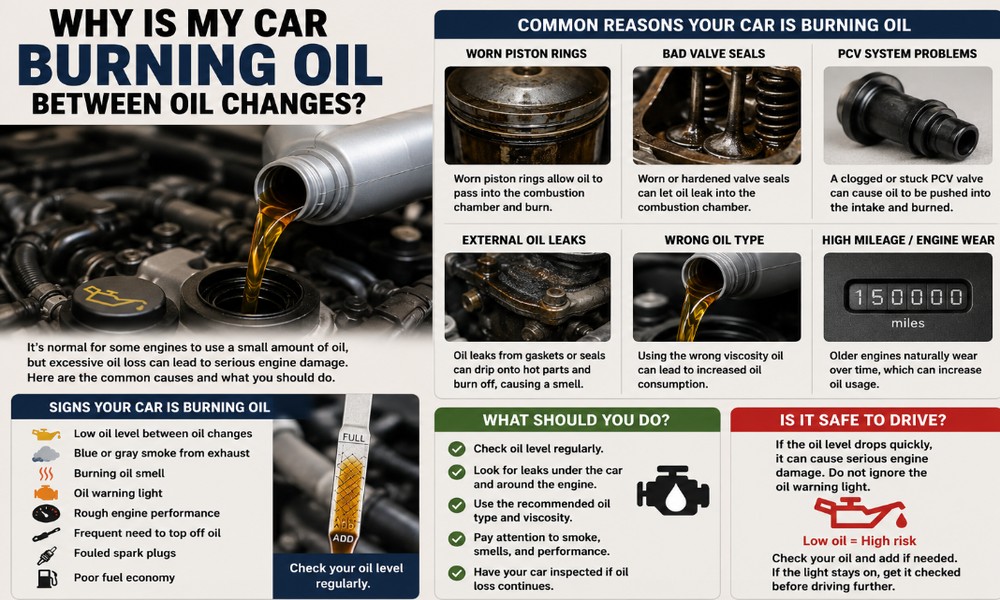
The main causes are worn piston rings, damaged valve seals, a faulty PCV system, turbocharger seal problems, and external leaks. The smoke pattern and the rate of oil loss can help narrow the cause, but they cannot confirm it by themselves.
Worn or Stuck Piston Rings
Piston rings seal the gap between each piston and the cylinder wall. They help keep combustion pressure in the cylinder and control the oil film on the cylinder wall.
When rings wear, stick, or lose tension, oil can move into the combustion chamber. The engine then burns it during combustion. This problem is more likely in an engine with high mileage, poor maintenance, heavy deposits, or cylinder wear.
Possible signs include:
- Blue smoke during hard acceleration.
- Low engine compression.
- Poor fuel economy.
- Reduced power.
- Increased crankcase pressure.
- Oil-fouled spark plugs.
- A strong oil-use rate without a visible leak.
A compression test can provide useful clues. A leak-down test often gives more information because it can show where cylinder pressure is escaping. These tests require the right tools and method, so a repair shop may need to perform them.
Worn Valve-Stem Seals or Valve Guides
Valve seals help control oil around the intake and exhaust valves. If a seal becomes hard, cracked, or worn, oil can enter the combustion chamber through the valve guide.
Valve-seal problems often cause a puff of blue smoke:


- After the car sits overnight.
- After a long idle.
- After the driver lets off the accelerator and then accelerates again.
The smoke may disappear once the engine runs at higher speed. That does not mean the problem has gone away. It may simply mean the amount of oil entering the engine is smaller at that moment.
A Faulty PCV System
The positive crankcase ventilation, or PCV, system removes combustion gases from the crankcase. It sends those gases back into the engine to be burned.
A stuck PCV valve, blocked hose, or failed separator can raise crankcase pressure. That pressure may push oil past seals or draw too much oil vapor into the intake. The result can look like an internal engine problem even when the piston rings are still usable.
PCV parts are often easier and less costly to inspect than internal engine parts. A technician should check the PCV valve, hoses, oil separator, and intake for oil before assuming the engine needs major repair.
Turbocharger Seal or Bearing Problems
Turbocharged engines use engine oil to lubricate the turbocharger. A damaged turbo seal, worn bearing, blocked oil drain, or excessive crankcase pressure can send oil into the intake or exhaust side.
Possible signs include:
- Blue smoke under boost.
- Loss of power.
- A loud turbo whine.
- Oil in the charge pipes or intercooler.
- Rapid oil loss.
- A check-engine light.
A small amount of oil vapor in turbo plumbing can be normal. A large amount of liquid oil is not something to ignore. Turbocharger failure can also affect engine control and, in rare cases, cause an engine to run on its own oil.
External Oil Leaks
An external leak is not technically oil burning inside the cylinders, but it can produce a burning-oil smell. Oil may drip onto a hot exhaust manifold, exhaust pipe, catalytic converter, or other engine parts.
Common leak points include:
- Valve-cover gaskets.
- Oil-filter housings.
- Oil-pan gaskets.
- Drain plugs.
- Front or rear crankshaft seals.
- Camshaft seals.
- Timing-cover gaskets.
- Oil-cooler seals.
- Turbo oil lines.
Look for fresh oil on the ground, wet areas on the engine, or oil residue under the vehicle. Do not crawl under a car supported only by a jack. Use properly rated jack stands on a firm surface, or have a qualified technician inspect it.
A Head-Gasket or Cylinder-Head Problem
A head-gasket failure can allow oil and coolant to mix or let oil enter a cylinder. This is less common than a simple leak or PCV fault, but it can cause serious damage.
Warning signs may include:
- White exhaust smoke with a sweet coolant smell.
- Milky oil under the oil cap.
- Bubbles in the coolant reservoir.
- Overheating.
- Coolant loss.
- Rough running.
- Oil in the coolant.
- Coolant in the oil.
Creamy residue under the oil cap can also form from condensation during short trips in cold weather. It is not proof of a failed head gasket by itself. A technician may need to test the cooling system, engine oil, and combustion gases.

How to Tell Whether the Engine Is Burning or Leaking Oil
The fastest way to narrow the problem is to compare the smoke, smell, oil level, and visible leaks. No single symptom proves the cause.


| Sign | More likely cause | What it suggests |
|---|---|---|
| Blue smoke during acceleration | Piston rings or turbo problem | Oil enters the cylinder under load |
| Blue puff after startup | Valve-stem seals | Oil leaks into the cylinder while parked |
| Blue smoke after long idle | Valve seals or PCV issue | Oil collects in the intake or cylinder |
| Oil on the ground | External leak | Oil leaves the engine without combustion |
| Burning-oil smell with no smoke | External leak | Oil may touch hot engine parts |
| White smoke with sweet smell | Coolant entering the engine | Possible cooling-system or head-gasket fault |
| Black smoke | Too much fuel | Usually a fuel or air-control issue, not oil |
| Low oil with oily intake pipes | PCV or turbo issue | Oil vapor or liquid oil enters the intake |
| Low oil with no visible leak | Internal oil use | Oil may be burning inside the cylinders |
Exhaust smoke can be hard to judge in cold weather. Water vapor is common during startup, especially in the United States during winter. It should reduce as the exhaust warms. Thick smoke that continues after warm-up needs attention.

How to Check Your Car for Oil Consumption
You can measure oil use at home if the vehicle is safe to inspect and the owner’s manual gives no special procedure. Use the correct oil grade and keep careful records.
1. Check the oil level correctly
Park on a level surface. Turn off the engine and wait for the period stated in the owner’s manual. Some vehicles require a short wait, while others use an electronic oil-level system with a specific check procedure.
For a dipstick:
- Remove the dipstick.
- Wipe it clean.
- Insert it fully.
- Remove it again.
- Read the level on the marked range.
- Add the correct oil only if needed.
- Recheck the level after a short wait.
Do not overfill the engine. Too much oil can create foaming, raise crankcase pressure, and damage seals or emissions equipment.
2. Record the mileage and oil level
Write down the date, odometer reading, oil level, and oil added. Check it under similar conditions each time.
A useful calculation is:
Oil used per 1,000 miles = oil added ÷ miles driven × 1,000
For a hypothetical example, if you add 1 quart after driving 2,000 miles:
1 ÷ 2,000 × 1,000 = 0.5 quart per 1,000 miles
That number is only a tracking result. It is not a universal pass-or-fail limit. Compare it with the vehicle manufacturer’s guidance for your exact engine.
3. Inspect for external leaks
With the engine off and cool, look for wet oil around the valve cover, oil filter, drain plug, oil pan, and lower engine. Cardboard placed under the parked vehicle can help show where drops fall.
Oil may travel across the engine or underbody before it drips. The location of a spot on the ground does not always match the source of the leak.
4. Look at the exhaust
Ask someone to watch the exhaust while you start the car and gently vary the engine speed. Do not stand behind the vehicle in a closed garage.
Blue smoke is more meaningful when it repeats under a specific condition. Note whether it appears at startup, after idling, during acceleration, or during deceleration.
5. Check the PCV and intake system
A technician can inspect the PCV valve, hoses, intake manifold, throttle body, turbo plumbing, and intercooler. Oil residue alone does not prove a major engine failure. The amount and location matter.
6. Ask for the right diagnostic tests
If the cause is not clear, useful tests may include:


- Compression testing.
- Cylinder leak-down testing.
- Crankcase-pressure testing.
- Vacuum testing.
- Cooling-system pressure testing.
- Combustion-gas testing.
- Borescope inspection.
- Smoke testing for external leaks.
- Scan-tool data and misfire checks.
The correct test depends on the symptoms. Replacing parts at random can cost more than diagnosing the cause first.
Can You Keep Driving a Car That Burns Oil?
You may be able to drive a car that uses oil if the level stays within the safe range and a qualified technician confirms that no urgent problem exists. You must check the oil often and fix the cause as soon as practical.
Stop driving and shut off the engine if:
- The oil-pressure warning light comes on.
- The engine makes knocking, tapping, or grinding sounds.
- The engine overheats.
- Thick smoke comes from the engine bay.
- Oil pours or sprays from the engine.
- The engine loses power suddenly.
- The exhaust becomes heavily smoky.
- The engine begins revving without control.
An oil-pressure light is not the same as a routine low-oil reminder. It may indicate that the engine is not building enough oil pressure. Continuing to drive can destroy bearings and other internal parts.
Burning oil can also damage the catalytic converter and oxygen sensors. Oil deposits may foul spark plugs and cause misfires. A misfiring vehicle can damage emissions equipment and may become unsafe in traffic.
How Much Does It Cost to Fix an Oil-Burning Engine?
The repair cost depends on the cause, vehicle design, labor time, and parts needed. A PCV valve or gasket repair is usually much simpler than replacing piston rings or rebuilding an engine, but actual prices vary widely across U.S. regions and vehicle models.
Typical repair categories include:
- PCV valve or hose: Often a smaller repair.
- External gasket or seal: Cost varies with access to the part.
- Valve-stem seals: Moderate to major labor, depending on the engine.
- Turbocharger: Can be costly, especially if related parts also need replacement.
- Piston rings or cylinder wear: Often requires major engine work.
- Engine replacement: May be considered when internal damage is severe.
Before approving major work, ask the shop for:
- The measured oil-use rate.
- Evidence that identifies the source.
- Compression or leak-down results when relevant.
- A written estimate.
- The warranty on parts and labor.
- Whether the repair addresses the cause or only reduces the symptoms.
A used-oil analysis may help in some cases, but it cannot replace a physical inspection. Oil additives and “stop smoke” products may change symptoms for a short time, yet they do not repair worn rings, damaged seals, or a failed turbocharger. Check the owner’s manual before using any additive.

Common Mistakes to Avoid
The most common mistake is adding oil without finding out why the level keeps dropping. Topping off may prevent immediate engine damage, but it does not fix the leak or internal oil use.
Avoid these mistakes:
- Waiting for the oil warning light before checking the level.
- Assuming blue smoke is always a bad head gasket.
- Assuming every oil spot comes from the oil pan.
- Using oil thicker than the manufacturer recommends.
- Overfilling the crankcase.
- Ignoring an oil smell inside the cabin.
- Replacing the catalytic converter before fixing the oil problem.
- Driving with an overheating engine.
- Using a jack without jack stands.
- Treating a temporary reduction in smoke as a permanent repair.
Use the oil viscosity and specification listed in the owner’s manual. The wrong oil can affect lubrication, fuel economy, variable valve timing, emissions systems, and warranty coverage.


When Should You See a Mechanic?
Arrange an inspection soon if the oil level drops between scheduled oil changes, even if the engine runs normally. A small leak can become a large leak, and internal oil use can damage emissions parts over time.
Seek urgent help when the oil-pressure light appears, the engine overheats, or you see heavy smoke. Pull over in a safe place, turn off the engine, and follow your vehicle’s roadside-assistance or owner’s-manual instructions.
Choose a shop that can perform engine-oil-consumption testing and basic internal-engine tests. Ask the technician to separate these findings:
- Where the oil is going.
- How quickly it is being lost.
- Whether the engine has low oil pressure.
- Whether the catalytic converter or spark plugs are affected.
- Whether repair or replacement makes economic sense.
For a newer vehicle, check your warranty documents and contact the manufacturer or dealer. Some engines have published service procedures for oil consumption, but coverage depends on the vehicle, mileage, maintenance history, and warranty terms.

Frequently Asked Questions
Is it normal for a car to use some oil?
Some engines use a small amount of oil between services. The acceptable amount differs by manufacturer and engine. Check the owner’s manual and measure the actual rate instead of relying on a general internet rule.
What color smoke means the car is burning oil?
Blue or blue-gray smoke often points to oil entering the combustion chamber. Smoke color can be misleading in poor light or cold weather, so use the smoke pattern with oil-level checks and other tests.
Can low oil cause blue smoke?
Low oil can increase engine wear and may worsen oil consumption, but low oil does not always cause the original problem. Find out why the level dropped before simply adding more oil.
Does thicker oil stop an engine from burning oil?
Thicker oil may reduce visible oil use in some worn engines, but it is not a guaranteed repair. Use only a viscosity and specification approved for the vehicle unless a qualified technician and the manufacturer provide different guidance.
Can an oil change fix an engine that burns oil?
An oil change can correct the wrong oil level or oil grade, but it will not repair worn piston rings, valve seals, a turbocharger fault, or an external leak. If oil use continues after the change, track the level and arrange a diagnosis.
Conclusion
A car that burns oil is usually dealing with one of two problems: oil is leaking outside the engine, or it is entering the cylinders and burning. Start with a correct oil-level check, inspect for leaks, note when smoke appears, and compare your measured oil use with the manufacturer’s guidance.
Do not ignore an oil-pressure light, overheating, heavy smoke, or engine noise. The sooner the cause is found, the better the chance of preventing expensive engine and emissions-system damage.
Sources: U.S. Environmental Protection Agency, Used Oil Management; National Highway Traffic Safety Administration, Vehicle Safety. For oil capacity, oil grade, warning lights, and acceptable oil use, use the owner’s manual for the exact vehicle.
