

A rattling car can have a simple cause, such as a loose heat shield, or a serious one, such as an internal engine problem. The sound’s location, timing, speed, and change under braking or turning can help narrow it down.
In the United States, common causes include loose exhaust parts, underbody shields, brake hardware, suspension parts, engine accessories, and debris trapped beneath the vehicle. Some rattles are safe to inspect at home. Others mean you should stop driving and arrange a tow.
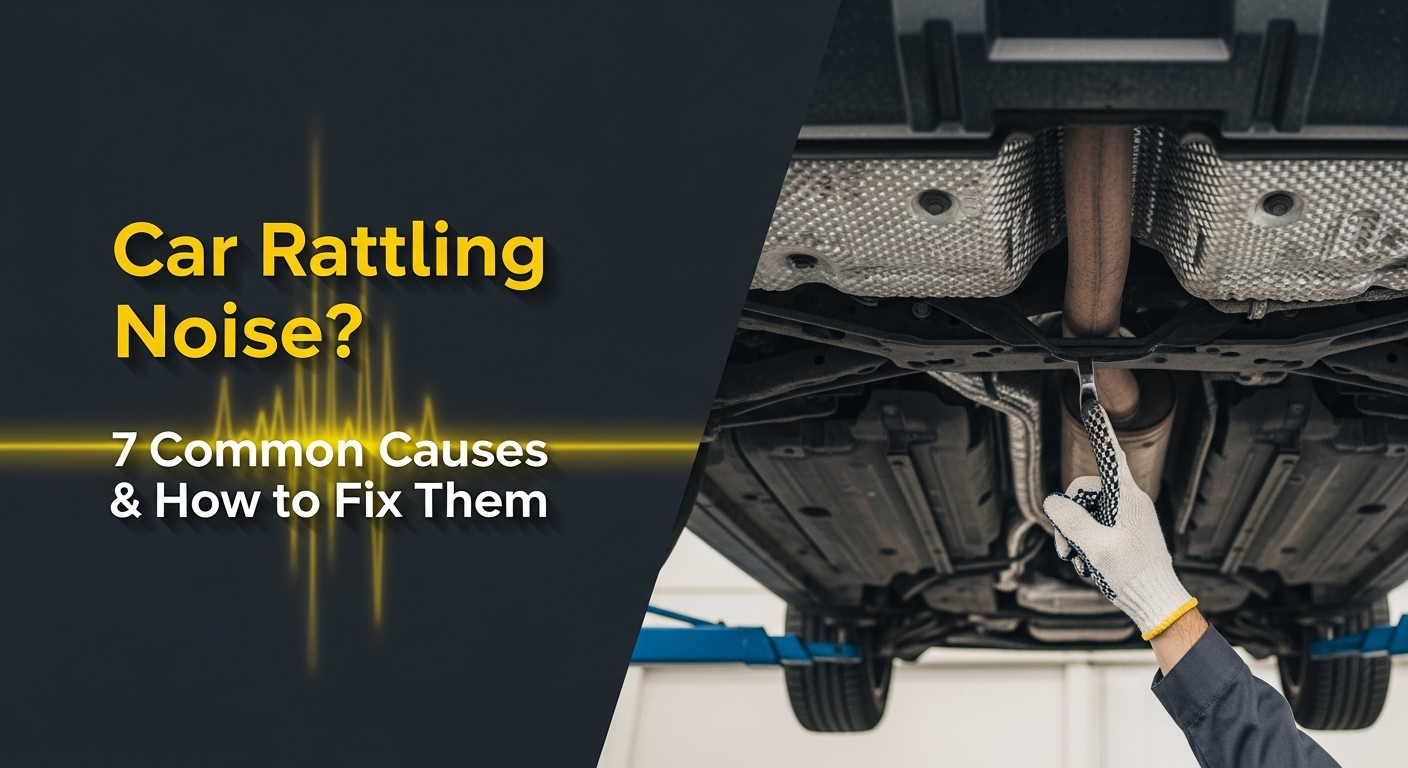
What does a rattling noise usually mean?
A rattle usually means that one part is loose, vibrating, or touching another part. The engine, exhaust, suspension, brakes, and body panels all produce different sounds when they move.
Use these clues to sort the noise:
| When you hear the rattle | Possible cause |
|---|---|
| At cold start or idle | Exhaust heat shield, loose bracket, engine accessory, timing-chain issue |
| When accelerating | Exhaust system, engine problem, loose shield, drivetrain mount |
| Over bumps | Sway-bar link, strut mount, control-arm part, loose underbody panel |
| When braking | Brake hardware, worn brake parts, debris, loose wheel component |
| When turning | Wheel-well liner, suspension part, CV joint, loose brake shield |
| At one engine speed | Resonating heat shield, exhaust pipe, belt tensioner, pulley |
| Under the hood | Belt, pulley, fan, alternator, timing components |
| Under the car | Exhaust, catalytic-converter shield, splash shield, loose fastener |
The sound may come from a different place than the failed part. A vibration can travel through the body, frame, or exhaust system. For example, an exhaust rattle may sound as if it comes from the dashboard.


Is the rattling noise dangerous?
A rattling noise is dangerous when it comes with warning signs such as low oil pressure, overheating, poor braking, loss of power, smoke, or a flashing check-engine light.
Stop driving and seek professional help if:
- The oil-pressure warning light stays on.
- The temperature gauge rises into the hot range.
- The check-engine light flashes.
- The engine runs poorly or loses power.
- The rattle becomes a deep knock that follows engine speed.
- The car pulls, shakes, or feels unstable.
- You smell fuel, burning oil, or melting plastic.
- A wheel feels loose or the noise started after hitting a pothole.
- A metal part hangs below the vehicle.
- The noise becomes loud during braking.
A short, light rattle from a loose exhaust shield may not require an emergency stop. Still, a loose part can fall off or damage nearby components, so arrange an inspection soon.

Common causes of a rattling car
Loose exhaust heat shield
A loose exhaust heat shield is one of the most common causes of a metallic rattle. Heat shields protect the floor, fuel system, wiring, and other parts from hot exhaust components.
The rattle often:
- Sounds like thin metal or small pebbles in a can
- Happens at idle or at a narrow engine-speed range
- Gets louder during cold starts
- Changes when you lightly raise engine speed
- Comes from under the car or near the front floor
Rust, broken fasteners, and vibration can loosen a shield. The shield may touch the exhaust pipe, creating a sharp buzz or rattle.
Do not touch the exhaust system after driving. It can remain hot long after the engine is turned off. A repair shop can replace missing fasteners, repair a damaged shield, or replace the part if rust has weakened it.
Loose exhaust pipe, muffler, or catalytic-converter part
A damaged exhaust hanger can let the exhaust pipe move. The pipe may hit the body, crossmember, or heat shield.
Look for:
- A deeper metallic sound
- A noise that changes when you accelerate
- An exhaust smell inside the cabin
- A pipe that hangs lower than normal
- A new sound after driving over a curb or rough road
A broken catalytic converter can also rattle. Its internal ceramic material may break apart and move inside the converter shell. A damaged converter can affect emissions and engine performance.


Do not repair an exhaust leak with household materials. Exhaust gases can contain carbon monoxide, an odorless gas that can enter the cabin. The National Highway Traffic Safety Administration warns that carbon monoxide exposure can be life-threatening.
Loose plastic splash shield or underbody panel
Modern cars use plastic panels beneath the engine and cabin. These panels improve airflow and protect components from water, dirt, and road debris.
A missing clip or screw can cause a panel to flap or rattle. The noise may rise with road speed rather than engine speed.
Check for:
- A panel hanging near the ground
- Scrape marks
- Missing clips
- A rattle that gets louder above a certain speed
- Noise after snow, ice, flooding, or road debris
Do not drive if the panel can contact a tire. A repair shop can replace clips or secure the panel. Do not use wire or zip ties near hot exhaust parts, rotating axles, belts, or tires.
Brake hardware or a loose brake shield
Brake parts can rattle when a retaining clip is missing or a brake pad fits poorly. A bent backing plate, also called a dust shield, can touch the brake rotor.
The sound may:
- Occur at low speed
- Change or stop when you press the brake pedal
- Come from one wheel
- Sound like scraping, clicking, or light rattling
A brake rattle does not always mean the brake pads are worn. However, any noise with grinding, vibration, a soft pedal, or longer stopping distance needs prompt attention.
Never place hands near a brake rotor after driving. It may be hot, and sharp metal edges can cause injury.
Suspension or steering parts
A rattle over bumps often points to the suspension or steering system. Possible causes include worn sway-bar links, loose stabilizer-bar bushings, worn ball joints, damaged strut mounts, and loose control-arm hardware.
The noise may come with:
- Clunks over potholes
- Uneven tire wear
- Steering that feels loose
- Pulling to one side
- A car that continues bouncing after a bump
- Knocking when turning into a driveway
Suspension problems can affect control of the vehicle. Do not diagnose a ball joint or other load-bearing part by simply shaking it unless you have the right tools and training.
Engine accessory, belt, or pulley
A rattle from the front of the engine can come from the serpentine-belt system. The belt drives accessories such as the alternator, power-steering pump, and air-conditioning compressor on many vehicles.
Possible sources include:
- Belt tensioner
- Idler pulley
- Alternator bearing
- Air-conditioning compressor
- Water pump
- Loose pulley or bracket
The noise may change when you turn the air conditioner on or off. A failing pulley can damage or throw the belt. On some engines, that can stop the alternator or water pump from working.


Keep hands, hair, clothing, and tools away from a running engine. Do not spray belt dressing onto a moving belt unless the vehicle manufacturer specifically allows it.
Low engine oil or internal engine damage
Low oil can contribute to engine noise, but a rattle does not prove that the oil level is low. Check the oil level on level ground with the engine off, using the procedure in the owner’s manual.
A serious engine rattle may sound like:
- A deep knock
- A fast tapping noise
- A noise that rises with engine speed
- A rattle that remains after the engine warms up
- A sound combined with low oil pressure or poor performance
If the oil-pressure warning light is on, turn off the engine as soon as it is safe. Continuing to drive can cause severe damage within minutes.
Timing-chain or timing-belt components can also make a rattle. The risk depends on the engine design. If timing parts fail, the engine may stop or suffer internal damage. A cold-start rattle that lasts several seconds deserves a professional diagnosis.
Loose wheel, tire, or lug nuts
A loose wheel is an urgent safety problem. A rattle or clicking near one wheel may follow recent tire, brake, suspension, or wheel work.
Stop driving and check for warning signs such as:
- New vibration through the steering wheel
- A wobble that increases with speed
- Repeated clicking or knocking
- Missing lug nuts
- A wheel that does not sit flush
- A tire losing air
Do not rely only on appearance. Lug nuts must be tightened to the vehicle maker’s specified torque. If you suspect a loose wheel, have the vehicle inspected before driving at highway speed.

How to find where the rattle is coming from
You can narrow down the source with safe observations. Do not crawl beneath a vehicle supported only by a jack. Use properly rated jack stands on a solid, level surface, or leave underbody work to a professional.
1. Record when the noise occurs
Note whether the rattle happens:
- During startup
- At idle
- When the engine is cold or warm
- During acceleration
- At a certain road speed
- Over bumps
- While braking
- While turning
- With the air conditioner on
- After rain, snow, or road debris
This information can save diagnostic time.
2. Decide whether engine speed or road speed controls it
This is one of the most useful tests.


If the rattle changes when you gently raise engine speed while parked, suspect the engine, exhaust, belt, or a heat shield.
If the noise changes with vehicle speed but not engine speed, suspect a wheel, tire, brake, underbody panel, or driveline component.
Only perform a parked engine-speed check outdoors, with the transmission in Park or Neutral as appropriate and the parking brake set. Keep people and objects away from the vehicle.
3. Listen from safe locations
With the vehicle off and cool, inspect around:
- The front grille and engine bay
- Each wheel
- The underside edges
- The rear bumper and exhaust outlet
- The cabin floor and dashboard
Look for loose trim, missing clips, hanging panels, or fresh scrape marks. Do not pull on hot exhaust parts or reach near fans and belts.
4. Check simple changes
If the rattle changes when you:
- Press the brake pedal, inspect the brake system.
- Turn the air conditioner on, consider the compressor or belt system.
- Drive over bumps, consider suspension or loose body parts.
- Turn left or right, consider the wheel area, liner, or suspension.
- Start the car cold, consider exhaust shields or timing components.
These tests identify patterns. They do not replace a full inspection.
5. Read warning lights and scan codes
A check-engine light may store a diagnostic trouble code. An inexpensive scan tool can read many engine and emissions codes, but a code does not always identify the exact failed part.
For example, an emissions code may result from an exhaust leak, sensor problem, wiring issue, or catalytic-converter problem. Avoid replacing parts based only on a code description.

A practical diagnosis table
The pattern below can help you decide how quickly to act. It is a starting point, not a final diagnosis.
| Rattle pattern | More likely sources | Recommended action |
|---|---|---|
| Thin buzz at idle | Heat shield, exhaust bracket | Inspect when cool; schedule repair |
| Deep knock that follows RPM | Internal engine problem | Stop driving; seek professional diagnosis |
| Rattle over bumps | Suspension, trim, underbody panel | Inspect soon; avoid hard driving |
| Rattle during braking | Brake hardware or brake shield | Arrange brake inspection promptly |
| Noise near one wheel after service | Lug nuts, brake parts, wheel liner | Stop if vibration or looseness is present |
| Rattle with A/C on | Compressor, pulley, belt tensioner | Turn off A/C if noise is severe; inspect |
| Flapping sound at highway speed | Splash shield or wheel-well liner | Slow down and inspect safely |
| Cold-start rattle that fades | Oil pressure, timing parts, exhaust shield | Check oil; arrange diagnosis if repeated |
What not to do when your car rattles
Avoid these common mistakes:
- Do not keep driving because the noise is “only a rattle.” A loose shield is minor, but a deep engine knock is not.
- Do not touch the exhaust when it is hot. Severe burns can occur.
- Do not work under a car held by a jack alone.
- Do not silence the noise by removing a heat shield. The shield protects nearby components from heat.
- Do not ignore an exhaust smell inside the cabin. Open the windows, leave the vehicle, and have it checked.
- Do not replace expensive parts before confirming the source.
- Do not spray lubricant on brakes, belts, or pulleys.
- Do not drive at highway speed if you suspect a loose wheel.
A repair estimate should identify the failed part, explain the safety risk, and distinguish urgent work from maintenance that can wait.


Can you fix a rattling noise yourself?
You may be able to handle a loose trim clip, floor mat, or accessible plastic panel. Basic checks are reasonable when the vehicle is parked, cool, and stable.
Professional help is the better choice for:
- Exhaust leaks
- Catalytic converters
- Brake components
- Wheel or lug-nut concerns
- Suspension and steering parts
- Timing-chain or timing-belt noise
- Engine knocks
- Parts near belts, fans, or hot exhaust components
Some vehicles also have hybrid or electric drivetrains. High-voltage components can carry dangerous energy even when the vehicle appears to be off. Do not open orange high-voltage cables, battery covers, or inverter parts. Follow the vehicle’s service information and use a qualified technician.
How much does it cost to fix a rattling car?
The cost depends on the failed part, vehicle design, rust, labor rates, and whether the repair involves emissions or safety equipment. A loose plastic clip may be inexpensive, while a catalytic converter, timing component, or suspension repair may cost much more.
Ask the shop:
- Where is the sound coming from?
- What part has failed?
- Is the vehicle safe to drive?
- What could happen if I wait?
- Does the estimate include parts, labor, taxes, and diagnostic time?
- Is the repair based on a confirmed test or only a suspected cause?
For emissions parts, check whether federal or state emissions rules and warranty coverage apply. Warranty terms vary by vehicle, part, mileage, and location.

Frequently asked questions
Why does my car rattle when I start it?
A startup rattle may come from an exhaust heat shield, a loose accessory, low oil level, or timing-chain components. If the rattle is loud, lasts more than a brief moment, or comes with an oil-pressure warning, shut off the engine and seek service.
Why does my car rattle when I accelerate?
Acceleration increases engine load and exhaust movement. A loose heat shield, exhaust hanger, engine mount, or internal engine problem may become louder. A deep knock, loss of power, smoke, or warning light requires immediate attention.
Why does my car rattle when I brake?
Brake hardware, a loose pad, a bent dust shield, or debris can rattle during braking. Grinding, pulling, vibration, a soft pedal, or longer stopping distance makes the problem urgent.
Why does my car rattle over bumps?
A rattle over bumps often comes from a loose underbody panel, wheel-well liner, suspension link, strut mount, or body trim. Since suspension faults can affect steering control, have persistent clunks inspected.
Can low oil cause a rattling noise?
Low oil can contribute to valve-train or timing-component noise and can lead to major engine damage. Check the oil level correctly. If the oil-pressure warning light is on, stop the engine rather than driving to a repair shop.
Bottom line
The most common reason a car makes a rattling noise is a loose shield, exhaust part, underbody panel, brake component, or suspension part. The safest way to narrow it down is to note when the noise occurs, determine whether engine speed or road speed changes it, and check for warning signs.
If the rattle comes with overheating, low oil pressure, poor braking, steering problems, a flashing check-engine light, or a deep engine knock, stop driving. When the cause is not obvious, a qualified repair shop can locate the vibration before a small loose part becomes a costly or dangerous failure.


