

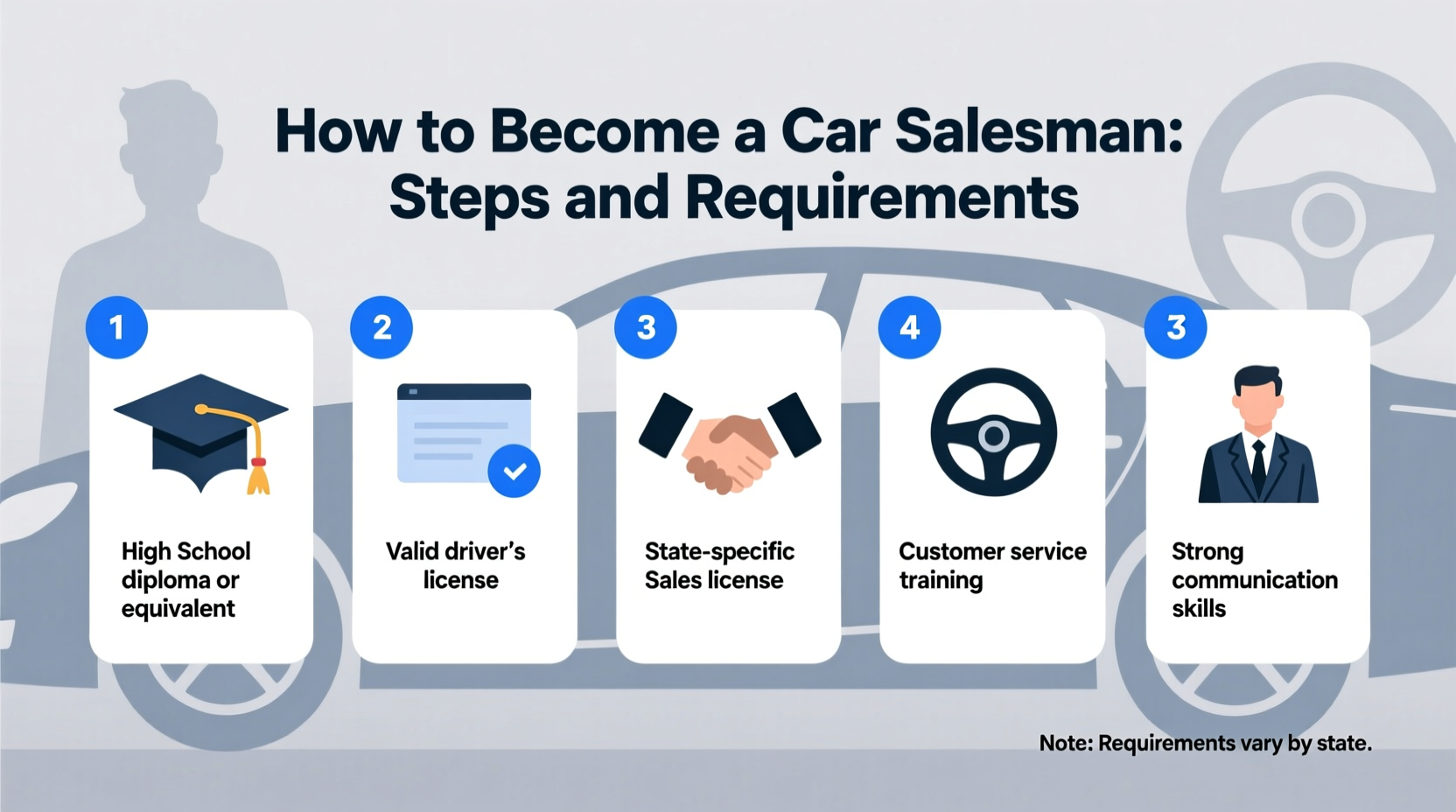
To become a car salesman in the United States, apply to a dealership, meet its hiring requirements, complete any state-required licensing or training, and learn how to guide customers through a vehicle purchase. Most dealerships look for a valid driver’s license, a high school diploma or equivalent, strong communication skills, and a clean, reliable work record.
You do not usually need a college degree or prior auto sales experience. Many dealerships train new hires on vehicle features, sales software, financing basics, and federal and state rules. Your income may include a base wage, commission, bonuses, or a mix of all three.
The exact requirements differ by state and dealership. Before applying, check your state’s motor vehicle agency and read the dealership’s job posting carefully.
What Does a Car Salesman Do?
A car salesman, also called an automotive sales consultant or auto sales representative, helps customers choose and buy vehicles. The job includes more than standing on a lot and handing over keys.
Typical duties include:
- Greeting customers in person, by phone, email, or text
- Asking about a customer’s needs and budget
- Explaining vehicle features and options
- Arranging test drives
- Finding vehicles in dealership inventory
- Discussing trade-ins
- Preparing or reviewing purchase paperwork
- Following up with past customers
- Meeting sales and customer-service goals
- Protecting customer information
A salesperson may sell new vehicles, used vehicles, or both. Some work at franchised dealerships, such as Ford, Toyota, or Honda stores. Others work at independent used-car dealerships.
The salesperson usually does not make the final decision on loan approval, interest rates, trade-in value, or contract terms. Those tasks may involve a sales manager, finance and insurance manager, lender, or dealership owner.
Car salesperson versus auto broker
A dealership salesperson works for a dealer and sells vehicles from that dealer’s inventory. An auto broker usually helps a customer find and negotiate a vehicle, often for a fee or commission. Broker rules and licensing requirements vary by state.
This article focuses on becoming a dealership salesperson.

What Qualifications Do You Need?
Most entry-level car sales jobs do not require a college degree. Dealerships often care more about communication, reliability, legal eligibility to work, and the ability to learn than about a specific major or certificate.
Common qualifications include:
| Qualification | Why dealerships may want it |
|---|---|
| High school diploma or equivalent | Shows basic reading, writing, and math skills |
| Valid driver’s license | May be needed to move or demonstrate vehicles |
| Acceptable driving record | Helps with test drives and vehicle movement |
| Customer-service skills | Builds trust and reduces misunderstandings |
| Basic math skills | Helps with prices, payments, discounts, and trade values |
| Computer skills | Most dealerships use customer relationship software |
| Professional appearance | Supports a dealership’s customer-facing image |
| Reliable transportation | Helps with schedules and daily attendance |
| Work authorization | Required under federal employment law |
These are common job requirements, not a single national legal checklist. An employer may set stricter or different standards.
A criminal record or poor credit history does not automatically prevent employment everywhere. Dealership policies, insurance rules, job duties, and state law can affect the decision. Answer application questions truthfully and ask how the dealership handles background checks.
Do you need a salesperson license?
There is no single nationwide car-salesperson license. State rules differ.
Some states regulate salespeople through dealer licenses, salesperson registrations, bonds, education, exams, or background checks. Other states may not require an individual salesperson license but still regulate the dealership and its sales practices.
Check these sources before you start selling:
- Your state department of motor vehicles
- Your state dealer licensing agency
- Your state attorney general’s consumer-protection office
- The dealership’s compliance or human resources manager
Do not assume that a license from one state works in another. Ask whether the dealership submits the application or whether you must do it yourself.

How to Become a Car Salesman: Step-by-Step
The simplest path is to prepare for customer-facing work, apply to several dealerships, complete the required screening, and learn the legal and product basics before working with customers.
1. Check your state’s rules
Start with official state sources. Search for terms such as:
- “[Your state] motor vehicle salesperson license”
- “[Your state] automobile dealer salesperson registration”
- “[Your state] motor vehicle dealer requirements”
Confirm:
- Whether individual salespeople must register
- Whether you need a background check
- Whether an exam or training course is required
- Whether the dealership must sponsor you
- Whether fees or renewal dates apply
- Whether rules differ for new and used vehicles
This step can prevent a delay after you receive a job offer.
2. Prepare a focused résumé
Your résumé should show results and people skills, not just job titles.
Useful experience includes:
- Retail sales
- Customer service
- Hospitality
- Call-center work
- Real estate
- Insurance
- Banking
- Fitness membership sales
- Electronics or phone sales
- Leasing or rental work
Use specific statements where possible. For example:
- “Helped 40 to 60 customers per day in a busy retail store.”
- “Exceeded monthly membership goal for three straight months.”
- “Handled customer concerns and resolved service issues.”
If you have no sales history, highlight attendance, communication, cash handling, teamwork, and learning speed.
3. Apply to more than one dealership
Visit dealership career pages and major job boards. You can also introduce yourself to a sales manager during a quiet business hour.
Apply to a mix of:
- Large franchise dealerships
- Independent used-car dealerships
- Luxury dealerships
- High-volume stores
- Commercial or fleet departments
A large store may offer formal training and many customer leads. A smaller store may provide closer coaching but fewer resources. Neither model is always better.
Ask whether the position is:
- New-car sales
- Used-car sales
- Internet sales
- Business development
- Fleet sales
- Product specialist
- Lot attendant with a path to sales
Some “sales” postings are mainly lead-generation or phone work. Read the pay plan before accepting.
4. Prepare for the interview
Dealership interviews often test your judgment and attitude through role-play. You may be asked to respond to statements such as:
- “I am only looking.”
- “Your price is too high.”
- “I need to talk with my spouse.”
- “I found a lower price online.”
- “I want the lowest monthly payment.”
A strong response does not pressure the customer. It asks a useful question and keeps the conversation open.
Example:
“That makes sense. Are you comparing the vehicle, the total price, or the monthly payment? I can help you compare the same terms so you know whether the offers are truly alike.”
The goal is to understand the customer’s concern, not to argue.
5. Review the pay plan before you accept
Ask for the compensation plan in writing. Important points include:
- Base pay or draw
- Commission rate
- Minimum commission, sometimes called a “mini”
- Bonuses
- Volume targets
- Customer satisfaction bonuses
- Chargebacks
- Pay for sold or delivered vehicles
- Rules for split deals
- Pay timing
- Benefits and paid time off
- Whether online leads have a different pay rate
A chargeback may occur when a deal later unwinds or a lender changes the approved terms. The exact rules depend on the employer and applicable law.
Do not rely on a verbal promise such as “you can make six figures.” Ask how many current salespeople reach the stated income and what sales volume is needed.
6. Complete onboarding and required training
Training may cover:
- Product knowledge
- Test-drive rules
- Customer privacy
- Dealership software
- Pricing and discounts
- Trade-in procedures
- Financing handoffs
- State and federal advertising rules
- Identity and document procedures
- Delivery checklists
You should understand what you may say and what must be handled by a manager or finance employee.
The Federal Trade Commission’s Used Car Rule requires covered dealers to display a Buyers Guide on used vehicles offered for sale. The guide includes information about warranty coverage and whether the vehicle is sold “as is,” where allowed.
Do not promise a warranty, payment, approval, discount, or vehicle condition unless the dealership has authorized and documented it.
7. Learn the inventory without memorizing every detail
Begin with the vehicles most likely to sell. For each one, learn:
- Starting price
- Trim levels
- Engine and drivetrain
- Fuel or charging needs
- Seating and cargo space
- Safety and driver-assistance features
- Warranty coverage
- Main differences from nearby models
- Available colors and stock status
- Typical customer fit
Use the manufacturer’s materials and the dealership’s approved information. If you do not know an answer, say so and verify it.
A clear answer such as “I want to confirm that before I tell you” is safer than guessing.
8. Build a follow-up routine
Many customers do not buy on the first visit. Follow up when you said you would, and make each message useful.
A good follow-up may include:
- A vehicle link
- A new arrival that matches the customer’s needs
- A trade-in document reminder
- A confirmed appointment
- A clear answer to a previous question
Do not send repeated messages with no new information. Follow dealership rules for consent, texting, email, and customer privacy.

What Skills Make a Good Car Salesperson?
The strongest car salespeople usually combine listening, product knowledge, organization, and patience. A forceful personality alone is not enough.
Listening
Ask open questions before showing vehicles. Useful questions include:
- What will you use the vehicle for?
- Who will ride in it most often?
- What matters most: price, space, fuel use, towing, or features?
- Do you have a trade-in?
- Are you replacing a vehicle or adding one?
- Are you considering a loan, lease, or cash purchase?
Good questions reduce wasted time and help prevent a poor match.
Clear explanations
Explain the total price, not only the monthly payment. A low monthly payment can result from a longer loan term, a larger down payment, or a different vehicle price.
The Consumer Financial Protection Bureau explains that auto loan terms can affect total interest and the overall cost of borrowing. Customers can use its auto loan resources to compare loan concepts before signing.
Organization
Track:
- Customer names
- Vehicle interests
- Appointments
- Follow-up dates
- Trade-in details
- Questions that need answers
- Documents still needed
A simple system is better than relying on memory.
Ethical judgment
Do not hide fees, misstate vehicle history, alter customer information, or pressure a customer to sign without understanding the deal. Short-term tactics can create complaints, chargebacks, bad reviews, and legal risk.
The FTC’s Automobile Buyers and Sellers guidance covers several rules and advertising issues that affect auto dealers.

How Much Do Car Salesmen Make?
Car sales income varies widely. The main factors are dealership traffic, vehicle prices, commission structure, sales volume, bonuses, experience, and local demand.
Common pay models include:
- Base pay plus commission: You receive an hourly wage or salary and earn commission on qualifying deals.
- Draw against commission: You receive an advance that may be offset against future commissions.
- Commission only: Your earnings depend largely on completed sales.
- Small commission plus bonuses: You earn a set amount per deal and may receive bonuses for volume, customer satisfaction, or product goals.
A simple hypothetical example shows why the pay plan matters:
- 10 qualifying sales
- $250 average commission per sale
- $1,000 monthly bonus
Estimated gross pay: 10 × $250 + $1,000 = $3,500
This is only an example. It does not predict income. The dealership may use different commissionable amounts, minimums, splits, deductions, or chargebacks.
Ask whether commission is based on:
- Vehicle gross profit
- A fixed amount per vehicle
- Front-end profit
- Back-end products
- Monthly unit volume
- Delivered vehicles rather than signed deals
Also ask about unpaid time, weekend schedules, health insurance, retirement plans, and paid leave. A higher advertised commission may not be better if customer traffic is low or the pay plan is difficult to understand.

What Is the Work Schedule Like?
Car sales often requires evenings, weekends, and holidays when customers have free time. Schedules vary by dealership and state law.
A typical week may include:
- Morning sales meetings
- Product training
- Customer appointments
- Test drives
- Vehicle demonstrations
- Follow-up calls and messages
- Deal paperwork
- Inventory checks
- Weekend showroom shifts
The job can involve long periods of waiting followed by fast, demanding deal work. You may stand or walk for much of the day, work outside, and handle customers who are stressed about money.
Ask during the interview:
- How many days per week are expected?
- How often do salespeople work Sundays?
- Are shifts posted in advance?
- Are there guaranteed days off?
- How are leads assigned?
- How long is the training period?
- What happens when the store is slow?

Common Mistakes New Car Salespeople Make
New salespeople often struggle because they focus on closing before they understand the customer or the process.
Guessing about prices or features
Incorrect information can damage trust and create compliance problems. Verify uncertain details with the vehicle label, manufacturer information, or a manager.
Talking too much
A long product speech can hide the customer’s real concern. Ask a question, listen, and connect one feature to that customer’s stated need.
Quoting only a monthly payment
Payment depends on price, down payment, interest rate, loan term, taxes, fees, and credit approval. Discuss the full structure of the deal.
Ignoring the trade-in
A customer’s trade may affect the purchase decision as much as the new vehicle. Gather accurate information and let the appropriate staff complete the appraisal.
Hiding fees or conditions
Do not describe a price as final if it excludes required charges. Ask the manager how advertised prices, taxes, registration, dealer fees, and optional products must be presented.
Failing to follow up
A customer may be interested but busy, waiting for a co-buyer, or comparing vehicles. A respectful, useful follow-up can keep the conversation active.
Accepting unclear pay promises
If the compensation plan is not written clearly, ask questions before signing. Keep a copy of the final plan and employee handbook.

How to Choose the Right Dealership
The dealership matters as much as the job title. A supportive store can help you learn faster and avoid preventable mistakes.
Compare dealerships by asking:
| Question | What the answer can tell you |
|---|---|
| How long do new salespeople usually stay? | May reveal training and turnover |
| How are leads assigned? | Shows whether opportunities are shared fairly |
| What training is paid? | Clarifies your early income |
| How many salespeople share the floor? | Helps estimate competition |
| What is the average monthly sales volume? | Gives context for income claims |
| Is the pay plan written? | Shows compensation clarity |
| Are chargebacks explained? | Helps you understand risk |
| Who handles finance questions? | Clarifies your role |
| What are the hours? | Helps you judge work-life fit |
| What customer complaints are common? | Reveals operational problems |
Do not treat low turnover or high income claims as proof of a good workplace. Use the answers to compare several stores.

Frequently Asked Questions
Do I need car sales experience?
No. Many dealerships hire entry-level applicants and provide training. Retail, hospitality, customer service, insurance, real estate, and phone sales can help, but they are not always required.
Can I become a car salesman with no college degree?
Usually, yes. Many dealerships require a high school diploma or equivalent rather than a college degree. State rules and employer policies may differ.
Do car salespeople need a license?
Some states require individual registration, licensing, education, testing, or background checks. Others regulate the dealer instead. Check your state motor vehicle agency before accepting a position.
Is car sales a good career?
It can suit people who enjoy customer contact, negotiation, changing schedules, and performance-based pay. It may be a poor fit if you need fixed hours, stable income, or limited weekend work.
Can I sell cars with a suspended license?
A dealership may require a valid driver’s license for test drives, vehicle movement, insurance, or employment. Requirements vary, so ask the employer and check your state rules. Do not drive a dealership vehicle illegally.
How long does it take to become a car salesman?
You may be able to start after the hiring and onboarding process, which can take days or weeks. A required state license, background check, or training course may add time. Becoming effective at the job usually takes longer because product knowledge and follow-up skills develop through practice.

Conclusion: Your Next Steps
To become a car salesman in the USA:
- Check your state’s salesperson and dealer rules.
- Create a résumé that shows customer and sales skills.
- Apply to several types of dealerships.
- Prepare for role-play interview questions.
- Review the written pay plan.
- Complete required screening and training.
- Learn the inventory and customer process.
- Build a clear, respectful follow-up routine.
Start by contacting three local dealerships and asking about entry-level sales openings, licensing requirements, training, hours, and compensation. Compare the written details before choosing your first store.
