

Most car batteries take anywhere from 30 minutes to 24 hours to charge, depending on method and condition.
I’ve worked on cars and tested chargers for years, so I know how confusing the question how long does it take to charge a car battery can be. This guide breaks down every factor that affects charging time, gives real examples, and shows you how to calculate charging time for your battery. Read on and you’ll know which charger to use, how long to leave it, and when a battery needs replacing.

How car batteries work and why charging time varies
A car battery stores energy in chemical form and releases it as electricity. Charging reverses that chemical reaction. The faster you push current into the battery, the sooner it reaches full charge.
Different battery types charge at different rates:
- Lead-acid flooded batteries charge slowly and tolerate moderate currents.
- Absorbent glass mat (AGM) batteries accept higher charge rates and recover faster.
- Lithium (LiFePO4) batteries charge quickly but need compatible chargers.
Battery state matters too. A deeply discharged battery takes longer than one that’s 50% full. Temperature and battery age change how well it accepts charge. That’s why the question how long does it take to charge a car battery rarely has a single answer.

Key factors that determine how long does it take to charge a car battery
Understanding these factors helps predict charging time.
Battery capacity (Ah)
- Higher amp-hour (Ah) ratings store more energy and require more time to recharge.
State of charge (SoC)
- A battery at 20% takes much longer to reach 100% than one at 70%.
Charger current (amps)
- A charger’s amp output is the main speed control. Higher amps = faster charge, up to the battery’s safe limit.
Charger type and charging profile
- Smart chargers adjust current and use stages (bulk, absorption, float). They protect battery life but may charge slower.
- Trickle chargers are slow but safe for long-term maintenance.
Alternator charging vs dedicated charger
- Alternators supply limited current while driving and usually recharge partially.
- Dedicated chargers plug into household power and can deliver controlled high currents.
Battery age, condition, and temperature
- Old or sulfated batteries accept current poorly and take longer.
- Cold batteries charge slower; hot batteries can be damaged by fast charging.
Parasitic drains
- Anything drawing current while you charge (alarms, radios) slows net charging.
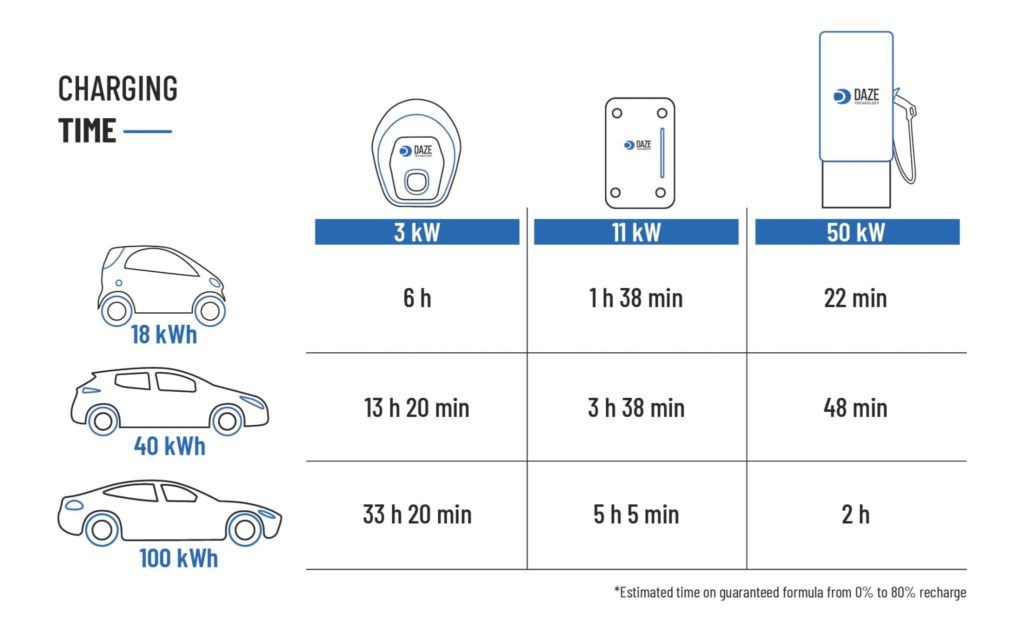
Typical charging times: examples and realistic scenarios
Here are common setups and rough times. These are examples, not guarantees.
Alternator while driving
- Typical current: 20–70 amps peak, but effective charge often 10–30 amps.
- Typical result: A partially discharged battery might recover in 30 minutes to a few hours of driving. Fully dead batteries usually need a charger.
Standard home chargers
- 2 amp trickle charger: 20–24 hours to recover a deeply discharged 50 Ah battery.
- 6 amp charger: 8–12 hours for a 50 Ah battery from low state.
- 10 amp charger: 5–6 hours for similar battery.
- 25 amp fast charger: 1–3 hours, but only safe if battery and charger ratings match.
Jump starter/boost and portable chargers
- Jump starters provide immediate starting power but don’t fully recharge the battery. You’ll need to charge afterward for several hours.
Smart chargers and multi-stage chargers
- Smart chargers may stretch total wall-time with absorption and equalization stages. Expect slower top-up but better battery life.
Fast charging and professional chargers
- Some professional chargers can charge quickly with controlled stages. These are often used in shops for fast turnaround.
If you ask how long does it take to charge a car battery using a 10 amp charger, expect roughly half a day for a moderately drained 50 Ah battery. If you wonder how long does it take to charge a car battery with a trickle charger, plan for overnight or longer.

Quick PAA-style questions
How long does it take to charge a car battery in a car while driving?
- Driving with the alternator can give partial charge in 30–60 minutes, but full recharge usually needs hours.
How long does it take to charge a car battery from dead to full with a 10A charger?
- For a typical 40–60 Ah battery, expect 4–8 hours. Add time for inefficiencies and absorption stage.
How long does it take to charge a car battery with a trickle charger?
- Trickle charging can take 12–48 hours for a full recovery, depending on battery size and how dead it was.
How to calculate charging time yourself
A simple formula helps estimate time.
Basic formula
- Hours = (Battery Ah × % to recover) / Charger amps × 1.2 (efficiency factor)
Example
- 50 Ah battery at 20% (need 80% = 40 Ah) with a 10A charger:
- Hours = (50 × 0.8) / 10 × 1.2 = 4.8 hours
Notes
- Always add 10–30% to account for inefficiency and absorption stage.
- Chargers that taper current as they approach full charge will extend total wall time.

Best practices to charge a car battery safely
Follow safe steps and you’ll protect the battery and yourself.
Before charging
- Check battery for cracks, leaks, or bulging. Don’t charge a physically damaged battery.
- Clean terminals and remove corrosion for a good connection.
During charging
- Use a charger rated for your battery type. Match lead-acid vs lithium settings.
- Start with a lower amp setting if unsure. Slow charges last longer but are gentler.
- Ensure proper ventilation. Charging can release gases with some battery types.
After charging
- Let the charger finish its absorption stage or switch to float mode.
- Re-measure voltage and specific gravity (if possible) to confirm a full charge.
Personal tip from experience
- I once tried a high-amp “fast” charge on an older battery — it never held a charge afterward. I now prefer a smart charger and regular maintenance charging. Slow and steady often saves money and time.
Avoid these mistakes
- Don’t connect a charger to a frozen battery.
- Don’t mix battery chemistries on the same charger.
- Don’t assume a quick boost equals a full, healthy battery.
Signs a battery needs replacement rather than charging
Charging won’t fix every problem. Watch for these signs.
Repeated short charge cycles
- If a battery needs frequent charging, its capacity may be failing.
Battery won’t hold charge
- If voltage drops shortly after charging, replacement is likely needed.
Swelling, leaking, or visible damage
- These are reasons to discard the battery safely.
Slow cranking with adequate charge
- If the battery is fully charged but the car cranks slowly, starter or electrical issues may exist, but battery age is a common cause.
If you’re asking how long does it take to charge a car battery but notice any of these signs, consider testing battery health or replacing it.

Frequently Asked Questions of how long does it take to charge a car battery
How long does it take to charge a car battery with a standard home charger?
Typical home chargers at 6–10 amps take 5–12 hours to bring a moderately discharged battery back to full. Deeply discharged batteries can take longer and need extra absorption time.
How long does it take to charge a car battery with a trickle charger?
Trickle chargers supply low current and may need 12–48 hours to fully charge a typical car battery, depending on size and state of charge. They’re best for maintenance and slow recovery.
How long does it take to charge a car battery using the alternator while driving?
An alternator can partially recharge a battery in 30–60 minutes of driving, but full recovery often takes several hours of driving or a dedicated charger. Heavy accessory use while driving reduces net charging.
How long does it take to charge a dead car battery with a fast charger?
Fast chargers can add a usable charge in 1–3 hours depending on battery size and charger output, but full safe charging may take longer due to absorption stages. Always use a charger suitable for the battery type.
How long does it take to charge a car battery in cold weather?
Cold temperatures slow the chemical reactions inside a battery, so charging can take significantly longer and may be less effective. If possible, warm the battery or bring it indoors before charging to improve performance.
Conclusion
Charging time depends on battery size, state of charge, charger type, temperature, and battery health. Use the simple formula to estimate time, choose the right charger, and prefer smart or slow charging for longer battery life. If a battery won’t hold charge after proper charging, test it or replace it.
Take action: check your battery specs, pick a charger that matches, and schedule a slow maintenance charge if you drive infrequently. If this guide helped, leave a comment with your battery type and charging setup — I’ll share tailored tips.