

A typical 2-car garage in the United States is 20 to 24 feet wide. For most homes, 24 feet wide by 24 feet deep is the most comfortable size. A 20-foot-wide garage may fit two smaller cars, but it leaves less room to open doors, walk between vehicles, or store items.
The right width depends on more than the cars. You also need to allow for wall thickness, garage door tracks, storage, work areas, and local building rules.

Standard Widths for a 2-Car Garage
A 2-car garage usually falls into one of these width ranges:
| Garage width | Best use | Main limitation |
|---|---|---|
| 20 feet | Two compact cars | Tight space for doors and storage |
| 22 feet | Two average cars | Usable, but limited side space |
| 24 feet | Most families and SUVs | More space and better comfort |
| 26–28 feet | Vehicles plus storage or work space | Needs more land and may cost more |
A 20-foot-wide garage is often treated as a compact 2-car garage. It can work when both vehicles are small and the garage is used mainly for parking.


A 24-foot-wide garage gives you more useful space. It can hold two average vehicles with room to open doors and walk around them. It also gives you better options for shelves, bikes, tools, and lawn equipment.
A garage wider than 24 feet may make sense if you own large trucks, full-size SUVs, or recreational equipment. It can also help if one side of the garage will serve as a workshop.
The 24-foot width is not a universal legal standard. It is a practical planning size used in many residential designs. The required size for your project may depend on local zoning rules, setbacks, permits, and the type of construction.
interior Width vs. Exterior Width
When someone says a garage is 24 feet wide, they may mean the outside foundation width or the inside usable width. Those measurements are not the same.
A garage’s exterior width includes the wall structure and exterior finishes. A garage’s interior width measures the clear space between the finished inside walls.
For example:
- A 24-foot exterior width may provide about 22 feet of interior width.
- A 24-foot interior width may require an exterior width of roughly 26 feet or more.
- Thick masonry walls, insulation, and other finishes can reduce the clear space further.
The exact difference depends on the wall system. A wood-framed wall with drywall takes less space than a thick masonry wall. A 2-by-4 wood wall with drywall and siding may have a smaller total footprint than a 2-by-6 wall with brick or stone veneer.
Always ask your designer or builder whether a dimension refers to:
- Foundation size
- Framing size
- Exterior finished size
- Interior finished size
- Clear space between walls
This distinction matters. A plan labeled “24-foot garage” may not give you 24 feet of usable interior space.

How Much Space Do Two Cars Need?
Two parked vehicles often need at least 18 to 20 feet of clear interior width. That is a practical estimate, not a universal code rule.


Many passenger cars are about 6 feet wide without mirrors. Trucks and SUVs can be wider. Mirrors also need space, even if they fold in while parking.
A simple planning example:
- Vehicle one: 6.5 feet wide
- Vehicle two: 6.5 feet wide
- Space between vehicles: 2 feet
- Space at both side walls: 2 feet total
That adds up to about 17 feet of interior width. In real use, extra space is helpful because drivers do not park perfectly every time. Children, shopping carts, tools, and doors also need room.
Here is how common widths feel in practice:
20-foot-wide garage
A 20-foot interior garage can fit two cars, but the fit may feel tight. You may need to park carefully to open both doors. Side storage can make the garage difficult to use.
22-foot-wide garage
A 22-foot interior garage offers a better fit for two average cars. It still may feel cramped with two large trucks or SUVs.
24-foot-wide garage
A 24-foot interior garage gives you more room to open doors and move around the vehicles. It is usually the safer choice for families, larger cars, and long-term storage.
26-foot-wide garage or wider
This size can support two vehicles plus deeper shelves, a tool bench, bicycles, or a small work area. The added width has the most value when you plan the storage before construction.

Typical 2-Car Garage Dimensions
Width is only one part of the layout. Depth affects whether you can park the vehicles and still use the space behind them.
Common dimensions include:
| Garage size | Approximate interior area | Practical use |
|---|---|---|
| 20 × 20 feet | 400 square feet | Two small cars, little storage |
| 20 × 22 feet | 440 square feet | Two cars with limited depth |
| 22 × 22 feet | 484 square feet | Average vehicles and some storage |
| 24 × 24 feet | 576 square feet | Two cars, storage, and walking space |
| 24 × 26 feet | 624 square feet | Larger vehicles or a work area |
| 26 × 28 feet | 728 square feet | Vehicles, storage, and a larger work zone |
These figures describe the labeled footprint. The usable area will be smaller if the dimensions are measured from the outside walls.
A 20-foot depth may work for compact cars, but it can be tight for pickups and SUVs. A depth of 24 feet or more usually gives better clearance at the front and back of the vehicles.
Measure your actual vehicles from the front bumper to the rear bumper. Then add space for:
- The garage door
- A walkway
- Shelves or cabinets
- A workbench
- Bicycles or lawn equipment
- Clearance around the vehicle
A garage that fits two cars on paper may not work well once storage is added.

What Is the Best Width for a 2-Car Garage?
For most American homes, 24 feet wide is the best general-purpose choice. It balances vehicle space, storage, construction cost, and land use.


Choose about 20 feet when:
- You have two small cars.
- The garage is mainly for parking.
- The lot is narrow.
- You do not need much storage.
- Local setbacks limit the building width.
Choose about 22 feet when:
- You want a modest amount of extra space.
- Both vehicles are average in size.
- You need a few shelves or wall cabinets.
- A 24-foot garage will not fit the lot or budget.
Choose 24 feet or more when:
- You own a truck or large SUV.
- You need room to open doors comfortably.
- You store bikes, tools, or lawn equipment.
- You want a workbench.
- You may buy larger vehicles later.
The best choice is based on your clear interior width, not just the advertised garage size. A 24-foot exterior garage may feel much like a 22-foot interior garage after walls and finishes are installed.
Garage Door Width for Two Cars
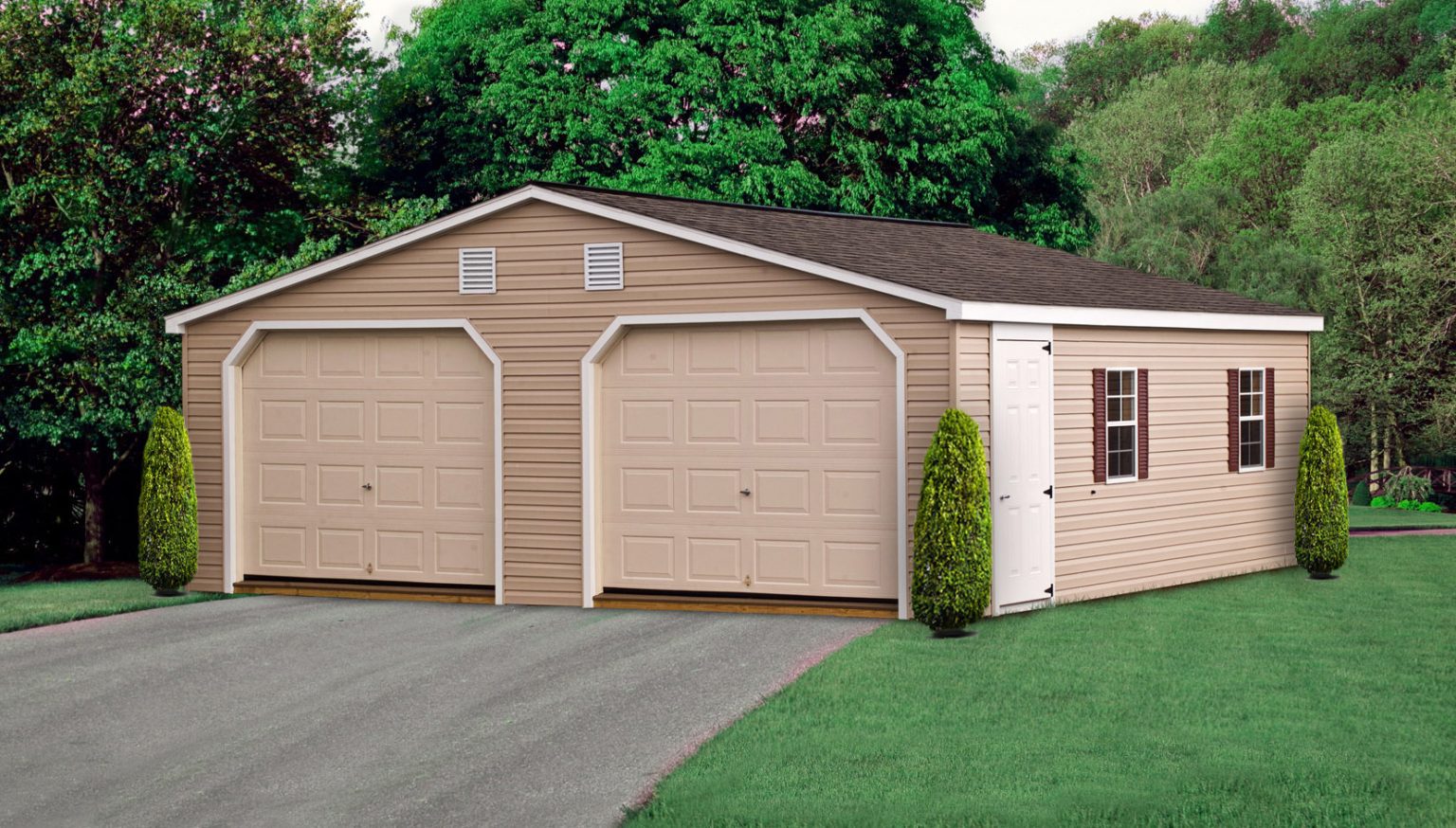
A 2-car garage commonly uses one wide garage door or two single doors.
Common door layouts include:
- One 16-foot-wide door
- One 18-foot-wide door
- Two 8-foot-wide doors
- Two 9-foot-wide doors
A 16-foot door is common, but it can feel narrow when two large vehicles enter side by side. An 18-foot door provides more approach room.
Two separate doors can offer more flexibility. One door can be used while the other remains closed. However, two doors need a center wall or support area, and they may cost more to install and maintain.
The door size is not the same as the garage width. A 16-foot door may sit in a garage that is 20, 22, or 24 feet wide. You also need room for:
- Door tracks
- Vertical side framing
- Exterior trim
- Interior wall protection
- Vehicle mirror clearance
Garage door manufacturers list standard sizes, but custom sizes may be available. For example, Clopay lists common residential garage door sizes, while the actual rough opening must follow the selected door’s installation instructions.

How to Calculate the Width You Need
You can estimate the needed interior width with a simple calculation.
Step 1: Measure both vehicles
Measure the widest point of each vehicle. Include the mirrors if they do not fold in during parking.
Step 2: Add space between the vehicles
Allow at least 24 inches between vehicles for a basic walkway. More space is better if people need to move around both vehicles.
Step 3: Add side clearance
Add space between each vehicle and the side wall. A total of 24 to 48 inches for both sides may work, depending on your needs.


Step 4: Add storage width
Add the depth of cabinets, shelves, or a workbench. A typical wall shelf may use 12 to 18 inches of width. A workbench may need 24 to 30 inches.
Example calculation
Suppose two SUVs are each 6.5 feet wide:
- SUV one: 6.5 feet
- SUV two: 6.5 feet
- Center walkway: 2 feet
- Side clearance: 3 feet total
- Storage along one wall: 1.5 feet
Total: 19.5 feet of clear interior width
This would fit, but it would not leave much room for error. A 22- to 24-foot interior width would provide a more comfortable layout.
This is a planning example, not a building-code formula. Confirm the final design with a qualified designer, builder, or local building department.

What Building Codes Say About 2-Car Garage Width
There is no single nationwide rule that gives every 2-car garage the same width. Requirements can vary by city, county, state, subdivision, and homeowners association.
The International Residential Code, or IRC, is widely used as a model code in the United States. Local governments adopt it with changes. The adopted local version controls your project.
Garage rules may cover:
- Fire separation from the home
- Door ratings
- Vehicle access
- Electrical outlets
- Ventilation
- Setbacks
- Lot coverage
- Drainage
- Ceiling height
- Structural design
- Required parking spaces
The International Code Council provides model codes, but your local authority having jurisdiction decides which code and amendments apply.
Before ordering plans or materials, contact your local building department. Ask for the rules on:
- Minimum garage size, if any
- Maximum building width
- Required setbacks
- Driveway width
- Garage placement
- Fire-rated walls and doors
- Permit requirements
A garage can fit two cars and still fail local zoning rules. Width is only one part of approval.

Attached vs. Detached 2-Car Garages
An attached garage may need a different design from a detached garage. The footprint, access route, and fire separation can all change.
An attached garage often shares a wall with the home. That may reduce layout options and require a protected wall or door between the garage and living space.


A detached garage may offer more freedom in width and placement. However, it still must meet local rules for setbacks, lot coverage, foundation work, electrical service, and driveway access.
For either type, check how the garage width affects:
- The driveway approach
- Turning space
- Sidewalk access
- Property lines
- Utility lines
- Stormwater flow
- Snow storage in colder regions
- Emergency access
The widest garage is not always the best garage if the driveway cannot provide a comfortable approach.

Common Mistakes When Planning a 2-Car Garage
The most common mistake is planning around the outside width instead of the usable inside width. Wall thickness and finishes reduce the space you can actually use.
Other frequent mistakes include:
- Measuring the car body but ignoring mirrors
- Choosing a 16-foot door for two large vehicles
- Forgetting space for door tracks
- Adding shelves after parking spaces are planned
- Using a 20-foot depth for a long truck
- Ignoring future vehicle changes
- Assuming local codes are the same everywhere
- Placing the garage too close to property lines
- Forgetting the width of the driveway apron
- Treating a storage area as free space
A narrow garage can also become harder to use when you add insulation, drywall, cabinets, or protective wall panels. Draw the vehicles to scale before construction. Mark door swing areas and walkways as well.
If you are building from scratch, a small increase in width may be cheaper before construction than a later remodel. Compare the added foundation, framing, roofing, siding, and driveway costs before making the choice.

Frequently Asked Questions
Is a 20-foot-wide garage big enough for two cars?
A 20-foot-wide garage can fit two compact or average cars, especially if that measurement is the clear interior width. It may feel tight with two large SUVs, trucks, storage cabinets, or a workbench.
Is a 24-foot garage wide enough for two trucks?
A 24-foot garage is often a better fit for two trucks than a 20-foot garage. Measure the trucks, mirrors, and door openings first. Large trucks may still need extra width for comfortable entry and storage.
What is the smallest practical 2-car garage?
About 20 feet wide by 20 feet deep is a common compact size. It is best for smaller vehicles and limited storage. A larger size, such as 22 by 22 feet or 24 by 24 feet, is more flexible.
Is a 16-foot garage door wide enough for two cars?
A 16-foot-wide garage door can serve two cars, but it may feel narrow when both vehicles are large. An 18-foot door or two separate doors may provide a more comfortable layout.
How wide should a driveway be for a 2-car garage?
A driveway serving two cars often needs about 20 to 24 feet of width near the garage. Local rules, site shape, turning space, and the type of vehicles can change that need. Check local requirements before paving.
Final Answer: How Wide Should a 2-Car Garage Be?
A 2-car garage is usually 20 to 24 feet wide, but 24 feet wide is the most practical choice for many U.S. homes. Use 20 feet only when space is limited and the vehicles are small. Choose more than 24 feet if you need room for trucks, storage, tools, or a workbench.


Before building, confirm whether the stated width is an interior or exterior measurement. Then measure your vehicles, add door and storage clearance, and verify local zoning and building requirements.
