

If you have an old car seat in the United States, do not put it in the trash without first making it unusable. Check its age, crash history, recalls, and condition. If it is expired, damaged, recalled, or missing key parts, remove the cover, cut the harness, mark the shell, and follow your local disposal or recycling rules. If it is still safe and complete, you may be able to give it to another family or use a local reuse program.

Quick answer: The safest options for an old car seat
The right choice depends on why the car seat is old.
| Condition of the car seat | Best next step |
|---|---|
| Expired | Recycle it if your area accepts car seats; otherwise make it unusable and dispose of it |
| In a moderate or serious crash | Replace it; do not donate or sell it |
| In a minor crash | Check the National Highway Traffic Safety Administration (NHTSA) criteria and the seat manual |
| Recalled | Stop using it and follow the recall remedy |
| Missing parts or instructions | Do not give it to another family unless the maker confirms it is complete and safe |
| Clean, unexpired, and never crashed | Consider donation or resale, if allowed by the manufacturer and local rules |
| Dirty but otherwise safe | Clean it only as the manual allows |
The safest general rule is simple: when you cannot prove that a car seat is safe, complete, and within its usable life, do not pass it on to a child.


Step 1: Find out why the car seat is no longer in use
Before you recycle, donate, or throw away a car seat, find the label and inspect the seat.
Check the expiration date
Most car seats have an expiration date or a date of manufacture. Look on:
- The bottom or back of the shell
- The side of the seat
- A sticker near the harness
- The owner’s manual
- The manufacturer’s website
Car seat life spans vary by model. Many seats are made for about six to ten years, but that is not a universal rule. Use the date and service life set by the manufacturer.
If you cannot find the date, contact the manufacturer with the model number and serial number. Do not guess.
An expired seat may have plastic that has aged, labels that have faded, or parts that are no longer supported. An expired seat is not automatically unsafe in every moment, but it is outside the maker’s tested service life. Do not use it for regular travel.
Check for crash damage
NHTSA advises replacing a child safety seat after a moderate or severe crash. A seat may look fine and still have hidden damage.
NHTSA says a seat may remain usable after a minor crash only when all of these conditions apply:
- You can drive the vehicle away from the crash site.
- The vehicle door closest to the car seat was not damaged.
- No one in the vehicle was hurt.
- The airbags did not deploy.
- There is no visible damage to the car seat.
When in doubt, replace the seat. Contact the manufacturer if you need a model-specific answer.
Check for recalls
Search the seat’s model number and manufacture date on the NHTSA recalls page. You can also check the manufacturer’s recall page.


A recall does not always mean you must throw the seat away. The maker may offer:
- A replacement part
- A repair kit
- New instructions
- A refund
- A replacement seat
Follow the official recall instructions. Do not continue using a recalled seat while you wait for a response unless the notice says it is safe to do so.
Check the parts and labels
A car seat should have all parts required by its manual. These may include:
- Harness straps
- Buckle
- Chest clip
- Padding
- Base
- Lock-off parts
- Recline parts
- Lower-anchor components
- Top-tether parts
- Warning labels
- Model and date labels
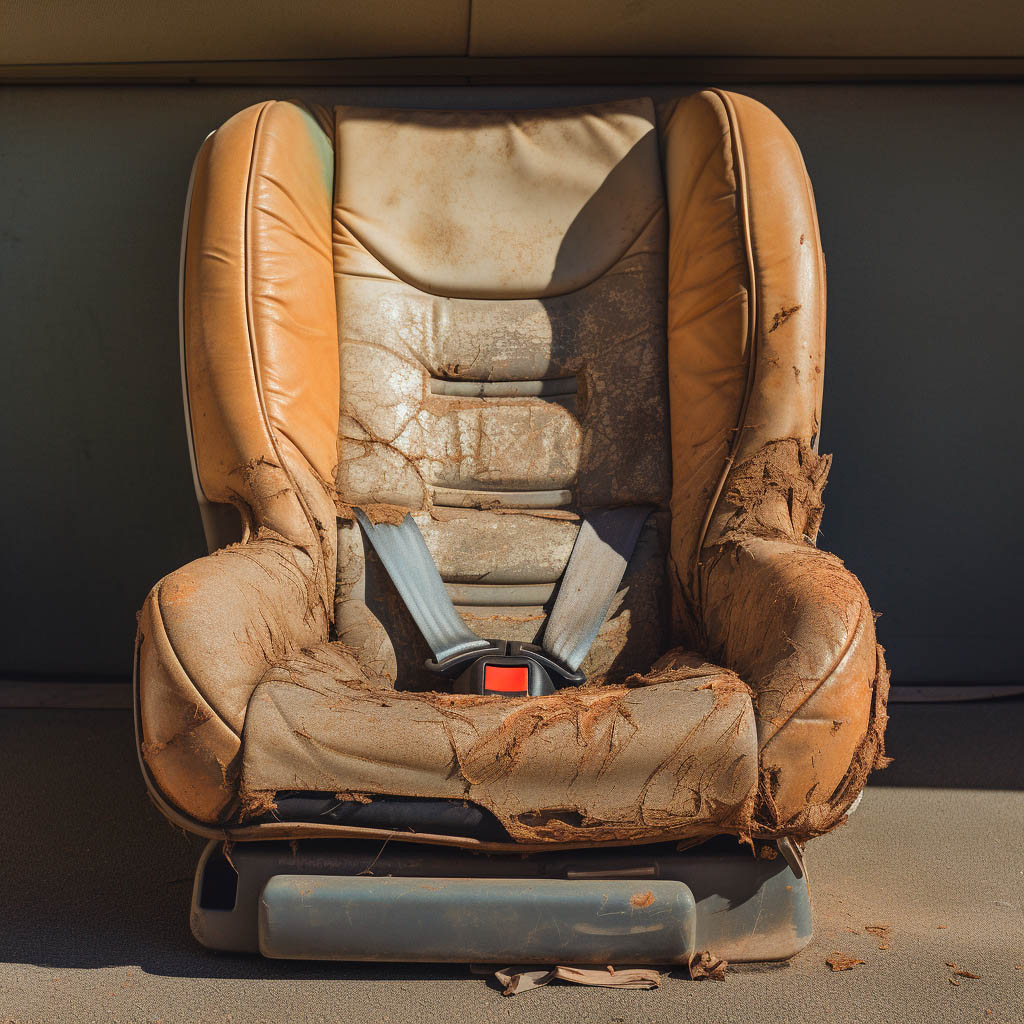
Do not use a seat with a cut harness, broken buckle, cracked shell, loose parts, or missing labels. Replacement parts must come from the manufacturer or an approved source. Homemade repairs can change how the seat works in a crash.
Step 2: Decide whether to donate or sell it
You may donate or sell an old car seat only if it is unexpired, never involved in a crash, not recalled, clean, complete, and supported by its original instructions.
When donation may be reasonable
A clean and current car seat may be accepted by:
- A local family resource center
- A domestic violence support program
- A church or community group
- A hospital or public health program
- A child passenger safety program
- A local parenting organization
Call first. Many groups do not accept used car seats because they cannot verify the seat’s history.
When offering the seat, tell the recipient:
- The model name and number
- The manufacture date and expiration date
- Whether it has ever been in a crash
- Whether it has been recalled
- Whether all parts and the manual are included
- How it was cleaned
Do not hide damage or an unknown history. A low-cost or free seat is not helpful if its safety history is unclear.
When selling may be a poor choice
Online marketplaces can make it hard to verify who owned the seat or how it was stored. A seller may not know that the seat was in a crash, recalled, or exposed to heat and damage.
If you sell it, provide clear photos of the labels and disclose the full history. Never sell a seat that is:


- Expired
- Recalled without a completed remedy
- Damaged
- Missing safety parts
- From an unknown source
- Involved in a crash
- Missing the model or date label
Some states, cities, charities, and retailers may have their own rules. Check before listing the seat.
Do not donate a seat with an unknown history
This is one of the most important limits. A seat from a yard sale, thrift store, or online listing may have no reliable history. It could have been in a crash or stored in conditions that damaged it.
If you cannot verify its history, treat it as unsafe for reuse. Recycle it or make it unusable before disposal.

Step 3: Recycle the car seat if your area accepts it
Car seat recycling is available in some parts of the United States, but it is not offered everywhere. A car seat contains several materials, including plastic, foam, fabric, and metal. Local programs must decide whether they have the equipment and staff to separate those materials.
Try these options:
- Contact your city or county solid-waste department. Ask if it accepts child safety seats.
- Check your recycling facility’s accepted-items list. Do not place a car seat in your curbside recycling bin unless the program clearly allows it.
- Call the manufacturer. Some makers provide recycling or take-back guidance.
- Ask hospitals, fire departments, and child passenger safety programs. Some run seasonal collection events.
- Search for a local household recycling event. These events may accept bulky plastic items that normal curbside service does not.
Do not assume that a store accepts old car seats. Retail programs can start, end, or change by location. Confirm the details before you drive there.
How to prepare a car seat for recycling
Follow the recycling program’s instructions first. If it tells you to bring the complete seat, do not take it apart.
If no program accepts the seat and local rules allow disposal, make it clearly unusable:
- Remove the cover and padding.
- Cut the harness straps.
- Remove or break the buckle if you can do so safely.
- Write “DO NOT USE—EXPIRED” or “UNSAFE—DO NOT USE” on the shell.
- Place the parts in a trash bag or follow your local bulky-waste rules.
The goal is to stop another person from finding the seat and using it for a child. Do not leave an unsafe seat beside a dumpster or at a donation center.
Why curbside recycling is usually not the right place
Most curbside programs are designed for items such as bottles, cans, paper, and certain containers. A car seat can jam sorting equipment or contaminate a load.
Even when the shell is plastic, its shape and mixed materials may make it unsuitable for standard recycling. Check the rules for your exact city or county.

Step 4: Dispose of an unsafe car seat correctly
If you cannot recycle the seat, dispose of it in a way that prevents reuse.
An unsafe car seat should not be:
- Donated
- Sold
- Left on the curb with a “free” sign
- Given to a friend “for emergencies”
- Placed in a thrift-store donation bin
- Used as a backup seat


To prepare it for disposal, remove the fabric, cut the harness, damage the buckle, and mark the shell. You may need to use household tools. Wear gloves and eye protection if you cut hard plastic or metal.
Then check your local solid-waste rules. Some communities require:
- A bulky-item appointment
- A special drop-off site
- A bag or tag
- A scheduled trash day
- A limit on large plastic items
Rules differ across the United States. Your city, county, or waste hauler is the best source for the final disposal step.

Can you reuse the fabric, foam, or base?
Reuse only parts that the manufacturer says can be removed and replaced. Do not use car seat parts for another safety purpose unless the manufacturer approves that use.
You may be able to reuse the cover as fabric for a craft project, but it should not return to a child safety seat unless it is the correct replacement cover. Do not replace the original padding with household foam. Different foam types can change the fit and crash performance.
A separate infant car seat base should not be passed on by itself unless you know:
- The exact seat model it fits
- Its expiration date
- Its crash history
- Its recall status
- That it has all required parts
A base from the wrong model may appear to click into place but still be unsafe.

What to do with an old booster seat
Booster seats also have expiration dates and model-specific instructions. They may not have a five-point harness, but they still guide the vehicle seat belt and protect a child during a crash.
Treat an old booster seat like any other child restraint:
- Check the expiration date.
- Check for recalls.
- Inspect the shell and belt guides.
- Replace it after a crash when required.
- Do not donate it if the history is unknown.
- Follow local recycling or disposal rules.
A backless booster may be smaller and easier to discard, but it should still be made unusable if it is unsafe. Cut or remove key parts and label it clearly.

Common mistakes to avoid
Do not rely on appearance alone
A clean seat may still be expired, recalled, or damaged. Safety checks depend on the model, date, history, and condition.
Do not wash parts against the manual
Some harness straps should not be soaked, bleached, machine-washed, or treated with strong cleaners. These actions may weaken the webbing.


Clean the seat only as directed in the manual. If you no longer have the manual, look for the manufacturer’s instructions online.
Do not use replacement parts from another brand
A buckle or harness may look similar but work differently. Use only parts approved for that exact seat.
Do not assume a minor crash is always harmless
The NHTSA minor-crash conditions are specific. If even one condition is not met, replace the seat or ask the manufacturer for guidance.
Do not give away a seat just because someone needs one
Helping another family is a good goal, but an unsafe seat creates risk. A certified child passenger safety technician or local program may help the family find a safe option.

A simple decision guide
Use this short sequence:
Is the seat expired?
If yes, recycle or dispose of it. Do not donate or sell it.Was it in a moderate or serious crash?
If yes, replace it and dispose of the old seat.Was it in a minor crash?
Compare the crash with NHTSA’s five minor-crash conditions and check the manual.Is it recalled?
Stop use and follow the manufacturer’s remedy.Is the history unknown?
Do not give it to another family. Make it unusable and dispose of it.Is it current, complete, clean, and never crashed?
Ask a local charity or program whether it accepts the seat.Does your local recycler accept it?
Follow that program’s preparation rules. Never place it in curbside recycling without permission.
Frequently asked questions
Can I put an old car seat in the trash?
Yes, if local waste rules allow it, but first make the seat unusable. Cut the harness, damage or remove the buckle, remove the cover, and mark the shell. Check with your city, county, or waste company for bulky-plastic rules.
Can I donate an expired car seat?
No. An expired car seat should not be donated for child use. Contact a recycling program or dispose of it after making it unusable.
Can I recycle a car seat at Target or Walmart?
Do not assume that a specific retailer accepts car seats. Collection events and store programs can change by date and location. Check the retailer’s current program page or call the store before going.
Can I sell a used car seat?
You can consider selling one only if it is unexpired, not recalled, complete, clean, and never involved in a crash. Provide the model, date, manual, and full history. Do not sell a seat with unknown history or missing labels.
What if I do not know whether the car seat was in a crash?
Treat the history as unknown. Do not use, donate, or sell the seat for child travel. Make it unusable and follow local disposal or recycling rules.
Where can I find help checking a car seat?
A certified child passenger safety technician may help with inspection, installation, and questions about the seat’s condition. Find a local technician through NHTSA’s child passenger safety resources.
Final recommendation
Start by checking the car seat’s expiration date, recall status, crash history, and parts. If any of those checks fail, do not pass the seat to another child. Ask your local waste department or recycling facility about accepted options, and make the seat unusable before disposal if recycling is not available.
For a current, complete seat with a known history, contact a local child safety program before donating or selling it.
