

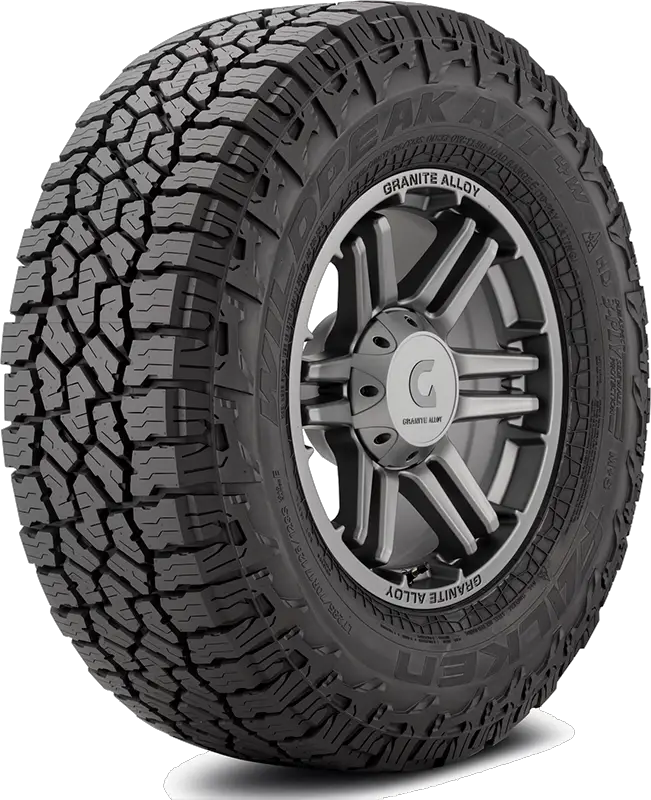
For most drivers in the United States, the Falken Wildpeak A/T4W is one of the longest-lasting true all-terrain tires available. Falken lists a treadwear warranty of up to 65,000 miles, depending on the tire size and rating.
That does not mean every A/T4W will last 65,000 miles. Load, alignment, inflation, rotation, road type, climate, and driving style all matter. A less aggressive tire, such as the Michelin Defender LTX M/S2, may last longer on pavement, but it is better described as a highway all-season tire than a traditional off-road all-terrain tire.
If you need one tire for an American pickup, SUV, or Jeep that sees both pavement and dirt, the Falken Wildpeak A/T4W is the strongest starting point. If maximum highway mileage matters more than off-road traction, consider a highway-terrain tire instead.
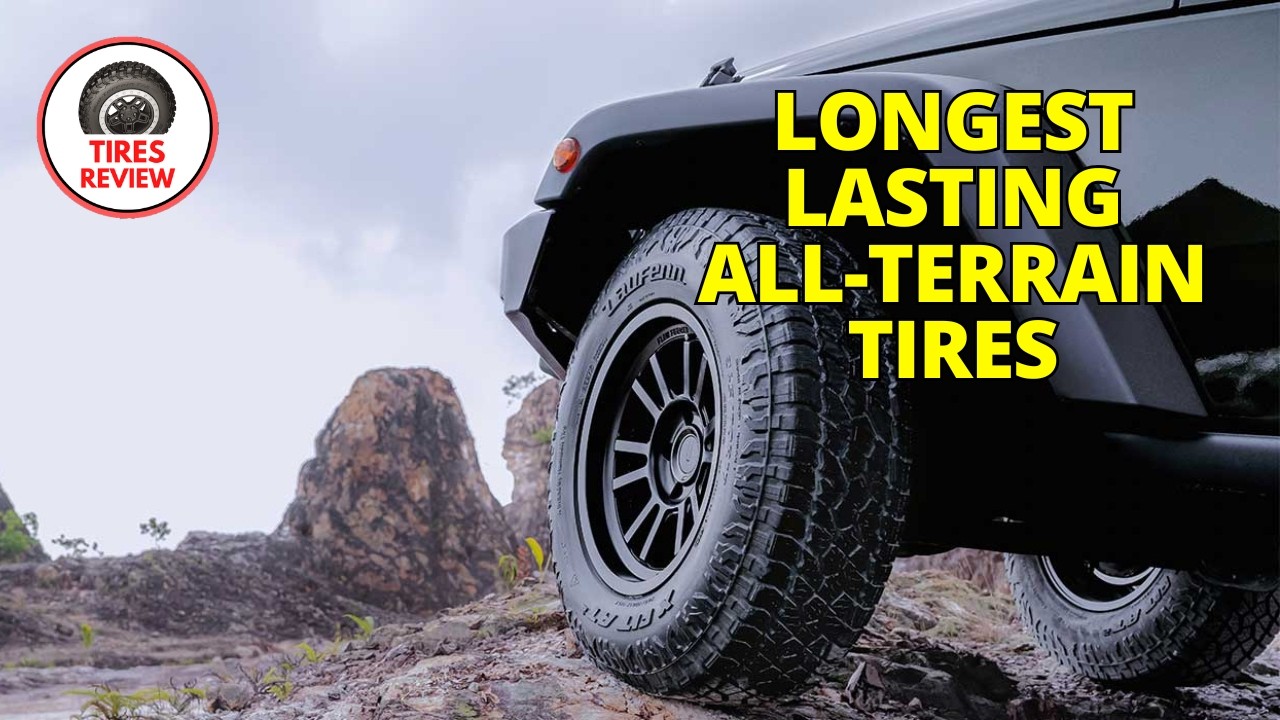
Quick answer: Which all-terrain tire lasts the longest?
The longest-lasting all-terrain tire depends on how you define “lasts longest.”
| Tire | Type | Advertised treadwear warranty* | Best use |
|---|---|---|---|
| Falken Wildpeak A/T4W | True all-terrain | Up to 65,000 miles | Mixed highway, gravel, snow, and light trails |
| Cooper Discoverer AT3 4S | Mild all-terrain | Up to 65,000 miles | Mostly pavement with occasional dirt |
| Toyo Open Country A/T III | All-terrain | Up to 65,000 miles on some fitments | Highway and moderate off-road use |
| General Grabber A/TX | All-terrain | Up to 60,000 miles | Snow, gravel, mud, and trail use |
| BFGoodrich All-Terrain T/A KO3 | Aggressive all-terrain | Up to 50,000 miles | Rough trails and severe-duty use |
| Michelin Defender LTX M/S2 | Highway all-season | Up to 70,000 miles on qualifying fitments | Mostly pavement |
*Warranties vary by size, load range, speed rating, and vehicle application. Always check the current warranty document for the exact tire.
The key point is simple: the highest mileage warranty does not automatically identify the most durable tire in real life. A tire with a softer, more aggressive tread can offer better trail grip but wear faster on dry pavement.
What makes an all-terrain tire last a long time?
A long-lasting all-terrain tire needs a stable tread design, a durable casing, and correct use. The tread must resist uneven wear while still leaving enough open space to clear mud, gravel, and snow.
Several factors have the largest effect:
- Tread compound: Harder compounds often wear slowly but may give up some wet or cold-weather grip.
- Tread depth: More tread can provide a longer service life, but depth alone does not predict mileage.
- Tread pattern: Large, staggered blocks help off-road traction but can wear unevenly if the tire is not rotated.
- Casing strength: A strong casing helps resist damage from rocks and sharp trail surfaces.
- Vehicle weight: Heavy trucks and SUVs place more stress on the tread.
- Alignment: Incorrect toe or camber can destroy a set of tires in a short time.
- Inflation pressure: Both overinflation and underinflation can cause poor wear.
- Driving surface: Asphalt usually creates more heat and abrasion than clean gravel.
- Driving style: Hard braking, fast cornering, and rapid acceleration increase wear.
A useful rule is this: the more a tire is built for deep mud, rocks, and heavy loads, the harder it may be to achieve very high highway mileage.

Best long-lasting all-terrain tires in the United States
1. Falken Wildpeak A/T4W: best overall for long life and true all-terrain use
The Falken Wildpeak A/T4W is a strong choice for drivers who want a real all-terrain tread without giving up too much road comfort. Falken offers the tire in a broad range of sizes for pickups, SUVs, and Jeeps.
Its main advantages are:
- Up to a 65,000-mile limited treadwear warranty on qualifying applications
- Severe Snow Service rating on qualifying sizes
- Strong sidewall options
- Good traction on gravel, dirt, and snow
- A tread design that remains useful for daily driving
The A/T4W is not the lightest or quietest tire in its class. Larger LT sizes can also reduce fuel economy and may ride more firmly. Still, it offers one of the best balances between mileage, winter traction, and trail ability.
Best for: Drivers who use their truck or SUV on pavement most days but regularly travel on gravel, dirt roads, snow, or mild trails.
2. Cooper Discoverer AT3 4S: best for mostly paved roads
The Cooper Discoverer AT3 4S is a mild all-terrain tire designed around highway comfort and long wear. It is less aggressive than the Falken Wildpeak A/T4W, so it generally makes more sense for daily drivers than for rocky trails.
The tire may be a good fit when you want:
- A long treadwear warranty
- Low road noise
- Good wet-road handling
- Light snow performance
- Occasional use on gravel and maintained dirt roads
Its limitation is the same feature that helps it last on pavement: the tread is not as open or rugged as a severe off-road tire. It is not the first choice for deep mud, sharp rocks, or frequent trail work.
Best for: Pickup and SUV owners who spend most of their time on American highways and city roads.
3. Toyo Open Country A/T III: best for a balanced truck setup
The Toyo Open Country A/T III is another established all-terrain option. Depending on the fitment, Toyo lists warranties of up to 65,000 miles.
It is known for a balanced design that works on:
- Dry pavement
- Wet roads
- Gravel
- Dirt
- Light mud
- Snow-covered roads
Toyo offers many sizes, including options for full-size pickups and heavier truck applications. Some LT versions may have a lower warranty than passenger-rated versions. Buyers should compare the exact size and load range rather than relying on the model name alone.
Best for: Drivers who want a broad size range and a tire that can handle both work use and regular road travel.
4. General Grabber A/TX: best when snow and trail traction matter
The General Grabber A/TX uses a more open tread than many mild all-terrain tires. It can provide useful grip on snow, loose dirt, and uneven ground while still working as a daily road tire.
Its strengths include:
- Strong winter and loose-surface traction
- Durable sidewall construction
- Many truck and SUV sizes
- A long limited treadwear warranty on qualifying fitments
The trade-off is that aggressive tread blocks can create more noise and may wear faster if the vehicle has poor alignment or spends all of its time on hot asphalt.
Best for: Drivers in areas with snow, gravel roads, hunting roads, and occasional off-road travel.
5. BFGoodrich All-Terrain T/A KO3: best for harsh trail use
The BFGoodrich All-Terrain T/A KO3 is designed for drivers who place more value on off-road durability than on the longest possible highway life. It is a natural choice for rock, dirt, worksite, and trail use.
Its design focuses on:
- Sidewall protection
- Tough trail use
- Loose-surface traction
- Heavy-duty pickup and SUV applications
- Severe Snow Service capability on qualifying sizes
Its advertised mileage warranty is lower than several road-focused all-terrain tires. That does not make it a poor tire. It reflects a different priority: the KO3 is built to withstand more abuse than a mild all-terrain tire.
Best for: Drivers who frequently leave pavement and need stronger off-road protection.

Is the Michelin Defender LTX M/S2 the longest-lasting tire?
The Michelin Defender LTX M/S2 may offer a higher mileage warranty than many all-terrain tires. However, it is primarily a highway all-season tire, not a traditional open-tread all-terrain tire.
It is usually better for drivers who need:
- Long pavement life
- Quiet highway travel
- Good wet-road behavior
- Stable towing manners
- Occasional gravel-road use
It is less suitable for:
- Deep mud
- Loose rock
- Steep dirt trails
- Frequent sidewall contact
- Serious off-road driving
This distinction matters because “all-terrain” is often used loosely in tire searches. A highway-terrain tire may last longer because its tread is optimized for smooth roads. That does not mean it will perform better on a trail.
Choose the Defender LTX M/S2 when road mileage is your main goal. Choose a true A/T tire when you need regular off-road traction.
How long should an all-terrain tire last?
A realistic service life for an all-terrain tire is often 40,000 to 65,000 miles, but that range is only a planning guide. Some tires wear out sooner, while carefully maintained tires may go farther.
Consider this example:
- A tire has a 60,000-mile warranty.
- The truck carries heavy loads.
- The driver uses aggressive acceleration.
- The tires are rotated late.
- The alignment is slightly incorrect.
That tire may not reach the warranty mileage. The warranty is a limited adjustment program, not a promise that the tire will last for that number of miles.
A tire’s usable life can also end before the tread is fully worn. Replace a tire if it has:
- Cracks between tread blocks or on the sidewall
- Bulges or bubbles
- Exposed cords
- Repeated air loss
- Serious cuts
- Uneven wear that cannot be corrected
- Tread depth at or near the legal or manufacturer limit
In the United States, state rules can differ. The National Highway Traffic Safety Administration advises replacing tires when tread is worn to 2/32 inch, and many tire makers recommend replacement sooner when wet or winter performance has declined.
Treadwear warranty versus real-world tire life
A treadwear warranty is useful for comparison, but it is not a laboratory ranking of durability.
Manufacturers set warranty terms under their own conditions. The coverage may require:
- Regular tire rotation
- Proof of maintenance
- Correct inflation
- Proper alignment
- Use on the original vehicle
- Replacement before a specified wear limit
- A prorated adjustment rather than a free replacement
Warranty mileage may also differ between P-metric and LT tires. A P-metric tire is often lighter and may ride more softly. An LT tire may carry more weight and resist damage better, but it can wear faster and use more fuel.
For that reason, compare tires in the same:
- Tire size
- Load range
- Vehicle type
- Road use
- Climate
- Driving pattern
A 65,000-mile warranty on a passenger-rated tire is not a direct comparison with a 50,000-mile warranty on a heavy-duty LT tire used on a work truck.
How to choose the longest-lasting all-terrain tire for your truck
Use your actual driving pattern rather than the most aggressive-looking tread.
Choose a mild all-terrain tire if:
- You drive on pavement most of the time.
- You use gravel roads from time to time.
- You want lower noise.
- You care about fuel economy.
- You want the best chance of reaching a high mileage warranty.
Good examples include the Cooper Discoverer AT3 4S and Toyo Open Country A/T III.
Choose a balanced all-terrain tire if:
- You drive daily on pavement.
- You regularly use dirt or gravel roads.
- You see snow.
- You want more sidewall protection.
- You still want a long treadwear warranty.
The Falken Wildpeak A/T4W is a strong fit for this use.
Choose an aggressive all-terrain tire if:
- You drive on rocky trails.
- You work at construction sites or remote locations.
- You need more sidewall protection.
- You accept extra noise and fuel use.
- You care more about damage resistance than maximum mileage.
The BFGoodrich All-Terrain T/A KO3 may make more sense here.
Before buying, confirm that the tire’s load index, speed rating, size, and load range meet or exceed the vehicle manufacturer’s requirements. The correct information is on the driver’s door-jamb label and in the owner’s manual.

How to make all-terrain tires last longer
Even the best long-lasting all-terrain tire can wear quickly without basic care.
Check pressure when the tires are cold
Use the pressure on the vehicle’s door-jamb label, not the maximum pressure printed on the tire sidewall. Check pressure at least once a month and before long trips.
Do not lower pressure for off-road driving unless you understand the risks. Reduced pressure can improve traction at low speed, but it can also increase sidewall damage and tire heat. Reinflate to the road setting before returning to pavement.
Rotate the tires on schedule
Most vehicles need rotation about every 5,000 to 8,000 miles, but the vehicle and tire maker may specify a different interval. Follow the schedule in the owner’s manual.
Directional tires and staggered fitments may need a special rotation pattern. Ask a tire professional if the front and rear sizes differ.
Check alignment after impacts
A hard pothole or trail impact can change alignment. Watch for:
- Pulling to one side
- A crooked steering wheel
- Feathered tread blocks
- Wear on one shoulder
- Vibration at highway speed
Fixing alignment early can save a complete set of tires.
Keep the vehicle within its weight limits
Overloading increases heat and stress. Check the vehicle payload rating before carrying tools, cargo, passengers, or a trailer load.
Match the tire to the road
Using a heavy, aggressive LT tire only for city driving can increase cost, noise, and fuel use without adding useful performance. Using a highway tire on rocky trails can increase the risk of cuts and punctures.

Common mistakes that shorten all-terrain tire life
Buying the largest tire that fits
A larger tire may rub suspension parts or body panels. It may also change the speedometer reading, reduce acceleration, increase steering effort, and place more stress on wheel bearings.
Check fitment before purchase. A lift kit does not automatically make every tire size safe.
Mixing different tire models
Mixing tread patterns can change handling, braking, and four-wheel-drive behavior. On many four-wheel-drive and all-wheel-drive vehicles, the tires need closely matched rolling circumferences.
Follow the vehicle maker’s instructions. Some systems may be damaged by large differences in tire diameter.
Running a tire at maximum sidewall pressure
The number molded into the sidewall is usually the tire’s maximum rated pressure, not the correct pressure for every vehicle. Use the vehicle placard unless a qualified tire professional gives a specific reason to change it.
Ignoring small vibrations
A vibration can come from a balance problem, bent wheel, tire separation, suspension wear, or alignment issue. Continued driving without inspection can make the problem worse.
Treating a warranty as a guarantee
A warranty does not cover every cause of early wear. It may exclude punctures, impact damage, irregular wear, misuse, racing, commercial use, or incorrect maintenance.
Read the warranty for the exact tire before using mileage as the main buying factor.
Frequently asked questions
What is the best all-terrain tire for high mileage?
The Falken Wildpeak A/T4W is one of the best high-mileage choices among true all-terrain tires. It offers a strong balance of warranty coverage, road manners, snow traction, and trail ability. A highway tire may last longer on pavement but will not provide the same off-road performance.
Are all-terrain tires good for highway driving?
Yes. Most modern all-terrain tires are designed for highway use. They may be noisier, heavier, and less fuel-efficient than highway-terrain tires. Check the tire’s speed rating and load rating before purchase.
Do LT all-terrain tires last longer than P-metric tires?
Not always. LT tires usually have stronger construction and higher load capacity, but they can be heavier and may wear faster on a light SUV. The vehicle, load, pressure, alignment, and driving surface matter more than the letters alone.
Which all-terrain tire is best for snow?
Look for the Three-Peak Mountain Snowflake, also called the Severe Snow Service symbol. It shows that the tire passed a defined snow-traction test. Not every all-terrain tire has this marking, and the marking does not make the tire equal to a dedicated winter tire on ice.
Can I use an all-terrain tire for towing?
Many all-terrain tires can tow when they have the correct load rating and are inflated properly. Do not exceed the vehicle’s payload, axle, tongue-weight, or trailer limits. A tire shop can confirm whether a specific tire size and load range fit the towing job.
When should I replace an all-terrain tire?
Replace it when the tread reaches the vehicle or tire maker’s limit, commonly 2/32 inch as the legal minimum in many situations, or sooner if wet or snow traction has dropped. Replace it immediately for a bulge, exposed cord, major cut, separation, or repeated air loss.
Research basis and limits
The mileage figures in this guide are based mainly on manufacturer warranty information and product specifications from:
- [Falken Wildpeak A/T4W warranty and product information](https:// FalkenTire.com)
- Cooper Tires warranty information
- Toyo Tires warranty information
- General Tire warranty information
- BFGoodrich warranty information
- Michelin North America warranty information
- NHTSA tire safety guidance
Manufacturer warranty claims are not the same as independent, long-term testing. Tire versions, sizes, load ranges, and warranty terms can change. Confirm the exact details for your vehicle and tire size before buying.
Bottom line
For a true all-terrain tire with a strong chance of long service life, start with the Falken Wildpeak A/T4W. The Cooper Discoverer AT3 4S and Toyo Open Country A/T III are also strong choices when highway mileage matters more than aggressive trail grip.
If you drive almost entirely on pavement, a highway tire such as the Michelin Defender LTX M/S2 may last longer and ride more quietly. If you frequently drive rocky trails, accept that a tougher all-terrain tire may give up some mileage in exchange for better protection.
The best next step is to check your truck’s door-jamb label, identify the required tire size and load range, and then compare warranties only among tires that meet those requirements.
