

Introduction
Most kids stop using a car seat or booster between ages 8 and 12. But age alone does not decide when a child can use a seat belt. In the United States, the safer choice depends on the child’s size, the car seat limits, and whether the vehicle belt fits well.
A child should move through these stages:
- Rear-facing car seat
- Forward-facing car seat with a harness
- Belt-positioning booster seat
- Vehicle seat belt alone
The final step is safe only when the child passes the full seat belt fit test. Many children are not ready at age 8. Some need a booster until age 10, 11, or 12.


This guide explains when kids can stop using car seats, how to check seat belt fit, what U.S. laws require, and which common mistakes to avoid.

The short answer: When can a child stop using a car seat?
A child can stop using a booster when the vehicle’s seat belt fits correctly without help from the booster. This often happens when the child is about 4 feet 9 inches tall, usually between 8 and 12 years old.
The seat belt should:
- Rest low across the hips and touch the upper thighs.
- Cross the middle of the chest and shoulder.
- Stay on the shoulder, not the neck or face.
- Let the child sit all the way back against the vehicle seat.
- Let the child bend their knees at the seat edge.
- Let their feet rest flat on the floor.
- Stay in the right position for the whole trip.
If the child cannot meet every point, they should keep using a booster seat.
The American Academy of Pediatrics, or AAP, and the National Highway Traffic Safety Administration, or NHTSA, advise parents to use each restraint stage until the child reaches the seat’s height or weight limit. These groups do not set one universal age for leaving a car seat.
A booster is still a type of child passenger restraint. It raises the child so the adult seat belt can protect the strongest parts of the body.

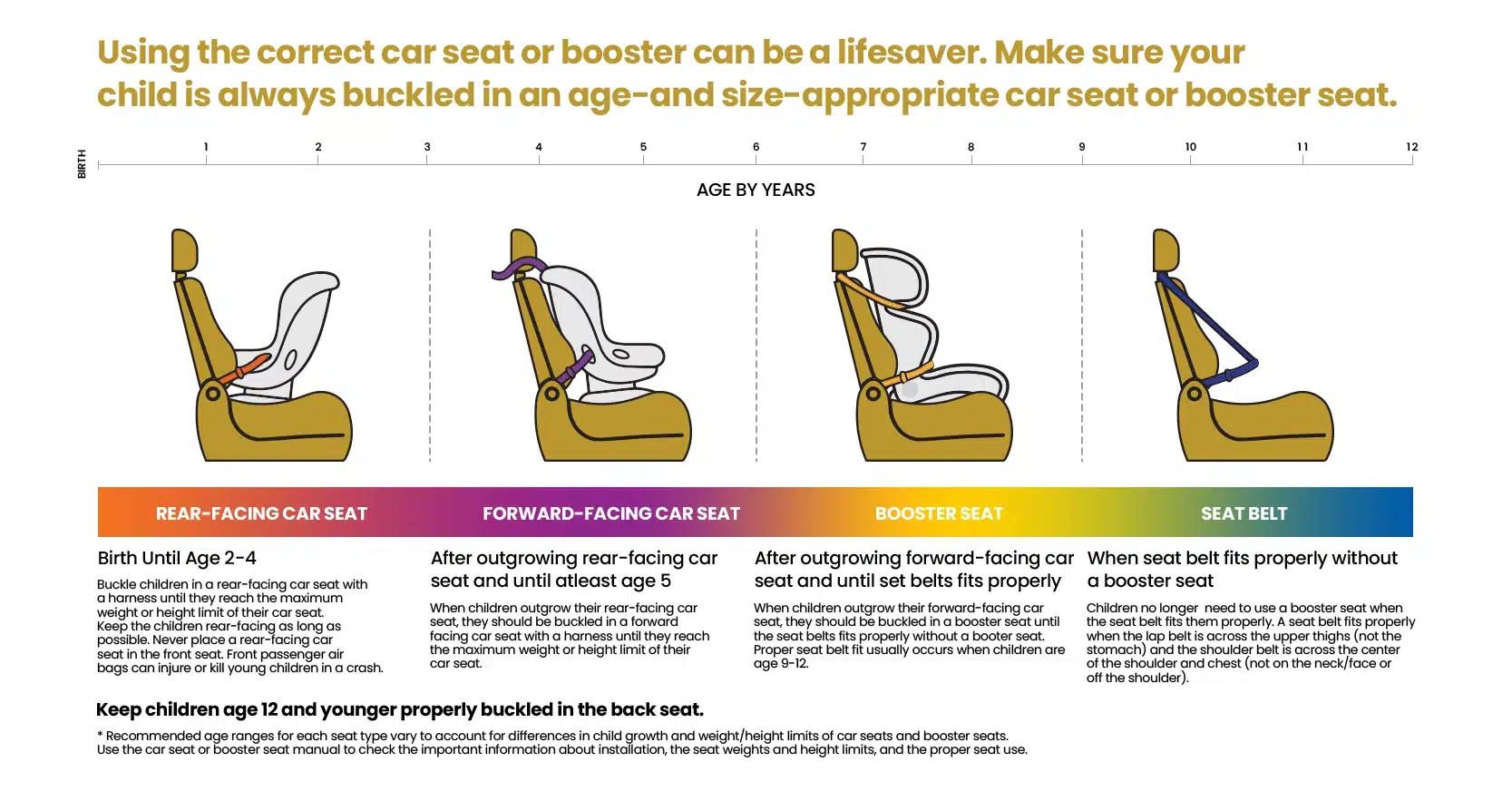
The four car seat stages in the United States
Children should move to the next stage because they outgrow the current restraint, not because they reach a certain birthday.
1. Rear-facing car seat
Babies and young children should ride in a rear-facing seat. Keep the seat rear-facing for as long as possible, up to the height or weight limit set by the manufacturer.
Rear-facing seats support a young child’s head, neck, and spine during a crash. A child may use an infant seat or a convertible seat in the rear-facing position.
Do not turn a child forward-facing just because their feet touch the vehicle seat. Bent legs are not, by themselves, a reason to turn the seat around.
2. Forward-facing car seat with a harness
When a child reaches the rear-facing limit, use a forward-facing seat with an internal harness and top tether. Keep using it until the child reaches the forward-facing height or weight limit.


The harness should pass through the slots set by the seat manual. It should lie flat and snug on the child’s body. Bulky coats can create extra space under the harness, so place a blanket over the buckled harness instead.
The top tether helps limit forward movement in a crash. Use it as the vehicle and car seat manuals direct.
3. Belt-positioning booster seat
After a child outgrows the forward-facing harness, the next step is usually a belt-positioning booster. The booster uses the vehicle’s lap-and-shoulder belt. It does not replace the belt.
A high-back booster can provide head and shoulder support. A backless booster may work when the vehicle seat has a head restraint and the belt fits correctly. The booster manual and vehicle manual control the details.
Use a booster for every ride. Short trips still carry crash risk.
4. Seat belt alone
A child may stop using a booster when the seat belt passes the full fit test. The child must also sit correctly without slouching, leaning, or moving the belt behind the back.
The child should ride in the back seat until at least age 13 when possible. The back seat offers more protection for most children.

How to perform the seat belt fit test
The seat belt fit test is the best way to decide when a child can stop using a booster. Test the child in the vehicle where they will ride most often. Belt fit can change from one vehicle to another.
Use these five checks:
1. Check the lap belt
The lap belt must lie low and flat across the child’s upper thighs or hips. It should not rest on the stomach.
A belt across the stomach can place force on soft organs during a crash. A booster helps guide the belt lower on the body.
2. Check the shoulder belt
The shoulder belt must cross the center of the chest and shoulder. It should not touch the neck. It should not fall off the shoulder.
Never place the shoulder belt behind the child’s back or under the arm. Those positions can cause serious injury in a crash.
3. Check the child’s back
The child must sit with their back against the vehicle seat. They should not lean forward to reach the belt or slouch under it.
If the child needs to lean forward to see out, they may still need a booster.
4. Check the knees and feet
The child’s knees should bend naturally at the edge of the vehicle seat. Their feet should reach the floor or a safe footrest.


A child who slides forward to bend their knees may not fit the belt well.
5. Check behavior
The child must stay in the correct position for the full ride. They should not move the shoulder belt, lean sideways, or tuck the lap belt under the stomach.
If the child cannot sit properly every time, continue using a booster.
If even one test fails, the child is not ready to stop using a booster.

Does a child’s age, height, or weight decide the answer?
Age, height, and weight all matter, but none gives the answer by itself.
Age
Many children leave boosters between ages 8 and 12. This is only a general range. A younger child may pass the fit test in one vehicle but not another. An older child may still need a booster if the belt sits too high or slips off the shoulder.
Height
The common 4-foot-9-inch guideline is a useful estimate. It is not a safety test by itself.
A child who is 4 feet 9 inches tall may still need a booster if the vehicle seat belt does not fit. A shorter child may fit well in some vehicles, but the full test still matters.
Weight
Weight is important when choosing a car seat or booster that has a stated weight range. It does not prove that an older child is ready for a seat belt alone.
The belt must fit the child’s body. Body weight by itself cannot show that the belt is in the right place.
Car seat limits
Every car seat and booster has limits. Check the labels and instructions for:
- Maximum forward-facing height
- Maximum forward-facing weight
- Minimum and maximum booster weight, if listed
- Minimum age, if listed
- Whether the seat requires a lap-and-shoulder belt
- Whether the seat can be used with a specific vehicle seat position
When the child reaches a limit, change to the next safe stage. Do not keep using a seat beyond its stated limits.

What do U.S. car seat laws require?
Car seat laws vary by state. They may set minimum ages, weights, or requirements for rear-facing seats, forward-facing seats, boosters, and seat belts.
State law is a legal minimum. It may not be the safest stopping point for every child.


Check your state’s current law through your state’s transportation or public safety agency. NHTSA also provides child passenger safety information and links to state requirements. Law changes can occur, so avoid relying on an old chart or social media post.
A state may allow a child to use a seat belt at an age when the belt still does not fit well. Parents can continue using a booster when the law allows a seat belt but the child fails the fit test.
Also check special rules for:
- The front seat
- Taxis and rideshare vehicles
- School buses
- Camp vans
- Children with medical needs
- Vehicles without lap-and-shoulder belts
For a legal question tied to a custody order, school policy, or unusual vehicle, ask the proper state agency or a qualified professional.
How to know whether a booster is the right next step
A booster is usually the right next step when a child has outgrown the forward-facing harness but does not pass the seat belt fit test.
Look for these signs:
- The child’s shoulders or ears reach the top limit of the harness seat.
- The child exceeds the harness weight limit.
- The harness no longer fits according to the manual.
- The child can sit upright but the seat belt rests on the neck or stomach.
- The child’s knees do not bend at the seat edge.
- The child slides down or leans to make the belt feel comfortable.
Do not move directly from a forward-facing harness to a seat belt just because the child has reached a certain age. The harness seat and the vehicle belt do different jobs.
A booster does not restrain the child with its own harness. It positions the child so the vehicle belt can work as designed.

Common mistakes that make car travel less safe
Several mistakes appear often in child passenger safety checks.
Turning a child forward-facing too soon
A child’s legs touching the vehicle seat does not mean the rear-facing seat is too small. Follow the seat’s rear-facing limits.
Moving to a booster too soon
A forward-facing harness may still be appropriate when a child is not ready to sit properly with a booster and seat belt.
Stopping booster use by age 8
Age 8 is not a universal finish line. Use the five-part belt fit test.
Using the shoulder belt behind the back
This can leave the upper body without proper restraint. Keep the shoulder belt across the chest and shoulder.
Letting the lap belt sit on the stomach
The lap belt should sit low on the hips and upper thighs. A booster may be needed to achieve this fit.
Adding unapproved accessories
Aftermarket belt guides, inserts, covers, and cushions can change how the restraint works. Use only parts approved by the car seat or vehicle maker.


Ignoring the top tether
When a forward-facing seat allows or requires a top tether, use it as directed. Read both the car seat and vehicle manuals.
Using a damaged or expired seat
Replace a seat after a moderate or severe crash unless the manufacturer says it may be reused under specific conditions. Replace a seat with missing parts, damage, or an unknown history.
Car seats also have expiration dates. The date and replacement rules vary by manufacturer. Check the label or manual.
Buying a used seat without its history
A used seat may have been in a crash, recalled, stored poorly, or missing key parts. If you cannot confirm its history and instructions, choose a different seat.

How to check and install a child restraint
A safe restraint needs both the right stage and a good installation.
- Read the car seat manual. Find the height, weight, belt path, harness, and tether rules.
- Read the vehicle manual. Check approved seating positions, lower anchors, seat belts, and tether points.
- Choose one installation method. Use the lower anchors or the vehicle seat belt as allowed. Do not use both unless both manuals permit it.
- Use the top tether for a forward-facing seat when required or allowed by the instructions.
- Tighten the installation. The seat should not move more than about 1 inch side to side or front to back when checked at the belt path. This common installation check does not replace the manuals.
- Tighten the harness. The straps should lie flat and snug. Do not leave slack at the child’s shoulders.
- Check the chest clip. It should sit at armpit level when the seat has one.
- Get help if needed. A certified Child Passenger Safety Technician can check the installation.
NHTSA offers a directory for finding child passenger safety inspection stations and events. Availability varies by location, so check before traveling.

What changes when children ride with other adults?
The same restraint rules apply when a child rides with a grandparent, babysitter, friend, or rideshare driver. A child should not use a seat belt alone in another car unless the belt passes the fit test in that vehicle.
Keep the car seat manual with the seat when possible. Show the other driver how to buckle the child and where the seat should go.
For carpools, plan ahead. A child may need a booster in one vehicle but not another. A small car, a deep seat, or a different belt path can change the fit.
For air travel, check the car seat label for aircraft approval. A booster usually cannot be used on an airplane because airplanes do not have shoulder belts. The airline and Federal Aviation Administration rules may affect which child restraint can be used.
When should you replace a car seat or booster?
Replace a child restraint when:
- It has reached the manufacturer’s expiration date.
- It was involved in a crash that meets the manufacturer’s replacement guidance.
- It has visible cracks, broken parts, damaged straps, or missing labels.
- You cannot identify the model or instructions.
- You cannot confirm that it has never been in a crash.
- The manufacturer or NHTSA lists a recall that has not been fixed.
Register the seat with the manufacturer. Registration helps the maker send recall notices.
A recall does not always mean the whole seat must be discarded. Follow the manufacturer’s repair or replacement instructions. Do not rely on a general internet post for a model-specific recall decision.


Quick decision table
| Child’s situation | Usual next step |
|---|---|
| Still within rear-facing height and weight limits | Keep riding rear-facing |
| Has outgrown rear-facing limits | Use a forward-facing harness seat |
| Has outgrown the forward-facing harness | Use a belt-positioning booster |
| Passes every seat belt fit check | Seat belt alone may be appropriate |
| Passes in one car but not another | Use the booster in the vehicle with poor fit |
| Cannot sit upright for the full trip | Continue using a booster |
| Meets state age law but fails the fit test | Continue using a booster |
The key rule is simple: move up when the child outgrows the current restraint, but stop using a booster only when the seat belt fits correctly and stays in place.

FAQs about when kids stop using car seats
Can a 7-year-old use a seat belt without a booster?
Usually, not yet. Some 7-year-olds may meet a state’s legal minimum, but most should use a booster if the shoulder belt touches the neck or the lap belt rests on the stomach. Apply the full seat belt fit test.
Can an 8-year-old stop using a booster?
Maybe. Age 8 is only a common legal or developmental reference point. If the child does not pass all five fit checks, keep using a booster.
Is 4 feet 9 inches the official rule everywhere?
No. It is a common safety guideline, not one nationwide rule. State laws differ, and the child’s actual belt fit matters more than a single height number.
Can a child use a backless booster?
Yes, when the booster and vehicle allow it and the child meets the booster’s limits. The vehicle should provide head support, and the lap-and-shoulder belt must fit correctly. Follow both manuals.
Should children sit in the front seat after they outgrow a booster?
Not usually. Children should ride in the back seat until at least age 13 when possible. Follow the vehicle manual, airbag instructions, and state law.
Final recommendation
Do not use age alone to decide when a child can stop using a car seat or booster. Keep the child rear-facing as long as the seat allows, use a forward-facing harness next, and use a booster until the vehicle belt passes every fit check.
Your next step is to place the child in the vehicle they use most. Check the lap belt, shoulder belt, back, knees, feet, and posture. If any part fails, keep using the booster and have the setup checked by a certified Child Passenger Safety Technician.
Sources
- National Highway Traffic Safety Administration: Car Seats and Booster Seats
- National Highway Traffic Safety Administration: Child Passenger Safety Laws
- American Academy of Pediatrics: Car Seats and Booster Seats
- Centers for Disease Control and Prevention: Child Passenger Safety
- National Digital Car Seat Check Form and Child Passenger Safety Technician Information
