

For most drivers in the United States, the best place to replace tires is a reputable tire shop, full-service auto repair shop, or dealership that can install the correct tires, balance the wheels, check tire pressure, and service the tire pressure monitoring system (TPMS) when needed.
The right choice depends on your vehicle, tire type, budget, warranty needs, and location. A national tire chain may offer easy scheduling and strong warranty support. An independent shop may provide more personal service and competitive prices. A dealership may be best for vehicles with special tires, sensors, or manufacturer-specific requirements.
This guide explains how to compare your options, what services you need, how to avoid common mistakes, and when you should stop driving before replacement.


The Best Places to Get Tires Replaced
The best place is not always the cheapest place. Choose a shop that has the correct tire size, trained technicians, proper equipment, clear pricing, and a good service record.
Tire shops and national tire chains
A tire shop is often the simplest choice for tire replacement. These businesses focus on tires, wheels, balancing, rotations, repairs, and related services.
They may offer:
- Several tire brands and price levels
- Online tire selection and appointments
- Road-hazard or mileage warranties
- Free tire rotations with a purchase
- Tire repair and replacement records
- Convenient locations across the U.S.
A national chain can be useful if you travel often. You may be able to use the same warranty or service plan at another location. However, service quality can vary by store, so check recent local reviews and ask for a written estimate.
Independent auto repair shops
A trusted local repair shop can be a good choice if you want one business to handle both tires and other vehicle work.
An independent shop may be best when:
- You already trust the technicians.
- The shop knows your vehicle’s service history.
- You need tires and suspension or brake work at the same visit.
- You want to speak directly with a local technician.
- You prefer a smaller business.
Ask whether the shop has equipment for your vehicle’s tire size, wheel type, and TPMS. Some low-profile tires and large wheels need special tools to prevent wheel or tire damage.
Vehicle dealerships
A dealership may be the right option for a newer vehicle, performance vehicle, luxury vehicle, or model with special tire requirements.
Dealerships can help when:
- The vehicle uses run-flat tires.
- The vehicle needs a specific tire type.
- The vehicle has all-wheel drive.
- The wheels include complex TPMS sensors.
- The car is still under a service or tire-related warranty.
- The manufacturer requires special procedures.
The main drawback is often a higher labor price. A dealership is not automatically safer or better for every vehicle, so compare its written estimate with other qualified shops.


Mobile tire services
Mobile tire companies bring tires and equipment to your home, office, or roadside location. This can save time and help if the vehicle is difficult or unsafe to drive.
Before booking, confirm that the mobile service can:
- Mount and balance all four tires
- Work with your wheel size
- Reset or relearn the TPMS
- Torque the lug nuts correctly
- Dispose of the old tires - Provide a written warranty
Mobile service may have fewer tire choices than a shop. It may also be unsuitable for some specialty vehicles or major alignment problems.
Online tire retailers
Online tire retailers can provide a wide selection and may offer competitive tire prices. Some ship tires to a local installer.
This option can work well if you know:
- Your exact tire size
- The tire type your vehicle needs
- The installer’s total labor cost
- The return and warranty rules
- The tire’s production date
- Whether installation includes balancing and TPMS service
Do not compare only the online tire price. Add mounting, balancing, valve stems, taxes, disposal fees, shipping, and any road-hazard coverage.

How to Choose Between a Dealership, Tire Chain, and Local Shop
Choose based on the job your vehicle needs, not only on the name over the door.
| Place | Best for | Main advantage | Possible drawback |
|---|---|---|---|
| Tire chain | Common cars and quick service | Broad tire choice and standard packages | Store quality may vary |
| Independent shop | Personal service and combined repairs | Staff may know your vehicle well | Fewer tire brands or locations |
| Dealership | Specialty, luxury, or newer vehicles | Manufacturer-specific knowledge | Often higher cost |
| Mobile service | Convenience or a vehicle that should not be driven | Work at your location | Limited equipment or inventory |
| Online seller plus installer | Price comparison and wide selection | Large product range | You must verify total installed cost |
A good shop should answer basic questions without pressure. It should also show the tire size, brand, model, load rating, speed rating, and total installed price before work begins.
What to ask before you book
Use these questions:
- What is the total out-the-door price for four tires?
- Does the price include mounting and balancing?
- Are new valve stems included?
- Is TPMS service included?
- Is a wheel alignment needed, and why?
- What warranty comes with the tires?
- What does the road-hazard plan cover?
- How will you dispose of the old tires?
- What is the tire’s DOT production date?
- Can I see the final torque and tire-pressure settings?
A shop that cannot explain its charges may create problems later. A shop that recommends an alignment should identify the reason, such as uneven wear, a steering concern, or a recent suspension repair.

How to Know When Your Tires Need Replacement
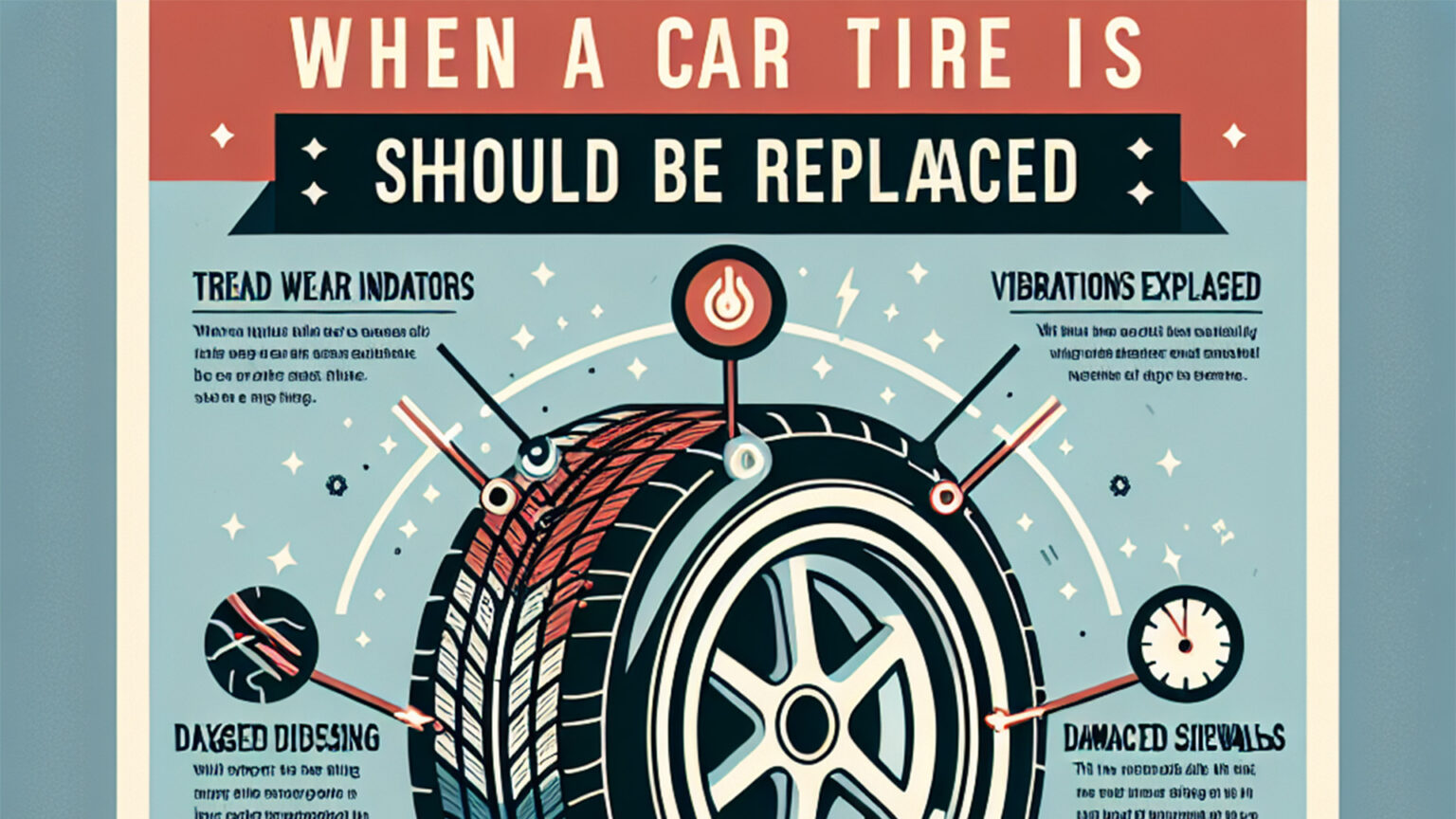
Replace tires when tread, age, damage, or vehicle use makes them unsafe or unsuitable.
Replace tires for low tread
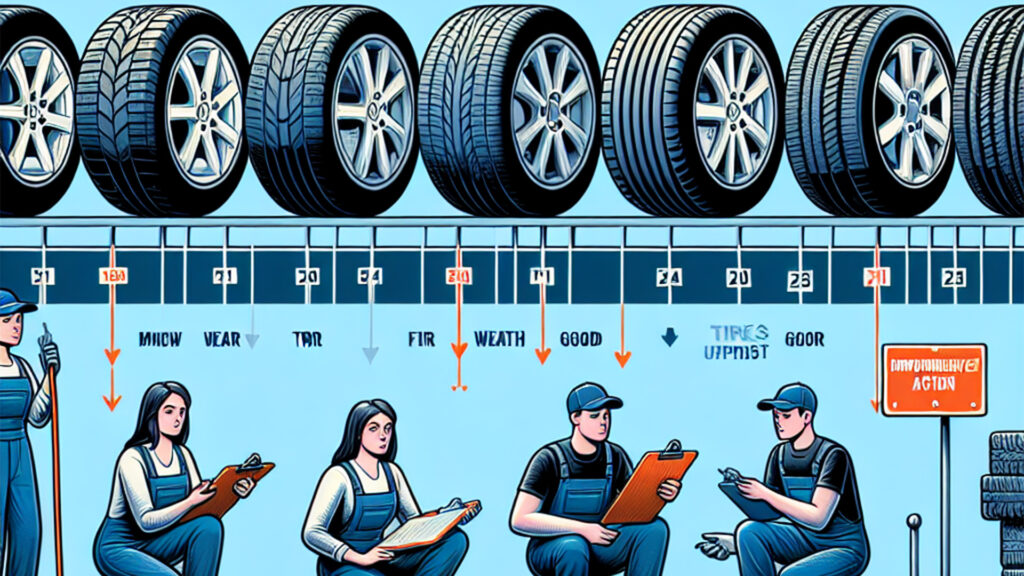
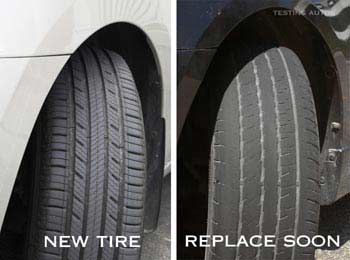
In the U.S., federal regulations use a treadwear indicator level of 2/32 of an inch for the legal minimum tread depth on standard passenger tires. Many tire professionals advise replacing tires before they reach that point, especially before wet-weather performance drops further.


Check the tread in several places. One area may look acceptable while another has severe wear.
Common signs include:
- Tread that is level with the wear bars
- Very shallow grooves
- Uneven wear across the tread
- Cupping or scalloped wear
- Wear on only one edge
- Frequent loss of air
- Cracks between tread blocks
A penny test is not a precise measurement. Use a tread-depth gauge or ask a tire shop to measure the tread.
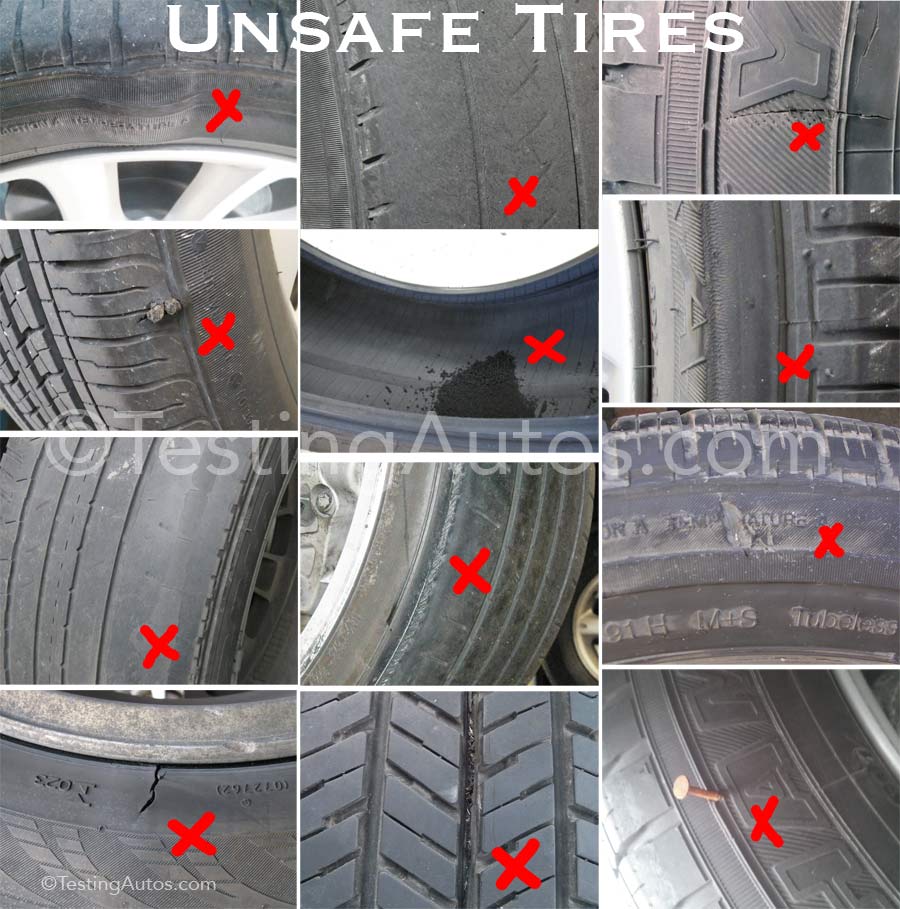
Replace tires with serious damage
Do not keep driving on a tire with damage that may affect its structure.
Seek immediate inspection for:
- A bulge or bubble in the sidewall
- A deep cut
- Exposed cords
- A puncture in the sidewall
- A tire that came off the rim
- Severe impact damage after a pothole
- Repeated air loss
- A flat tire that was driven while deflated
A plug or patch may be suitable for some small tread punctures. It is not a safe fix for every puncture. The technician must inspect the inside of the tire and follow accepted repair procedures.
Consider tire age
Tires can age even when the tread looks good. Heat, sunlight, storage, and underinflation can affect rubber over time.
Find the DOT Tire Identification Number on the sidewall. The last four digits show the week and year of manufacture. For example, 2324 means the tire was made in the 23rd week of 2024.
The National Highway Traffic Safety Administration advises drivers to follow the tire maker’s age guidance. Some tire manufacturers recommend replacement at six to ten years from the date of manufacture, even if tread remains. The exact limit depends on the brand and model, so check the tire maker’s guidance.
Replace tires as a set when appropriate
Replacing all four tires is usually best when:
- All four tires have similar wear.
- The vehicle is all-wheel drive.
- The tire maker or vehicle maker requires matched tires.
- The remaining tires are old or damaged.
- The vehicle has handling problems with mixed tires.
If you replace only two tires, many tire makers recommend placing the new tires on the rear axle. Better rear traction can help reduce the risk of oversteer on wet roads. Follow the tire and vehicle manufacturer’s instructions because vehicle design can change the recommendation.

What Tires Should You Buy?
Buy tires that match your vehicle and driving needs. The most expensive tire is not always the best choice, and the cheapest tire may cost more if it wears quickly or performs poorly in conditions you face.
Start with the correct tire size
Find the tire size on:
- The driver’s door-jamb label
- The owner’s manual
- The current tire sidewall


A size such as 225/60R17 99H contains several details:
- 225 is the tire width in millimeters.
- 60 is the aspect ratio.
- R means radial construction.
- 17 is the wheel diameter in inches.
- 99 is the load index.
- H is the speed rating.
The replacement tire should meet the vehicle maker’s required size, load index, and speed rating. Do not rely only on a tire that “looks like” the old one.
Match the tire to your climate
Your location and driving conditions matter.
- All-season tires: A common choice for moderate climates and light winter conditions.
- Summer tires: Designed for warm weather performance. They may not suit cold or snowy conditions.
- Winter tires: Made for cold temperatures, snow, and ice. They are not the same as all-season tires with a snowflake symbol.
- All-terrain tires: Useful for drivers who split time between pavement and rough roads. They may create more noise and use more fuel.
- Highway tires: Often suited to pickups and SUVs used mainly on paved roads.
If you regularly drive on snow or ice, look for the Three-Peak Mountain Snowflake symbol. This identifies tires that meet a specific severe-snow service performance requirement. It does not guarantee that a vehicle will stop quickly in every winter condition.
Consider how you drive
Tell the tire technician about your normal use:
- City driving
- Long highway trips
- Heavy loads
- Towing
- Gravel roads
- Mountain roads
- Frequent rain
- Snow and ice
- Performance driving
This information can change the recommendation. A tire built for quiet highway travel may not be ideal for towing or rough roads.

What Tire Replacement Services Should Be Included?
A proper tire replacement involves more than removing four old tires and installing four new ones.
Mounting and balancing
Mounting places the tire on the wheel. Balancing corrects weight differences in the tire and wheel assembly.
A balanced wheel can help reduce:
- Steering-wheel vibration
- Uneven tread wear
- Stress on suspension parts
- Highway vibration
Ask whether the shop includes computer balancing in the quoted price.
Valve stems and TPMS service
Rubber valve stems can wear and leak. Some shops replace them during tire installation. Metal valve stems may use service kits with seals and small parts that also wear.
TPMS monitors tire pressure. A tire shop may need to:


- Protect the sensor during removal
- Replace a damaged sensor
- Replace a service kit
- Relearn the sensor positions
- Reset the system
The exact process depends on the vehicle. Ask whether TPMS service is included before work starts.
Wheel alignment
A wheel alignment adjusts the angles of the wheels. It does not balance the tires.
An alignment may be useful when:
- The vehicle pulls to one side.
- The steering wheel is off center.
- Tires have uneven edge wear.
- Suspension parts were replaced.
- The vehicle hit a major pothole or curb.
New tires do not automatically require an alignment. An honest shop should explain the measurement or symptom that supports the recommendation.
Correct inflation and lug-nut torque
The shop should inflate the tires to the pressure listed on the vehicle’s door-jamb label or in the owner’s manual. Do not use the maximum pressure printed on the tire sidewall as the normal vehicle setting unless the vehicle maker specifies it.
Lug nuts should be tightened to the vehicle maker’s torque specification. Incorrect torque can cause wheel problems or make later removal difficult.
Before leaving, check that:
- The tire-pressure warning light is off, if the system allows it to reset.
- The lug nuts are installed.
- The tire pressures are correct.
- The steering wheel feels normal during a short, safe drive.
- The vehicle does not pull or vibrate.
How Much Does Tire Replacement Cost in the U.S.?
The total cost depends on tire size, tire type, brand, vehicle, labor, taxes, and extra services. Prices also vary by state and city, so a local written estimate is more useful than a national average.
Your estimate may include:
- Four tires
- Mounting
- Balancing
- New valve stems or TPMS service kits
- Tire disposal
- Sales tax
- Road-hazard coverage
- Wheel alignment
- TPMS sensor replacement
- Shipping or delivery
Ask for the total installed price, not only the tire price.
A simple comparison formula
Use this formula:
Total cost = tire price + installation + balancing + valves or TPMS service + disposal + tax + optional coverage
For example, if a tire costs $150 and four tires cost $600, the final bill may be higher after labor, tax, disposal, and other services. This is a hypothetical example, not a typical price quote.
Compare the same items at each shop. One quote may include balancing and disposal while another lists them separately.
Warranty questions to ask
Tire warranties differ by brand and model. Ask about:


- Limited treadwear coverage
- Workmanship and materials coverage
- Road-hazard coverage
- Free rotation terms
- Free flat repair terms
- Proration after a failure
- Mileage limits
- Required maintenance records
A warranty may require proof of regular rotation and proper inflation. Keep the invoice and service records.
What to Do Before You Visit a Tire Shop
Prepare before you schedule service. This can prevent delays and reduce the chance of buying the wrong tire.
Gather the needed information
Have these details ready:
- Vehicle year, make, model, and trim
- Current tire size
- Front and rear tire sizes, if different
- Drive type, such as front-wheel drive or all-wheel drive
- Typical weather
- Usual load or towing needs
- Current tire problems
- Your target budget
Take a clear photo of the driver’s door-jamb label and tire sidewall if you are requesting an online quote.
Check whether the vehicle is safe to drive
Do not drive to a shop if a tire has a sidewall bulge, exposed cords, a major cut, or rapid air loss. Use a spare tire if it is properly inflated and suitable for the vehicle, or arrange roadside service.
If a tire is only slightly low, inflate it to the vehicle maker’s recommended pressure before driving a short distance. If it loses air again, stop driving and have it inspected.
Get at least two written quotes
Two quotes can reveal whether a recommendation is standard or optional. Make sure both quotes list:
- Tire brand and model
- Tire size
- Load and speed ratings
- Tire quantity
- Labor
- Balancing
- Valve or TPMS work
- Disposal
- Taxes
- Warranty coverage
Do not choose a shop only because it has the lowest first number. A low quote that leaves out required services may not be the lowest final cost.
Common Mistakes When Replacing Tires
Avoid these mistakes to protect your vehicle and your budget.
Buying by size alone
The correct size does not guarantee the correct load rating, speed rating, construction, or seasonal performance. Match the full specification.
Mixing unsuitable tires
Different tire types can change handling. Mixing winter, summer, all-season, run-flat, and standard tires may be unsafe or prohibited by the manufacturer.
For all-wheel-drive vehicles, differences in tire circumference can place stress on the drivetrain. Check the owner’s manual before replacing only one tire.
Ignoring the tire’s production date
A tire can sit in storage before sale. Ask to see the DOT code and compare the age of the tires in the set.
Assuming an alignment is always required
An alignment can be valuable when symptoms or measurements support it. It is not a required add-on for every tire purchase.
Skipping rotation and pressure checks
New tires will not last as long if the vehicle has incorrect pressure, worn suspension parts, or poor alignment. Check pressure at least monthly and before long trips. Rotate tires according to the vehicle and tire maker’s schedule.
Driving away without checking the work
Look for a TPMS warning light, vibration, pulling, or unusual noise during a careful test drive. Return to the shop promptly if something feels wrong.
When Should You Replace One, Two, or Four Tires?
The number of tires depends on tread depth, damage, vehicle design, and the manufacturer’s instructions.
| Situation | Usual approach |
|---|---|
| One tire has minor repairable damage | Repair may be possible after inspection |
| One tire is damaged beyond repair | Replace one only if the remaining tires are closely matched and the manufacturer allows it |
| Two tires are worn or damaged | Replace two, often with the new pair on the rear axle |
| All tires are worn or aged | Replace all four |
| All-wheel-drive vehicle has uneven tread | Ask the manufacturer or a qualified shop before replacing fewer than four |
| Different front and rear sizes | Follow the vehicle’s replacement procedure |
Some vehicles require all four tires to have closely matched tread depth. Others may allow a limited difference. The owner’s manual and tire maker’s guidance should control.
A shop may be able to shave a replacement tire to match the tread depth of the other tires, but this is a specialized service and is not suitable for every vehicle or tire.
U.S. Safety and Tire Information Sources
The following U.S. sources provide useful baseline information:
- National Highway Traffic Safety Administration: Tires
- NHTSA: Tire Safety Ratings and Buying Tips
- U.S. Tire Manufacturers Association: Tire Care and Safety
- Tire Identification Number information from NHTSA
These sources explain tire safety, recalls, pressure, tread, tire age, and the information found on a tire sidewall. Manufacturer instructions still matter because tire and vehicle requirements can differ.
Frequently Asked Questions
Is it better to replace tires at a dealership or tire shop?
A tire shop is often practical for common vehicles and routine tire work. A dealership may be better for specialty tires, run-flat systems, unusual wheel sizes, or vehicles with manufacturer-specific requirements. Compare total installed prices and included services.
Can I buy tires online and have a local shop install them?
Yes, many local shops install customer-supplied tires. Ask about installation fees, warranty limits, shipping damage, tire age, TPMS service, balancing, and disposal before ordering.
Should new tires go on the front or rear?
When replacing only two tires, many tire manufacturers recommend putting the new tires on the rear axle. This can help maintain rear traction on wet roads. Follow the vehicle and tire manufacturer’s instructions.
How long does tire replacement take?
A routine four-tire installation may take about an hour or more, depending on the shop, vehicle, tire size, TPMS work, and whether an alignment is needed. Ask the shop for its current time estimate.
Can I replace tires at a discount warehouse or big-box store?
You can, if the location has the correct equipment and qualified technicians for your vehicle. Confirm that the store includes balancing, TPMS service, proper torque, disposal, and warranty support.
Should I replace tires before a long road trip?
Inspect them before the trip. Replace tires with low tread, damage, repeated air loss, severe uneven wear, or advanced age. Also check pressure, the spare tire, and the tire tools before leaving.
Conclusion: The Safest Place Is a Qualified Shop With a Clear Estimate
For most U.S. drivers, start with a reputable local tire shop, national tire chain, or trusted repair shop. Use a dealership when your vehicle has special tire, wheel, or drivetrain requirements.
Before you book, compare the full installed price and confirm the tire size, load rating, speed rating, tire age, balancing, TPMS service, warranty, and disposal fees. If a tire has a bulge, exposed cords, major damage, or rapid air loss, do not drive it to the shop. Arrange a safe inspection or roadside service instead.
Your next step is simple: photograph the vehicle’s door-jamb tire label, check the current tires for damage and wear, and request two written quotes that list every included service.
