

The best place to donate a car seat in the United States depends on its age, condition, crash history, and local rules. A safe, unexpired car seat with all parts and a known history may go to a local family, shelter, or child-safety program. An expired, damaged, recalled, or incomplete seat should not be donated. Recycle or dispose of it instead.
Start by checking the seat’s expiration date, model number, recall status, and history. Then call the organization before you drive there. Many charities do not accept used car seats because they cannot confirm how the seat was stored or whether it was in a crash.

The Best Places to Donate a Car Seat
The best donation option is usually a local group that can check the seat and place it with a family who needs it. Call first, since acceptance rules differ by city and organization.
1. Local shelters and family service groups
Domestic violence shelters, homeless shelters, refugee support groups, and family resource centers may need car seats for children leaving unsafe homes or entering temporary housing.


Ask for the agency’s family services team. Do not leave a seat at the door. Staff may need to check:
- The seat’s expiration date
- The model and manufacture date
- The recall history
- Whether the seat has been in a crash
- Whether the seat has every required part
- Whether the cover and straps are clean and undamaged
Some shelters accept only new seats. Others accept used seats only when the donor can confirm the full history.
2. Local child passenger safety programs
A certified Child Passenger Safety Technician, or CPST, may know of a family or program that needs a seat. CPSTs are trained to teach caregivers how to use and install car seats. They may also identify local donation programs.
Use the National Highway Traffic Safety Administration’s child passenger safety search tool to find inspection help and safety information. A technician may not accept the seat as a donation, but they can often tell you whether it is safe to pass on.
3. Hospitals, health departments, and early childhood programs
Some hospitals, county health departments, WIC offices, and public health programs run car seat education or distribution events. Acceptance rules vary.
These groups may prefer:
- New seats
- Specific seat types
- Seats for a certain age or weight range
- Seats purchased through an approved program
- Seats with proof of purchase
Call the maternity, injury prevention, or community health department. The main hospital desk may not know the current policy.
4. Local parenting and mutual-aid groups
A nearby parent group may connect a safe, eligible seat with a family who needs one. Examples include:
- Buy Nothing groups
- Community centers
- Neighborhood parent groups
- Faith-based family programs
- School family resource offices
- Local social-service networks
Share the seat’s brand, model, manufacture date, expiration date, condition, and crash history. Do not describe an unknown history as “probably fine.” A parent needs clear facts to make a safe choice.


5. National charities and donation programs
Some national organizations accept new car seats or run limited local programs. Policies can change by location and season. A national charity may not accept used seats at all.
Before donating, check the organization’s official website or call the local branch. Ask these exact questions:
- Do you accept used car seats?
- Do you accept this brand and model?
- Must the seat be unexpired?
- Do you require the original manual or registration card?
- Will you inspect the seat before giving it to a family?
- Do you accept infant seats, convertible seats, booster seats, or all three?
A national name does not guarantee that every local branch follows the same rule.

When You Should Not Donate a Car Seat
Do not donate a car seat if you cannot confirm that it is safe and legal to use. A kind donation can create risk when the next caregiver does not know the seat’s history.
Do not pass on a seat that is:
- Expired
- Involved in a moderate or serious crash
- Missing its date label or model number
- Missing important parts
- Cracked, bent, or badly worn
- Recalled without a completed remedy
- Exposed to flood water, fire, or harsh chemicals
- Missing its instructions when the installation method cannot be confirmed
- So dirty that the harness or padding cannot be cleaned safely
Crash history matters
NHTSA advises replacing a car seat after a moderate or severe crash. A seat may look normal after a crash and still have hidden damage.
NHTSA lists conditions for possible reuse after a minor crash. The crash must meet all of the agency’s criteria, including that no one was injured, the vehicle could be driven away, the door nearest the seat was not damaged, airbags did not deploy, and there is no visible damage to the seat.
If you are unsure whether a crash was minor, replace the seat rather than donate it. You can read the NHTSA guidance on replacing car seats after a crash.
Check the expiration date
Car seat makers set expiration dates because materials, labels, parts, and safety guidance can change over time. There is no single expiration period that applies to every seat.
Look for a label on the:
- Back
- Bottom
- Side
- Base
- Harness area
The label may show a “do not use after” date or a manufacture date. If it shows only the manufacture date, read the manual or contact the maker for the correct service life.
Do not guess the date from the seat’s appearance. A clean seat can still be too old to use.
Check for recalls
Find the seat’s model name, model number, and manufacture date. Search the NHTSA Recalls Look-up Tool and the manufacturer’s recall page.
A recall does not always mean the seat must be thrown away. The maker may provide a repair part or new instructions. Do not donate it until the recall remedy is complete.


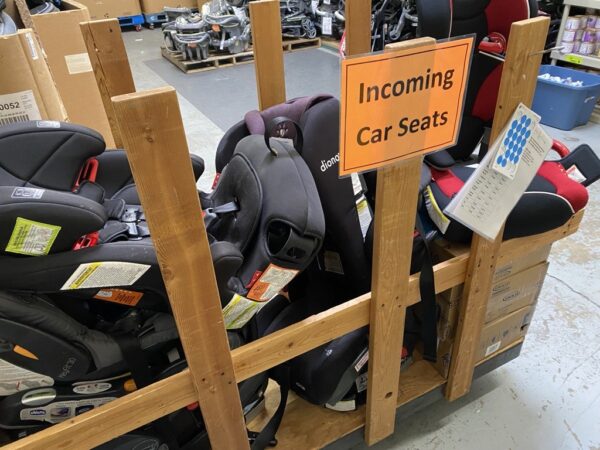
How to Prepare a Car Seat for Donation
Prepare the seat before offering it to a charity or family. Good records make it easier for the next caregiver to judge the seat.
Step 1: Find the labels
Take clear photos of every label. At minimum, record:
- Brand
- Model name
- Model number
- Manufacture date
- Expiration date, if listed
- Serial number, if listed
Keep the manual if you have it. If the manual is missing, look for a downloadable copy on the manufacturer’s official website.
Step 2: Confirm the seat’s history
Write down whether the seat has:
- Been in a crash
- Been checked after a crash
- Been exposed to water or fire
- Been stored in extreme conditions
- Had any parts replaced
- Been used by more than one child
Be direct. If the history is unknown, tell the recipient or organization. An unknown history may make the seat unsuitable for donation.
Step 3: Inspect every part
Check the shell, harness, buckle, chest clip, padding, base, tether, and adjustment parts. Look for cracks, frayed straps, bent metal, loose parts, or a buckle that does not lock and release as designed.
Do not repair a seat with household glue, tape, screws, or third-party parts. Use only parts approved by the manufacturer.
Step 4: Clean it by following the manual
Cleaning rules differ. Many harness straps should not be soaked, bleached, machine-washed, or treated with strong chemicals. Those actions may weaken the webbing.
Follow the seat’s manual. If you cannot find the cleaning directions, ask the manufacturer before washing the harness.
Step 5: Include the needed parts
Give the seat with its approved parts. Depending on the model, that may include:
- Infant insert
- Base
- Harness pads
- Buckle
- Chest clip
- Lower anchors
- Tether strap
- Lock-off parts
- Instruction manual
Do not add aftermarket accessories unless the seat maker specifically approves them.
Step 6: Share the safety information
Give the recipient a short written record with the model, dates, recall check, cleaning method, and crash history. This does not make an unsafe seat safe, but it gives the next caregiver useful information.


Donation or Recycling: Which Option Is Right?
Donate a seat only when it is safe, complete, unexpired, and accepted by a responsible organization. Recycle or dispose of it when it fails any of those tests.
| Seat condition | Best next step |
|---|---|
| New and unopened | Donate to a shelter, hospital program, or family service group |
| Used, unexpired, complete, and known history | Call a local family program or parent group |
| Used but history is unknown | Do not donate; ask a CPST or manufacturer for guidance |
| Expired | Recycle or dispose of it |
| Damaged or crash-involved | Do not donate; ask about local disposal |
| Recalled with no available remedy | Do not donate or use |
| Missing key parts | Do not donate unless the manufacturer provides approved replacements |
| Clean but missing labels | Do not pass it on |
How to recycle a car seat
Car seat recycling is local. Some communities accept seats through household recycling events, county waste programs, or special collection days. Some stores also run limited trade-in events.
Use the EPA’s recycling information and your city or county waste department to look for local options. Search for terms such as:
- “car seat recycling near me”
- “child safety seat disposal”
- “car seat recycling event”
- “[your county] bulky plastic recycling”
Before taking the seat to a recycling center, ask whether it accepts car seats. Many centers do not accept them in curbside bins.
If your local program tells you to put the seat in the trash, follow its instructions. Some programs ask residents to cut the harness straps and mark the seat as unsafe before disposal. Do this only when the local program or manufacturer recommends it, and remove personal information from labels if needed.
Do not place an unsafe seat in a donation bin. It may be taken by another person who does not know that it is expired or damaged.

Do Stores Take Used Car Seats?
Some stores accept car seats during limited trade-in events, but store participation and dates change. These programs often provide a coupon or store credit rather than a cash donation. The seat may be recycled instead of given to another child.
Target has operated car seat trade-in events in the United States. Check the Target car seat trade-in page for current details, accepted items, and participating locations before going to a store.
A trade-in is not the same as donating a usable seat to a family. It may be the better choice for an expired or unwanted seat when the program accepts it for recycling. It is not a reason to give away a seat that is damaged or recalled.
Walmart stores, local baby retailers, and county programs may also offer occasional events. Do not assume a store accepts car seats year-round. Ask about the current program, the seat types accepted, and whether the location takes seats in person.

How to Find a Car Seat Donation Program Near You
Use a short search process so you do not waste a trip or place an unsafe seat with a family.
- Record the seat details. Write down the brand, model, manufacture date, expiration date, and condition.
- Check recalls. Use NHTSA’s recall tool and the manufacturer’s website.
- Call local programs. Start with family shelters, county health departments, hospitals, and CPST programs.
- Ask about acceptance rules. Confirm that the group accepts used seats and your specific type.
- Send photos if requested. Include the labels, shell, harness, buckle, and base.
- Arrange a handoff. Give the seat directly to staff or the approved recipient.
- Get disposal instructions if rejected. Ask whether the group knows of a local recycling or waste option.
A simple phone script
“I have a [brand and model] car seat made in [month and year]. It expires on [date]. It has not been in a crash, has all parts, and has a known history. Do you accept this type of used seat, and do you inspect it before distribution?”
This script gives the organization the facts it needs. It also helps prevent an unsuitable seat from being accepted by mistake.
Common Mistakes to Avoid
The most common mistake is treating a car seat like ordinary baby gear. Safety depends on details that may not be visible.


Avoid these errors:
- Leaving a seat outside a charity or fire station
- Assuming a seat is safe because it looks clean
- Donating a seat without checking the expiration date
- Failing to disclose a crash
- Sending a recalled seat without the repair
- Washing harness straps against the manual’s instructions
- Including unapproved toys, liners, or padding
- Giving away a seat without its base when the base is required
- Assuming a local fire station accepts used seats
- Putting a car seat in curbside recycling without checking local rules
- Using a social-media post that says only “free car seat” with no safety details
If a recipient cannot install the seat correctly, the donation has not fully solved the problem. Encourage the caregiver to read the manual and seek help from a certified CPST.

Frequently Asked Questions
Can I donate a car seat to Goodwill?
Goodwill acceptance rules vary by local organization. Some locations may not accept used car seats because they cannot verify the seat’s age, crash history, or condition. Call the specific Goodwill location before you go.
Will a fire station take my old car seat?
Some fire stations host inspection events or work with child passenger safety programs. Many do not accept used car seats for donation or disposal. Call first rather than leaving the seat at the station.
Can I donate an expired car seat?
No. An expired car seat should not be passed to another family. Ask your local waste department, recycling center, or store trade-in program about disposal.
Can I give away a car seat that was in a minor crash?
NHTSA provides conditions for possible reuse after a minor crash. All conditions must be met, and the seat must have no visible damage. If you cannot confirm every condition, replace the seat instead of donating it.
Is it safe to donate a car seat without the manual?
A missing manual does not always make a seat unusable, but it makes correct installation harder. Download the official manual from the manufacturer before donating. If you cannot identify the exact model, do not pass the seat on.
Conclusion: Choose Safety Before Convenience
The safest place to donate a car seat is a local program that accepts used seats, checks their condition, and understands child passenger safety. Before donating, confirm the seat is unexpired, complete, unrecalled, cleanable, and free from crash or damage concerns.
If any key fact is unknown, do not donate the seat. Contact a CPST, the manufacturer, or your local waste program for the next safe step. Your best action today is to record the seat’s model and dates, check for recalls, and call the receiving organization before arranging a handoff.
