How Often To Rotate Tires AWD: The Right Schedule
For most AWD vehicles in the United States, rotate the tires about every 5,000 to 8,000 miles, or at the interval listed in the owner’s manual. Many drivers match tire rotation with each oil change.
Your vehicle’s manual always comes first. Some automakers set a shorter interval, such as 5,000 miles. Others allow 7,500 or 8,000 miles under normal driving. AWD systems can be sensitive to differences in tire size and tread depth, so regular rotation matters more than simply waiting for visible wear.
Why AWD Vehicles Need Regular Tire Rotation
AWD vehicles send power to more than one axle. This can improve traction, but it also means the tires must work together closely.
Tires do not wear at the same rate on every corner:
- Front tires often wear faster because they steer, brake, and may drive the vehicle.
- Rear tires may wear more slowly in normal driving.
- Aggressive turns, hard braking, towing, and poor alignment can speed up uneven wear.
- Different AWD systems may shift power between the front and rear axles.
When the tires have different rolling sizes, the AWD system may need to compensate for the difference. A small difference may be acceptable on some vehicles, but a larger difference can add heat and stress to the center differential, clutch pack, transfer case, or other drivetrain parts.
That does not mean every AWD vehicle needs rotation at exactly the same mileage. It means the tires should stay as closely matched as the vehicle maker requires.
The Best AWD Tire Rotation Schedule
Use this schedule as a starting point, then confirm it in your owner’s manual.
| Driving conditions | Suggested rotation timing |
|---|---|
| Normal mixed driving | Every 5,000–8,000 miles |
| Mostly highway driving | Follow the manual; inspect at each service |
| Frequent city driving or short trips | About every 5,000 miles |
| Towing, heavy loads, or mountain roads | Inspect more often and use the shorter manual interval |
| Severe weather or rough roads | Inspect at every oil change |
| Uneven wear already present | Have the tires and alignment checked promptly |
The most useful rule is simple: rotate the tires before uneven wear becomes obvious.
Some tire makers recommend rotating every 5,000 to 8,000 miles. The United States Tire Manufacturers Association also advises following the vehicle and tire manufacturer’s recommendations. These are general intervals, not a substitute for the service schedule written for your exact vehicle.
Should AWD tires be rotated more often than 2WD tires?
Not always. An AWD vehicle does not automatically require a shorter rotation interval than a front-wheel-drive or rear-wheel-drive vehicle.
However, AWD tires need closer attention because tread-depth differences may affect the drivetrain. If your vehicle maker specifies 5,000 miles, use 5,000 miles. If it specifies 7,500 miles, use that interval unless your driving conditions call for more frequent service.
How to Find the Correct Rotation Interval
Check these sources in this order:
- Owner’s manual: Look under “maintenance,” “tires,” or “tire rotation.”
- Maintenance schedule: Check whether the interval changes for severe driving.
- Tire manufacturer’s instructions: These may give a general rotation range.
- Tire shop inspection: Ask the technician to measure tread depth on all four tires.
- Vehicle manufacturer service information: This is useful when the manual is missing or unclear.
Do not rely only on the sticker inside the driver’s door. That label gives important tire size and inflation information, but it may not list the rotation schedule.
If you recently replaced only one or two tires, ask about tread-depth matching before driving normally. Some AWD vehicles require all four tires to have nearly the same rolling circumference. The allowable difference varies by make and model, so there is no safe universal percentage for every AWD vehicle.
Which Tire Rotation Pattern Is Right for AWD?
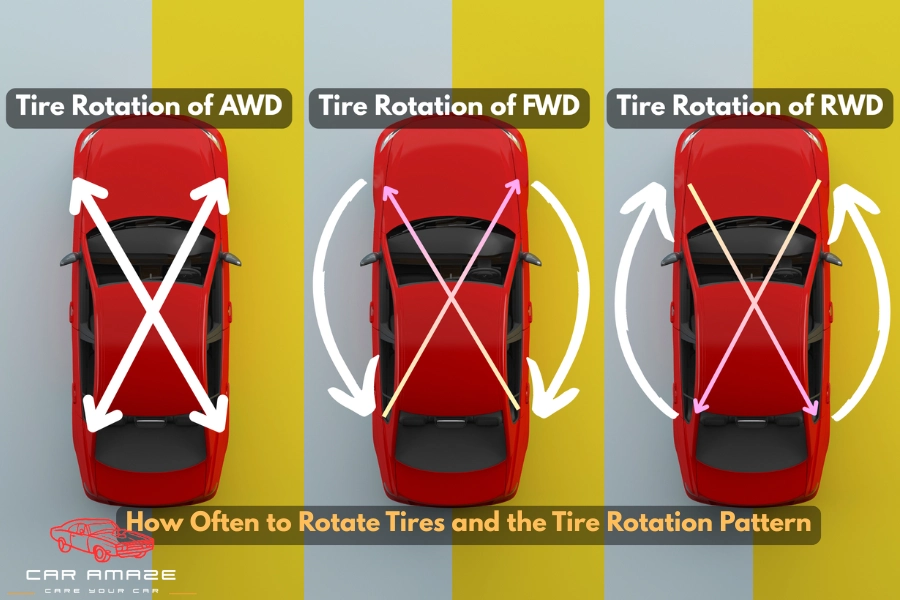
The correct pattern depends on the tire design and wheel setup. AWD does not, by itself, determine the pattern.
Non-directional tires on four matching wheels
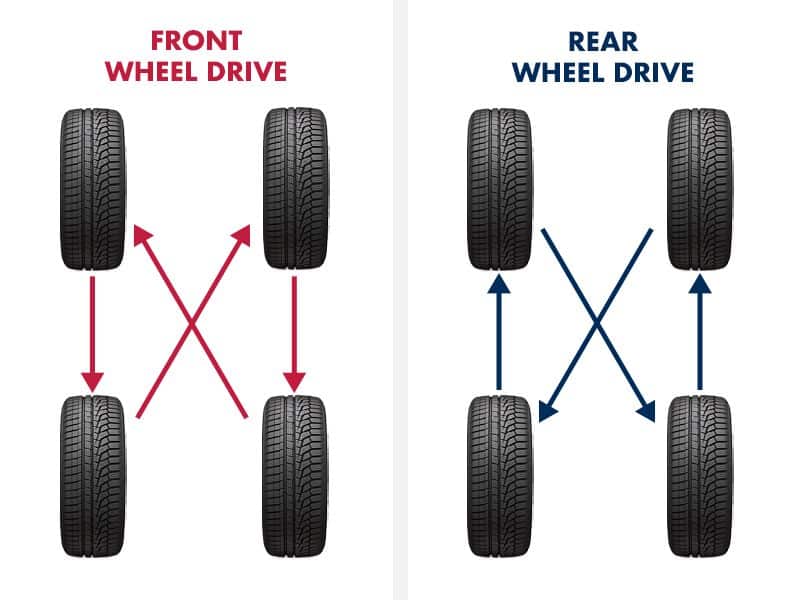
A common pattern is the rearward cross:
- Move the rear tires straight to the front.
- Move the front tires to the opposite sides at the rear.
Another option is the forward cross:
- Move the front tires straight to the rear.
- Move the rear tires to the opposite sides at the front.
Many vehicles can also use an X-pattern. The service information for your vehicle and tires should decide the pattern.
Directional tires
Directional tires have a tread designed to roll in one direction. They usually show an arrow or wording such as “Rotation” on the sidewall.
For these tires:
- Move the front tire to the rear on the same side.
- Move the rear tire to the front on the same side.
Do not switch a directional tire to the opposite side unless a technician remounts it on the wheel.
Staggered tire sizes
Some performance vehicles use wider tires at the rear than at the front. This is called a staggered setup.
If the front and rear tires have different sizes, they normally cannot be moved front to back. Side-to-side rotation may be possible only if the tire design allows it.
A staggered AWD vehicle needs special care. Use the pattern listed by the vehicle maker or tire maker. Never force a rotation pattern that changes the tire’s intended position.
Different wheel sizes or tire types
Do not rotate tires across different wheel diameters, load ratings, speed ratings, or construction types unless the manufacturer allows it.
A tire rotation is not a reason to mix:
- Different tire sizes
- Different brands with different rolling dimensions
- Directional and non-directional tires in an improper pattern
- Run-flat and standard tires without vehicle approval
- Tires with incompatible load or speed ratings
How to Rotate AWD Tires Safely
A tire shop can usually rotate four tires quickly, but the basic process is useful to understand.
Before the vehicle is lifted
- Check the owner’s manual for the approved rotation pattern.
- Confirm that all four tire sizes match the vehicle’s requirements.
- Inspect the sidewalls for cuts, bulges, cracks, or exposed cords.
- Measure tread depth across each tire.
- Check for uneven wear, such as wear on one edge or in patches.
- Note the tire pressure before moving the tires.
Do not rotate a tire with a bulge, serious sidewall damage, or exposed cord. Replace it or have it assessed by a qualified tire professional.
During the rotation
A trained technician should:
- Lift and support the vehicle at the correct lift points.
- Move the tires according to the approved pattern.
- Inspect the brakes, wheels, and suspension while the tires are off.
- Install the wheels correctly.
- Tighten the lug nuts to the vehicle maker’s torque specification.
- Set tire pressure using the cold-pressure value on the vehicle label.
- Reset the tire pressure monitoring system if the vehicle requires it.
The tire pressure printed on the tire sidewall is not usually the vehicle’s recommended operating pressure. Use the label inside the driver’s door or the owner’s manual.
After the rotation
Drive slowly for the first few miles and pay attention to:
- Steering pull
- New vibration
- Tire noise
- A tire-pressure warning
- A vehicle that feels unstable
If you notice a problem, stop when safe and have the wheel installation and tire pressures checked.

Signs Your AWD Tires Need Rotation Now
Mileage is useful, but tire condition can tell you more.
Schedule a rotation or inspection if you see:
- One front tire wearing faster than the other
- More wear on the outer or inner shoulder
- Cupping or scalloped tread blocks
- Feathered tread that feels smooth in one direction and sharp in the other
- Vibration that changes with road speed
- Tire noise that has increased over time
- Uneven tread depth between the front and rear axles
Rotation can help even out normal wear. It cannot repair an alignment problem, bent wheel, worn suspension part, or damaged tire.
A simple tread-depth check can reveal a problem early. Use a tread-depth gauge, or ask a tire shop to measure each tire in several locations. Compare the tires from side to side and front to rear, not just the most worn spot.
AWD Tire Tread Depth: Why Matching Matters
AWD systems need tires that have similar overall rolling size. Tread depth affects that size because a tire with more tread has a slightly larger rolling circumference than a worn tire.
For example, replacing one badly worn tire with a new tire can create a meaningful difference even when both tires have the same size printed on the sidewall. Whether that difference is acceptable depends on the vehicle.
Your owner’s manual may provide:
- A maximum tread-depth difference
- A maximum circumference difference
- A requirement to replace all four tires
- A recommendation to shave a new tire to match the others
- A rule about using the same tire model on all four corners
Do not assume that replacing only the damaged tire is safe for every AWD vehicle. Ask a dealer or qualified tire professional to compare the measured tread depths and the manufacturer’s limits.
When Not to Rotate the Tires Yourself
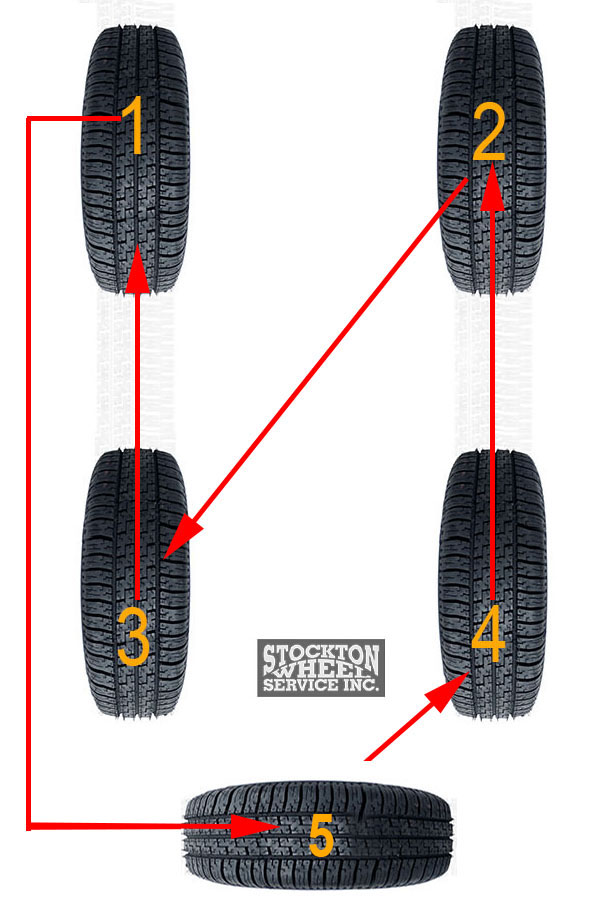
A DIY rotation may be reasonable for someone with proper tools, a level work area, wheel chocks, and a way to support the vehicle safely. A jack alone is not a safe support system for working around a vehicle.
Have a professional handle the job when:
- You do not have jack stands or a suitable lift.
- The vehicle has a staggered wheel setup.
- The tires are directional.
- The tires have different sizes.
- The lug nuts require special adapters.
- You notice uneven wear or vibration.
- A tire has damage or a slow leak.
- You recently replaced only one or two tires.
- The AWD system has a known tire-matching requirement.
Never place any part of your body under a vehicle supported only by a portable jack.
Common AWD Tire-Rotation Mistakes
Waiting until the tires look worn
Rotation is preventive maintenance. Waiting for visible wear can allow small differences to become severe.
Using the same pattern on every vehicle
Directional, staggered, and asymmetric tire setups have different limits. Check the sidewall and manual first.
Rotating a damaged tire
Rotation does not make a damaged tire safe. Inspect every tire before moving it.
Ignoring alignment problems
If a tire wears on one edge, rotation may move the problem to another wheel. The vehicle may need an alignment or suspension repair.
Mixing tire models without checking compatibility
Different tires may have different rolling characteristics, even when the size numbers match. AWD vehicles often benefit from a matched set.
Forgetting tire pressure after rotation
Each tire may move to a wheel position with a different pressure requirement. Set all four tires to the vehicle’s recommended cold pressure.
Assuming tire rotation fixes vibration
A rotation can reveal or change a vibration, but vibration may also come from an unbalanced wheel, bent rim, damaged tire, or worn suspension part.
Quick AWD Tire-Rotation Decision Guide
Use this guide when deciding what to do next:
- The manual gives a rotation interval: Follow it.
- No interval is listed: Use about 5,000–8,000 miles and confirm with the vehicle maker or tire maker.
- The tires show uneven wear: Rotate only after checking alignment and suspension.
- The tires are directional: Keep each tire on the same side unless it is remounted.
- The vehicle has staggered sizes: Use the approved side-to-side pattern, if any.
- One tire is much newer: Check AWD tread-matching limits before driving long distances.
- You feel vibration after rotation: Stop and have the installation, balance, and tire condition checked.
- You are unsure about safe lifting: Use a professional tire service.
Key Takeaways
- Rotate most AWD tires every 5,000 to 8,000 miles, unless the owner’s manual says otherwise.
- Use the vehicle’s maintenance schedule as the primary source.
- AWD vehicles may be sensitive to tread-depth and rolling-circumference differences.
- Directional and staggered tire setups need special rotation patterns.
- Check tire pressure after rotation.
- Uneven wear, vibration, or a large tread-depth difference requires inspection.
- Do not replace or rotate AWD tires without checking the manufacturer’s tire-matching rules.
Frequently Asked Questions
Is tire rotation more important on an AWD vehicle?
It can be. AWD vehicles may be more sensitive to differences in tire rolling size, so regular rotation helps keep wear more even. The exact importance depends on the vehicle’s AWD design and the manufacturer’s requirements.
Can I rotate AWD tires every 10,000 miles?
Only if the owner’s manual allows that interval. For many vehicles, 10,000 miles is longer than the usual recommendation. Long intervals can allow front-to-rear wear differences to grow.
Do all four tires need to be replaced on an AWD vehicle?
Not always, but some AWD manufacturers require all four tires to remain closely matched. If one tire is damaged, compare the tread depth and check the manual before replacing it.
Can I rotate AWD tires at home?
Yes, if you have the correct rotation pattern, a level work area, proper lifting equipment, jack stands, a torque wrench, and the necessary skills. Do not work under a vehicle supported only by a jack.
Should I rotate tires before or after an oil change?
Either is fine. Many U.S. drivers rotate tires at every oil change because the service interval is easy to remember. The tire rotation interval should still match the vehicle maker’s schedule.
What if my AWD tires have different tread depths?
Small differences may be allowed, but the vehicle maker sets the limit. Measure the tread depth and consult the owner’s manual, dealer, or qualified tire professional before continuing to drive on a mismatched set.
Evidence and Sources
This guide is based on general U.S. tire-service guidance and manufacturer maintenance practices. Exact intervals and tread-matching limits vary by vehicle.
Useful primary sources include:
- United States Tire Manufacturers Association: Tire Care and Safety
- National Highway Traffic Safety Administration: Tire Safety
- Your vehicle’s owner’s manual and official maintenance schedule
- The tire manufacturer’s service and rotation instructions
Conclusion
For most AWD vehicles, plan to rotate the tires every 5,000 to 8,000 miles. The safest answer for your specific vehicle is the interval and rotation pattern in the owner’s manual.
Keep the tires matched, check for uneven wear, maintain the correct cold pressure, and inspect the tires whenever they are rotated. If the vehicle has directional tires, staggered sizes, or unequal tread depth, confirm the correct procedure before moving any wheel.