

Canada makes popular vehicles such as the Honda CR-V, Toyota RAV4, Lexus RX, Ford Super Duty, and Chevrolet Silverado.
If you are asking what cars are made in Canada, the answer includes far more than a few famous sedans. Canadian plants build SUVs, pickup trucks, minivans, electric delivery vans, and major vehicle parts for brands such as Honda, Toyota, General Motors, Ford, and Stellantis. This guide explains which models are built here, where they are made, and how to confirm a vehicle’s true country of origin before you buy.
What cars are made in Canada?
Canada has one of North America’s strongest auto industries. Most vehicle production is based in Ontario, where large assembly plants sit near parts suppliers, rail lines, highways, and the U.S. border.
The exact list can change as automakers adjust production. A model may also be built in more than one country. For that reason, the name of a vehicle is not enough to prove where a specific unit was assembled.
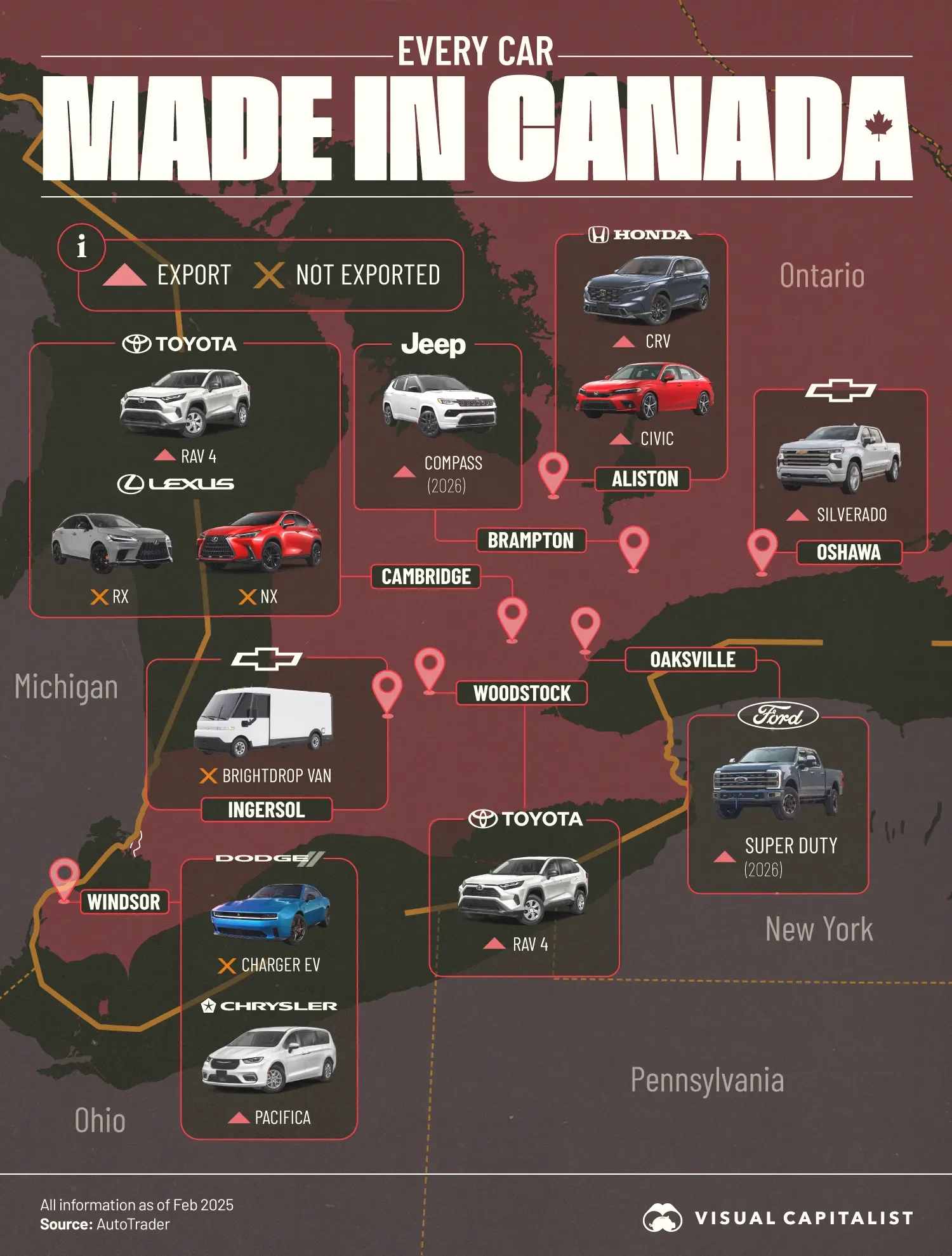
The main vehicles associated with Canadian assembly include:
• Honda CR-V, including hybrid versions, built in Alliston, Ontario
• Honda Civic sedan and Civic hybrid models, built in Alliston, Ontario
• Toyota RAV4, including hybrid versions, built in Woodstock, Ontario
• Lexus RX and RX hybrid models, built in Cambridge, Ontario
• Chrysler Pacifica and Chrysler Voyager minivans, built in Windsor, Ontario
• Chevrolet Silverado HD pickup trucks, built in Oshawa, Ontario
• GMC Sierra HD pickup trucks, built in Oshawa, Ontario
• BrightDrop electric delivery vans, built at the CAMI plant in Ingersoll, Ontario, depending on the current production schedule
• Ford Super Duty pickups, with Canadian production planned for the Oakville Assembly Complex as the plant is retooled
This list answers the basic question of what cars are made in Canada, but production schedules can change by model year. Always check the vehicle identification number, or VIN, for the exact vehicle you are considering.
Which automakers build cars in Canada?
Several global automakers operate major plants in Canada. Their facilities do more than assemble vehicles. They also support engineering, battery work, stamping, engine production, research, and a large network of Canadian suppliers.
Honda
Honda has operated in Alliston, Ontario, for decades. The plant is one of the company’s key North American production sites.
Honda Canada has built several well-known models over the years, including:
• Honda Civic
• Honda CR-V
• Honda Pilot, during certain production periods
• Honda Odyssey, during certain production periods
Model assignments can shift. In recent production cycles, the Alliston plant has focused heavily on Civic and CR-V models, including hybrid vehicles.
Toyota
Toyota operates plants in Cambridge and Woodstock, Ontario. These facilities build Toyota and Lexus vehicles for buyers across Canada, the United States, and other markets.
Toyota’s Canadian-made vehicles include:
• Toyota RAV4
• Toyota RAV4 Hybrid
• Lexus RX
• Lexus RX Hybrid
Toyota has also produced the Corolla in Cambridge. However, production plans change, so shoppers should check the model year and plant information rather than relying on older lists.
General Motors
General Motors has major Canadian operations in Oshawa and Ingersoll.
The Oshawa Assembly plant builds heavy-duty pickup trucks. Depending on the production plan, these vehicles include:
• Chevrolet Silverado HD
• GMC Sierra HD
The CAMI Assembly plant in Ingersoll has been linked with BrightDrop electric commercial vans. The plant has also built the Chevrolet Equinox in earlier production periods.
Stellantis
Stellantis operates the Windsor Assembly Plant. Its main Canadian-made products are minivans.
These include:
• Chrysler Pacifica
• Chrysler Voyager
The plant has also produced the Dodge Grand Caravan in the past. That model ended production in 2020, so it should not be confused with current Canadian-built vehicles.
Ford
Ford’s Oakville Assembly Complex has a long history of building popular vehicles, including the Ford Edge. Edge production ended in 2024 as Ford prepared the site for a major transformation.
Ford plans to add Super Duty pickup production at Oakville. That means the list of what cars are made in Canada will continue to evolve as the retooled plant comes online.

Where are cars made in Canada?
Most Canadian vehicle assembly takes place in Ontario. The province has a deep automotive network and easy access to major U.S. markets.
Alliston, Ontario
Honda operates its Canadian manufacturing campus in Alliston. The facility is north of Toronto and includes assembly operations for Honda vehicles.
Alliston is best known for Civic and CR-V production. It also supports thousands of direct and indirect jobs.
Cambridge, Ontario
Toyota’s Cambridge plant is one of the country’s best-known auto facilities. It has produced Toyota and Lexus vehicles for many years.
Today, Lexus RX production is strongly associated with the Cambridge plant. The site has also built other Toyota models during different production periods.
Woodstock, Ontario
Toyota’s Woodstock facility builds the RAV4. This includes gasoline and hybrid versions during relevant model years.
The RAV4 is one of Canada’s most important locally assembled vehicles because compact SUVs remain highly popular in both Canada and the United States.
Windsor, Ontario
Stellantis builds minivans in Windsor. The plant has been a major local employer for decades.
The Chrysler Pacifica is one of the best-known vehicles produced there. The site has also built other minivan models over time.
Oshawa, Ontario
General Motors’ Oshawa plant builds heavy-duty pickup trucks. These trucks are larger and more work-focused than the Chevrolet Equinox or GMC Terrain once associated with Canadian GM production.
The Chevrolet Silverado HD and GMC Sierra HD are important products for Canadian manufacturing because pickup demand remains strong across North America.
Ingersoll, Ontario
The CAMI plant in Ingersoll has a long history with General Motors. It has built crossover vehicles and later became associated with BrightDrop electric delivery vans.
Commercial electric vans have a different purpose from passenger cars. They help businesses reduce fuel use while supporting Canada’s growing electric vehicle supply chain.
Oakville, Ontario
Ford’s Oakville site is being retooled. It previously built the Ford Edge, but future production plans include Ford Super Duty pickups.
This transition shows why online lists can become outdated. A plant’s past products, current products, and planned products may all be different.
What Canadian-made vehicles are available today?
The answer depends on the model year, trim, and production location. A vehicle sold in Canada may come from a Canadian plant, a U.S. plant, Mexico, Japan, South Korea, or another country.
Some of the most important Canadian-made vehicles include the following.
Honda CR-V
The Honda CR-V is a compact SUV with strong demand in Canada. Canadian production has included gasoline and hybrid versions, depending on the model year and factory assignment.
The CR-V is popular because it offers:
• Good interior space
• Easy entry and exit
• Strong fuel economy in hybrid form
• A comfortable ride
• Available all-wheel drive
If you want a Canadian-built CR-V, check the VIN on the specific vehicle. Honda may build the same model in more than one country.
Honda Civic
The Honda Civic is one of Canada’s best-known locally assembled cars. The Alliston plant has built Civic models for the North American market.
Civic production may include sedan and hybrid versions, depending on the year. Hatchback production has often been assigned to other Honda plants, so body style matters.
Toyota RAV4
The Toyota RAV4 is one of the most recognizable vehicles made in Canada. The Woodstock plant builds RAV4 models for North American buyers.
The RAV4 is available in several forms, such as:
• Gasoline models
• Hybrid models
• Plug-in hybrid versions in selected markets and production periods
Do not assume every RAV4 is Canadian-built. Toyota uses multiple plants, so the VIN remains the best way to verify the origin.
Lexus RX
The Lexus RX is a luxury SUV built in Cambridge, Ontario. It is one of the clearest examples of a high-end vehicle assembled in Canada.
Canadian-built RX models may include gasoline and hybrid powertrains. The RX also shows that “made in Canada” does not only apply to affordable family vehicles.
Chrysler Pacifica
The Chrysler Pacifica is assembled in Windsor. It is a family minivan with available gasoline and plug-in hybrid versions, depending on the model year.
The Pacifica offers features that many families value:
• Three rows of seating
• Sliding rear doors
• Flexible cargo space
• Available all-wheel drive
• Available plug-in hybrid technology in certain years
Chevrolet Silverado HD and GMC Sierra HD
Oshawa builds heavy-duty versions of these full-size pickup trucks. They are designed for towing, hauling, construction work, farming, and commercial use.
These are not the same as every Silverado or Sierra sold in Canada. Light-duty models may come from other plants, so the “HD” label is important when checking Canadian production.
BrightDrop electric vans
BrightDrop electric vans are designed for delivery fleets and commercial users. The Canadian plant in Ingersoll has been used for BrightDrop production.
Production levels can vary with market demand. Buyers should confirm current availability and assembly information before placing a fleet order.
Are cars made in Canada fully Canadian?
No. A car assembled in Canada is not usually made entirely from Canadian parts.
Modern vehicles cross borders many times during production. Engines, transmissions, batteries, electronic systems, glass, seats, tires, and small components may come from several countries.
The phrase “made in Canada” usually refers to final assembly. That means the vehicle reached its completed form at a Canadian plant. It does not mean every part was mined, manufactured, or designed in Canada.
A vehicle can have:
• Final assembly in Canada
• An engine from the United States
• A transmission from Mexico
• Batteries from another country
• Software developed by teams in several regions
• Canadian steel and aluminum mixed with imported materials
This global supply chain is normal in the auto industry. It also explains why a Canadian-built vehicle can qualify for different trade rules than a vehicle with only a small amount of Canadian content.
How can you tell if a car was made in Canada?
The easiest method is to check the VIN.
A VIN is a 17-character code assigned to a specific vehicle. The first character identifies the region or country where the vehicle was built.
A VIN that starts with “2” generally indicates Canada. However, the VIN should not be your only check when buying a used vehicle.
Use these steps:
Find the VIN on the dashboard near the windshield or inside the driver’s door.
Check the first character.
Review the vehicle’s build label or certification label.
Ask the dealer for the final assembly location.
Compare the VIN with a trusted vehicle history report.
Confirm the information with the automaker if the details conflict.
The VIN is more reliable than a dealer listing, online advertisement, or a badge on the vehicle. A dealership can accidentally publish the wrong country of origin, especially when a model is imported from several plants.
Does buying a Canadian-made car support Canada?
Buying a Canadian-assembled vehicle supports the local manufacturing network, but the effect is broader than one assembly job.
The Canadian auto industry supports:
• Assembly workers
• Parts suppliers
• Tool and die companies
• Transport firms
• Software specialists
• Battery and energy companies
• Port and rail services
• Dealers and repair businesses
A vehicle assembly plant works like the hub of a wheel. The plant is the center, while suppliers and service companies form the spokes.
Still, the economic benefit varies. A vehicle assembled in Canada may contain many imported parts. A vehicle assembled elsewhere may include Canadian-made components. Final assembly is important, but it does not tell the whole economic story.
Are Canadian-made cars reliable?
A vehicle’s country of assembly does not determine reliability by itself. Design, maintenance, parts quality, manufacturing controls, and owner use all matter.
Honda, Toyota, General Motors, Stellantis, and Ford use standardized quality systems across their global plants. Canadian factories must meet the same corporate and regulatory requirements as the company’s plants in other countries.
When comparing reliability, look at:
• The exact model and model year
• The engine and transmission
• Repair and recall records
• Long-term owner reports
• Warranty coverage
• Maintenance history
• Independent reliability data
For example, a Canadian-built RAV4 from one year may have a different powertrain or software system than a RAV4 from another year. Country of assembly is useful information, but it should not replace a full vehicle review.
What are the benefits of buying a Canadian-made car?
Canadian-built vehicles offer several practical benefits. These benefits do not guarantee that one model is better than another, but they can matter to shoppers.
Strong parts availability
Vehicles built for the North American market often share parts with nearby models. That can make routine service easier.
Support for local jobs
Purchasing a vehicle assembled in Canada helps maintain demand within the Canadian auto network.
Familiar regional specifications
Canadian-built vehicles are often designed for North American roads, weather, fuel standards, and safety rules.
Easier dealer support
Popular Canadian-built models usually have a broad dealer network. That can help with repairs, recalls, and replacement parts.
Strong resale demand
Models such as the Honda CR-V, Toyota RAV4, and Lexus RX often have strong demand. Resale value depends on condition and history, but local production does not hurt buyer interest.
What are the limitations of buying a Canadian-made car?
It is easy to treat Canadian assembly as a quality guarantee. That is a mistake.
A Canadian-built vehicle can still have:
• Recalls
• High repair costs
• Complex electronics
• Poor fuel economy
• Expensive insurance
• Long wait times for certain parts
• A weak resale value if demand falls
You should also compare the entire cost of ownership. A vehicle built in Canada may cost more to insure or maintain than an imported model with a lower purchase price.
My practical advice is simple: use Canadian assembly as one helpful factor, not the deciding factor. Check safety scores, reliability data, fuel costs, warranty terms, and real-world owner feedback before you buy.

How Canadian auto production is changing
Canada’s auto industry is moving toward electrification. Automakers are investing in batteries, electric motors, charging systems, and new assembly methods.
This change will affect what cars are made in Canada in several ways:
• More plants may build hybrid vehicles
• Battery plants may supply North American assembly sites
• Existing factories may be retooled for electric models
• Commercial electric vans may gain a larger role
• Some gasoline models may move to other countries
• Production may shift based on tax credits and trade rules
The transition will not happen overnight. Gasoline vehicles, hybrids, plug-in hybrids, and battery-electric vehicles are likely to share the market for years.
Canada also has important natural resources used in batteries, including nickel and other minerals. However, mining resources does not automatically mean a battery will be fully made in Canada. Processing and cell production may occur in several countries.
Canadian-made cars versus imported cars
A Canadian-built vehicle is not automatically better than an imported vehicle. The right choice depends on your needs.
Canadian-made vehicles may suit you if:
• You want to support domestic manufacturing
• You prefer a North American service network
• You want a model assembled close to your market
• You are shopping for a popular Honda, Toyota, Lexus, Chrysler, Chevrolet, or GMC
• You want to confirm the vehicle’s assembly history through the VIN
An imported vehicle may suit you if:
• You want a model unavailable from Canadian plants
• You prefer a specific engine or body style
• You value a brand with overseas manufacturing expertise
• The imported model has better fuel economy or features
• The price and warranty offer better value
The best vehicle is the one that fits your budget, climate, family, driving habits, and repair needs.
Common mistakes when checking Canadian vehicle production
Shoppers often make the same errors when researching what cars are made in Canada.
Mistake 1: Trusting the brand name
A Canadian brand is not the same as a Canadian-built vehicle. Brands may build models in many countries.
Mistake 2: Assuming every trim is built in the same place
One trim, engine, or body style may come from a different factory than another.
Mistake 3: Using an old production list
Automakers change plant assignments. A list from five years ago may not describe today’s model.
Mistake 4: Confusing parts content with final assembly
A vehicle may contain Canadian parts but be assembled elsewhere. Another vehicle may be assembled in Canada with many imported components.
Mistake 5: Ignoring the VIN
The VIN identifies the actual vehicle in front of you. It is more useful than a general statement about the model.
Frequently Asked Questions
What cars are made in Canada right now?
Common Canadian-built vehicles include the Honda CR-V, Honda Civic, Toyota RAV4, Lexus RX, Chrysler Pacifica, Chevrolet Silverado HD, and GMC Sierra HD. Production can vary by model year, trim, and plant schedule.
What is the most popular car made in Canada?
The Toyota RAV4 and Honda CR-V are among the most popular Canadian-assembled vehicles. Both are compact SUVs with strong demand in Canada and the United States.
Is the Toyota RAV4 made in Canada?
Many Toyota RAV4 models are built at Toyota’s Woodstock, Ontario, plant. However, Toyota also uses plants in other countries, so check the VIN on the specific RAV4 you want to buy.
Is the Honda CR-V made in Canada?
Honda has built CR-V models in Alliston, Ontario. Some CR-V vehicles are produced at other Honda plants, so the country of assembly can differ by model year and vehicle.
Is the Ford F-150 made in Canada?
The Ford F-150 is not generally known as a current Canadian-assembled vehicle. Ford’s Oakville plant has built other models and is being retooled for planned Super Duty production.
Are Canadian-made cars better?
Canadian assembly alone does not prove that a vehicle is better. Reliability depends on the model, powertrain, maintenance, design, and quality history.
How do I know if my car was made in Canada?
Check the first character of the 17-character VIN. A VIN beginning with “2” generally indicates Canadian assembly, but you should confirm the result with the vehicle label or a trusted history report.
Conclusion
Canada builds a wide range of vehicles, from Honda CR-V and Toyota RAV4 SUVs to Lexus RX luxury models, Chrysler Pacifica minivans, and heavy-duty Chevrolet and GMC pickups. Most production is centered in Ontario, where automakers work with a large network of Canadian suppliers.
The most important lesson is to check the exact vehicle, not only the model name. Production can change by year, trim, engine, and factory. Before buying, inspect the VIN, compare reliability data, review ownership costs, and ask the dealer for the final assembly location.
Use this guide as a starting point, then verify the vehicle in front of you. If you found it helpful, explore more vehicle buying guides and share your Canadian-built car experience in the comments.