

Buying a used car in the United States can save you money, but a low price does not always mean a good deal. The car may have hidden accident damage, unpaid loans, flood history, costly repairs, or a title problem.
The safest approach is to check the vehicle’s history, documents, condition, safety recalls, and total cost before you buy. You should also arrange an independent inspection and avoid rushing because a seller wants a quick decision.
This guide explains what to look for when buying a used car in the USA, including private-party sales, dealership purchases, certified pre-owned vehicles, and cars bought online.
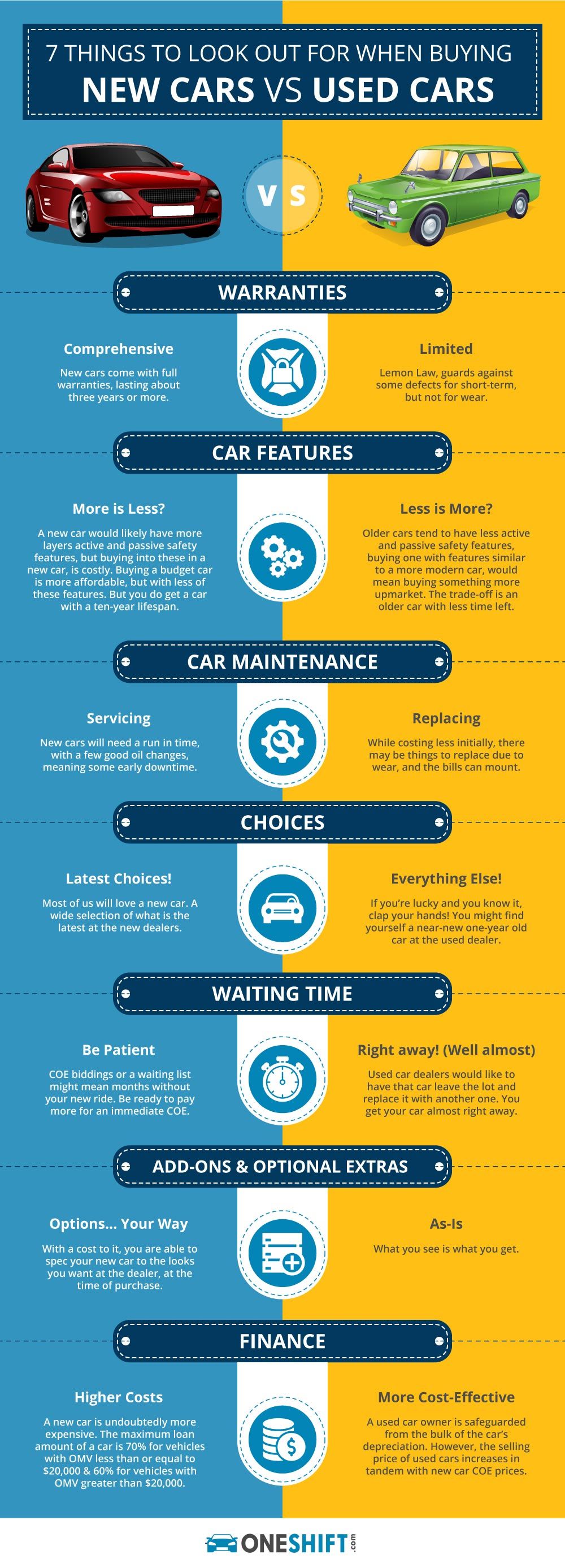
1. Set a Budget Before You Shop
Start with the full cost of ownership, not just the advertised price. A used car can require taxes, registration, insurance, fuel, maintenance, repairs, and financing costs soon after purchase.


Your budget should include:
- The purchase price
- Sales tax
- Title and registration fees
- Dealer documentation or processing fees
- Insurance
- Loan interest
- Fuel
- Tires and brakes
- Routine service
- Emergency repairs
A simple rule is to keep a separate repair fund. The amount depends on the car’s age, condition, mileage, and repair history. An older luxury car, for example, may cost less to buy but more to maintain than a newer economy car.
Compare the total price, not the monthly payment
A low monthly payment may result from a longer loan term. That can increase the total interest and keep you in debt after the car loses value.
Ask the lender or dealer for:
- The vehicle price
- The annual percentage rate, or APR
- The loan term
- The total amount financed
- The total cost of the loan
- All add-on products and fees
The Federal Trade Commission advises buyers to get financing terms in writing and review the contract before signing. Dealer financing is not always the cheapest option, so compare it with a bank or credit union.
Choose the right type of seller
Each seller type has different risks and benefits.
| Seller type | Possible benefit | Main risk |
|---|---|---|
| Private seller | Often a lower price | Usually limited legal protection |
| Independent dealer | More vehicle choice | Fees and vehicle quality can vary |
| Franchise dealer | May offer certified vehicles | Prices may be higher |
| Online seller | Convenient shopping | You may not see the car in person |
| Auction | Sometimes low prices | Limited inspection and return rights |
A private seller may not provide a warranty. Some states also offer fewer protections for private-party sales than for dealer sales. Check your state’s rules before sending money or signing a bill of sale.

2. Research the Car Before You Meet the Seller
Research the exact year, make, model, trim, engine, and drivetrain. Two cars with the same model name may have different engines, features, fuel costs, and repair risks.
Check:
- Typical market prices
- Common repair concerns for that model year
- Fuel economy
- Insurance cost
- Safety ratings
- Parts availability
- Recall history
- Maintenance intervals
- Resale value
Use several pricing sources. Kelley Blue Book, Edmunds, and NADA-based tools can provide useful estimates, but the real value depends on location, condition, mileage, title status, options, and demand.
Do not use a price guide as proof that a car is worth the seller’s price. Use it as a starting point.


Check safety recalls
Search the vehicle identification number, or VIN, through the official NHTSA recall lookup tool. An open recall means the manufacturer has identified a safety defect that still needs repair.
Recall repairs are generally completed at no cost by an authorized dealer. However, an open recall can still be a reason to delay the purchase until the repair is confirmed.
A recall search does not reveal every mechanical problem. It also does not replace a vehicle history report or a physical inspection.
Watch for model-specific costs
A hybrid, electric vehicle, diesel vehicle, turbocharged car, luxury vehicle, or four-wheel-drive truck may have higher repair costs. Ask about the parts and systems that are unique to that vehicle.
For example:
- A hybrid may need battery or inverter service.
- An electric vehicle may have battery warranty limits.
- A truck may have expensive four-wheel-drive repairs.
- A turbocharged engine may need strict oil service.
- A luxury vehicle may require costly electronic modules.
- A performance car may have worn tires, brakes, or clutch parts.
The right question is not only, “Can I afford the purchase?” Ask, “Can I afford the likely repairs?”
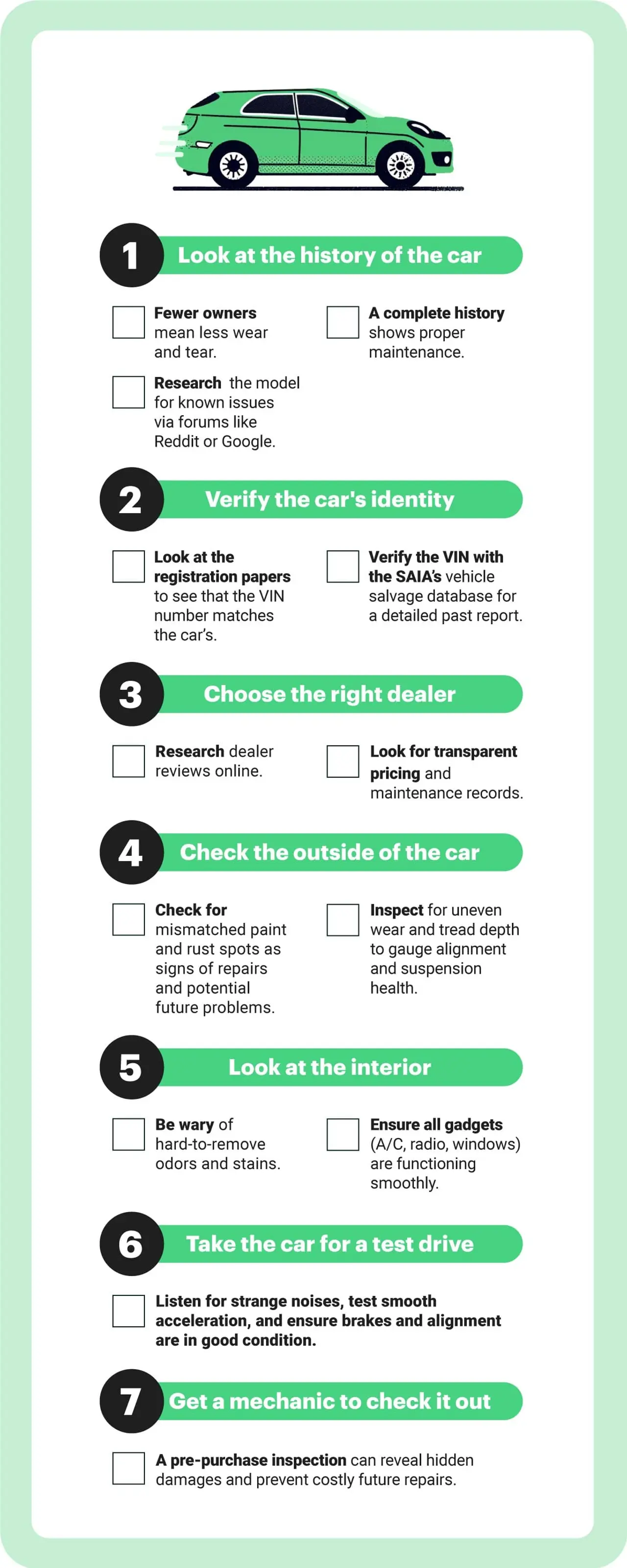
3. Verify the VIN, Title, and Vehicle History
The VIN is the car’s main identity record. In most modern US vehicles, it is a 17-character code found on the dashboard near the windshield and on the driver’s door-jamb label.
Match the VIN on:
- The dashboard
- The driver’s door label
- The title
- The registration
- The seller’s records
- Any vehicle history report
Do not buy the car if the VIN is missing, altered, damaged, or inconsistent. Ask the seller to explain any mismatch. Walk away if the explanation does not make sense.
Check the title status
The title may show serious history. Common title brands include:
- Salvage
- Rebuilt
- Flood
- Fire
- Hail
- Lemon law
- Odometer discrepancy
- Junk
- Non-repairable
Title terms vary by state. A vehicle branded as salvage in one state may receive a different label in another state. This is one reason to review the actual title and not rely only on the seller’s description.
A rebuilt or reconstructed car may be legal to drive, but it can be harder to insure, finance, or resell. It may also hide poor-quality repairs.
Use more than one history check when needed
The US Department of Justice’s National Motor Vehicle Title Information System helps consumers access title, brand, and certain theft data from participating sources. The system can help identify title problems, but it is not a complete mechanical inspection.
You can also check:
- A reputable vehicle history provider
- The National Insurance Crime Bureau VINCheck
- State DMV records
- Manufacturer service records
- Insurance records, when available


No history report is complete. Not every accident, repair, flood, or theft is reported. A clean report does not prove that the vehicle has never been damaged.
Look for odometer problems
Compare the mileage shown on:
- The title
- Service invoices
- Inspection records
- Registration records
- Oil-change labels
- Vehicle history reports
- Electronic service records
Be cautious if the mileage drops between records or seems too low for the car’s wear. Heavy wear on the steering wheel, pedals, seat, door handles, and floor mat can conflict with a low odometer reading.
Federal law prohibits odometer tampering. If you suspect fraud, do not ignore it. Ask your state motor vehicle agency or law enforcement for guidance.

4. Inspect the Exterior in Daylight
Inspect the car when it is clean, dry, and in daylight. Rain can hide paint differences, dents, and scratches. A dark garage can hide rust and poor body repairs.
Walk around the car and look for:
- Different paint colors between panels
- Uneven gaps around doors, hood, and trunk
- Overspray on rubber trim or glass
- Wavy reflections in the body
- Cracked lights
- Rust bubbles
- Fresh undercoating
- Mismatched tires
- Broken trim
- Water stains inside lights
Paint differences do not always mean a major accident. A panel may have been repaired after a minor parking-lot scrape. Still, the seller should explain the work, and an inspector should check the structure.
Check for accident repairs
Look under the hood and inside the trunk if you can do so safely. Look for:
- Bent metal
- Crumpled frame areas
- New bolts beside old bolts
- Missing factory labels
- Uneven welds
- Non-factory seams
- Overspray
- Trunk-floor damage
- Headlights with different dates or brands
Do not judge structural safety from appearance alone. Modern crash damage can be hidden behind bumpers, fenders, and interior panels. A qualified inspection is needed if you see signs of a major crash.
Check the tires and brakes
Tires can reveal alignment, suspension, or maintenance problems. Look for:
- Uneven wear
- Cracks
- Bulges
- Very low tread
- Different tire sizes
- Tires from different brands or seasons
Use a tread-depth gauge if possible. A US penny can give a rough check, but it is not a precise measurement. Tire condition should be judged against the tire maker’s markings, age, damage, and tread wear.
Look through the wheel openings at the brake rotors. Light surface rust can be normal after rain. Deep grooves, heavy rust, or a large ridge may indicate brake work is needed. A mechanic can measure the brake parts accurately.


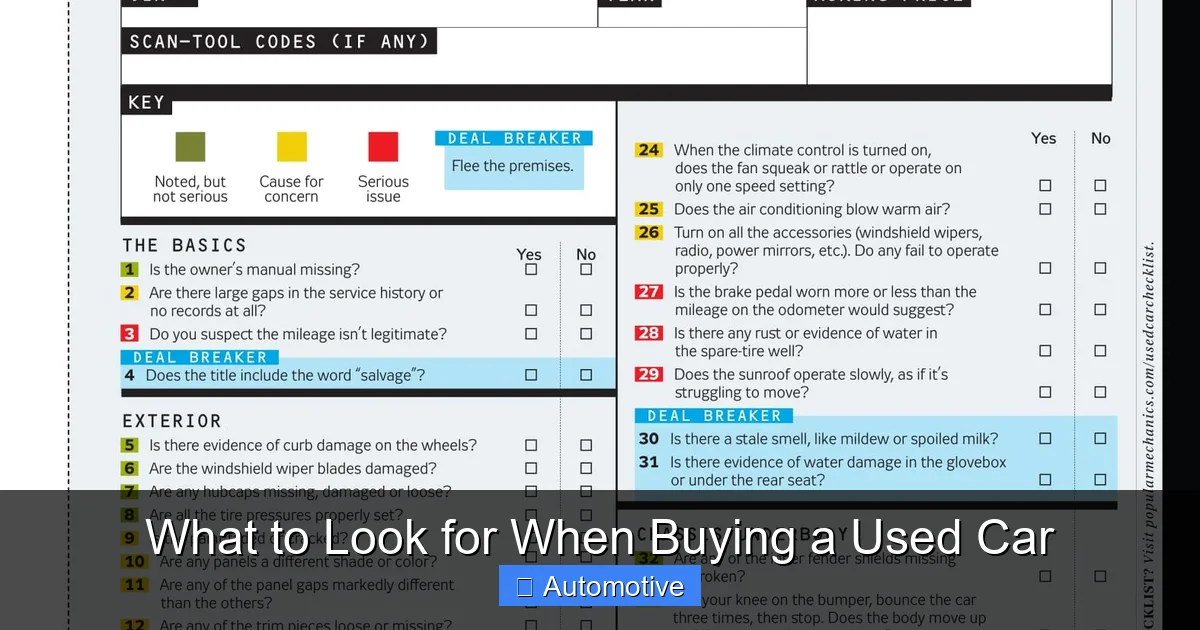
5. Inspect the Interior and Electrical Systems
A car’s interior often shows how it was used. Excessive wear may indicate hard use, high mileage, water damage, or poor care.
Check:
- Seats and seat belts
- Carpets and floor mats
- Door panels
- Headliner
- Dashboard warning lights
- Windows and locks
- Mirrors
- Wipers and washers
- Air conditioning
- Heater
- Radio and navigation
- Backup camera
- Parking sensors
- USB ports
- Sunroof
- Power seats
- Heated seats
- Interior lights
Turn the ignition on without starting the engine. Most warning lights should appear briefly as the system checks itself. After the engine starts, warning lights such as the check-engine, airbag, ABS, oil-pressure, or battery light should not remain on.
A seller may clear a warning light before showing the car. That is why an inspection should include a scan for diagnostic trouble codes and readiness monitors.
Look for water or flood damage
Flood damage can cause problems months or years later. Look for:
- Damp or musty smells
- Stained carpets
- Rust under seats
- Mud or silt in hidden areas
- Corrosion on electrical connectors
- Water lines in the trunk
- New carpet in an older vehicle
- Fogging inside lights
- Electrical faults across several systems
Do not assume a dry interior means the car was never flooded. Some damage is hidden behind trim and under carpeting.
A flood-branded title is a major warning. But flood damage may not appear in a history report if it was never reported to an insurer or state agency.

6. Start the Engine Cold and Take a Proper Test Drive
Ask the seller not to warm up the car before you arrive. A cold start can reveal problems that may disappear when the engine reaches operating temperature.
Before driving, listen for:
- Long cranking
- Ticking
- Knocking
- Grinding
- Belt squeal
- Loud rattles
- Rough idle
- Excessive exhaust smoke
Do not stand behind the exhaust for a long time. Blue smoke can suggest oil burning. Thick white smoke after warm-up may indicate coolant entering the engine. Black smoke may indicate an overly rich fuel mixture. A qualified mechanic should diagnose the cause.
Use a varied test-drive route
Drive on local roads and, if legal and safe, a highway. Test:
- Cold starting
- Acceleration
- Braking
- Steering
- Lane stability
- Transmission shifting
- Suspension movement
- Cruise control
- Air conditioning
- Heating
- Parking and reversing
The car should track straight on a reasonably level road. It should not pull hard, shake at speed, or make loud clicks during turns.


During braking, watch for:
- Vibration through the steering wheel
- Pulling to one side
- Grinding
- Pulsing
- Excessive pedal travel
- Warning lights
During acceleration, watch for hesitation, slipping, jerking, or unusual noises. An automatic transmission should shift without severe impacts. A manual transmission should not have a clutch that slips or engages at the very top of the pedal.
Never test a car in an unsafe way. Obey speed limits and road laws. If the seller refuses a reasonable test drive, consider that a serious warning.

7. Get an Independent Pre-Purchase Inspection
A pre-purchase inspection is one of the best protections for a used-car buyer. Take the car to a mechanic you choose, not only to a shop recommended by the seller.
Ask for a written inspection that covers:
- Engine
- Transmission
- Cooling system
- Steering
- Suspension
- Brakes
- Tires
- Exhaust
- Frame and body structure
- Electrical systems
- Diagnostic codes
- Fluid leaks
- Signs of flood damage
- Signs of poor repairs
- Remaining maintenance needs
For a hybrid or electric vehicle, ask whether the shop can inspect the high-voltage system and battery condition. For a diesel truck, ask for a technician with diesel experience. For an all-wheel-drive vehicle, inspect the transfer case, differentials, and related systems.
What if the seller refuses an inspection?
Do not buy the car based only on trust. A seller may have a valid reason, such as a tight schedule, but the risk remains yours.
You can:
- Ask for a mobile inspection.
- Offer to pay the inspection fee.
- Schedule the inspection at a nearby shop.
- Request a short deposit only if the terms are written.
- Walk away if the seller still refuses.
An inspection is not a guarantee. It is a snapshot of the vehicle on that day. Some intermittent faults and future failures cannot be predicted.

8. Review the Warranty, Return Policy, and Buyer’s Order
Do not assume every dealer-sold used car has a warranty or return period. In the United States, warranty and return rules can vary by state and by contract.
Look for these terms:
- As-is
- Implied warranty
- Limited warranty
- Service contract
- Certified pre-owned warranty
- Dealer return policy
- Manufacturer warranty
- Powertrain coverage
- Deductible
- Transfer restrictions
An “as-is” sale may place most repair risk on the buyer. A dealer warranty may cover only certain parts for a limited time. A service contract is a separate agreement and may exclude wear items, diagnostic fees, or pre-existing conditions.
Read the Buyers Guide displayed on a dealer vehicle. The FTC requires dealers to display this guide on used cars offered for sale. It states whether the vehicle is sold with a warranty or as-is, subject to applicable rules.
Get all promises in writing. A spoken promise such as “we will fix that later” is difficult to enforce if it is not in the contract or repair order.


9. Check for Liens, Loans, and Stolen-Vehicle Records
A lien means another party may have a legal claim to the vehicle. The seller should provide clear proof that the loan is paid or explain how the lien will be released.
Before paying, confirm:
- The seller’s name matches the title
- The title is signed correctly
- There are no undisclosed lienholders
- The VIN matches every document
- The registration status is clear
- The vehicle is not reported stolen
- The seller can legally transfer ownership
Do not send a large payment to an unknown seller before confirming the title. Be especially careful with wire transfers, gift cards, cryptocurrency, and requests to pay outside the dealership’s normal process.
If a lender holds the title, arrange payment directly with the lender or use a secure process approved by your state DMV. Keep copies of the title, bill of sale, payment record, inspection report, and seller messages.
10. Recognize Red Flags and Know When to Walk Away
Some warning signs are small by themselves. Several together can point to a larger problem.
| Red flag | Why it matters |
|---|---|
| Seller will not show the title | Ownership may be unclear |
| VIN does not match | Possible document or identity problem |
| Price is far below market value | Damage, fraud, or urgent repair may be hidden |
| Seller refuses inspection | You cannot verify the condition |
| Fresh paint on one side | May hide accident or rust repair |
| Warning lights are on | Safety or mechanical faults may exist |
| Warning lights were recently cleared | The problem may not be fixed |
| Strong air freshener smell | May hide smoke, mold, or water damage |
| New carpet in an old car | Could hide flood damage |
| Mismatched tires | May show poor maintenance or alignment issues |
| Seller pressures you to act now | Pressure reduces your chance to check facts |
| History report and title disagree | The records need further investigation |
| Seller wants payment before viewing | Common fraud warning |
Walk away if the title is branded in a way you cannot accept, the VIN is suspicious, the seller cannot prove ownership, or the vehicle has major structural or flood damage that you do not fully understand.
A good deal should still be available after a careful inspection. If the seller says you must decide immediately, let the car go.

11. Use This Used-Car Inspection Checklist
Save this checklist on your phone before you shop.
Before meeting the seller
- Research the exact model and year.
- Check market prices.
- Estimate insurance and repair costs.
- Check the VIN for recalls.
- Ask for the VIN and title details.
- Request service records.
- Arrange financing before negotiating, if needed.
At the car
- Match the VIN on the car and documents.
- Review the title and registration.
- Check for liens and title brands.
- Inspect the body in daylight.
- Check tires, lights, glass, and rust.
- Look for flood or smoke damage.
- Test warning lights and electrical features.
- Start the engine cold.
- Take a safe test drive.
- Ask questions about repairs and ownership.
Before paying
- Get an independent inspection.
- Review the vehicle history report.
- Confirm the warranty or as-is terms.
- Read every fee in the buyer’s order.
- Confirm the final price and financing terms.
- Get all repair promises in writing.
- Complete the bill of sale.
- Transfer the title correctly.
- Insure the vehicle before driving it home.

Key Takeaways
The most important things to look out for when buying a used car are:
- A clean and transferable title
- A VIN that matches all records
- No unresolved safety or ownership problems
- A complete, believable service history
- No signs of flood, fire, or poor structural repair
- A safe and consistent test drive
- An independent pre-purchase inspection
- Clear warranty, return, and financing terms
- A total cost that fits your budget
- A seller who allows reasonable checks
A vehicle history report is useful, but it is not enough by itself. The strongest decision combines documents, history, physical inspection, test driving, and advice from an independent mechanic.
Frequently Asked Questions
Is a used-car history report worth paying for?
Usually, yes. A reputable report may reveal title brands, reported accidents, odometer readings, theft records, and ownership history. However, it may not include every repair or accident. Treat it as one source of evidence, not as a substitute for an inspection.
How many miles is too many for a used car?
There is no single mileage limit that applies to every vehicle. Maintenance, age, engine type, climate, driving conditions, and service records matter more than the number alone. A high-mileage car with strong records may be safer financially than a low-mileage car with neglect or an unclear history.
Should I buy a used car with a rebuilt title?
A rebuilt-title car may cost less, but it can carry higher risks. It may be harder to finance, insure, or resell. Buy one only if you understand the damage history, have strong repair records, and obtain an inspection from a qualified professional who can assess the structure.
Can I return a used car after buying it?
Do not assume you have a three-day cancellation right. Federal law does not generally give consumers a three-day right to cancel an ordinary vehicle purchase after signing at a dealership. Return rights depend on the contract, seller, and state law. Review the paperwork before you pay.
What should I do if the seller will not provide the VIN?
Do not send money or travel to buy the car without the VIN. A legitimate seller should normally allow you to verify the vehicle’s identity and history. Refusal is a strong reason to move on.
Is a certified pre-owned car always a safe purchase?
No. Certified pre-owned programs usually include eligibility rules, inspections, and a limited warranty, but programs differ by manufacturer and dealer. Read the certification checklist, warranty terms, exclusions, and deductible. An independent inspection can still be useful.
Conclusion
The safest way to buy a used car in the USA is to slow down and verify each part of the deal. Check the VIN and title, review the history, inspect the car in daylight, take a proper test drive, and hire an independent mechanic.
Do not let a low price, urgent seller, or attractive monthly payment replace basic checks. If the records are unclear or the seller refuses a reasonable inspection, walk away. There will always be another used car.
