

Yes. In most cases, you can cancel your car insurance at any time in the United States. You do not usually have to wait until the policy renewal date.
However, cancellation can trigger fees, a refund adjustment, a coverage gap, or problems with your state vehicle registration. If you finance or lease the car, your lender may also require continuous coverage.
The safest approach is to arrange replacement coverage first, then submit a clear cancellation request to your insurer and keep written proof.
What happens when you cancel car insurance?
When you cancel, your insurer ends coverage on the date and time you request, or on another date the company accepts. After that point, the policy will not pay for a new accident, theft, or other covered loss.


Your final bill or refund may depend on:
- Your policy’s cancellation terms
- The cancellation date
- Whether you paid in advance
- Any cancellation or short-rate fee
- Unused premium
- Claims already paid or still being reviewed
- State insurance rules
Many insurers refund unused premium. Some use a pro rata method, which means the refund is based on the exact unused time. Others may use a short-rate method, which applies a penalty when you cancel before the policy term ends.
Your policy documents and state law control the details. The National Association of Insurance Commissioners explains that insurance rules can differ by state, so check your policy and your state insurance department before acting.
Can you cancel car insurance before the renewal date?
Yes. Most U.S. auto insurance policies allow the policyholder to cancel before renewal.
You may be able to cancel:
- The day after buying the policy
- Before the next billing date
- Before the six-month or 12-month renewal
- After selling the car
- After moving to another state
- When switching insurers
- When you no longer drive the vehicle
Some insurers charge an early cancellation fee. Others do not. A fee may be listed as a cancellation fee, administrative fee, or short-rate charge.
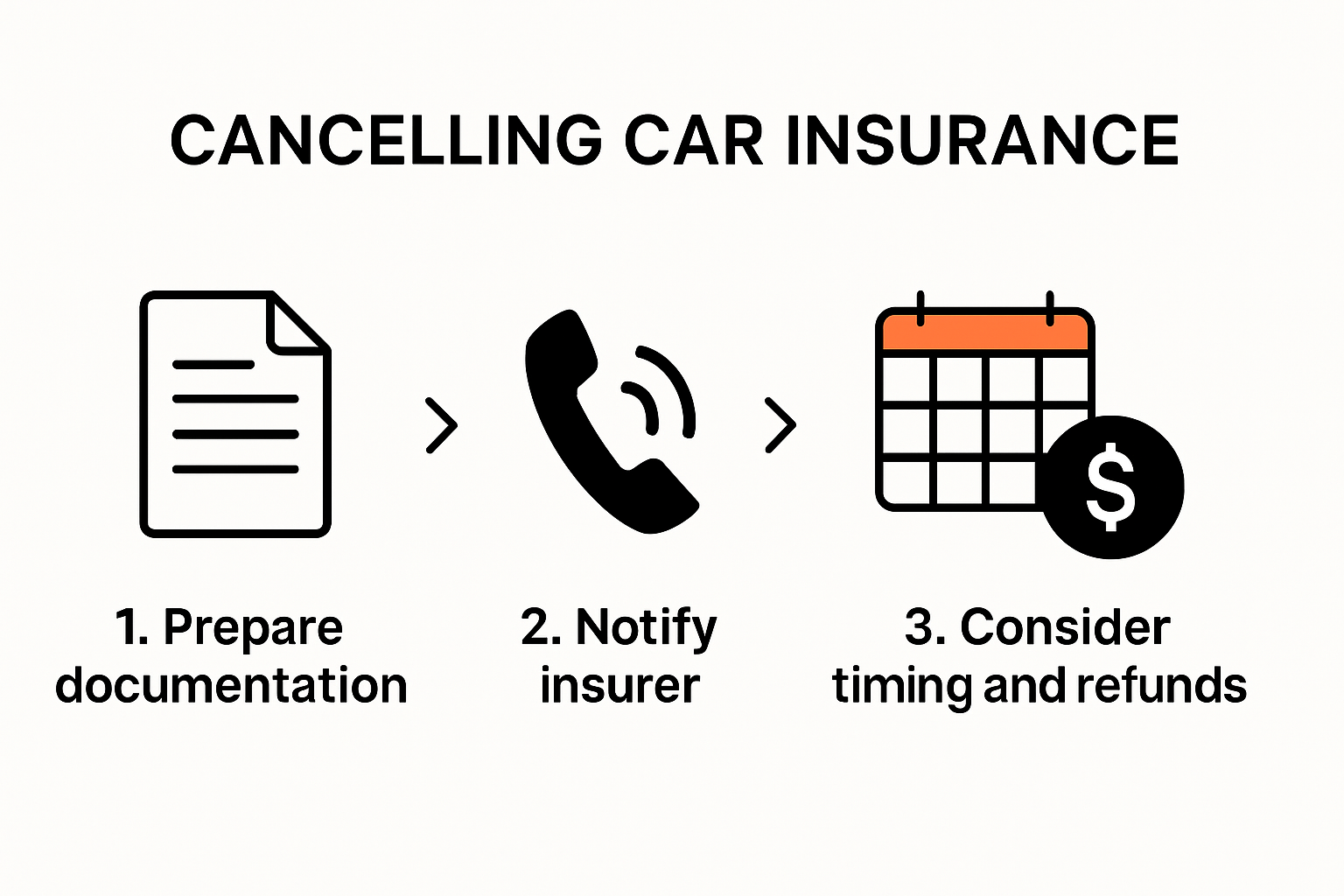
Ask the insurer these questions before you cancel:
- What date and time will coverage end?
- Will you owe a cancellation fee?
- Will I receive a refund?
- How will you calculate the refund?
- Do you need proof that the car was sold, traded, or replaced?
- Will you notify my lender or state motor vehicle agency?
Do not rely only on a phone conversation. Request written confirmation by email, letter, or through the insurer’s online account.
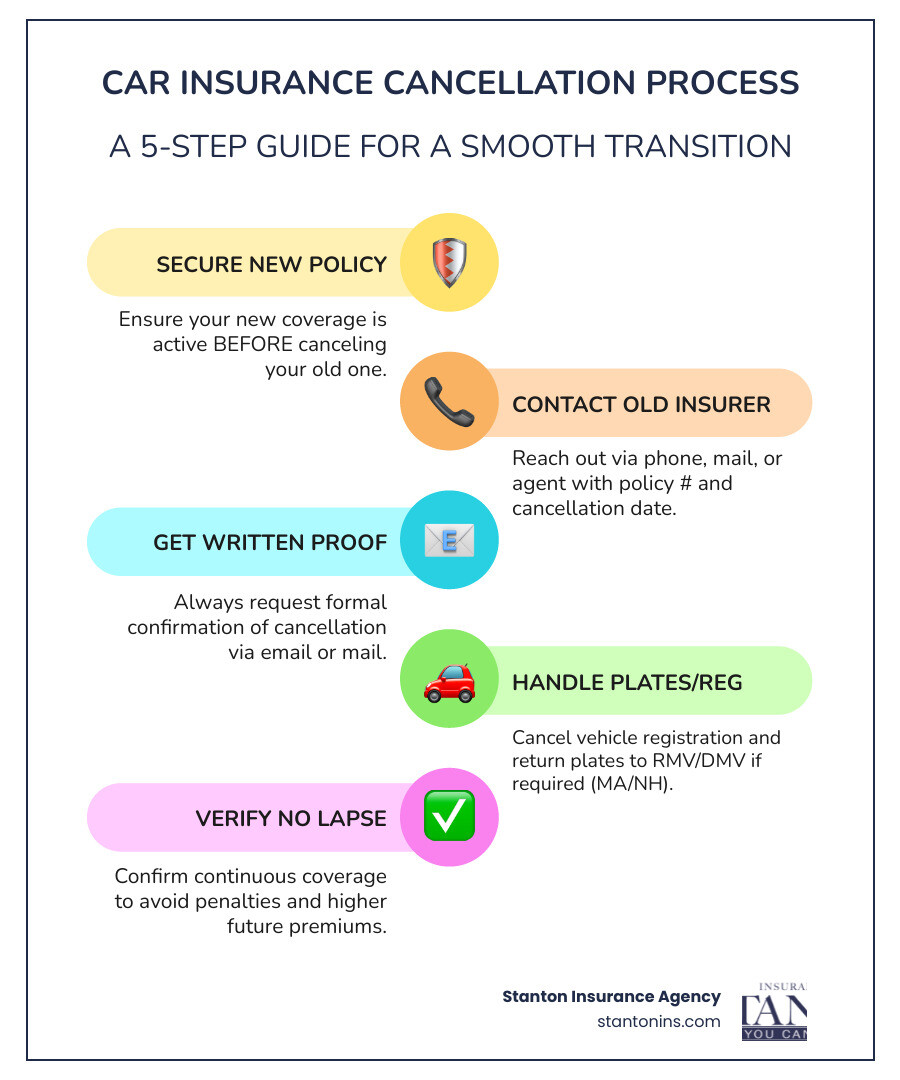
How to cancel your car insurance safely
Follow these steps to reduce the risk of a coverage gap or registration problem.


1. Check whether you still need coverage
Before canceling, confirm what will happen to the vehicle.
You may still need insurance if:
- You plan to drive the car
- The vehicle is parked on a public street
- The car is financed or leased
- Your state requires insurance for a registered vehicle
- Another person may use the car
- You need comprehensive coverage for theft, fire, or storm damage
A car that is not being driven may still be exposed to theft, vandalism, falling objects, fire, or weather damage. Some insurers offer a storage or comprehensive-only policy, but availability and state rules vary.
Do not cancel simply because the car is parked. First ask the insurer and your state motor vehicle agency what coverage and registration steps apply.
2. Buy replacement insurance before canceling
If you are changing companies, start the new policy before the old one ends.
For example:
- Old policy ends: March 31 at 11:59 p.m.
- New policy starts: March 31 at 12:01 a.m.
Ask both insurers to confirm the exact effective time. A one-day gap can leave you personally responsible for damage, injuries, towing, or legal claims.
In many states, driving without required insurance can lead to fines, license suspension, registration suspension, or other penalties. The Insurance Information Institute also warns that a lapse can make future insurance more expensive.
3. Contact your insurer
The company may let you cancel by:
- Phone
- Website or mobile app
- Written letter
- Local agent
The required process differs by insurer. Give the company:
- Your full name
- Policy number
- Vehicle details
- Requested cancellation date
- Reason for cancellation, if requested
- New insurer information, when relevant
- Proof of sale or a bill of sale, if applicable
You do not always need to explain why you are canceling. A clear request to end the policy is usually enough, but the insurer may ask for more information to process the request.
4. Get written confirmation
Ask for a document that shows:
- The cancellation date
- The cancellation time
- The policy number
- Any refund or balance
- Any fee charged
- Whether automatic payments will stop


Keep the confirmation with your insurance records. It can help if the insurer later bills you or if a state agency asks why the policy ended.
5. Confirm the refund and stop automatic payments
If you paid ahead, the insurer may send a refund to your bank account, credit card, or by check. The amount may not equal the unused days multiplied by your daily premium because of fees, taxes, or the insurer’s refund method.
Do not cancel an automatic payment until you know whether the insurer still owes a final bill. A bank stop-payment order does not cancel the insurance contract by itself.
What if you sold, traded in, or totaled the car?
You can usually cancel coverage for a vehicle you no longer own, but do not assume the insurer will cancel it automatically.
Contact the insurer after:
- Selling the vehicle
- Trading it in
- Transferring the title
- Returning a leased vehicle
- Having the vehicle declared a total loss
Give the company proof when requested. Useful documents may include:
- Bill of sale
- Dealer trade-in paperwork
- Notice of transfer
- Lease return receipt
- Salvage or total-loss documentation
If you still own another vehicle, you may not need to cancel the entire policy. The insurer may remove only the sold or totaled car and recalculate your premium.
If you sold your only car, ask whether your state requires you to surrender the plates or cancel the registration. States handle this in different ways. The official website of your state’s motor vehicle agency is the best source for that step.
What if you finance or lease the vehicle?
You may be able to cancel your personal auto policy, but you usually cannot leave a financed or leased car uninsured.
Most loan and lease agreements require collision and comprehensive coverage. These cover damage to the vehicle itself and protect the lender’s financial interest.
If you cancel required coverage, the lender may:
- Send you a warning
- Buy force-placed insurance
- Add the cost to your loan
- Declare the loan in default
- Take other action allowed by the contract
Force-placed insurance can cost more than a standard policy and may protect only the lender, not you.
Before canceling, contact the lender or leasing company. Ask what coverage limits, deductibles, and policy dates they require. If you are switching insurers, make sure the new policy lists the lender or lessor correctly as an interested party.


Can you cancel car insurance during a claim?
You can often cancel a policy while a claim is open, but cancellation does not erase the insurer’s duties for an accident that happened while the policy was active.
For example, if a covered crash happened on June 1 and you cancel the policy on June 10, the insurer may still handle the June 1 claim under the policy terms.
The result can depend on:
- The date of the loss
- Whether the policy was active at that time
- The type of claim
- Policy exclusions
- Whether you gave timely notice
- State law
Ask the claims representative how cancellation will affect the open claim. Keep copies of photos, estimates, police reports, medical records, and claim messages.
Do not cancel because you think it will make a pending claim disappear. It generally will not, and failing to cooperate with a valid claim can create separate problems.
Can an insurer refuse to let you cancel?
An insurer may not process the cancellation exactly as you request if:
- The request is missing required information
- The requested date is unclear
- The policyholder is not the person making the request
- The account has a claim or billing issue
- State rules require a specific notice
- The policy has multiple named insureds
- The vehicle has a lender or lease requirement
This does not always mean you are unable to cancel. It may mean the company needs a signed form or other proof.
Ask the insurer to explain the reason in writing. If the company does not follow the policy or state rules, you can contact your state insurance department. The NAIC provides links to state insurance departments through its consumer insurance resources.
Should you cancel or switch your car insurance?
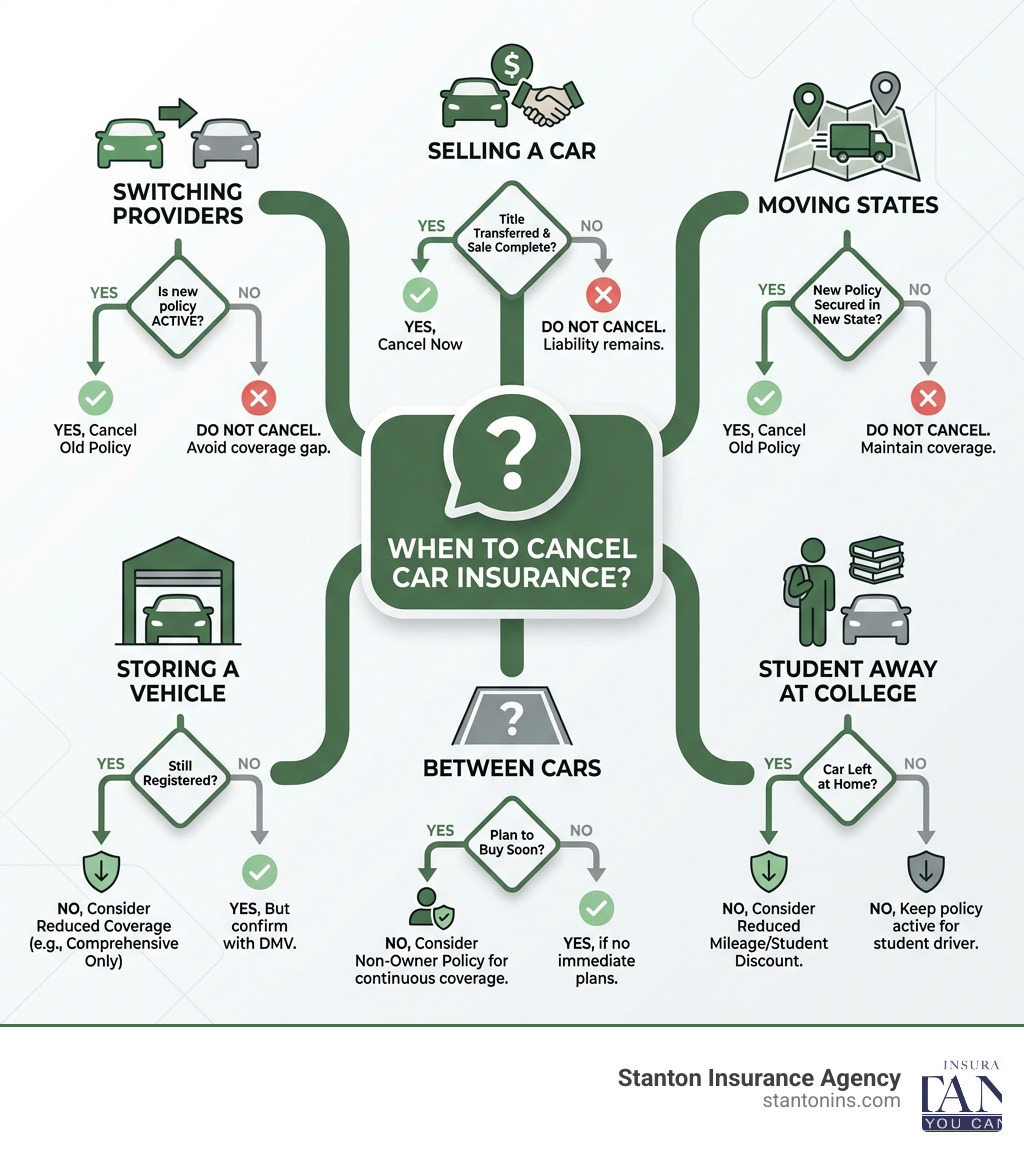
The right choice depends on why you want to end the policy.
| Situation | Usually safer action |
|---|---|
| You found a lower rate | Start the new policy before ending the old one |
| You sold your only car | Ask the insurer about cancellation and your state about registration |
| You sold one of several cars | Remove that vehicle instead of canceling the full policy |
| You are moving to another state | Buy a policy in the new state and coordinate the dates |
| You are storing the car | Ask about storage or comprehensive-only coverage |
| You are unhappy with a claim | Review the claim process before ending needed coverage |
| You cannot afford the premium | Ask about payment plans, discounts, limits, and higher deductibles |
| You are leaving the country temporarily | Ask about storage, registration, and future insurance requirements |
Switching insurers does not always require canceling the old policy yourself. A new insurer or agent may offer to handle the cancellation, but confirm that the old policy actually ended.
Changing coverage limits or deductibles may solve a cost problem without creating a lapse. Be careful when reducing liability limits. The lowest premium may leave you with greater personal financial risk after a serious crash.
What are the risks of canceling without replacement coverage?
The biggest risk is a coverage lapse. A lapse is a period when you own or operate a vehicle but have no active insurance.
A lapse may cause:
- Tickets or registration penalties
- Suspension of driving privileges
- Personal responsibility for accident costs
- Higher future premiums
- Difficulty meeting a lender’s requirements
- Problems proving continuous insurance
- Loss of certain insurance discounts
Even a short lapse can matter. If you are not driving and do not own a registered vehicle, the risk may be different, but confirm the rules first.


Never drive after the cancellation time unless the vehicle has valid coverage. If a new policy is delayed, do not assume an application or payment receipt means coverage has started. Obtain the new insurer’s declarations page or written confirmation of the effective date.

Can you cancel car insurance and get a refund?
Often, yes, but the amount varies.
A simple hypothetical example:
- You pay $1,200 for six months.
- You cancel halfway through the term.
- A pro rata refund might start near $600.
- A cancellation fee, taxes, or other charges could reduce that amount.
This is only an example. Your actual refund depends on the policy, state rules, payment plan, and insurer’s calculation.
You may receive no refund if:
- The premium was already earned
- The policy had a minimum premium
- Fees equal the unused amount
- A claim or balance affects the account
- You paid only for coverage already provided
Request an itemized final statement. It should show the cancellation date, refund or balance, and each charge.
Common mistakes to avoid
Avoid these errors when ending auto insurance:
- Canceling before replacement coverage begins
- Assuming the dealership canceled the policy
- Forgetting to remove a sold car from the policy
- Ignoring a lender’s insurance requirement
- Stopping payments without written cancellation
- Failing to return plates when required
- Driving after the policy ends
- Relying on a text message without checking the effective time
- Canceling every vehicle when only one car was sold
- Assuming a parked car needs no protection
- Throwing away the cancellation confirmation
The most serious mistake is creating a gap without realizing it. Treat the start of the new policy and the end of the old policy like two ends of the same bridge. Both dates must connect.
Frequently asked questions
Can I cancel my car insurance the same day?
Possibly. Many insurers can process a same-day cancellation, but the exact time matters. Ask the company to confirm when coverage ends in writing. Do not drive after that time unless another policy is active.
Do I need a reason to cancel car insurance?
Usually, no. An insurer may ask why you are canceling for recordkeeping, but the policy and state rules determine whether a reason or document is required. A sale, move, or vehicle replacement may require proof.
Is there a penalty for canceling car insurance early?
There may be a cancellation fee or short-rate adjustment. Some insurers do not charge one. Review the policy and ask for an itemized calculation before choosing a cancellation date.
Can I cancel car insurance if I still owe money?
You may be able to cancel, but any unpaid premium can remain due. Cancellation does not erase a valid balance. If the vehicle is financed, the lender may still require insurance until the loan is paid off.
Can I pause my car insurance instead of canceling it?
Some insurers offer storage, suspension, or comprehensive-only options. These programs differ by company and state. Ask whether the option covers driving, theft, weather damage, and lender requirements before choosing it.


Bottom line
You can usually cancel car insurance at any time in the United States, including before the renewal date. The safest process is to confirm your state and lender requirements, arrange replacement coverage when needed, submit the cancellation request, and obtain written proof.
If you sold the car, also check your registration and license-plate obligations with your state motor vehicle agency. If you are unsure about a fee, refund, claim, or lender demand, contact the insurer and your state insurance department before ending coverage.
Sources and further reading
- National Association of Insurance Commissioners: Auto Insurance
- Insurance Information Institute: Auto Insurance
- NAIC: State Insurance Departments
- Your state’s official motor vehicle agency website for registration and plate requirements