

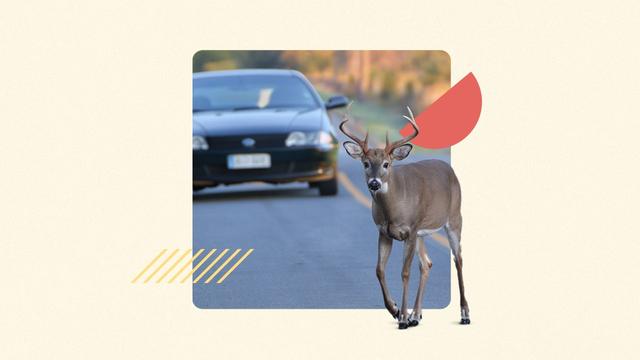
Deer run in front of cars because roads often cut through their travel routes. When a deer crosses a road, bright headlights, loud traffic, or sudden movement may startle it. The deer may freeze, turn back, or continue forward without judging the car’s speed.
This risk is common across the United States, especially in wooded and rural areas. Deer-vehicle crashes rise in the fall, during dawn and dusk, and in places where roads divide forests, fields, and water sources.
The safest response is simple: slow down, stay alert, and never swerve sharply to avoid a deer unless you can do so without entering another lane or leaving the road.

Why do deer run in front of cars?
Deer usually do not run toward cars on purpose. They are trying to cross the road, escape a threat, follow another deer, or reach food, water, or shelter.


Several factors can make a deer appear to “run in front” of a vehicle:
Roads cross natural deer paths
Deer move between feeding and resting areas each day. A road may pass through that route. The deer sees the road as part of its normal habitat, not as a danger zone.
This is more likely near:
- Forest edges
- Farm fields
- Suburban greenbelts
- Rivers, ponds, and creeks
- Wildlife crossings
- Parks and large undeveloped areas
- Roads with thick brush on both sides
A road can also divide a deer’s habitat. When development removes open land, deer may use the remaining corridors more often.
Deer are active at dawn and dusk
Deer often move during low-light periods. This includes the hour before sunrise and the hours around sunset. These times also make it harder for drivers to see movement near the road.
Deer can appear suddenly because their brown coats blend with trees, grass, and shadows. By the time a driver sees the animal, the stopping distance may already be too long.
Headlights can confuse or startle deer
Bright headlights may cause a deer to stop and stare. This is why drivers sometimes see glowing eyes before they see the animal’s body.
Headlights do not reliably “hypnotize” deer. The light may simply startle the animal or limit its ability to judge what is coming. A deer may remain still for a moment, then bolt in an unpredictable direction.
One deer may be followed by others
Deer often travel in groups. If one deer crosses the road, more may follow seconds later.
This is one of the most useful facts for drivers: seeing one deer means you should look for more. Slow down and scan both sides of the road before continuing.
A deer may be escaping another threat
A deer can enter the road while fleeing:


- A dog
- A hunter
- Another deer
- A vehicle
- A predator
- Loud construction or machinery
A frightened deer may focus on escape instead of traffic. It may also change direction without warning.
Deer do not understand traffic the way people do
Deer can learn that some roads are dangerous, but they do not consistently judge vehicle speed, distance, or stopping time. A vehicle traveling 55 mph may look far away to a deer but reach the crossing point in seconds.
That mismatch creates the familiar pattern: the deer waits near the shoulder, enters the lane, and crosses just as a vehicle approaches.

When are deer-vehicle crashes most common in the United States?
Deer crashes are most common during the fall mating season and migration periods, but the risk exists all year.
Fall is the highest-risk season
In much of the United States, deer movement increases from October through December. The peak often occurs in November, when breeding activity causes bucks and does to move more than usual.
Fall also brings:
- Shorter daylight hours
- More driving during dawn and dusk
- Increased deer movement
- Hunting activity
- Colder weather
- More travel through rural areas
The exact peak differs by state and local deer behavior. Drivers should follow warnings from their state wildlife agency and transportation department.
Dawn and dusk require extra care
Many deer crashes occur between sunset and sunrise. Drivers should take special care during:
- The first hour after sunrise
- The last two hours before sunset
- The hours after dark
- Cloudy or foggy conditions
- Times when glare reduces visibility
Use high beams when legal and safe, but switch to low beams when approaching another vehicle. High beams can help you see deer farther ahead, but they cannot prevent every sudden crossing.
Weather can change deer movement
Rain, snow, fog, and strong wind can push deer toward sheltered areas or open roads. After a storm, deer may also move more as they search for food.
Poor weather increases the need for slower speeds because it reduces both visibility and tire grip. Do not rely on bright lights alone.
Rural roads are not the only concern
Deer are common in suburban areas across the United States. A wooded neighborhood, golf course, greenway, or park can support deer even when homes and businesses are nearby.
Treat divided highways, country roads, and suburban streets differently, but stay alert on all of them. A deer can cross a four-lane road in seconds.


What should you do when a deer runs into the road?
The safest response is to brake firmly while keeping control of the vehicle. Do not make a sudden, high-speed swerve that could send you into oncoming traffic, a ditch, a tree, or another vehicle.
Follow these steps:
- Take your foot off the accelerator.
- Brake firmly and stay in your lane.
- Keep both hands on the steering wheel.
- Look where you want the vehicle to go, not only at the deer.
- Sound the horn if the deer has time to react.
- Watch for additional deer.
- Stop only when it is safe to do so.
The best maneuver depends on the road, traffic, speed, and distance. In many cases, controlled braking is safer than swerving.
Why swerving can be more dangerous
A deer is usually smaller and more flexible than a vehicle. A sharp swerve may avoid the deer but cause a more serious crash with:
- An oncoming vehicle
- A guardrail
- A tree
- A utility pole
- A ditch
- A cyclist or pedestrian
This does not mean a driver must hit a deer in every situation. If the deer is far away and the road is clear, a controlled lane change may be possible. The key rule is to avoid losing control or entering a more dangerous path.
Should you flash your headlights?
Flashing headlights may not reliably move a deer. It is better to reduce speed and prepare to stop.
If you are driving behind another vehicle, do not use high beams in a way that blinds the other driver. Safe visibility matters, but it must not create a second hazard.
Should you honk?
A horn may scare a deer away from the lane, but the animal may also run unpredictably. Use the horn when it can help, while continuing to brake and maintain control.
Do not assume that one long horn blast will clear the road. Keep watching both shoulders.
What if the deer stops in the road?
Keep braking and give the deer space if possible. Do not drive around it at high speed. A stopped deer may suddenly turn back or move toward the vehicle.
If traffic behind you is close, avoid abrupt actions that could cause a rear-end crash. Once you stop, use hazard lights when appropriate and remain aware of other traffic.

How can drivers reduce the chance of hitting a deer?
Drivers cannot remove the risk, but they can reduce it by changing speed, attention, and scanning habits.
Slow down in deer habitat
A lower speed gives you more time to see, react, and stop. It also reduces the force of a collision.
Pay extra attention when you see:
- Deer crossing signs
- Heavy brush near the shoulder
- Open fields beside wooded areas
- Wildlife fencing
- Recent deer carcasses
- Warning signs from local transportation agencies


A deer crossing sign does not mean deer are present every day. It means the area has a known or documented risk.
Scan the road edges
Do not look only at the center of the lane. Scan both shoulders for:
- Eye shine
- Movement in grass
- Ears or legs between trees
- A partial body behind brush
- A group of deer near the edge
At night, eye shine can warn you before the animal enters the lane. Slow down as soon as you see it.
Use your headlights correctly
Keep headlights, windshields, and mirrors clean. Dirt and glare can reduce visibility.
Use high beams on dark roads when no vehicle is approaching and when local rules allow them. Return to low beams before you meet or follow another vehicle closely.
Keep your attention on driving
Do not use a phone, adjust complex controls, or stare at a roadside distraction in a known deer area. A few seconds of inattention can cover a large distance.
Drivers should also avoid assuming that a quiet road is a safe road. Deer can appear on roads with little traffic because they may use them as easy crossing points.
Give motorcycles and smaller vehicles extra care
A collision with a deer can be especially dangerous for a motorcyclist. Motorcyclists may have less protection and less room to recover from a sudden evasive move.
Drivers should avoid abrupt lane changes near motorcycles. Motorcyclists should slow down early and keep a clear escape path without swerving into traffic.

What should you do after hitting a deer?
After a collision, move to safety before dealing with the animal or vehicle. A damaged car, a frightened deer, and passing traffic can create several hazards at once.
If the car still moves safely
- Turn on hazard lights.
- Pull as far off the road as possible.
- Turn off the engine if appropriate.
- Check yourself and your passengers for injuries.
- Call 911 if anyone is hurt or the crash creates a traffic hazard.
- Contact local law enforcement or the state wildlife agency as required.
- Call your insurance company.
- Take photos from a safe location.
The reporting rules differ by state. Some states require a report for a crash, a vehicle recovery, or a collision that causes injury or significant property damage. Follow your state’s instructions.
Do not approach the deer
A wounded deer may kick, charge, or move suddenly. Do not try to touch, restrain, transport, or kill the animal.
Tell the dispatcher or wildlife agency where the deer is located. Give the road name, direction of travel, nearby mile marker, and any immediate traffic danger.


Do not stand in a traffic lane
If your vehicle is disabled, stay inside with your seat belt on when that is safer than standing outside. If you must leave the car, move well away from traffic only when you can do so safely.
Check your vehicle for:
- Broken headlights
- Fluid leaks
- A damaged radiator
- Loose body panels
- Steering problems
- Brake problems
- A deployed air bag
Do not continue driving if the vehicle leaks fluid, has steering or brake damage, or has parts that may fall off.
Insurance coverage may vary
A deer collision is often handled under comprehensive auto coverage rather than collision coverage, but policies and deductibles differ. Damage caused by swerving into another object may be handled differently from direct contact with the animal.
Review your policy and ask your insurer how the claim would apply. Do not assume that every deer-related crash has the same coverage.
Common myths about deer and cars
Myth: Deer are frozen by headlights
Reality: Deer may stop when startled by light, but headlights do not reliably immobilize them. The animal may remain still, turn, or run across the road.
Myth: A deer will always run away from a car
Reality: A deer may run in any direction. It may move toward the lane, turn around, or follow another deer.
Myth: One deer means the road is clear after it crosses
Reality: Other deer may follow. Slow down and scan both sides for at least several seconds.
Myth: Deer whistles guarantee safety
Reality: There is no reliable basis for treating aftermarket deer whistles as a guarantee against collisions. They do not replace slower speeds, careful scanning, and controlled braking.
Myth: Swerving is always the best way to avoid a deer
Reality: Swerving can avoid the animal but create a more serious crash. Controlled braking in the lane is often the safer first response, unless staying in the lane creates an immediate greater danger.
Myth: Deer are only a rural-road problem
Reality: Deer also live near suburbs, parks, golf courses, and wooded neighborhoods. Roads near green space can carry a meaningful risk even inside developed areas.

How much damage can a deer cause?
A deer can cause serious damage even when the vehicle does not seem to be traveling very fast. The animal’s body can strike the hood, grille, windshield, roof, or side of the vehicle.
Possible damage includes:
- A crushed hood
- Broken headlights
- A damaged radiator
- Cracked glass
- Bent fenders
- Broken sensors
- Air-bag deployment
- Steering or suspension damage
Vehicle size affects the type of damage, but no vehicle is immune. Trucks and SUVs may have a different impact height than sedans, while motorcycles expose riders to a much higher injury risk.
The financial cost also varies. Repair costs depend on the impact point, vehicle model, safety-system damage, and whether the vehicle can be driven after the crash. A mechanic should inspect the vehicle before you assume it is safe.


What does research say about deer-vehicle collisions?
Transportation and wildlife agencies treat deer-vehicle collisions as both a road-safety problem and a wildlife-management issue.
The Federal Highway Administration reports that wildlife-vehicle collisions cause substantial property damage, injuries, and deaths in the United States each year. Deer are among the most common large animals involved in these crashes.
Research and agency guidance consistently point to several risk factors:
- High deer density
- Roads that divide habitat
- High traffic speed
- Low-light travel
- Fall breeding activity
- Poor visibility
- Lack of fencing or wildlife crossings
The exact number of crashes is difficult to measure. Some collisions are not reported, and reporting rules differ by state. Estimates should therefore be treated as national approximations, not as a precise count of every crash.
Useful U.S. sources include:
- Federal Highway Administration: Wildlife-Vehicle Collision Reduction Study
- Federal Highway Administration: Wildlife Crossing Structure Handbook
- Insurance Institute for Highway Safety: Animal Crashes
- National Park Service: Wildlife Safety
These sources support the main practical lesson: drivers should manage speed and attention because deer movement is difficult to predict.

Frequently asked questions
Why do deer jump in front of cars at night?
Deer may cross roads at night while moving between feeding and resting areas. Headlights can startle them or make it hard for them to judge distance. Their movement is not deliberate; it is usually a crossing attempt that happens to overlap with the vehicle’s path.
What time of year do most deer get hit by cars?
In many parts of the United States, collisions increase in the fall, especially from October through December. November is often a high-risk month because of breeding activity. Local patterns differ, so state and county warnings are useful.
What should you do if a deer is on the shoulder?
Slow down, cover the brake, and scan the opposite shoulder. The deer may enter the road, and another deer may follow. Do not speed up until you have passed the animal and the area is clear.
Is it safer to hit a deer or swerve?
There is no answer that fits every road situation. A controlled stop or slowdown is usually safer than a sharp swerve. If swerving would send you into traffic, a ditch, or a fixed object, keep control of the vehicle and brake.
Do deer cross roads in groups?
They often can. A deer traveling alone may be followed by others, especially during periods of increased movement. After seeing one deer, slow down and continue watching both sides of the road.
Can deer see car headlights?
Deer can detect light, but they may not judge the vehicle’s speed or distance well. Headlights can startle them, make them pause, or cause sudden movement. Drivers should not expect headlights to guide the deer away.
Key takeaways
- Deer run in front of cars because roads cross their normal travel routes.
- The greatest risk often occurs at dawn, dusk, and during the fall breeding season.
- One deer may be followed by more.
- Slow down and scan both road edges.
- Brake firmly and keep control of the vehicle.
- Avoid sharp swerves unless they are clearly safer.
- Do not approach an injured deer after a crash.
- Report the collision according to your state’s rules.
Conclusion
Deer do not usually run toward cars by choice. They are crossing roads, escaping danger, following other deer, or moving through habitat that a roadway has divided.
For drivers in the United States, the best defense is steady attention. Reduce speed in deer areas, use headlights wisely, watch the shoulders, and prepare to brake near dawn, dusk, and during the fall. If a collision happens, protect people first, avoid the animal, and contact the proper authorities.
