How Long Can You Drive On Low Tire Pressure: Safe Guide
You should drive on low tire pressure only long enough to reach a safe place where you can check and inflate the tire. There is no safe mileage limit. A tire that is slightly low may reach a nearby gas station, while a badly underinflated or flat tire should not be driven at all.
If the tire pressure warning light comes on while you are driving in the United States, slow down, avoid hard turns and sudden braking, and pull over safely. Check the tire pressure as soon as possible. If the tire looks flat, feels unstable, or loses air quickly, call roadside assistance instead of continuing.
Low pressure lets the tire flex more than designed. That creates heat, harms handling, reduces fuel economy, and can lead to tire failure. The risk rises with speed, heavy loads, hot weather, and long distances.

The Short Answer: Drive Only to a Safe Place
A tire with low pressure may be driven a short distance at low speed if it still holds air and the vehicle feels normal. That distance should be limited to reaching a safe location, such as a nearby parking lot, service station, or tire shop.
Do not treat “a few miles” as a guaranteed safe limit. Tire damage can begin before the driver notices a problem. The tire’s condition, pressure level, load, road temperature, and speed all change the answer.
Use this general guide:
| Tire condition | Can you drive? | Best action |
|---|---|---|
| Slightly below the door-jamb pressure | Only a short trip, with care | Inflate it soon |
| Pressure warning light is on, but the tire looks normal | Usually only to a nearby safe place | Drive slowly and check pressure |
| Tire is visibly soft or badly low | No normal driving | Inflate it before moving, if safe |
| Tire is flat, damaged, or losing air fast | No | Install the spare or call for help |
| Tire has a sidewall bulge, cut, or exposed cord | No | Do not drive on it |
| Run-flat tire with a documented emergency range | Only within the vehicle and tire maker’s limits | Follow the owner’s manual |
The safest rule is simple: low pressure is a repair or inflation problem, not a distance challenge.
Why Low Tire Pressure Is Dangerous
Low tire pressure makes the tire’s sidewalls bend more with each rotation. That extra movement produces heat inside the tire. If the heat becomes excessive, the internal structure can weaken and the tire may fail.
Underinflation also changes how the vehicle responds. Steering may feel heavy or slow, and the vehicle may pull to one side. Braking distance and cornering control can suffer, especially on wet roads.
The National Highway Traffic Safety Administration warns that underinflated tires can overheat and fail. NHTSA also identifies tire problems as a major vehicle safety concern in the United States. Its tire-safety guidance recommends checking pressure regularly and using the pressure listed on the vehicle’s tire information label or in the owner’s manual.
Low pressure can cause other problems:
- Faster wear on both tire shoulders
– Lower fuel economy - Poor handling during emergency maneuvers
- Damage to the sidewall and internal belts
- Increased risk of a blowout
- Damage to the wheel if the tire collapses
A tire may look acceptable from outside after being driven while low. Internal damage is not always visible. That is why a tire that was driven while severely underinflated should be inspected by a qualified tire professional.

What to Do When the Tire Pressure Light Comes On
Follow these steps when the TPMS light appears while you are driving.
1. Reduce speed smoothly
Avoid sudden steering, hard braking, and fast lane changes. Keep both hands on the wheel and notice whether the vehicle pulls, shakes, or feels unstable.
2. Move to a safe place
Exit the highway if you can do so safely. Pull into a well-lit parking lot, rest area, or wide shoulder away from traffic. Do not stop in an unsafe location just to check the tire.
3. Inspect all four tires
Look for:
- A tire that appears lower than the others
- A nail, screw, or other object in the tread
- A cut, bulge, or split sidewall
- Tire debris
- Air escaping from the valve area
Do not remove a nail or screw. It may be slowing the leak.
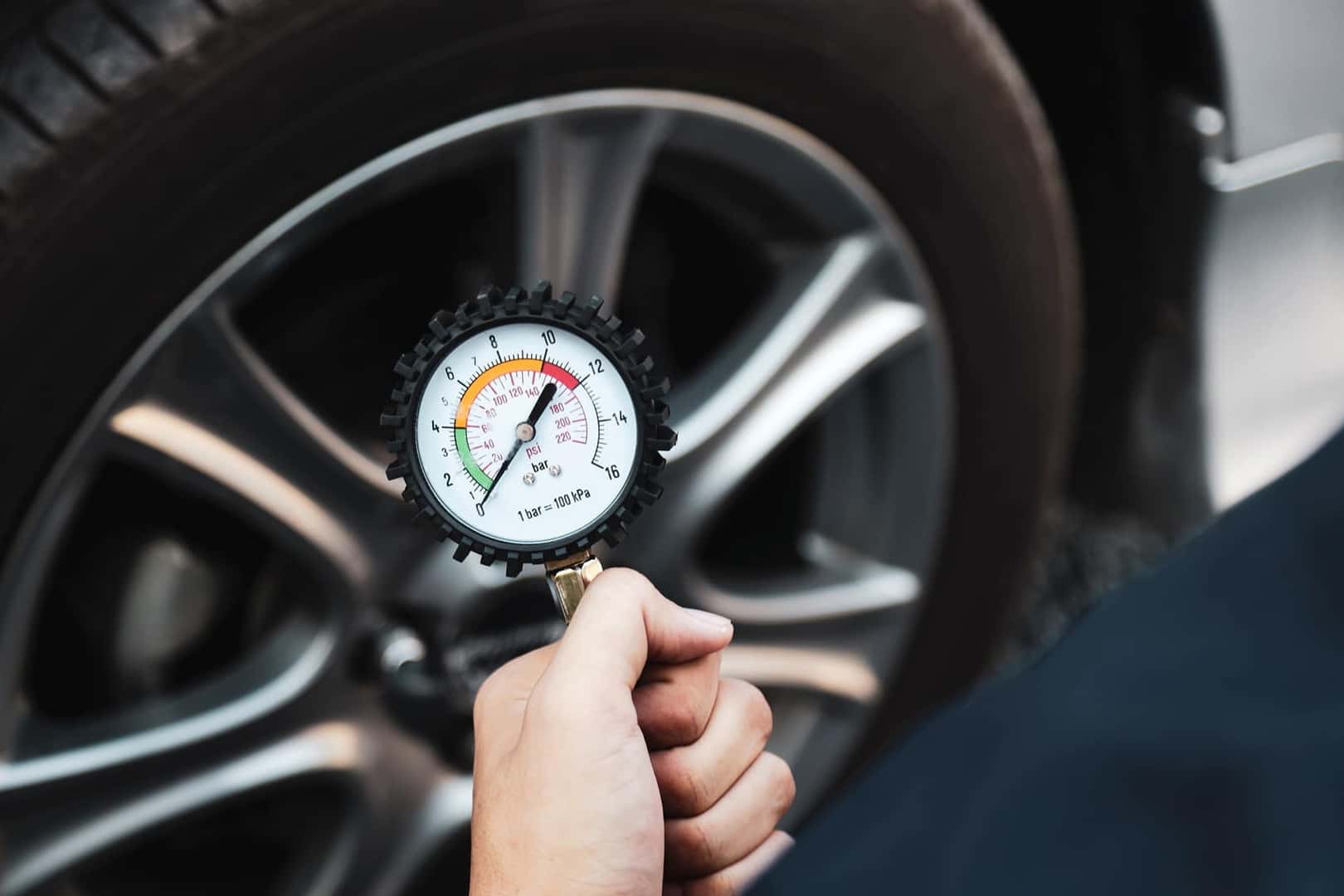
4. Measure pressure with a tire gauge
Use a reliable gauge when the tires are cold, if possible. “Cold” usually means the vehicle has been parked for at least three hours or has driven only a short distance at low speed.
Find the correct pressure on the driver-side doorjamb label, inside the fuel door, or in the owner’s manual. Do not use the maximum pressure printed on the tire sidewall as the vehicle’s normal target.
5. Inflate or repair the tire
If the tire only needs air, inflate it to the vehicle maker’s recommended cold pressure. If it is punctured, badly damaged, or will not hold air, do not continue driving.
6. Recheck the warning light
The TPMS light may not turn off at once. Some vehicles need to be driven briefly before the system updates. If the light flashes and then stays on, the system may have a fault rather than a simple low-pressure warning. Check the manual or have the system inspected.

How Far Can You Drive at Different Pressure Levels?
The exact answer depends on the tire and vehicle, but pressure level can help guide the decision.
Slightly low tire pressure
If a tire is a few pounds per square inch below the recommended pressure and shows no damage, you may be able to drive carefully to a nearby air pump. Keep the trip short and slow. Inflate the tire before normal driving.
Do not assume a small pressure loss is harmless. A slow leak from a nail, valve, or wheel seal can become worse without warning.
A tire that is 10 or more PSI low
A tire that is 10 PSI below the placard pressure has a meaningful loss of air. It may flex too much, especially at highway speed or under a heavy load. Driving farther than necessary can damage the tire.
Inflate it before driving if you have access to an air pump. If you cannot inflate it, use the spare tire or call for roadside help.
A visibly flat tire
Do not drive on a flat tire. Even a short trip can destroy the tire and damage the wheel. Driving on a flat can also make the vehicle difficult to control.
A tire with almost no air
Never try to “make it home” on a tire with very little air. The tire may separate internally, and the wheel may become damaged. Move the vehicle only if necessary to escape immediate danger, and then stop.
A run-flat tire
Some run-flat tires can travel for a limited distance after losing pressure. The permitted distance and speed vary by tire and vehicle. Many manufacturers publish limits such as a specific maximum speed and a restricted emergency distance, but those limits are not universal.
Use the exact instructions in the vehicle owner’s manual and the tire manufacturer’s information. A run-flat tire with sidewall damage may still be unsafe to drive.

What Changes the Safe Driving Distance?
A tire does not fail based on pressure alone. Several conditions can make a short drive much riskier.
Speed
Heat builds faster at highway speeds. If you must reach a safe place, use the lowest practical speed and avoid interstate driving when another route is available.
Distance
The farther you drive, the more times the tire flexes and heats. A tire that survives a one-mile trip may suffer damage during a 20-mile trip.
Vehicle load
Passengers, luggage, tools, and cargo increase the force placed on the tire. A heavily loaded SUV, pickup, or van needs more caution than an unloaded passenger car.
Outside temperature
Hot pavement and warm weather can increase tire temperature. Cold weather can lower pressure, but a warning light should still be checked rather than ignored.
Road surface
Potholes, rough pavement, curbs, and gravel can damage an already weak tire or wheel. Avoid them when possible.
Tire age and condition
Old, worn, cracked, repaired, or previously damaged tires have less margin for further stress. A tire with worn tread or visible cracking should be inspected even if it still holds air.

Recommended Tire Pressure vs. Maximum Tire Pressure
Use the vehicle manufacturer’s recommended pressure, not the maximum pressure molded into the tire.
The recommended pressure is found on the vehicle certification label, usually on the driver-side doorjamb. It is also listed in the owner’s manual. This number is selected for the vehicle’s weight, handling, braking, and tire configuration.
The tire sidewall may show a higher number. That figure is generally the tire’s maximum permitted inflation pressure under stated conditions, not the correct everyday pressure for the vehicle.
For example, if the doorjamb label says 35 PSI and the tire sidewall says 44 PSI, 35 PSI is the normal cold inflation target. Do not inflate to 44 PSI simply because it is printed in larger numbers.
Check all four tires. The front and rear axles may have different recommended pressures, and the spare tire may use a different pressure as well.

Can You Drive With the Tire Pressure Warning Light On?
You should not ignore the tire pressure warning light. If it turns on, check the tire pressure at the first safe opportunity.
A steady warning light often means one or more tires are below the vehicle’s programmed threshold. On many vehicles, the TPMS warning is designed to alert the driver when pressure is about 25% below the recommended cold pressure. The exact behavior depends on the vehicle and system.
A flashing light may indicate a TPMS malfunction. In that case, the tires may still be low even though the system is not reporting them correctly. Check the pressure manually.
The light may also come on after a sudden temperature drop. Air pressure commonly falls as temperatures fall, but the tire still needs to be inflated to the correct cold pressure.
Do not reset the TPMS without checking the tires first. Resetting the system does not add air or repair a leak.

What If the Tire Keeps Losing Air?
A tire that repeatedly loses pressure has a problem that needs diagnosis. Adding air over and over is not a repair.
Common causes include:
- A nail or screw in the tread
- A leaking valve core
- A damaged valve stem
- Corrosion or damage where the tire meets the wheel
- A bent or cracked wheel
- A puncture near the sidewall
- Previous tire damage
A puncture in the center portion of the tread may sometimes be repairable, depending on its size, angle, and the tire’s internal condition. Damage in the sidewall or shoulder is generally not repaired with a normal plug or patch.
If the tire was driven while very low, tell the tire shop. The technician may need to remove the tire from the wheel to inspect the inside. An external plug alone cannot confirm that the tire’s internal structure remains safe.
Common Mistakes to Avoid
Driving until the tire “looks flat”
A tire can be dangerously underinflated before it looks obviously flat. Use a pressure gauge rather than your eyes alone.
Using the sidewall number as the target
The sidewall maximum is not the vehicle’s recommended pressure. Check the doorjamb label or owner’s manual.
Driving fast to save time
Speed increases heat and stress. If you must drive to a safe place, slow down and keep the distance as short as possible.
Releasing air from a hot tire
A tire’s pressure rises while driving because the air inside heats up. Do not bleed air from a hot tire unless the vehicle maker specifically instructs you to do so. Check and adjust pressure when the tires are cold.
Assuming the TPMS light is always accurate
The system can have a sensor or communication fault. A manual pressure check is still needed.
Continuing after a tire repair kit is used
A temporary sealant or inflator may help you reach a repair facility, but it does not always make the tire suitable for normal travel. Follow the kit and vehicle instructions.

Frequently Asked Questions
How many miles can you drive with low tire pressure?
There is no universal safe mileage limit. Drive only as far as needed to reach a safe place, and avoid driving if the tire is visibly flat, damaged, or losing air quickly.
Can low tire pressure cause a blowout?
Yes. Underinflation increases tire flex and heat. That can weaken the tire and raise the risk of a failure, especially at high speed, with a heavy load, or in hot weather.
Is it safe to drive 10 miles with low tire pressure?
It depends on how low the pressure is and whether the tire is damaged. Ten miles may be too far for a badly underinflated tire. Inflate it first or use a spare tire when possible.
Can I drive to a gas station with a flat tire?
Usually, no. Driving on a flat tire can damage the tire, wheel, and vehicle. Call roadside assistance or install the spare if you can do so safely.
How often should I check tire pressure?
Check tire pressure at least once a month and before long trips. Check it when the tires are cold, and inspect the tires whenever the TPMS warning light comes on.
Final Takeaway
The answer to “how long can you drive on low tire pressure?” is: only long enough to reach a safe place, and sometimes not at all.
Slow down, avoid hard maneuvers, check all tire pressures, and use the vehicle’s doorjamb pressure label as your target. If the tire is flat, damaged, unstable, or losing air, stop driving and use a spare tire or roadside assistance. A few minutes spent checking the tire can prevent a costly failure and a dangerous loss of control.
Sources
- National Highway Traffic Safety Administration: Tire Safety
- NHTSA: Tire Pressure Monitoring System
- U.S. Department of Transportation: Tire Safety Information
- Your vehicle owner’s manual and driver-side doorjamb tire information label