How To Find Load Index On Tire: Read The Sidewall
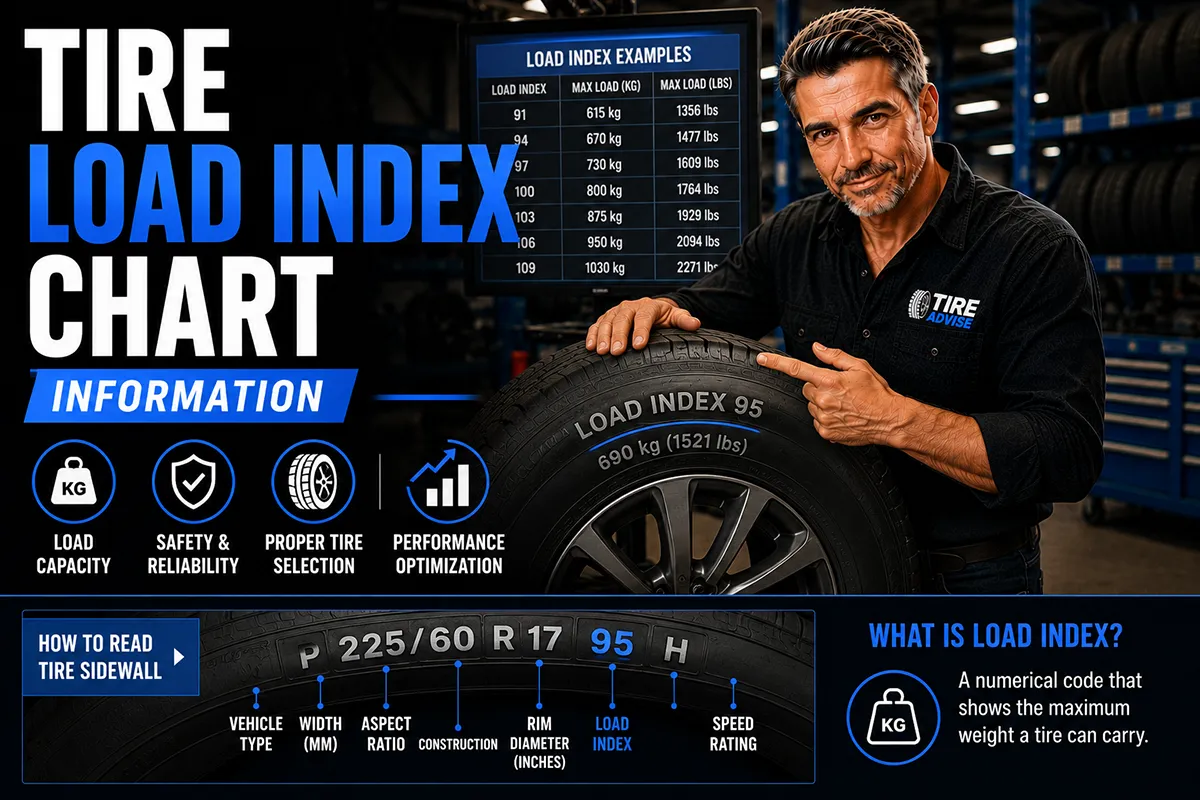
To find a tire’s load index in the United States, read the tire sidewall and look for the number in the service description after the tire size. In P225/65R17 102H, the number 102 is the load index. It means the tire can carry up to 1,874 pounds when used at its rated inflation pressure.
You can also check the tire and loading information label on the driver-side door jamb. That label lists the correct tire size, cold inflation pressure, and load information for your vehicle. The U.S. National Highway Traffic Safety Administration (NHTSA) advises drivers to follow the vehicle manufacturer’s tire information and never exceed the tire’s load limit.
What Is a Tire Load Index?
A tire load index is a number that shows the maximum weight one tire can support under specific test conditions. The number is part of the tire’s service description, which also often includes a speed rating.
For example:
P215/60R16 95H
P= Passenger tire215= Tire width in millimeters60= Aspect ratioR= Radial construction16= Wheel diameter in inches95= Load indexH= Speed rating
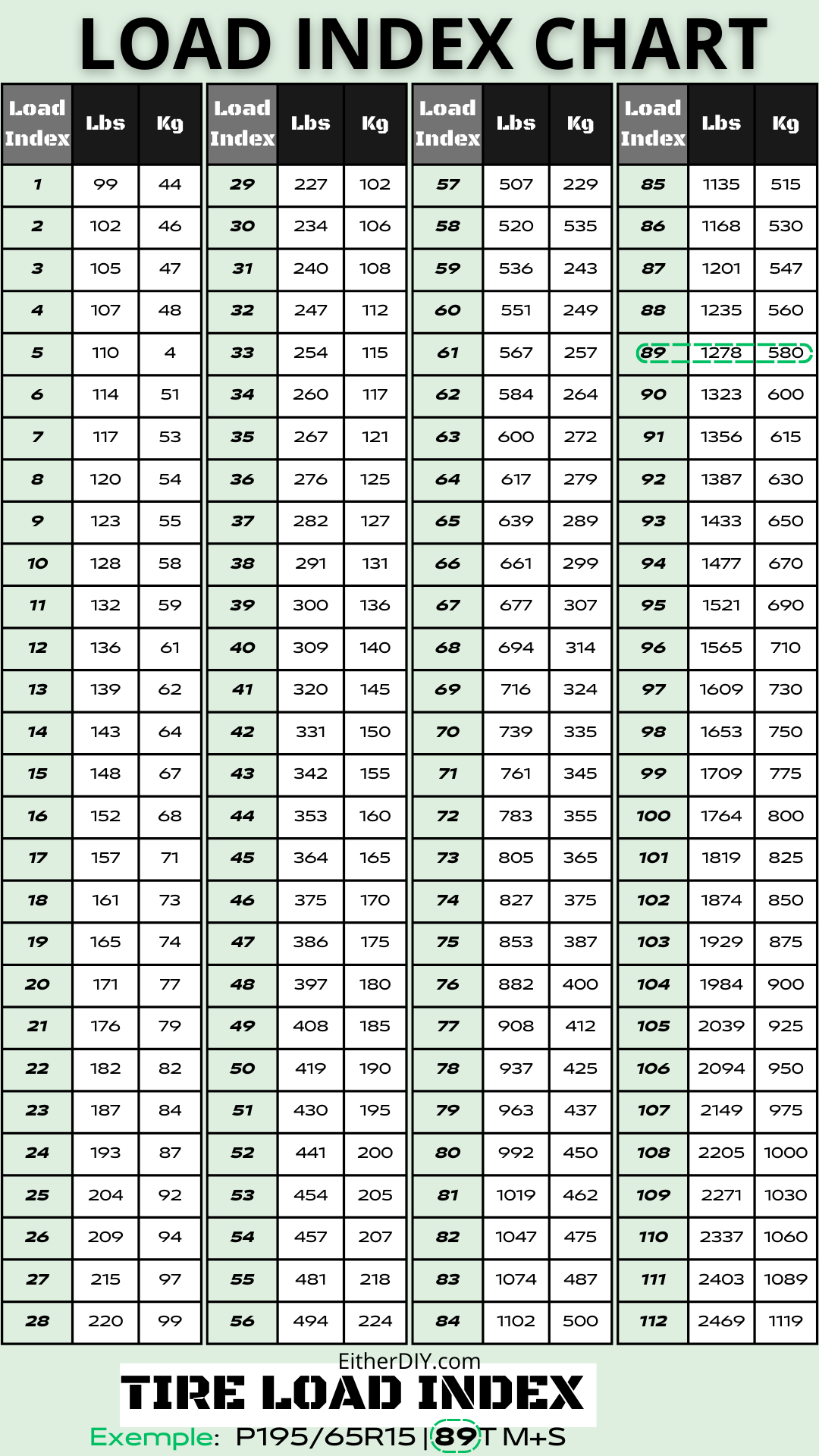
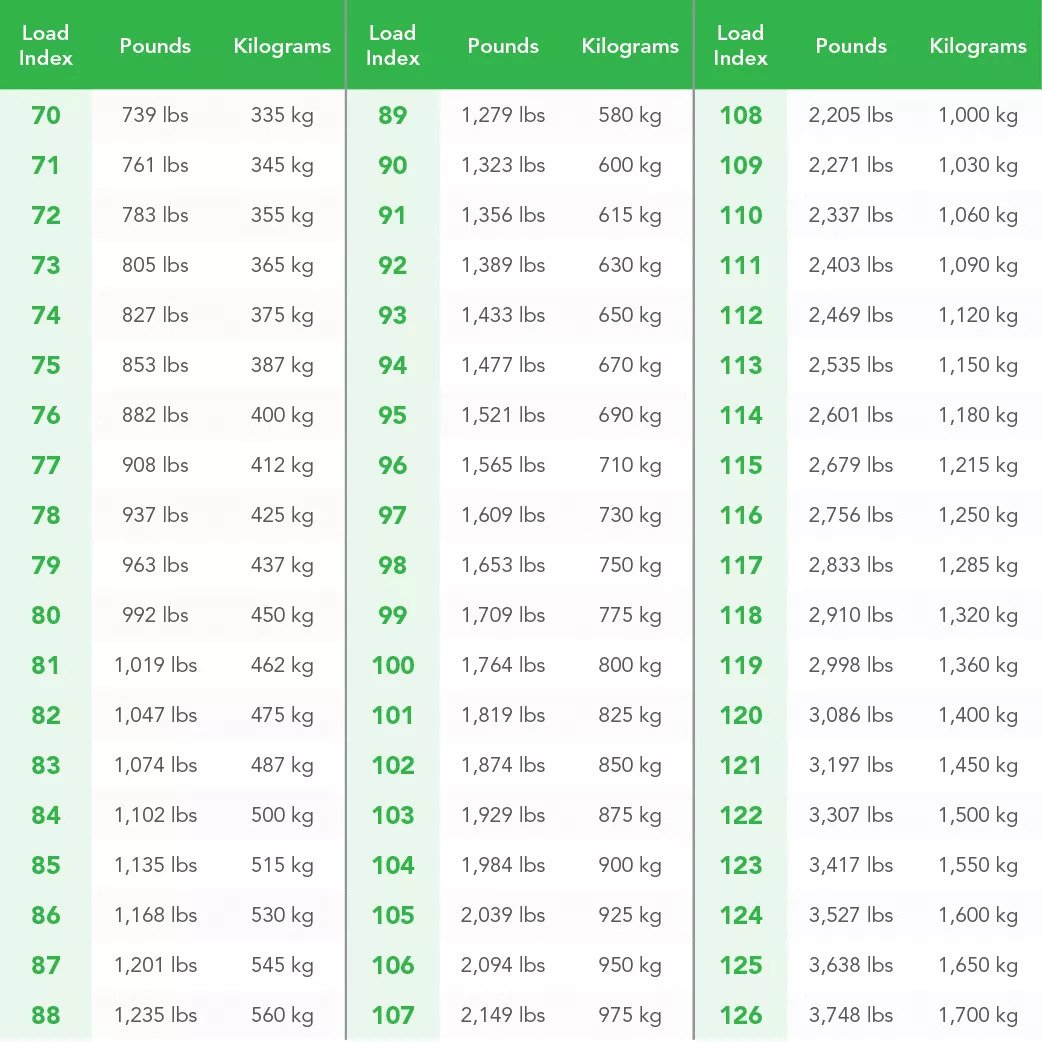
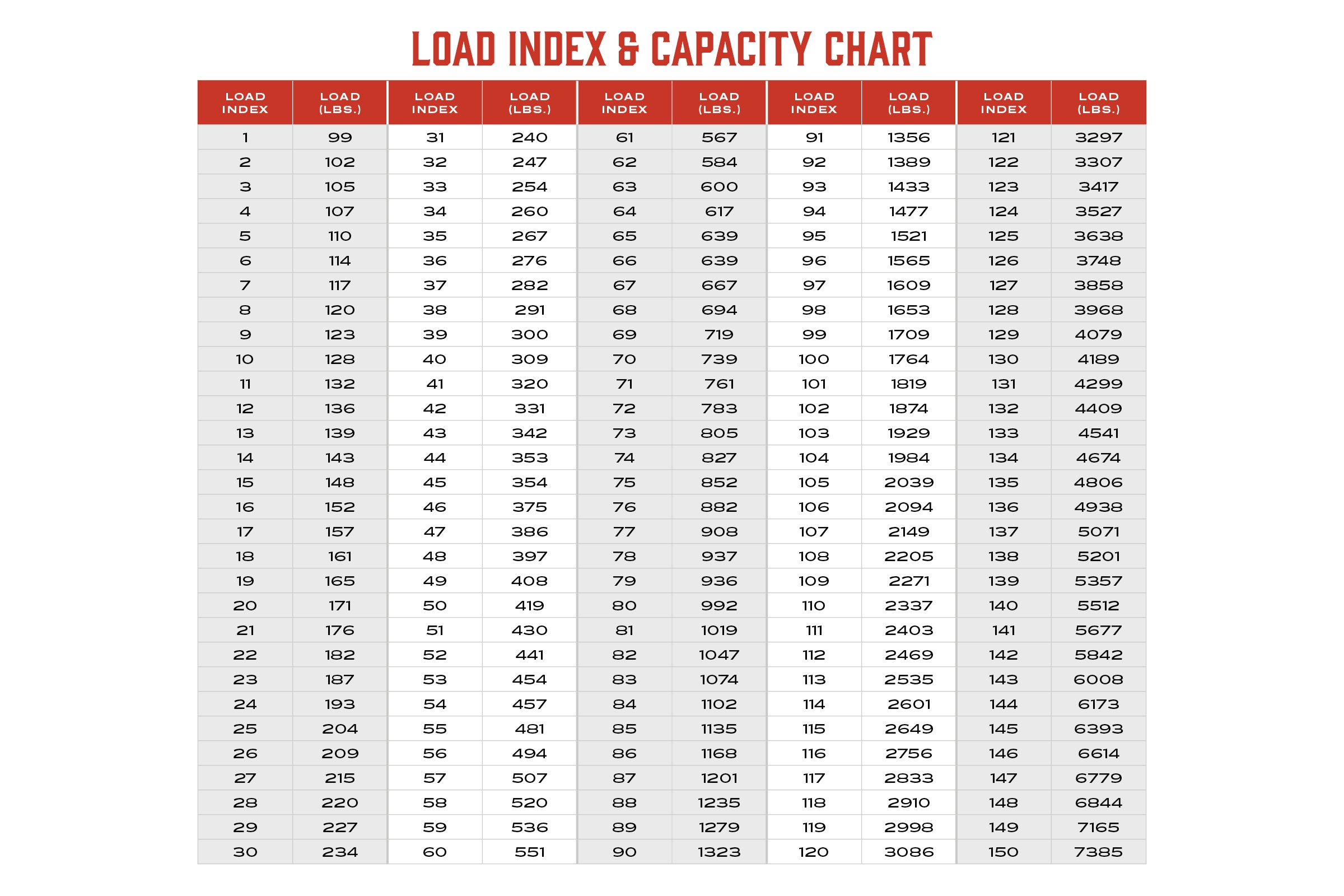
the load index is not a weight measurement by itself. It is a code that matches a standardized load capacity. You must use a load index chart to convert the number into pounds or kilograms.
A higher load index generally means that the tire can carry more weight. However, the tire must still be the correct size, construction, pressure rating, and type for the vehicle.

Where Is the Load Index Printed on a Tire?
The load index is usually printed on the tire sidewall after the tire size and before the speed rating. Look for a sequence that looks like one of these:
205/55R16 91VP245/75R16 111TLT265/70R17 121/118S225/65R17 102H XL
The load index may appear on both sides of the tire, but not always. If you do not see it on the outward-facing side, check the inner sidewall. You may need a flashlight or a vehicle lift to read it safely.
Do not confuse the load index with these other markings:
- DOT number: Identifies the tire’s manufacturing and certification information.
- Tire size: Shows width, aspect ratio, construction, and wheel size.
- Maximum load: May be printed as a weight in pounds and kilograms.
- Maximum pressure: Shows the highest permitted cold inflation pressure for the tire.
- Speed rating: A letter such as
H,V, orTthat indicates the tire’s rated speed category. - UTQG numbers: Treadwear, traction, and temperature grades found on many passenger tires.
The load index is normally a two- or three-digit number close to the end of the tire size marking.

How to Read a Tire Load Index Step by Step
Follow these steps to identify the load index accurately.
1. Find the tire size
Stand beside the tire and inspect the sidewall. Find the part that begins with a letter or a number, such as:
P225/65R17
or:
LT275/70R18
2. Look immediately after the size
The load index usually follows the wheel size. In this example:
P225/65R17 102H
The number 102 is the load index.
3. Separate the load index from the speed rating
The letter after the number is usually the speed rating. In 102H:
102= Load indexH= Speed rating
Some tires have more than one load index, especially light-truck tires designed for single or dual-wheel use. An example is:
LT225/75R16 110/107S
The first number may refer to single-tire use, while the second may refer to dual-tire use. The tire manufacturer’s data should be used to confirm the meaning.
4. Check the load index against a chart
Use a recognized tire load index chart to find the rated capacity. For example:
- Load index
91= 1,356 pounds - Load index
95= 1,521 pounds - Load index
100= 1,764 pounds - Load index
102= 1,874 pounds - Load index
104= 1,984 pounds - Load index
106= 2,094 pounds - Load index
109= 2,271 pounds - Load index
112= 2,469 pounds - Load index
116= 2,756 pounds - Load index
120= 3,086 pounds
These ratings apply when the tire is inflated according to the conditions specified by the tire manufacturer. They do not mean that any vehicle can safely carry four times that weight.
5. Compare it with the vehicle label
Open the driver-side door and look for the vehicle certification label or tire and loading information label. Compare the tire’s size and load rating with the original specification.
If the sidewall marking and vehicle label do not seem to match, do not guess. Check the owner’s manual or ask a qualified tire professional.

Tire Load Index Chart: Common Ratings
The table below converts several common passenger-car and light-truck load indexes into maximum weight per tire.
| Load index | Maximum load per tire |
|---|---|
| 80 | 992 lb |
| 84 | 1,102 lb |
| 87 | 1,201 lb |
| 89 | 1,279 lb |
| 91 | 1,356 lb |
| 93 | 1,433 lb |
| 95 | 1,521 lb |
| 97 | 1,609 lb |
| 98 | 1,653 lb |
| 100 | 1,764 lb |
| 102 | 1,874 lb |
| 104 | 1,984 lb |
| 106 | 2,094 lb |
| 107 | 2,149 lb |
| 109 | 2,271 lb |
| 111 | 2,403 lb |
| 112 | 2,469 lb |
| 114 | 2,601 lb |
| 116 | 2,756 lb |
| 118 | 2,910 lb |
| 120 | 3,086 lb |
| 121 | 3,197 lb |
| 123 | 3,417 lb |
| 126 | 3, garant? |
The last row is intentionally omitted because load index tables vary in presentation and must be checked against the exact tire type and rating. For a tire not listed here, use the complete chart supplied by the tire manufacturer or a recognized tire-industry reference.
The key point is simple: the load index applies to one tire, not the full vehicle. A tire with a load index of 102 is rated for 1,874 pounds under its specified conditions. Four tires with that rating are not automatically proof that the vehicle can carry 7,496 pounds.

How to Use the Door-Jamb Tire Label
The driver-side door-jamb label is the best starting point for finding the correct tire load rating for your vehicle. It is usually attached to the door, door pillar, or inside edge of the driver’s door.
The label may show:
- Original tire size
- Recommended cold tire pressure
- Front and rear tire specifications
- Spare-tire information
- Seating capacity
- Maximum combined weight of occupants and cargo
The label may not show the load index as a number. Instead, it may list a tire size such as P235/55R19. In that case, use the original equipment tire, the owner’s manual, or the vehicle manufacturer’s specifications to confirm the required load capacity.
The door-jamb label tells you what the vehicle was designed to use. The tire sidewall tells you what the specific tire is rated to carry. Both pieces of information matter.
Do not use the maximum pressure printed on the tire sidewall as the normal pressure unless it matches the vehicle manufacturer’s recommendation. The vehicle label usually gives the correct cold inflation pressure for normal operation.
What Does “XL” Mean on a Tire?
XL means Extra Load. An XL tire is built to carry more weight than a standard-load tire of the same size when inflated to the proper pressure.
For example:
235/45R18 98W XL
Here:
98is the load indexWis the speed ratingXLidentifies the tire as Extra Load
XL does not replace the load index. You still need to read the number and compare it with the vehicle’s requirements.
An XL tire may be suitable when the vehicle manufacturer specifies it or when the replacement tire meets the vehicle’s required load capacity and other specifications. It is not automatically the best choice for every vehicle.
What Does “LT” Mean on a Tire?
LT means Light Truck. LT tires are designed for certain pickups, vans, and SUVs. They may use different load and inflation standards from passenger tires.
An LT tire may show markings such as:
LT265/70R17 121/118S
The two load indexes can indicate different capacities for single and dual applications. The correct rating depends on how the tire is installed and used.
Some vehicles can use either passenger or light-truck tires, while others require one specific type. Check the owner’s manual, door label, and tire manufacturer’s fitment information before changing from a passenger tire to an LT tire or the other way around.
A higher number alone does not make a tire suitable. Tire construction, rim compatibility, clearance, pressure, handling, and vehicle requirements must also match.

How to Compare the Tire Load Index With Your Vehicle’s Needs
Use the vehicle’s Gross Vehicle Weight Rating, axle ratings, and tire label rather than relying on a simple “load index times four” calculation.
Important ratings include:
- GVWR: The maximum allowed total weight of the vehicle, including occupants, cargo, fuel, and equipment.
- GAWR: The maximum weight allowed on a specific axle.
- Payload rating: The weight of people and cargo the vehicle can carry.
- Tire load rating: The maximum load a tire can support at its specified pressure.
A tire’s capacity must support the actual load placed on its axle. The front and rear axles may carry different amounts of weight, especially in trucks, SUVs, vans, and vehicles towing a trailer.
For example, a hypothetical tire with load index 102 has a rated capacity of 1,874 pounds. Two tires on one axle provide a combined nominal capacity of 3,748 pounds. That does not mean the axle may safely carry that amount, because the vehicle’s GAWR, wheel rating, suspension, tire pressure, and other limits may be lower.
When replacing tires, choose a tire that meets or exceeds the vehicle manufacturer’s required load index unless the vehicle or tire manufacturer gives a different approved specification.

Can You Use a Tire With a Higher Load Index?
A tire with a higher load index may be an acceptable replacement if it also matches the vehicle’s required size, construction, speed rating, rim, clearance, and inflation requirements.
For example, replacing a tire with load index 95 with one rated 98 may provide a higher stated load capacity. But the change can affect ride comfort, handling, tire pressure, and wheel compatibility.
Do not assume that a higher load index solves every fitment issue. Confirm all of these details:
- Tire size
- Load index
- Speed rating
- Tire type, such as P, LT, or XL
- Rim width and diameter
- Vehicle clearance
- Recommended inflation pressure
- Front and rear axle requirements
Never replace a required tire with one that has a lower load index unless the vehicle manufacturer specifically approves it.

Common Mistakes When Checking Tire Load Index
Several mistakes can lead to the wrong conclusion about a tire’s capacity.
Mistaking the speed rating for the load index
In 95H, 95 is the load index and H is the speed rating. The letter does not show weight capacity.
Reading the tire size as the load rating
In P225/65R17 102H, 225 is the tire width and 17 is the wheel diameter. Neither number is the load index.
Using the tire’s maximum load without checking pressure
The maximum load applies at a specified inflation pressure. A tire may carry less weight if it is operated below the pressure needed for that load.
Treating the four-tire total as the vehicle’s payload
The vehicle’s GVWR and axle ratings may be lower than the combined theoretical tire capacity.
Ignoring different front and rear requirements
Some vehicles use different tire sizes or load ratings on the front and rear axles. Check each axle separately.
Assuming a larger tire always carries more weight
A larger-looking tire may have a lower load index or may be unsuitable for the wheel and vehicle. Read the complete service description.
Replacing only one tire with a mismatched rating
A replacement tire should match the other tires in size, load capacity, speed rating, and type as closely as practical. For all-wheel-drive vehicles, the owner’s manual may impose additional limits on tire diameter differences.
What to Do If the Load Index Is Hard to Find
If you cannot read the sidewall, use this sequence:
- Clean the sidewall with mild soap and water.
- Turn the steering wheel to expose more of the front tire.
- Check the inner sidewall if the outer side does not show the complete marking.
- Use the vehicle door label and owner’s manual.
- Look up the exact tire brand, model, and size on the manufacturer’s website.
- Ask a tire shop to verify the marking before buying or installing a replacement.
Do not rely on a blurry photo, a partial marking, or a seller’s short description. The exact tire model and full service description matter.
If the sidewall has been damaged, cut, bulged, or worn away, have the tire inspected. A missing marking may be a sign of serious damage, not just a reading problem.

Does Tire Pressure Change the Load Capacity?
Yes. Tire load capacity depends on inflation pressure, tire construction, tire size, and the conditions listed by the manufacturer.
Use the cold tire pressure on the vehicle’s door-jamb label for normal driving. “Cold” means the vehicle has been parked long enough for the tires to cool, usually away from direct sun and before a long drive.
Underinflation can cause excess heat, poor handling, uneven wear, and tire failure. The U.S. Tire Manufacturers Association and NHTSA both emphasize maintaining proper inflation and checking pressure regularly.
Do not reduce pressure below the vehicle recommendation to improve comfort. Do not inflate beyond the tire or wheel limit to carry extra weight. If you regularly haul heavy cargo or tow, follow the vehicle manufacturer’s loading instructions and confirm the needed pressure and tire rating.

Frequently Asked Questions
Is the load index printed on every tire?
Most modern tires include a load index in the service description, but the marking may be on the inner sidewall or may be difficult to see. Some specialty, vintage, trailer, and commercial tires use different marking systems. Check the tire manufacturer’s specifications if the number is unclear.
Is a higher tire load index better?
Not always. A higher load index can provide greater load capacity, but the tire must still fit the vehicle and wheel. It may also change ride feel, handling, pressure requirements, or compatibility.
Can I use a lower load index if I do not carry heavy loads?
Usually, no. The replacement tire should meet the vehicle manufacturer’s required load rating. The requirement applies to the vehicle’s design and possible operating load, not only to what you carry on one particular trip.
Is load index the same as ply rating?
No. Load index is a standardized numerical capacity code. Ply rating is an older term often used with light-truck tires to describe strength or load range. They are related but not interchangeable.
Does the DOT number show the tire load index?
No. The DOT identification number provides manufacturing and certification information, including the production date code. It does not replace the tire’s load index marking.
Key Takeaways
- Find the load index after the tire size and before the speed-rating letter.
- In
225/65R17 102H, 102 is the load index. - Use a load index chart to convert the number into pounds.
- The rating applies to one tire under specified pressure and test conditions.
- Check the driver-side door label before replacing tires.
- Never choose a lower load index without approval from the vehicle or tire manufacturer.
- Confirm size, tire type, speed rating, wheel fit, pressure, and axle limits—not just the load index.
Conclusion
Finding the load index on a tire is usually quick: read the number after the tire size and before the speed rating. Then compare that number with the vehicle’s door-jamb label and manufacturer specifications.
For a safe replacement, the load index is only one part of the decision. Match the tire size, construction, speed rating, pressure requirements, and vehicle axle limits. If the marking is damaged or confusing, have a qualified tire professional verify it before you drive or buy a replacement.