

Introduction
Many cars sold in the United States use a continuously variable transmission, or CVT. Common examples include the Nissan Sentra, Honda Civic, Subaru Forester, Toyota Corolla, Toyota Prius, Hyundai Elantra, Kia Forte, and Mitsubishi Outlander.
A CVT can improve fuel economy and make acceleration smooth. However, not every vehicle from a brand uses one, and a hybrid eCVT works differently from a belt-and-pulley CVT. The exact transmission can also change by model year, engine, trim, and drivetrain.
This guide lists major U.S.-market vehicles with CVT or eCVT transmissions and explains how to check the transmission before you buy.

Which Cars Have a CVT Transmission in the United States?
The following table covers many current and recent U.S.-market vehicles. It is not a list of every CVT vehicle ever sold. Automakers can change powertrains during a model year, so check the vehicle’s window sticker or owner’s manual before purchase.


| Brand | Models commonly offered with a CVT or eCVT | Transmission type |
|---|---|---|
| Chevrolet | Trailblazer, Malibu | CVT on some versions and model years |
| Honda | Civic, HR-V, CR-V, Accord | CVT or hybrid eCVT, depending on powertrain |
| Hyundai | Elantra, Kona, Venue | IVT, Hyundai’s name for a CVT |
| Kia | Forte, Soul, Seltos | IVT on selected engines and trims |
| Lexus | UX hybrid, ES hybrid, NX hybrid, RX hybrid | Hybrid eCVT |
| Mitsubishi | Outlander, Eclipse Cross, Outlander Sport | CVT on selected versions |
| Nissan | Sentra, Altima, Rogue, Kicks, Versa | Xtronic CVT |
| Subaru | Impreza, Crosstrek, Forester, Outback, Legacy, Ascent, WRX | Lineartronic CVT or manual on selected trims |
| Toyota | Corolla, Corolla Hatchback, Corolla Cross, Prius, Camry hybrid, RAV4 hybrid, Sienna | CVT or hybrid eCVT |
Nissan cars with CVT transmission
Nissan is one of the most recognizable CVT users in the U.S. Nissan calls its system Xtronic CVT. Depending on the model and year, it is used in vehicles such as:
- Nissan Sentra
- Nissan Altima
- Nissan Rogue
- Nissan Kicks
- Nissan Versa
- Some older Nissan Murano models
The Nissan Z, Frontier, and Titan use different transmissions. Do not assume that every Nissan has a CVT.
Honda cars with CVT transmission
Honda uses both standard CVTs and hybrid eCVTs:
- Honda Civic gasoline models
- Honda Civic hybrid
- Honda HR-V
- Honda CR-V gasoline models
- Honda CR-V hybrid
- Honda Accord hybrid
- Earlier Honda Accord turbo models
The Civic Si and Civic Type R use manual transmissions. The current Accord lineup is primarily hybrid in the U.S., so its two-motor hybrid system uses an eCVT-style drive unit rather than a normal belt CVT.
Subaru vehicles with CVT transmission
Subaru uses a transmission called Lineartronic, which is a type of CVT. It is common in:
- Subaru Impreza
- Subaru Crosstrek
- Subaru Forester
- Subaru Outback
- Subaru Legacy
- Subaru Ascent
- Subaru WRX with the available automatic transmission
The Subaru BRZ uses a conventional manual or automatic transmission, not a CVT. A Subaru model with a manual gearbox also does not have a CVT.
Toyota cars with CVT transmission
Toyota offers both belt-type CVTs and hybrid eCVTs:
- Toyota corolla
- Toyota Corolla Hatchback - Toyota Corolla Cross
- Toyota Prius
- Toyota Camry hybrid
- Toyota RAV4 hybrid
- Toyota Sienna hybrid
- Toyota Highlander hybrid
- Toyota Crown


The standard Corolla generally uses a CVT, while some trims may have a manual transmission. The Prius, Camry hybrid, RAV4 hybrid, Sienna, and other Toyota hybrids use an eCVT system.
The regular gasoline RAV4 uses a conventional automatic transmission, not a belt CVT.
Hyundai and Kia vehicles with CVT or IVT
Hyundai calls its CVT an Intelligent Variable Transmission, or IVT. Kia also uses the IVT name on many models.
Common examples include:
- Hyundai Elantra with selected engines
- Hyundai Kona with the 2.0-liter engine
- Hyundai Venue
- Kia Forte
- Kia Soul
- Kia Seltos with selected engines
A turbocharged version of the same model may use a dual-clutch or conventional automatic transmission instead. For example, the transmission can change between a base engine and a turbo engine.
Mitsubishi vehicles with CVT transmission
Mitsubishi has used CVTs widely in its U.S. lineup. Examples include:
- Mitsubishi Outlander
- Mitsubishi Outlander Sport
- Mitsubishi Eclipse Cross
- Some older Mitsubishi Mirage models
The Outlander plug-in hybrid uses a different hybrid drive layout from the regular gasoline Outlander. Always check the exact powertrain rather than relying only on the model name.
What Is a CVT?
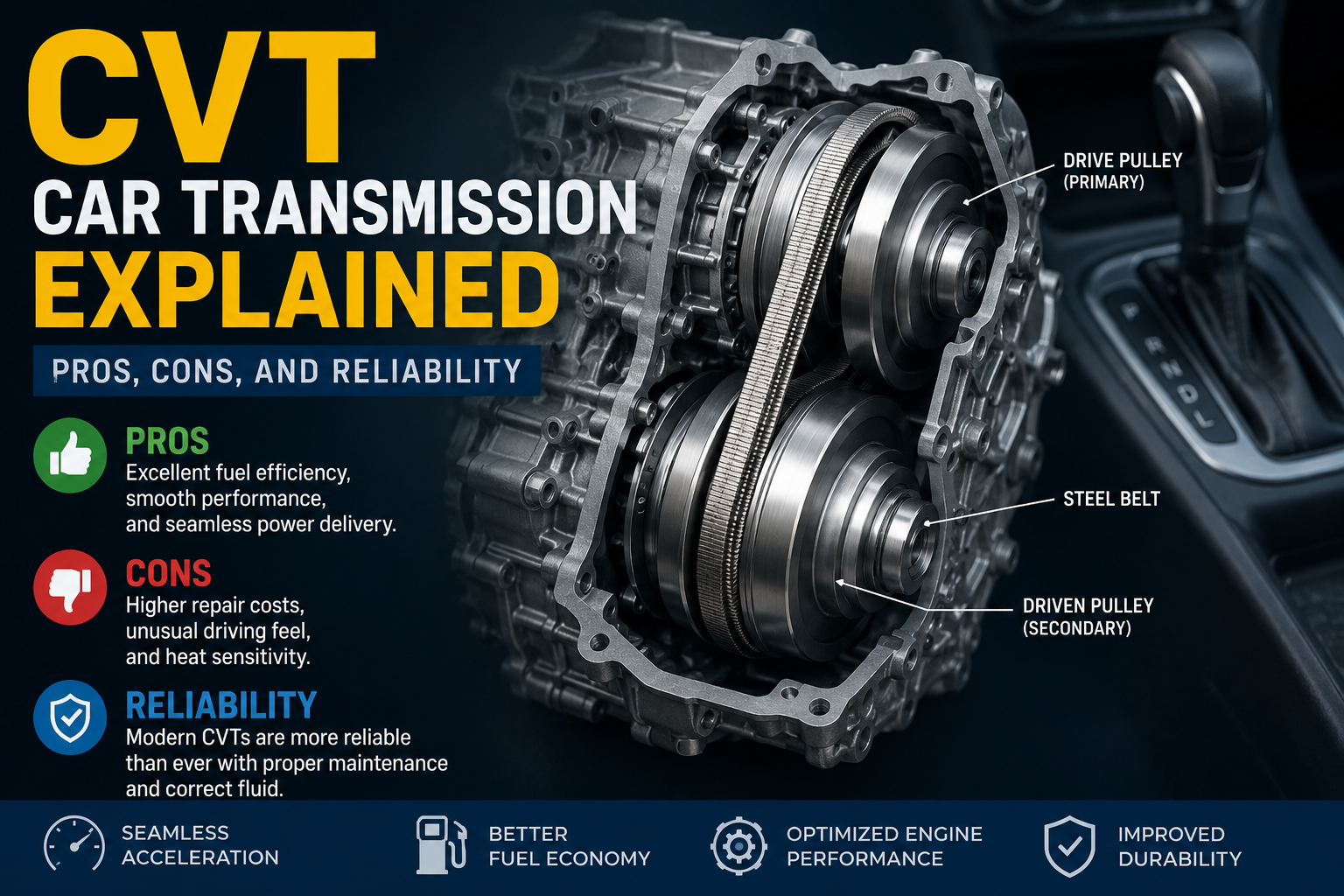
A CVT is an automatic transmission that can use many gear ratios instead of a fixed set of gears.
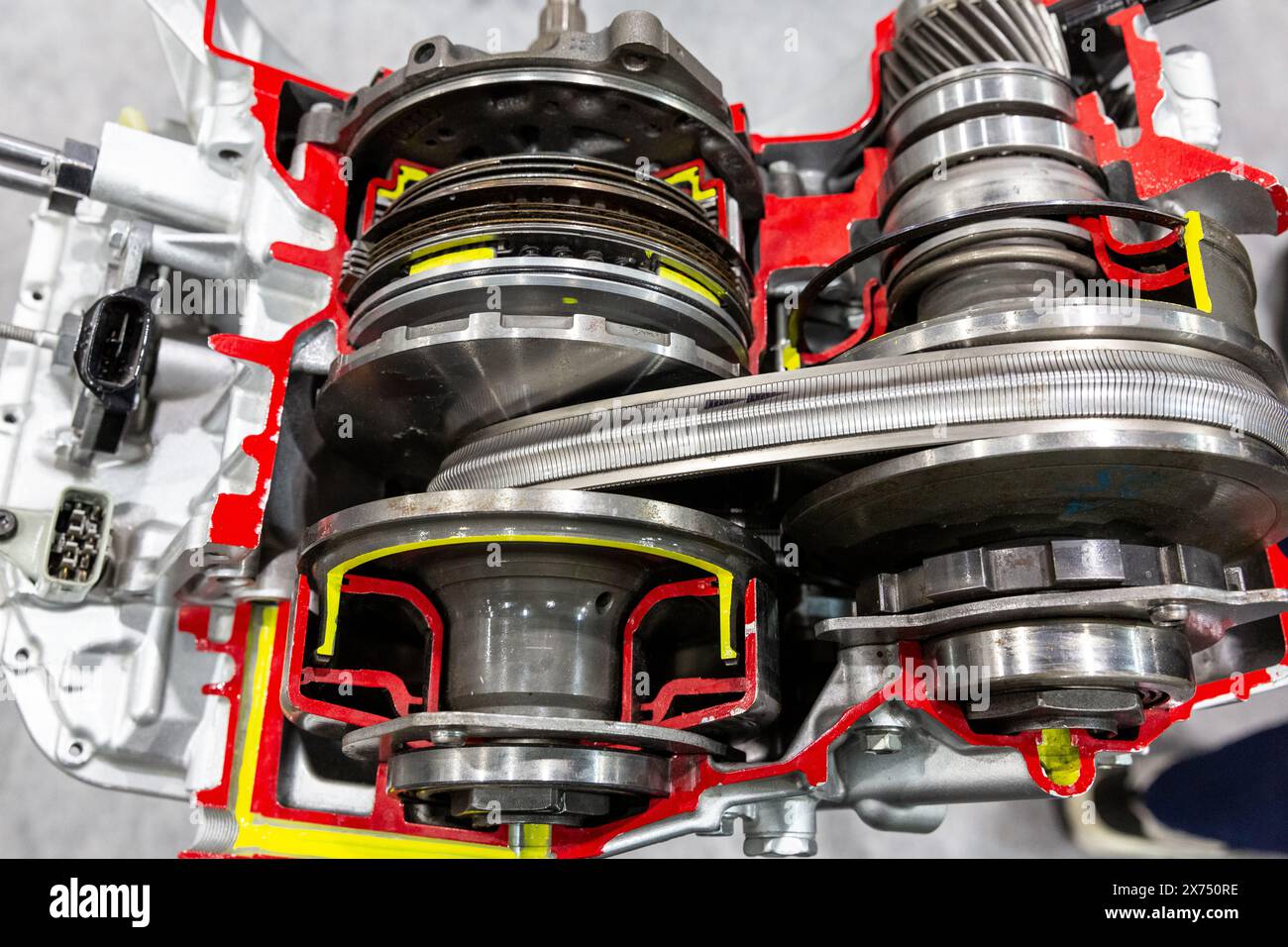
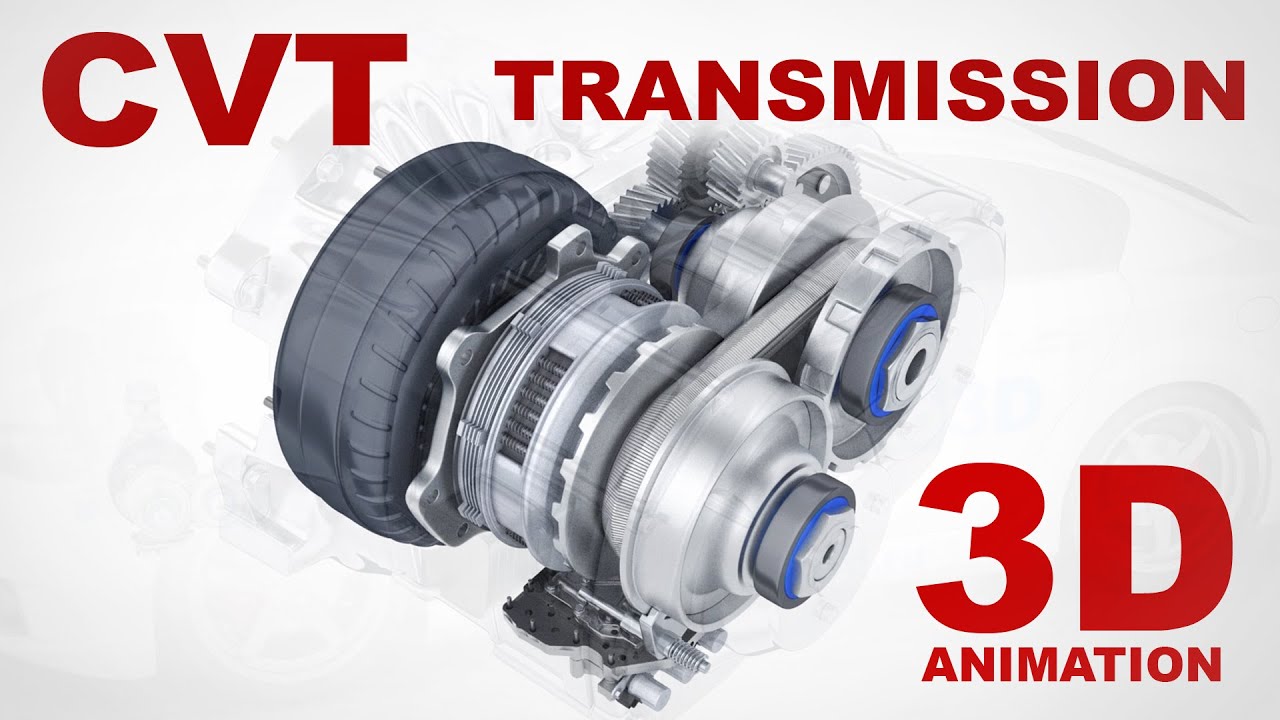
A traditional automatic shifts through separate gears, such as first, second, third, and fourth. A belt-type CVT uses two variable-width pulleys linked by a strong belt or chain. The pulleys change size as the vehicle moves, creating a continuous range of ratios.
This design lets the engine stay near a useful speed during acceleration. It can also keep the engine at an efficient speed while cruising.
A CVT still has a reverse function, a neutral setting, and a drive setting. It may also offer simulated gear changes, paddle shifters, or a sport mode. These features can make the vehicle feel more like one with a traditional automatic transmission.
What is an eCVT?
An eCVT is a hybrid transmission that uses electric motors and a planetary gearset to vary the relationship between engine speed and wheel speed. It usually does not use the belt-and-pulley design found in many gasoline CVTs.
Toyota, Honda, Ford, and Lexus use eCVT-style systems in several hybrid vehicles. The name sounds similar to CVT, but the mechanical design is different.
An eCVT may feel very smooth because the electric motors help control the power flow. It also has fewer traditional transmission parts than many conventional automatics. That does not mean every hybrid eCVT has identical repair needs or long-term costs.


CVT vs. Automatic Transmission: What Is the Difference?
The main difference is how the transmission changes its ratio.
| Feature | Belt-type CVT | Traditional automatic |
|---|---|---|
| Ratio changes | Continuous range | Fixed gear steps |
| Shifting feel | Often smooth or steady | Noticeable gear changes |
| Engine sound | May hold a steady high speed | Usually rises and falls with shifts |
| Main efficiency goal | Keep the engine in an efficient range | Balance performance, comfort, and efficiency |
| Common service concern | Correct CVT fluid is essential | Correct automatic fluid is essential |
A CVT can make an engine sound louder during hard acceleration because the engine may hold a high rpm while the vehicle gains speed. This behavior is normal for many CVTs, although a sudden change in sound, vibration, or response can signal a problem.
A traditional automatic may feel more familiar to drivers who prefer clear gear changes. A CVT may suit drivers who value smooth operation and fuel economy.
Neither design is automatically better for every driver. The vehicle’s engineering, maintenance record, software, cooling system, and driving conditions matter more than the transmission label alone.

How Can You Tell if a Car Has a CVT?
The most reliable way to identify a CVT is to check the exact vehicle record, not just the brand or model.
1. Check the window sticker
A new or recently sold vehicle may have a Monroney window sticker. Look for the transmission description in the equipment or mechanical section.
The sticker may say:
- Continuously variable transmission
- Xtronic CVT
- Lineartronic CVT
- Intelligent Variable Transmission
- Electronically controlled continuously variable transmission
- Hybrid continuously variable transmission
2. Read the owner’s manual
The manual identifies the required fluid and often names the transmission type. This is especially useful for used cars with several engine choices.
3. Search the manufacturer’s U.S. specifications
Use the automaker’s U.S. website and select:
- The model year
- The exact model
- The engine
- The trim
- Front-wheel drive or all-wheel drive
Transmission information can change between these choices.
4. Decode the VIN carefully
A VIN decoder can identify the engine, trim, and factory configuration. However, a basic decoder may not display the transmission in plain language. Use a dealer, repair database, or manufacturer service record when the transmission is unclear.
5. Check the transmission fluid label
The fluid specification can provide a clue, but it is not a complete identification method. Never add fluid based only on a guess. CVT fluid is not automatically interchangeable with standard automatic transmission fluid.
Are CVT Transmissions Reliable?
A CVT can be reliable when it is properly designed, maintained, and used within its limits. Reliability varies by vehicle, model year, engine, software calibration, cooling system, driving conditions, and repair history.


A vehicle with a CVT deserves the same checks as any used car:
- Review maintenance records.
- Confirm that the correct CVT fluid was used.
- Look for delayed engagement when shifting into Drive or Reverse.
- Watch for shuddering during light acceleration.
- Listen for whining, grinding, or new mechanical noise.
- Check for warning lights.
- Test the vehicle both cold and fully warmed up.
- Have an independent mechanic inspect it before purchase.
Do not treat a smooth test drive as proof that the transmission is healthy. Some faults appear only after the fluid warms up or during highway driving.
Does a CVT need special maintenance?
Yes. The service plan depends on the vehicle. Some manufacturers specify a CVT fluid inspection or replacement at certain intervals. Others use a maintenance schedule that changes with severe service, such as:
- Frequent stop-and-go driving
- Towing
- Long periods of idling
- Driving in very hot or cold conditions
- Repeated short trips
- Heavy loads
- Dusty or unpaved roads
Use the maintenance schedule for the exact vehicle. A general automatic transmission service interval may not apply to a CVT.
Can you tow with a CVT?
Some CVT vehicles can tow a limited trailer weight, while others are not designed for towing. The limit depends on the model, engine, cooling system, drivetrain, hitch equipment, and trailer brakes.
Check the owner’s manual before towing. Never use a higher rating from a similar model as a substitute for the exact vehicle’s rating.

What Are the Advantages and Disadvantages of a CVT?
A CVT can be a good fit when smooth operation and fuel economy matter most. It may be less appealing if you prefer quick, familiar gear changes or regularly tow heavy loads.
Potential advantages
- Smooth acceleration without regular shift shocks
- Efficient engine operation at many speeds
- Good fuel economy in some vehicle designs
- Fewer conventional gear changes
- Easy operation in traffic
Potential disadvantages
- Engine noise may remain high during hard acceleration
- Some drivers dislike the “rubber-band” feel
- Repairs can be costly after major internal damage
- Fluid type and service procedures are specific
- Towing and high-load use may be limited
- CVT behavior varies widely by brand and model
Fuel economy is not guaranteed simply because a car has a CVT. Aerodynamics, vehicle weight, engine size, hybrid technology, tires, and driving style also affect fuel use.

Which CVT Cars Are Best for Different Drivers?
There is no single best CVT vehicle for every buyer. The right choice depends on the vehicle’s size, use, budget, and powertrain.
For a small commuter car
Consider vehicles such as:
- Toyota Corolla
- Honda Civic
- Nissan Sentra
- Hyundai Elantra
- Kia Forte
- Subaru Impreza


These models are commonly used for daily commuting and often offer good fuel economy. Compare seating space, road noise, warranty coverage, and service costs before choosing.
For a small SUV
Consider:
- Honda HR-V
- Subaru Crosstrek
- Subaru Forester
- Toyota Corolla Cross
- Nissan Kicks
- Hyundai Kona
- Mitsubishi Eclipse Cross
All-wheel drive, ground clearance, cargo space, and towing limits can vary greatly. A CVT alone does not determine whether an SUV is suitable for snow, trails, or towing.
For a hybrid
Consider:
- Toyota Prius
- Toyota Camry hybrid
- Toyota RAV4 hybrid
- Toyota Sienna
- Honda Accord hybrid
- Honda CR-V hybrid
- Lexus hybrid models
Most of these use an eCVT-style hybrid system rather than a standard belt CVT. Compare total fuel cost, battery warranty, cargo space, and repair support.
For a performance-oriented driver
A CVT may not be the first choice for drivers who want strong shift feel or track use. Some vehicles offer simulated ratios or paddle controls, but these features do not turn a CVT into a conventional multi-speed automatic.
The Subaru WRX is one exception in that it offers a performance-focused CVT option alongside a manual transmission. The driving feel remains different from a dual-clutch or traditional automatic system.
Common Mistakes When Shopping for a CVT Car
Assuming every model from a brand has a CVT
A brand may use several transmission types at the same time. Nissan, Honda, Subaru, Toyota, Hyundai, and Kia all sell vehicles with different transmission designs.
Confusing a hybrid eCVT with a belt CVT
Both systems vary the drive ratio, but they use different hardware. Research the exact hybrid system before comparing service or repair concerns.
Using the wrong transmission fluid
CVT fluid is made for the belt, chain, pulley, and clutch materials used in that transmission. Standard automatic transmission fluid may cause damage if the manufacturer does not approve it.
Judging a used CVT only by mileage
A high-mileage vehicle with clear service records may be a better purchase than a lower-mileage vehicle with unknown maintenance. Driving conditions and service history matter.
Ignoring warning signs
Do not dismiss shuddering, slipping, delayed engagement, overheating, or warning lights as normal CVT behavior. Have the vehicle diagnosed before buying or continuing to drive it.

Frequently Asked Questions
Do all Nissan cars have CVT transmissions?
No. Many Nissan cars use an Xtronic CVT, including the Sentra, Altima, Rogue, Kicks, and Versa. Nissan trucks and sports cars such as the Frontier, Titan, and Z use other transmission types.
Is a CVT better than a regular automatic?
Neither is always better. A CVT may provide smooth operation and good efficiency. A traditional automatic may offer a more familiar feel and can be preferred for certain heavy-duty or performance uses.
Do CVT cars have gears?
A belt-type CVT does not use fixed forward gears in the same way as a traditional automatic. Some CVTs simulate gear steps through software. Hybrid eCVTs use a different gear-and-motor design.


How long does a CVT last?
There is no reliable lifespan that applies to every CVT. Service history, design, operating conditions, fluid quality, heat control, and driving habits all affect durability. A pre-purchase inspection is more useful than relying on a single mileage estimate.
Can a CVT be repaired?
Some CVTs can be repaired with individual components, while others are more commonly replaced as a complete unit. The best option depends on the failure, parts availability, labor cost, vehicle value, and manufacturer procedures.
Final Answer: What Cars Have CVT Transmission?
Many popular U.S. cars and SUVs use a CVT, including the Nissan Sentra, Nissan Rogue, Honda Civic, Honda HR-V, Subaru Forester, Subaru Outback, Toyota Corolla, Hyundai Elantra, Kia Forte, Mitsubishi Outlander, and Chevrolet Trailblazer on selected versions and model years.
Hybrid models such as the Toyota Prius, Toyota Camry Hybrid, Toyota RAV4 Hybrid, Honda Accord Hybrid, Honda CR-V Hybrid, and Lexus hybrids generally use an eCVT-style system.
Before buying, verify the exact model year, engine, trim, and drivetrain. Then confirm the required fluid and maintenance schedule. That final check is more reliable than assuming every vehicle with the same model name uses the same transmission.
