

FWD means front-wheel drive. On a front-wheel-drive car, the engine sends power to the two front wheels. Those wheels pull the car forward and also help steer it.
FWD is common on cars, sedans, hatchbacks, and many small SUVs sold in the United States. It can improve fuel economy, save space, and cost less than all-wheel drive. However, it does not give the same traction as AWD or 4WD in every condition.

How Does Front-Wheel Drive Work?
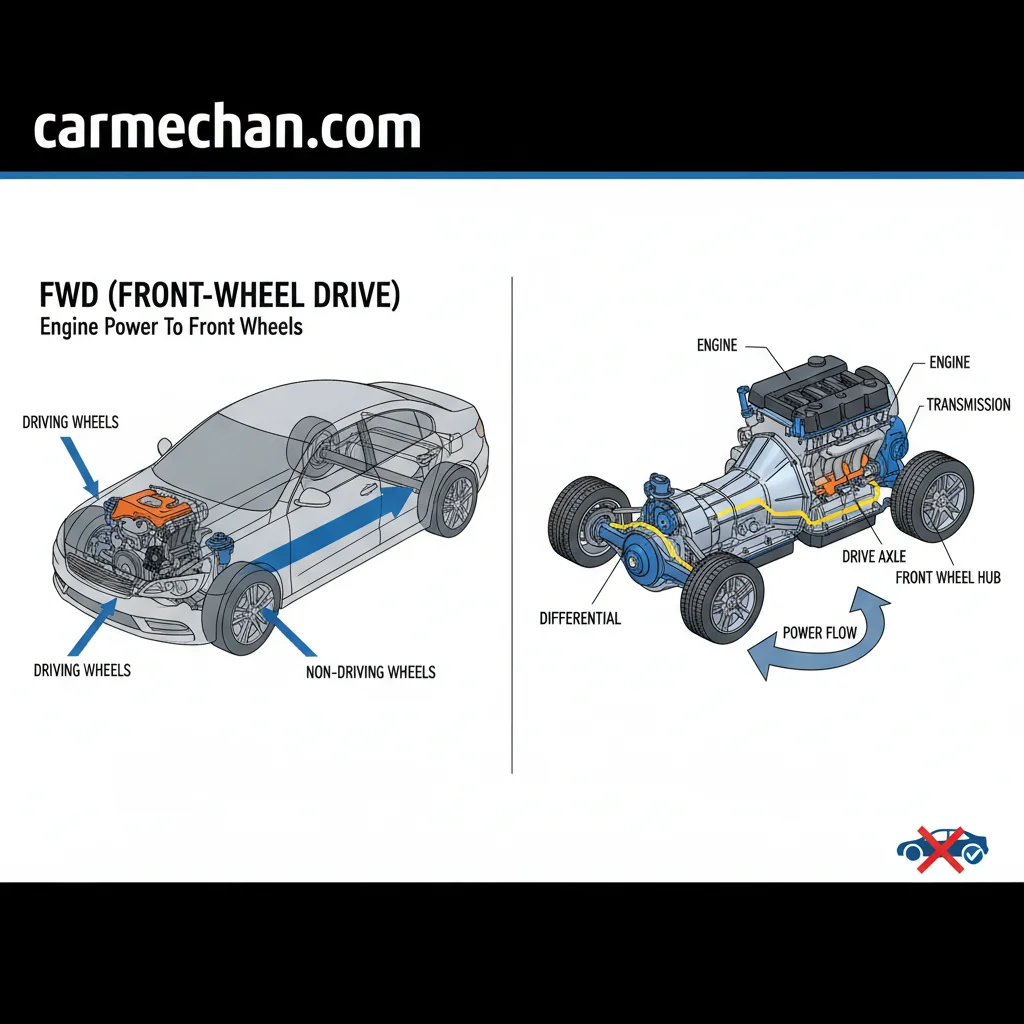
Front-wheel drive sends engine power to the front axle through the transmission and a differential. The differential lets the left and right front wheels turn at different speeds when the car turns.
The front tires do two jobs:
- They steer the car.
- They transfer engine power to the road.


This layout is different from rear-wheel drive, where the rear wheels push the car. It is also different from all-wheel drive, where the vehicle can send power to all four wheels.
Main FWD parts
A front-wheel-drive system usually includes:
- Engine: Creates power.
- Transmission: Changes the engine’s speed and torque.
- Differential: Splits power between the two front wheels.
- Axle shafts: Carry power from the differential to the wheels.
- Constant-velocity joints: Let the front wheels steer while still receiving power.
Because these parts sit near the front of the car, a FWD vehicle can use a compact engine bay. Many modern FWD vehicles use a sideways-mounted engine, called a transverse engine.
What happens when you press the gas?
When you press the accelerator, the engine sends torque through the transmission. The differential divides that torque between the front wheels. The tires then pull the vehicle along the road.
If one front tire loses grip, the differential may send more usable power to the slipping tire. Electronic traction control can reduce wheelspin by applying the brake or reducing engine power.
FWD does not make a car immune to slipping. Tire condition, road surface, speed, and driver input still matter.

FWD vs. RWD, AWD, and 4WD
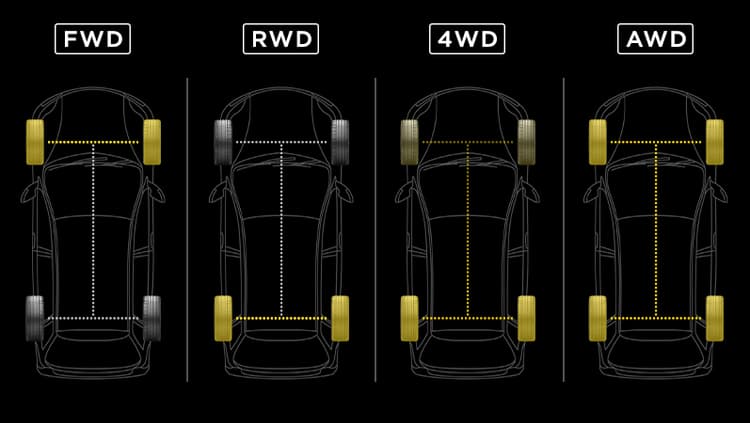
FWD, RWD, AWD, and 4WD describe how a vehicle sends power to its wheels. The best system depends on the road, weather, vehicle size, and intended use.
| Drivetrain | Wheels powered | Common strengths | Common limits |
|---|---|---|---|
| FWD | Two front wheels | Good efficiency, lower cost, useful cabin space | Less suited to heavy towing or high-power launches |
| RWD | Two rear wheels | Balanced handling and strong towing ability | Can lose rear traction on slippery roads |
| AWD | All four wheels as needed or full time | Better traction during many slippery starts | Adds weight, cost, and service needs |
| 4WD | Usually all four wheels when selected | Strong performance off road and in deep conditions | Often less efficient and less suited to dry-road use when locked |
FWD vs. RWD
A FWD vehicle pulls itself forward. A RWD vehicle pushes itself forward from the rear axle.
FWD often works well for daily driving, city streets, and normal highway use. RWD can offer better weight balance and may be a better fit for sports cars, trucks, and vehicles that tow heavy loads.
RWD vehicles may also feel more stable when carrying a heavy trailer because the rear wheels provide the driving force. Still, the vehicle’s tires, suspension, weight, and stability systems all affect real-world performance.


FWD vs. AWD
AWD can send power to all four wheels. Some AWD systems work all the time. Others send power to the rear wheels only when the system detects a loss of traction.
AWD may help a vehicle start moving on wet, icy, or snowy roads. It does not shorten every stop, and it does not replace winter tires. Braking depends mainly on the tires and road surface, not just the drivetrain.
FWD vs. 4WD
Four-wheel drive is common in pickup trucks and off-road SUVs. Many 4WD systems let the driver select a high or low range. Low range gives extra torque at low speed for steep slopes, rocks, mud, or heavy work.
Do not assume AWD and 4WD are the same. Check the owner’s manual for the vehicle’s exact system and operating limits.

What Are the Advantages of FWD?
The main advantages of front-wheel drive are efficiency, packaging, and predictable daily use. These benefits explain why FWD is common in U.S. passenger cars and compact SUVs.
Better use of space
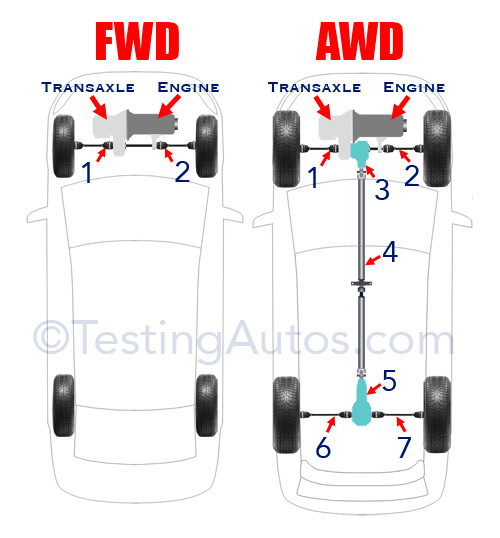
A FWD layout places the engine, transmission, and differential at the front. It does not need a long driveshaft running to a rear differential.
This can create more room for passengers and cargo. It can also reduce the number of drivetrain parts under the cabin.
Potentially better fuel economy
FWD can weigh less and create fewer mechanical losses than some AWD or 4WD systems. Less weight may help the vehicle use less fuel.
Actual fuel economy depends on the engine, transmission, body shape, tires, driving speed, and vehicle weight. The U.S. Environmental Protection Agency publishes official fuel-economy ratings for new vehicles, so compare those ratings rather than assuming every FWD car gets the same mileage.
Good traction during normal driving
The engine sits over the front axle in many FWD vehicles. That weight can help the front tires maintain grip during acceleration.
This can be useful on wet pavement and light snow. It does not provide unlimited traction. A worn or poorly inflated tire can still slip.
Lower purchase and service complexity
FWD systems often use fewer parts than AWD systems. That can reduce vehicle weight and may lower manufacturing and maintenance costs.
The actual repair cost depends on the make, model, age, and failed part. A FWD car can still need expensive repairs, such as a transmission, differential, or axle replacement.
What Are the Disadvantages of FWD?
The main FWD drawbacks appear during hard acceleration, heavy towing, performance driving, and some slippery conditions.
Front tires do more work
The front tires steer, brake, and provide engine power. This gives them more work than the rear tires.


As a result, front tires may wear faster. Regular tire inspections and rotations can help promote more even wear. Follow the rotation pattern and schedule in the vehicle owner’s manual.
Torque steer
Torque steer is a pull to one side during strong acceleration. It can occur when the front wheels receive high engine torque and do not have equal grip.
Modern vehicles often reduce torque steer with better suspension design and electronic controls. It can still appear in powerful FWD cars or when one tire is on a slick surface.
If a car suddenly pulls during normal driving, do not assume it is normal torque steer. Uneven tire pressure, poor alignment, worn suspension parts, or a brake problem may cause a pull.
Limited performance for heavy loads
FWD can work well for light trailers and everyday loads when the vehicle is rated for them. However, heavy towing can place more demand on the front tires and drivetrain.
Always check the vehicle’s official owner’s manual and tow rating. Never exceed the stated limits.
Possible understeer
Understeer happens when the vehicle turns less than the driver expects. The front tires lose grip first, so the car tends to continue toward the outside of the turn.
Entering a corner too fast can cause understeer in any vehicle. The safest response is to ease off the accelerator and avoid sudden steering or braking.

Is FWD Good in Snow and Rain?
FWD can work well in light snow and rain when it has good tires and the driver uses smooth inputs. The front-mounted engine can place useful weight over the drive wheels.
However, FWD does not automatically make a vehicle safe on ice or deep snow. The tires are the main connection between the vehicle and the road.
FWD in snow
For winter driving:
- Use tires with adequate tread.
- Consider winter tires if you drive often in snow or ice.
- Keep all tires at the pressure listed on the vehicle information label.
- Accelerate gently.
- Leave more space for braking.
- Clear snow from the roof, lights, windows, and sensors.
- Slow down before turns, hills, and intersections.
AWD can help a vehicle accelerate in some slippery conditions. It cannot guarantee steering or braking control.
FWD in rain
On wet roads, reduce speed and avoid sudden inputs. Worn tires increase the risk of hydroplaning.
Hydroplaning occurs when water prevents part of the tire from contacting the road. If it happens, ease off the accelerator and keep the steering steady. Do not slam on the brakes or make a sharp turn.
Should you buy AWD instead?
AWD may be useful if you regularly drive on unplowed roads, steep wet roads, or areas with frequent snow. It also may suit drivers who want extra traction for certain outdoor activities.


FWD may be enough for drivers who spend most of their time on cleared roads. Good tires and careful driving often matter more than the drivetrain badge.
How Can You Tell if a Car Is FWD?
The easiest way to confirm a vehicle’s drivetrain is to check the owner’s manual or the vehicle’s official specifications. Do not rely only on appearance or a badge.
You can also check:
- The window sticker or sales listing: It may state “FWD,” “AWD,” “4WD,” or “RWD.”
- The vehicle identification number: A dealer or manufacturer database may identify the exact configuration.
- The dashboard display: Some vehicles show the active drivetrain mode.
- The underside of the vehicle: A driveshaft leading to a rear differential often indicates AWD or 4WD, but this check is not ideal for a casual owner.
- A repair shop or dealer: They can confirm the system by the vehicle identification number.
Some cars have “FWD” buttons, drive modes, or labels that refer to a setting rather than the vehicle’s permanent layout. Read the manual if the label is unclear.

Does FWD Mean the Same Thing on Every Car?
No. FWD identifies the powered axle, but FWD vehicles can still differ in important ways.
Two FWD cars may have different:
- Engine power
- Transmission design
- Tire size
- Suspension layout
- Ground clearance
- Traction-control settings
- Tow ratings
- Snow and ice performance
- Maintenance schedules
A small sedan and a three-row FWD SUV may both be front-wheel drive, yet they can feel very different. The drivetrain is only one part of the vehicle’s design.
Some vehicles also use hybrid systems. A hybrid may power the front wheels with an engine, an electric motor, or both. The vehicle’s technical specifications explain how that system works.

FWD Maintenance Tips
FWD does not require a special daily routine, but several checks help protect the system.
Check the front tires
Inspect the front tires for:
- Uneven wear
- Low tread
- Cracks or bulges
- Nails or other damage
- Incorrect air pressure
Use the pressure shown on the driver’s door-jamb label or in the owner’s manual. Do not use the maximum pressure printed on the tire sidewall as the normal setting unless the vehicle maker says so.
Rotate the tires
Rotate the tires according to the owner’s manual. The correct pattern depends on tire type, drivetrain, and whether the tires are directional or staggered.
Some vehicles cannot rotate front and rear tires if they use different tire sizes. Ask a qualified tire shop if the manual does not give a clear pattern.
Inspect CV boots
The rubber boots around the constant-velocity joints keep grease inside and dirt out. A torn boot can allow grease to escape and may lead to a clicking noise during turns.


Have a damaged CV boot checked soon. Replacing a boot may be less costly than replacing the entire axle, depending on the condition.
Pay attention to warning signs
Have the vehicle inspected if you notice:
- Clicking while turning
- Vibration during acceleration
- A clunk from the front end
- A pull to one side
- Grease near a wheel or axle
- A drivetrain warning light
- Repeated tire wear on one edge
Stop driving and seek help if steering, braking, or wheel control feels unsafe.
Common Misunderstandings About FWD
“FWD means all four wheels move sometimes.”
Usually, no. FWD normally means the front wheels receive engine power. A vehicle with a system that can power all four wheels is generally labeled AWD or 4WD.
“FWD is always better in snow.”
No. FWD can help with forward motion, but tire grip controls braking and turning. A FWD vehicle with worn tires may perform worse than a vehicle with good tires in another drivetrain configuration.
“AWD stops faster than FWD.”
Not by itself. AWD can help with acceleration, but it does not automatically improve braking. Tire grip, speed, road conditions, brakes, and driver actions determine stopping performance.
“FWD cars cannot tow.”
Some FWD cars can tow. The correct limit depends on the specific vehicle, equipment, trailer, cargo, and local requirements. Use the manufacturer’s tow rating.
“A FWD warning always means the drivetrain failed.”
Not always. A dashboard light may indicate a traction-control event, sensor issue, transmission problem, or another fault. Check the owner’s manual and have the vehicle scanned if the light stays on.

Is a FWD Car Right for You?
A FWD car may fit you well if you want:
- A practical daily driver
- Good use of interior space
- A lower-cost alternative to AWD
- Efficient city and highway transportation
- Adequate traction on maintained roads
- Simple, predictable operation
AWD or 4WD may make more sense if you regularly drive through deep snow, rough trails, loose surfaces, or demanding work conditions. Even then, select based on the full vehicle design, not only the drivetrain label.
Before buying, compare the vehicle’s official fuel-economy rating, tire size, ground clearance, tow rating, maintenance needs, and winter performance. A test drive on dry pavement cannot show how the car will behave in every condition.

Frequently Asked Questions
What does FWD stand for?
FWD stands for front-wheel drive. It means the engine sends power to the vehicle’s two front wheels.
Is FWD better than AWD?
Neither is always better. FWD often costs less and may use less fuel. AWD can provide more traction during acceleration on some slippery surfaces. Your roads, weather, budget, and driving needs decide which is more useful.


Can a FWD car drive in snow?
Yes. A FWD car can drive in snow with suitable tires, enough tread, proper tire pressure, and careful speed control. Deep snow, ice, steep roads, and poor tires can still create serious traction problems.
Are FWD cars good for highway driving?
Yes. FWD cars can be well suited to highway driving. Highway safety depends on speed, tires, braking, visibility, driver attention, and the vehicle’s condition—not just the drivetrain.
Does FWD save gas?
It can. FWD may weigh less and have fewer drivetrain losses than some AWD systems. However, the engine, vehicle size, aerodynamics, tires, and driving habits also affect fuel use.
Can you switch a FWD car to AWD?
Usually, not in a practical or economical way. An AWD conversion may require major changes to the transmission, floor structure, suspension, electronics, fuel system, and rear axle. It is normally better to choose the drivetrain you need when buying the vehicle.
Bottom Line
FWD means that the front wheels power the car. It is a common layout in the United States because it can offer efficient packaging, useful traction, and lower cost.
FWD works well for many drivers and everyday roads. Its limits become clearer with heavy towing, high power, deep snow, ice, and worn tires. Check the owner’s manual, maintain the tires, and choose AWD or 4WD only when your normal driving conditions justify it.
