

The correct wiper blade size depends on your vehicle’s year, make, model, windshield, and wiper position. A 2020 Ford F-150 may use a different size from a 2020 Ford Escape. Even the driver and passenger sides may need different lengths.
For the most accurate answer, check your owner’s manual, an official vehicle fit guide, or a parts catalog using your full vehicle details. You can measure the old blade as a quick check, but do not rely on measurement alone. The rear wiper, if your vehicle has one, often uses a different size and connector.
This guide explains how to find the right size in the United States, how to check fit, and what to do if the listed size does not seem to work.

How to Find the Right Wiper Blade Size
Use your vehicle’s full details before buying a replacement. You usually need the:


- Model year
- Vehicle make
- Vehicle model
- Body style or trim
- Wiper position
For example, “2018 Honda CR-V” may not provide enough detail in some fit guides. The guide may also ask whether the vehicle has a standard windshield, rain-sensing wipers, or a special trim.
1. Check the owner’s manual
The owner’s manual is often the best starting point. Look in the maintenance, service, or replacement parts section. Some manuals list blade lengths. Others show the correct part number instead.
If the manual does not list the size, use the vehicle identification number, or VIN, through an authorized dealer or vehicle parts catalog. The VIN can help confirm factory equipment and trim.
2. Use a trusted fit guide
Many auto parts stores and wiper manufacturers offer vehicle lookup tools. Enter the year, make, and model. Then confirm that the results show separate sizes for:
- Driver-side front
- Passenger-side front
- Rear window
Use a guide that identifies the exact vehicle, not one that only sorts blades by length.
3. Check the old blade
The length may be printed on the blade frame or packaging from the last replacement. You can also remove the old blade and measure it from end to end.
Measuring helps catch a clear mismatch. It does not prove that the old blade was correct. A previous owner may have installed the wrong size, or the vehicle may have different blade sizes on each side.
4. Compare the connector
Length is only one part of fit. The new blade must also attach to the wiper arm.
Common U.S. wiper arm connections include:


- Hook-style, often called J-hook
- Push-button
- Side-pin
- Bayonet
- Pinch-tab
- Top-lock
Many replacement blades include several adapters. Select the adapter that matches the arm on your vehicle. Do not force an adapter into place.
Do Driver and Passenger Wiper Blades Use the Same Size?
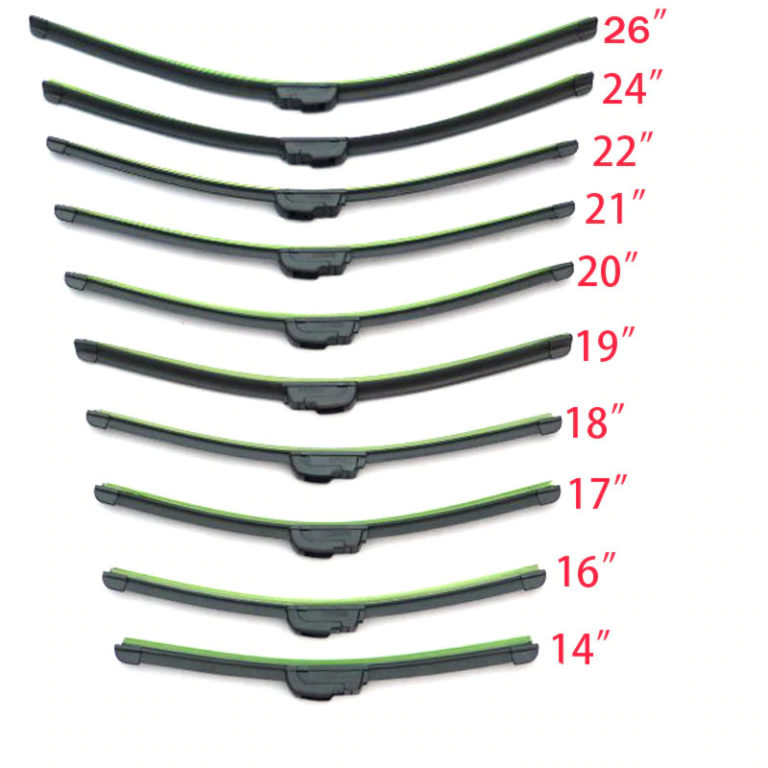
No. Many vehicles use different sizes on the driver and passenger sides. The driver-side blade may be longer because it must clear more of the windshield in front of the driver.
Some vehicles use equal-length blades. Others use three different sizes when a rear blade is included. The rear blade may also have a special design that does not fit the front arm.
A fit guide may show the sizes in this order:
| Wiper position | What to check |
|---|---|
| Driver side | Front blade on the driver’s side |
| Passenger side | Front blade on the passenger’s side |
| Rear | Blade on the rear window, if equipped |
Always match the blade to its position. Installing the longer blade on the wrong side can cause the ends to touch, overlap, or strike the windshield trim.
The correct blade should move across the glass without hitting the other blade, the hood, the trim, or the edge of the windshield. It should also park in the normal position when switched off.
Can I Measure My Old Wiper Blades?
Yes, but use measurement as a check rather than your only source.
Place the old blade on a flat surface. Measure the rubber blade from one end to the other. Do not include the metal wiper arm. Record the driver, passenger, and rear measurements separately.
A small difference may appear between the measured length and the size shown in a catalog. Wiper blades are often sold in whole-inch sizes. For example, a blade that measures close to 21 inches may be listed as a 21-inch blade.
Do not round up without checking clearance. A blade that is too long can:
- Touch the other blade
- Hit the windshield frame
- Extend beyond the glass
- Catch on trim
- Create a safety risk if it moves out of place
A blade that is too short leaves part of the windshield uncleared. The missed area can block your view during rain, snow, or road spray.
The best process is simple:
- Look up the vehicle in a trusted fit guide.
- Measure the old blade.
- Compare the result with the listed size.
- Check the connector and blade position.
- Stop if the information conflicts, and confirm with the owner’s manual or an authorized parts source.
What Happens If the Wiper Blade Is the Wrong Size?
A wrong-size blade may still attach and move. That does not make it safe or correct.


If the blade is too long
A blade that is too long may strike:
- The other wiper blade
- The windshield pillar
- The hood
- The plastic cowl below the windshield
- The edge of the glass
It may also lift at the end or fail to park correctly. Turn the wipers off if you hear a repeated knock or see contact with another part of the vehicle.
If the blade is too short
A short blade leaves a strip of glass unwiped. That strip can sit in the driver’s line of sight. The problem is worse at night, when headlights shine through rain or road spray.
A short blade may also reduce the cleared area near the center of the windshield. Do not assume that a one-inch difference is harmless.
If the connector is wrong
A blade with the wrong connector can loosen or detach. This can damage the glass and leave you without a working wiper during a storm.
Before driving, gently pull on the installed blade. It should stay locked to the arm. Follow the blade maker’s fitting instructions. If the lock does not click or the blade feels loose, remove it and use the correct adapter.
How to Replace Wiper Blades Safely
Replacing a blade usually takes only a few minutes. Work carefully because the bare wiper arm can snap against the windshield.
What you need
You normally need:
- The correct replacement blade
- A clean cloth
- The fitting instructions
- A towel or folded cloth to protect the glass
Replacement steps
- Turn the vehicle off. Set the wipers to their normal parked position.
- Lift the wiper arm. Some arms do not lift far because the hood blocks them. Do not force the arm.
- Protect the glass. Place a folded towel on the windshield below the arm.
- Release the old blade. Press the tab or open the clip, depending on the connector.
- Slide the old blade off.
- Attach the new blade. Use the correct adapter for the arm.
- Check the lock. Make sure the blade clicks or locks into place.
- Lower the arm slowly. Never let it fall onto the glass.
- Test with washer fluid. Use washer fluid, not dry glass, to check movement.
If the wipers have a service position, use the instructions in the owner’s manual. Some vehicles require the ignition or wiper switch to be used in a specific order.
Signs the installation worked
The blade should:
- Stay attached during movement
- Wipe smoothly
- Clear water across the full intended path
- Park in its normal position
- Avoid contact with trim and the other blade
- Make little or no chatter on a wet windshield
Do not test a new blade on dry glass. Dirt and dry friction can damage the rubber and create noise.
Why Wipers Leave Streaks After Replacement
Streaks do not always mean the blade size is wrong. Several problems can cause poor wiping.


Dirty glass
Road film, wax, tree sap, and bugs can stop the rubber from making full contact. Clean the windshield with glass cleaner or washer fluid and a clean cloth.
Dirty rubber
Wipe the rubber edge with a damp cloth. If the cloth picks up black residue, clean the blade gently. Replace the blade if the rubber is torn, cracked, hardened, or split.
Bent wiper arm
The arm may not press evenly against the glass. This can create a dry strip or streak on one side. Do not bend the arm unless the vehicle maker gives a safe procedure. A repair shop can inspect it.
Wrong blade design
Some vehicles need a beam-style blade, a conventional frame blade, or a special rear blade. A blade can have the correct length but still perform poorly if its shape does not match the vehicle’s windshield.
Poor installation
An adapter that is not fully locked can hold the blade at the wrong angle. Recheck the connector and compare it with the instructions.
Replace the blade if cleaning does not help. If a new, correctly sized blade still skips or leaves a large unwiped area, inspect the arm and windshield.
How Often Should You Replace Wiper Blades?
There is no single replacement date for every vehicle. Replace the blades when they no longer clear the glass well or when the rubber shows damage.
Common signs include:
- Streaks
- Skipping
- Chattering
- Squeaking
- Missed sections
- Cracked rubber
- Splitting or tearing
- A loose blade
- A blade that does not return to the glass
Weather affects blade life. Strong sun, heat, ice, snow, salt, and frequent use can age the rubber faster. In parts of the United States with hot summers, dry conditions, or heavy winter storms, inspect the blades more often.
Do not use the wipers to remove thick ice. Clear the ice first with a scraper and allow the defroster to help. Frozen blades can tear when the wiper motor starts.
Wiper Blade Size Examples
The examples below show how to read a fit result. They are hypothetical and do not identify a universal fit for any vehicle.
| Vehicle lookup result | Correct interpretation |
|---|---|
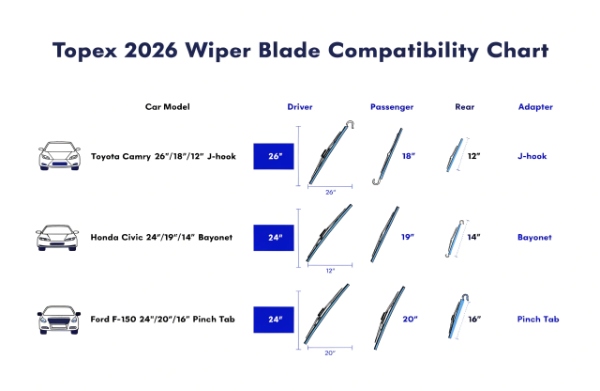
| Driver 24 inches, passenger 18 inches | Buy one 24-inch driver blade and one 18-inch passenger blade |
| Driver 22 inches, passenger 22 inches | Both front blades use 22 inches |
| Driver 26 inches, passenger 18 inches, rear 12 inches | Buy three blades with those positions and sizes |
| Front blades listed, no rear size | The guide may not support the rear blade or the vehicle may have no rear wiper |
The key point is that size belongs to both the vehicle and the position. A “24-inch blade” is not automatically right for every vehicle or every side.
Common Mistakes to Avoid
Avoid these errors when choosing wiper blades:
- Buying by vehicle make alone
- Assuming both front blades are equal
- Using the driver-side size on the passenger side
- Treating the rear blade like a front blade
- Measuring the arm instead of the blade
- Trusting the old blade without checking its condition
- Ignoring the connector type
- Forcing an adapter
- Choosing a longer blade to clear more glass
- Testing the blade on dry glass
- Letting the bare arm fall onto the windshield
- Driving with a loose or partly locked blade
If a catalog gives two different results, do not guess. Check the owner’s manual, compare the vehicle trim, and contact the manufacturer or a qualified parts counter.


Key Takeaways
- Look up wiper blades by year, make, model, trim, and position.
- The driver and passenger blades may use different lengths.
- The rear blade usually has its own size and connector.
- Use the owner’s manual or a trusted fit guide first.
- Measure the old blade only as a cross-check.
- Confirm that the connector locks firmly.
- Test the new blade with washer fluid.
- Replace damaged, streaking, skipping, or noisy blades.
Frequently Asked Questions
What is the most accurate way to find my wiper blade size?
Use the owner’s manual or a vehicle-specific fit guide. Enter the full year, make, model, and trim when requested. Then confirm the driver, passenger, and rear positions separately.
Can I use a larger wiper blade?
Usually, you should use only the size listed for your vehicle. A larger blade may hit another blade, the vehicle trim, or the windshield frame. It may also park incorrectly.
Are front and rear wiper blades interchangeable?
Usually not. Rear blades often use a different length, shape, or connector. Buy a rear blade listed specifically for the rear window of your vehicle.
Do all cars use the same wiper connector?
No. Vehicles use several connector designs, including J-hooks, push-buttons, side-pins, bayonet fittings, and pinch tabs. The replacement blade must include the correct connector or adapter.
Can I drive with one old and one new wiper blade?
You can, if both blades are the correct size and work properly. However, replacing both front blades at the same time often gives more even wiping. Always replace a damaged or loose blade at once.
Why does my new wiper blade squeak?
The glass or rubber may be dirty, the blade may be poorly fitted, or the wiper arm may not press evenly. Clean the windshield and rubber first. If the noise remains, recheck the connector and inspect the arm.
Conclusion
To find what size wiper blades your car needs, start with the vehicle’s year, make, model, trim, and wiper position. Confirm the information with the owner’s manual or a reliable vehicle fit guide. Then use the old blade’s measurement and connector as a final check.
Do not guess based on length alone. The correct blade must fit the glass, attach securely to the arm, and move without touching nearby parts. If the size or connector information conflicts, pause the installation and confirm the fit before driving in rain or snow.
