

Introduction
Yes. Many urgent care centers in the United States offer routine physicals, including sports physicals, school physicals, work physicals, camp physicals, and some Department of Transportation (DOT) exams.
However, services vary by location. Some clinics may not provide immigration medical exams, complete specialty forms, or perform physicals that require a certified examiner. Call the urgent care center before you go and ask what type of physical it offers, what documents you need, and whether you need an appointment.
What is a physical exam?
A physical exam is a health visit that checks your general condition. The clinician may review your health history, measure vital signs, perform a basic exam, and complete a required form.
A physical is not the same as an urgent visit for an illness or injury. It is usually planned in advance and focuses on your current health and ability to take part in a specific activity.
A typical physical may include:
- Blood pressure and pulse
- Height, weight, and body mass index
- Temperature, when needed
- Heart and lung exam
- Vision screening
- Hearing screening, when required
- Review of medicines and allergies
- Review of past illnesses, surgeries, and injuries
- Questions about family health history
- A check of movement, strength, and joints
- Vaccination review
- Lab tests, if the form or clinician requires them
The exam may also include questions about mental health, sleep, substance use, diet, or exercise. Answer honestly. The goal is to find health issues that could affect your safety.
Which types of physicals can urgent care provide?
Urgent care can often provide common school, sports, work, and camp physicals. The exact answer depends on the clinic, the form, and the rules of the organization requesting the exam.
| Type of physical | Can urgent care usually do it? | What may change the answer |
|---|---|---|
| Sports physical | Often | The school or athletic league may require a specific form |
| School physical | Often | State and school rules may require vaccines or extra tests |
| Camp physical | Often | The camp may have its own form and deadline |
| Pre-employment physical | Often | The employer may require drug testing, labs, or a special exam |
| Annual wellness exam | Sometimes, but a primary care office may be better | Preventive care often needs a longer-term health record |
| DOT medical exam | Only at a clinic with a certified medical examiner | The examiner must be listed in the Federal Motor Carrier Safety Administration system |
| Immigration medical exam | Usually no | USCIS requires an exam by a designated civil surgeon |
| School bus or commercial driver exam | Sometimes | State or federal rules may apply |
| Disability or insurance exam | Not usually | The organization may require a specific physician or specialist |
Sports physicals
Urgent care centers commonly offer sports physicals. The clinician may review your medical history and check your heart, lungs, joints, strength, flexibility, and vision.
A sports physical does not replace a full primary care visit. It may not include every preventive service, such as a complete vaccine review, cholesterol screening, or ongoing care for asthma.
The American Academy of Pediatrics supports the use of a preparticipation physical evaluation to assess an athlete before sports. Bring the correct school or league form. Some forms ask about fainting, chest pain, past concussions, sudden death in the family, or prior bone and joint injuries.
If you have chest pain with exercise, unexplained fainting, severe shortness of breath, or a known heart condition, tell the clinician before the exam. You may need more testing or clearance from a specialist.
School and camp physicals
Many urgent care clinics complete school and camp forms. The visit may include a basic exam, vaccine review, and screening required by the school, camp, or state.
Requirements differ across the United States. For example, one school may ask for a tuberculosis test, while another may not. Some programs require proof of specific vaccines or a health-care provider’s signature.
Bring:
- The school or camp form
- Your vaccine record
- Your child’s medical history
- A list of medicines and allergies
- Any needed insurance or payment information
Work and pre-employment physicals
An urgent care center may perform a pre-employment physical if the employer accepts that clinic. The employer may also require drug testing, a tuberculosis test, a respirator evaluation, hearing testing, or a lifting assessment.
Ask the employer what the exam must include. A basic physical may not meet the employer’s needs.
The clinician should receive only the information needed for the job requirement. The Americans with Disabilities Act limits when an employer can require medical exams and how medical information may be handled. The U.S. Equal Employment Opportunity Commission provides guidance for employers and workers.
DOT physicals
A DOT physical is a special exam for certain commercial motor vehicle drivers. It must be performed by a medical examiner listed on the Federal Motor Carrier Safety Administration’s National Registry.
Not every urgent care clinician can perform a DOT medical exam. When you call, ask:
“Does your clinic have a medical examiner listed on the FMCSA National Registry for DOT physicals?”
Bring your driver’s license, glasses or contact lenses, hearing aids if used, a list of medicines, and information about medical conditions. The FMCSA may require additional documents for conditions such as diabetes, heart disease, sleep apnea, or high blood pressure.
A normal urgent care physical does not count as a DOT physical unless it meets the federal requirements and is completed by a qualified examiner.
Immigration medical exams
Most urgent care centers cannot perform a USCIS immigration medical exam. U.S. Citizenship and Immigration Services requires the exam to be completed by a designated civil surgeon in the United States.
A clinic may advertise “immigration physicals” but still not have a designated civil surgeon. Check the USCIS civil surgeon process before booking. The required paperwork, vaccines, and tests are different from those used for a sports or work physical.
What happens during an urgent care physical?
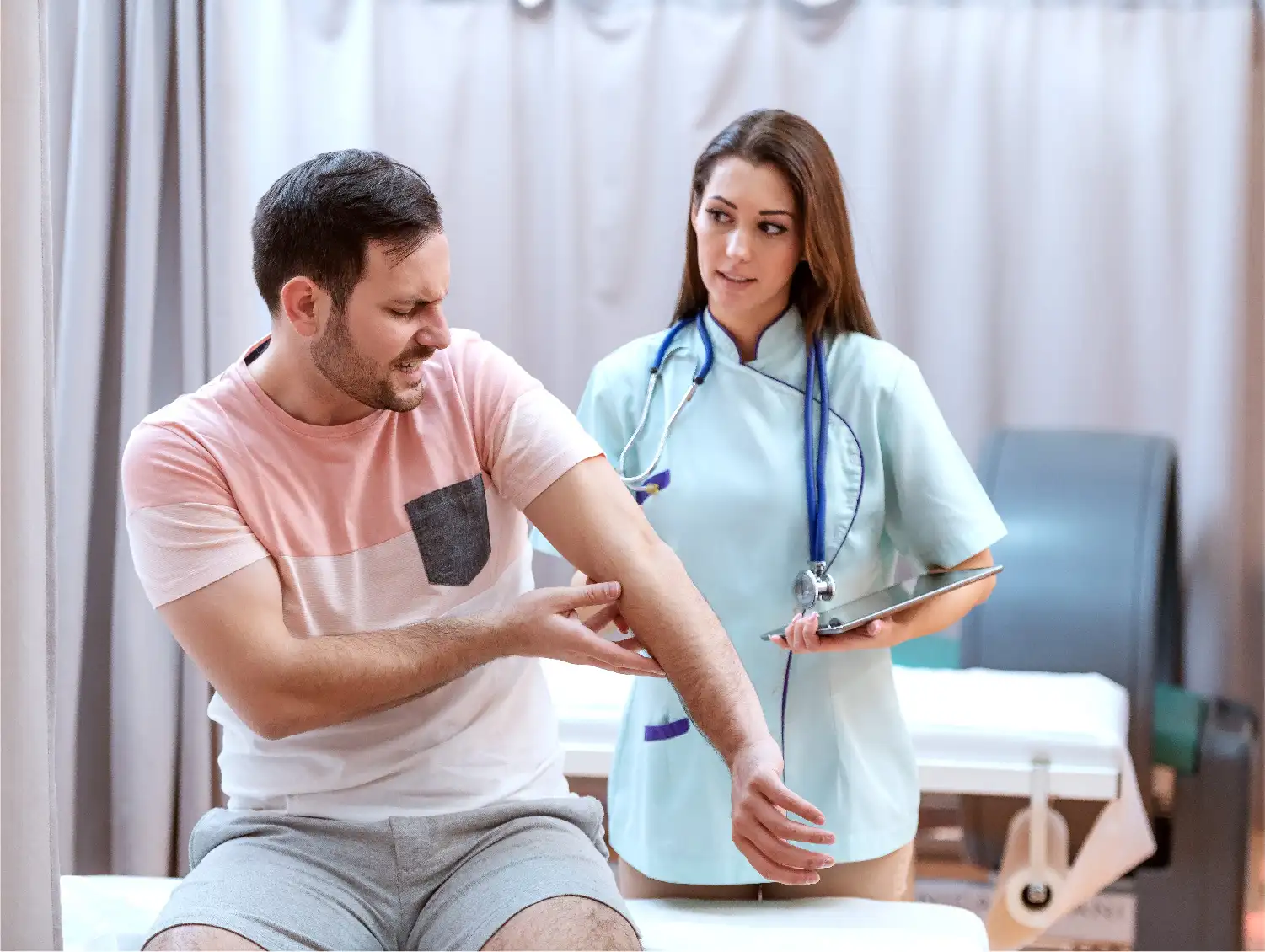
The visit usually starts with paperwork and a review of your health history. A medical assistant may record your vital signs before the clinician examines you.
The clinician may ask about:
- Current symptoms
- Past medical conditions
- Surgeries and hospital stays
- Medicines and supplements
- Allergies
- Vaccines
- Family history
- Tobacco, alcohol, or drug use
- Exercise and activity level
- Previous injuries
The exam then depends on the purpose of the visit. A sports physical may focus on the heart, lungs, joints, muscles, and past injuries. A work physical may focus on your ability to perform certain job tasks.
The clinician may approve the form, approve it with limits, or ask for more information. For example, they may request old medical records, a specialist note, a lab result, or another test.
A physical does not guarantee that you will be cleared for every activity. It only reflects the information available during that visit.
How to prepare for an urgent care physical
Preparation can make the visit faster and reduce the chance of a missing form or repeat visit.
Before you go
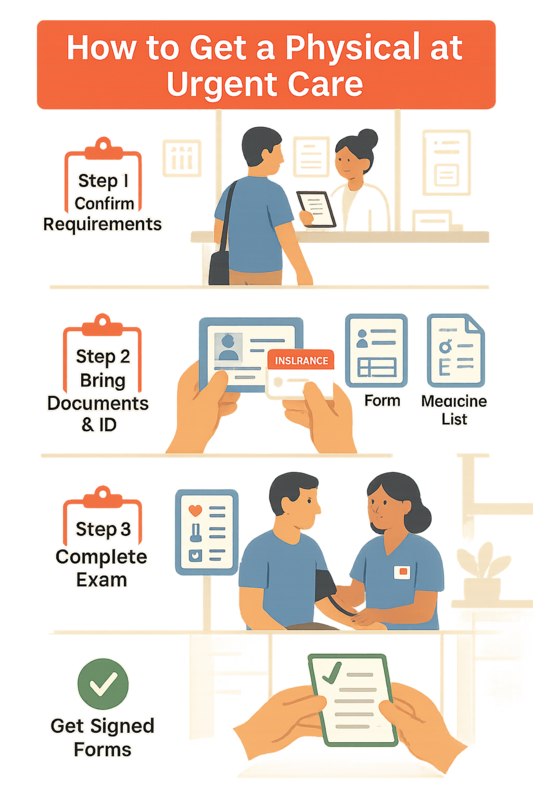
Find out exactly what exam you need.
Ask the school, employer, sports program, government agency, or camp for its form and instructions.Call the urgent care clinic.
Confirm that it offers your type of physical. Ask whether it accepts walk-ins, requires an appointment, and provides any required testing.Gather your health information.
Bring a medicine list, allergy list, vaccine record, glasses, hearing aids, and relevant medical records.Check whether fasting is needed.
Most basic physicals do not require fasting. Some employer or insurance exams may include blood tests that do. Follow the clinic’s instructions.Wear practical clothing.
Loose clothing makes it easier to check your joints, lungs, and movement.Arrive early.
Forms, insurance checks, and medical history may take time.
What to bring
Bring:
- A government-issued ID
- Insurance card, if using insurance
- The required physical form
- Payment method
- Vaccine records
- A list of medicines and doses
- A list of allergies
- Glasses or contact lenses
- Hearing aids
- Medical records for relevant conditions
- Employer or school instructions
Do not assume the clinic can access all of your primary care records. If you have a complex health history, ask your regular clinician what records are needed.
How much does an urgent care physical cost?
The cost depends on the type of physical, your insurance, the clinic, and extra services. A basic physical may have a flat self-pay price, while a physical with lab work, vaccines, imaging, or forms may cost more.
Insurance coverage also varies. A sports or work physical may be treated as an administrative service rather than a covered preventive visit. A deductible, copay, or coinsurance may apply.
Before the visit, ask:
- What is the self-pay price?
- Is the physical covered by my insurance?
- Is there a separate fee for forms?
- Are vaccines included?
- Are labs or drug tests included?
- Will I pay separately for a tuberculosis test?
- Is a follow-up visit included if more information is needed?
Do not compare prices based only on the advertised exam fee. A low base price may not include vaccines, lab tests, forms, or required follow-up.
Medicare annual wellness visits are a separate benefit with specific rules. An urgent care center may not provide the same ongoing prevention and care planning that a primary care practice provides.
When urgent care may not be the best place
Urgent care can be convenient for a simple form-based exam. A primary care clinician may be better when the visit involves ongoing care or a complex medical history.
Consider primary care if you need:
- A complete annual wellness visit
- Long-term management of diabetes, asthma, or high blood pressure
- A detailed review of several medicines
- Follow-up after a serious illness or injury
- Specialist referrals
- A complete vaccine and screening plan
- Review of records from several health systems
- Evaluation of symptoms found during the physical
Urgent care may also refer you elsewhere if your blood pressure is very high, your heart rhythm is abnormal, or your medical history needs more review.
A physical is not the right setting for an emergency. Call 911 for severe chest pain, severe trouble breathing, signs of a stroke, fainting with ongoing symptoms, or a life-threatening injury.
Common reasons an urgent care physical is delayed or rejected
The most common problem is bringing the wrong form or asking for a service the clinic does not provide.
Your visit may be delayed if:
- The form requires a certified examiner
- The clinic lacks a required test
- Your vaccine record is missing
- The employer requires a drug test the clinic does not offer
- Your medical condition needs specialist clearance
- The form has a deadline the clinic cannot meet
- The clinician cannot verify important medical information
- You need a test that requires a separate appointment
- The form belongs to another state, school, employer, or agency
A clinic may also decline to sign a form if the exam does not show that clearance is safe. That does not necessarily mean you cannot participate. It may mean that more testing or a specialist review is needed.
Do not ask a clinician to leave out a known condition. An incomplete form can create safety risks and may be rejected later.
Urgent care physicals vs. primary care physicals
Both settings can perform a basic exam, but they serve different purposes.
| Feature | Urgent care physical | Primary care physical |
|---|---|---|
| Main purpose | Complete a time-sensitive form or basic exam | Provide ongoing preventive care |
| Medical history | May be limited | Usually more complete |
| Access to records | May be limited | Often part of the same care system |
| Follow-up | May require another clinician | Built into the care relationship |
| Common use | Sports, school, camp, and work forms | Annual exams and chronic disease care |
| Convenience | Often offers extended hours | May have longer scheduling waits |
| Cost | Varies by exam and coverage | Depends on insurance and preventive-care rules |
If you only need a simple sports form before a deadline, urgent care may be practical. If the physical is also your yearly health review, primary care may provide more value.

How to choose an urgent care clinic for a physical
Use the clinic’s website or phone line to confirm the service before you travel. Ask specific questions rather than simply asking whether the clinic “does physicals.”
You can ask:
- Do you provide sports, school, camp, or work physicals?
- Do you complete this exact form?
- Do you provide DOT exams through an FMCSA-listed examiner?
- Do you offer required labs, vaccines, hearing, or vision tests?
- Do you accept walk-ins?
- How long does the visit usually take?
- Can you complete the form during the same visit?
- What is the total self-pay cost?
- Do you send results to the employer, school, or patient?
- What should I bring?
Choose a primary care office or designated specialist when the form requires detailed records, complex clearance, or ongoing follow-up.

FAQs about urgent care physicals
Can I get a physical at urgent care without an appointment?
Often, yes. Many urgent care centers accept walk-ins, but appointments may reduce wait time. Call first because some clinics schedule physicals separately from illness visits.
Does urgent care provide sports physicals for children?
Many do. Bring the sports organization’s form, vaccine record, medicine list, and information about prior injuries. Ask whether the clinic has age limits or requires a parent or guardian to attend.
Can urgent care give vaccines during a physical?
Some clinics provide vaccines, but stock and insurance coverage vary. Ask whether the clinic has the specific vaccine you need and whether it can document the dose on your form.
Can urgent care do a physical and drug test at the same visit?
Sometimes. The employer may require a specific drug test, chain-of-custody process, or laboratory. Confirm both requirements with the employer and clinic before the visit.
Can urgent care clear me for sports if I have asthma or a heart condition?
The clinician may be able to evaluate you, but clearance depends on your history and current findings. You may need records or approval from your primary care clinician or a specialist. Do not stop medicine before the exam unless your clinician tells you to do so.
Conclusion
Urgent care often does physicals in the United States, especially sports, school, camp, and basic work physicals. It may also offer DOT exams, but only through a properly qualified examiner. Immigration medical exams and complex clearance visits usually require a designated or specialized provider.
Before you go, confirm the exact form, required tests, price, appointment rules, and documents. If you need ongoing preventive care or have a complex condition, your primary care clinician may be the better choice.
Next step
Call the urgent care center and say:
“I need a [sports, school, work, camp, DOT, or other] physical. Do you complete the required form, provide all needed tests, and what should I bring?”
Sources
- Centers for Disease Control and Prevention: Adult and adolescent immunization schedules
- Federal Motor Carrier Safety Administration: National Registry of Certified Medical Examiners
- U.S. Citizenship and Immigration Services: Find a doctor
- American Academy of Pediatrics: Preparticipation physical evaluation
- U.S. Equal Employment Opportunity Commission: Disability discrimination
