

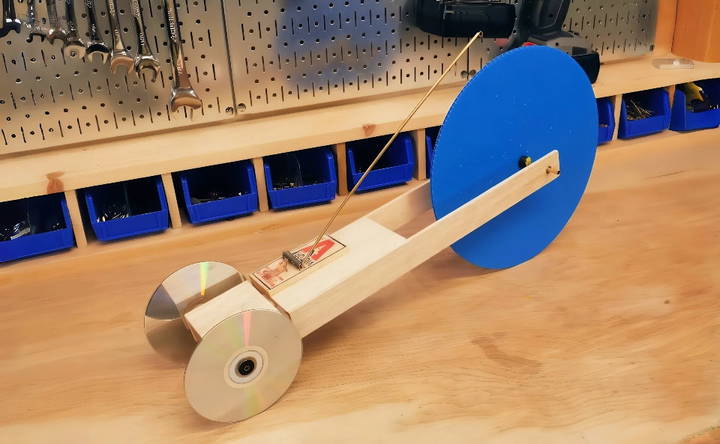
To build a mousetrap car, attach a lever arm to a standard snap mousetrap, connect the arm to a rear axle with string, and mount that axle between four lightweight wheels. When the trap releases, the spring pulls the string, turns the axle, and moves the car forward.
This project is common in U.S. middle school, high school, and STEM classrooms because it shows how stored energy, torque, friction, and wheel size work together. The best design depends on your goal: a distance car needs low friction and a long pull, while a speed car needs quick energy release and strong traction.

What You Need to Build a Mousetrap Car
A simple mousetrap car needs a trap, a frame, two axles, four wheels, and a way to transfer spring force to the rear axle. Most parts can come from a craft store, hardware store, or recycling bin.
Materials
- One standard wooden snap mousetrap
- A lightweight frame, such as foam board, cardboard, balsa wood, or thin wood
- Two straight axles, such as wooden dowels or stiff metal rods
- Four wheels, such as CDs, toy wheels, jar lids, or large bottle caps
- Four straw sections or small eyelets for axle bearings
- Strong string or fishing line
- A wooden skewer, dowel, or stiff wire for the lever arm
- Hot glue or craft glue
- Tape
- Scissors or a craft knife
- Ruler
- Pencil
- Drill, awl, or hole punch
- Small washers or beads, if needed
- Safety glasses
The axles must be straight, and the wheels should be close to the same size. Uneven wheels can make the car turn or rub against the frame.
A standard mousetrap has a spring-powered metal bar. Do not remove the spring or weaken the trap. The spring stores energy when the bar is pulled back, then releases that energy when the bar moves forward.
Useful design targets
These are practical starting points, not fixed rules:
| Part | Starting point | Why it helps |
|---|---|---|
| Frame length | 12 to 18 inches | Gives room for the trap and axles |
| Frame width | 3 to 5 inches | Keeps the car stable |
| Lever arm | 12 to 18 inches | Provides a longer pull for distance |
| Wheel diameter | 3 to 6 inches | Balances speed, distance, and clearance |
| Axle spacing | 8 to 14 inches | Helps the car track straight |
| Wheel alignment | Parallel within a small margin | Reduces rubbing and turning |
For a first build, use a frame about 14 inches long and 4 inches wide. Keep it light, but not so light that it bends or twists.

How Does a Mousetrap Car Work?
A mousetrap car converts stored spring energy into motion. The trap pulls a lever arm, the lever arm pulls a string, and the string rotates the drive axle.
The main parts have different jobs:
- Mousetrap: stores and releases energy.
- Lever arm: increases the distance that the trap can pull the string.
- String: transfers the pull to the axle.
- Drive axle: changes the string’s pull into rotation.
- Wheels: turn axle rotation into forward motion.
- Frame: holds the parts in alignment.
The car moves only if the spring force is greater than the resistance from the wheels, bearings, string, and floor.
Torque and wheel size
Torque is the turning force at the axle. A larger axle gives more torque because the string pulls farther from the axle’s center. A smaller axle gives less torque but lets the string unwind over more axle rotations.
This creates a key trade-off:
- Small drive axle: more distance and more pulling force.
- Large drive axle: faster wheel rotation and often more speed.
- Large wheels: more distance per wheel rotation.
- Small wheels: easier starting force and less mass.
For a distance car, use a small drive-axle spool and larger wheels. For a short race, a larger axle can release the string faster, but the car may struggle to start.
A simple calculation
The distance traveled per axle rotation is approximately:
[
\text{Distance per rotation} = \pi \times \text{wheel diameter}
]
For example, a 4-inch wheel travels about:
[
3.14 \times 4 = 12.56\text{ inches}
]
That is the theoretical distance for one wheel rotation without slipping. Real distance will be lower if the wheels skid, rub, or lose alignment.
If the drive axle has a 0.25-inch diameter and the wheel has a 4-inch diameter, the wheel turns about 16 times for each full rotation of the drive axle:
[
4 \div 0.25 = 16
]
This explains why a small axle can help a car travel far. The string must unwind through many axle rotations before it runs out.

Step-by-Step: How to Build a Mousetrap Car
Follow the steps in order. Test each part before adding the next one. Small alignment problems are much harder to find after the car is fully assembled.
1. Plan the frame
Draw a simple rectangle on paper before cutting the frame. Mark the front axle, rear axle, mousetrap, and lever arm.
Place the mousetrap near the center of the frame. The rear axle should sit behind it if the rear wheels are the drive wheels. Leave enough room for the lever arm to move without hitting the frame.
Keep the frame straight. A warped frame can make the car pull to one side.
2. Cut and reinforce the frame
Cut the frame from foam board, cardboard, balsa wood, or thin plywood. A 14-by-4-inch frame is a useful starting size.
Add narrow strips of material under the frame if it bends. Reinforcement is helpful, but avoid adding more weight than needed. A heavy frame requires more force to start and increases rolling resistance.
Round or tape sharp edges. Use a craft knife only on a stable surface, and ask an adult for help when required.
3. Install the axle bearings
Cut four short sections of drinking straw. Glue two under the front of the frame and two under the rear.
The straw sections act as bearings. The axles turn inside them with less friction than they would against the frame.
Check these points before the glue dries:
- The front bearings are parallel to each other.
- The rear bearings are parallel to each other.
- The front and rear axle lines are at right angles to the frame.
- The openings are large enough for the axles to spin freely.
Do not glue the axles into the straw. The axles must rotate.
4. Prepare the axles
Slide one axle through the front bearings and one through the rear bearings. The rear axle will usually be the drive axle.
The axles should extend a similar distance on both sides. If one side extends too far, the car may be uneven or the wheel may rub on the frame.
Spin each axle by hand. It should turn several times after a gentle push. If it stops at once, check for crooked bearings, glue, or a bent axle.
5. Attach the wheels
Mount one wheel at each end of each axle. Keep each wheel centered and perpendicular to the axle.
You can use glue, small pieces of tubing, beads, or washers to hold the wheels in place. Do not let glue flow into the straw bearings.
Leave a small gap between each wheel and the frame. The wheel should not touch the frame while turning.
If you use CDs, add a small hub made from cardboard, foam, or a bottle cap. The center hole of a CD is too large for many small axles.
6. Attach the mousetrap
Place the mousetrap on the top of the frame. Secure it with tape, zip ties, or glue.
The trap must not shift when the spring releases. However, avoid covering the moving bar or spring with glue.
Test the trap by moving the bar slowly. Make sure the bar has a clear path and cannot strike the frame, wheels, or your fingers.
7. Add the lever arm
Attach a straight lever arm to the moving bar of the mousetrap. A wooden dowel or skewer can work.
The lever arm should point toward the rear drive axle when the trap is set. Keep it light and straight. A heavy arm wastes energy and can bend the trap bar.
Use strong tape or a small amount of glue to secure the arm. Let the glue dry fully before testing.
For a distance design, start with a lever arm around 12 to 18 inches long. The longer arm lets the string pull for a longer time, but it also swings through a larger space.
8. Make the axle spool
Create a small spool at the center of the rear axle. The string will wrap around this spool.
You can use:
- A short piece of straw
- A small section of a pen tube
- A stack of tape layers
- A small wooden or plastic cylinder
The spool must be centered. If it is off-center, the axle will wobble and the string may slip.
Keep the spool narrow. A wide spool can cause the string to move sideways as it unwinds.
9. Tie and wind the string
Tie one end of the string to the tip of the lever arm. Tie the other end to the rear axle spool.
With the mousetrap released, turn the drive wheels backward so the string wraps around the spool. Keep the string in a straight line.
Set the trap carefully. The lever arm should move forward as the string unwinds. If the arm moves in the wrong direction, reverse the string path or use the other side of the axle.
Wind the string evenly. Crossed loops can jam or pull the car sideways.
10. Test the car
Place the car on a smooth, flat floor. A wood, tile, or low-pile indoor floor works better than thick carpet.
Hold the car in place, set the trap, and point the car straight. Release it without pushing.
Watch the first few inches. The car should start smoothly, travel forward, and keep all four wheels in contact with the floor.

How to Make a Mousetrap Car Go Farther
To increase distance, reduce resistance and make the spring pull the axle for a longer time. Do not simply make the lever arm longer without checking the rest of the design.
Try these changes:
- Use a smaller drive-axle spool.
- Use larger, lightweight wheels.
- Use a longer lever arm.
- Reduce wheel and axle friction.
- Improve wheel alignment.
- Add traction to the drive wheels if they slip.
- Remove unnecessary frame weight.
- Keep the string tight and straight.
A small spool is often the most useful distance change. It increases the number of axle rotations available from the same length of string.
A longer lever arm can also help, but it needs more room. If the arm drags, hits the frame, or bends, it will reduce performance rather than improve it.
Large wheels can travel farther per rotation. They also have greater rotational mass, so very large wheels may make the car slow to start. Use light wheels that remain rigid.

How to Make a Mousetrap Car Faster
A speed-focused mousetrap car needs quick acceleration, good traction, and low mass. It does not use exactly the same design as a distance car.
Start with these changes:
- Use a shorter lever arm.
- Use a larger axle spool.
- Use smaller or medium-size wheels.
- Keep the frame short and stiff.
- Use a direct string path.
- Add light traction to the drive wheels.
- Reduce the weight of the frame and attachments.
A shorter lever arm releases the string more quickly. A larger spool also makes the axle turn faster at the start.
The trade-off is distance. The string may run out sooner, and the car may not travel as far as a long-arm design.
If the wheels spin in place, the car has more drive force than the floor can handle. Add a narrow rubber band or a strip of balloon rubber around the drive wheels. Use only enough traction to stop slipping. Too much rubber can increase rolling resistance.

Troubleshooting a Mousetrap Car
Most failures come from friction, poor alignment, or an inefficient string path. Check the simplest cause first.
| Symptom | Likely cause | Fix |
|---|---|---|
| Car does not move | String is loose, axle is stuck, or trap is too weak | Spin the axle, retie the string, and check for glue |
| Car moves only a few inches | Spool is too large or wheels slip | Use a smaller spool or add light traction |
| Car turns left or right | Wheels or axles are not parallel | Realign the bearings and wheel hubs |
| Wheels wobble | Wheels are off-center or axles are bent | Replace or recenter the part |
| String falls off | Spool is off-center or string pulls sideways | Center the spool and align the lever arm |
| Car starts slowly | Frame is heavy, wheels are large, or axle friction is high | Reduce weight and improve the bearings |
| Trap arm hits the car | Arm path is blocked | Move the trap or shorten the arm |
| Wheels rub the frame | Wheel spacing is too narrow | Add a washer or spacer |
| Car spins its wheels | Drive wheels lack traction | Add a thin rubber surface |
| Axle turns but wheels do not | Wheel connection slips | Secure the wheel hubs |
Test one change at a time. If you change the spool, wheels, string, and frame at once, you will not know which change helped.
A fast alignment test
Lift the car so the wheels are off the floor. Turn the drive axle by hand.
Both wheels should turn in the same plane. If one wheel appears to wobble, fix that wheel first. Then place the car on the floor and give it a gentle push with the mousetrap unset.
A well-aligned car should roll straight for several feet. If it curves, adjust the axle bearings or wheel position before testing the spring.

Safety Rules for Building and Testing
A mousetrap can pinch skin and launch its metal bar with force. Treat the trap as a mechanical device, not as a toy.
Follow these rules:
- Wear safety glasses during cutting and testing.
- Keep fingers away from the trap bar and spring.
- Set the trap on a stable surface.
- Ask an adult to help with cutting, drilling, hot glue, or trap setup.
- Do not point the lever arm at a person.
- Test the car on the floor, not on a table edge or staircase.
- Keep pets and small children away from the test area.
- Do not use the device to catch or harm animals.
- Remove damaged traps, cracked wheels, and splintered axles.
Use common workshop guidance from organizations such as the U.S. Consumer Product Safety Commission for age-appropriate tool use and the manufacturer’s instructions for any adhesive or cutting tool. The mousetrap car itself is a classroom project, but the tools used to build it can still cause injury.

Distance Car or Speed Car: Which Design Should You Choose?
Choose a distance design if your goal is to travel as far as possible. Choose a speed design if your goal is to cover a short track quickly.
| Goal | Lever arm | Drive spool | Wheels | Main priority |
|---|---|---|---|---|
| Long distance | Long | Small | Large and light | Long string travel and low friction |
| Fast start | Short | Large | Small or medium | Quick axle rotation and traction |
| Balanced design | Medium | Medium | Medium | Reliable performance |
The best design also depends on the floor. A smooth indoor floor may need more wheel traction. A rough surface may need larger wheels and a stronger frame.
If a school assignment has rules, read them before building. Some U.S. competitions limit wheel diameter, frame size, materials, or the number of mousetraps. A design that performs well may still fail if it breaks the event rules.
How to Measure and Improve Performance
Measure each test with the same method. Mark a start line on the floor and measure the distance from that line to the front axle or another fixed point.
Record:
- Lever arm length
- Wheel diameter
- Drive-spool diameter
- Car mass, if available
- Distance traveled
- Time over a set track
- Whether the car slipped or turned
A simple test table can reveal useful patterns:
| Test | Change | Distance | Time | Result |
|---|---|---|---|---|
| 1 | Baseline design | — | — | — |
| 2 | Smaller spool | — | — | — |
| 3 | Longer arm | — | — | — |
| 4 | Better alignment | — | — | — |
Run each design more than once. A single run can be affected by a string knot, floor dust, or a small change in starting position.
The most useful improvement is often not a new part. It is careful alignment. A straight car wastes less energy than a car that drags one wheel or repeatedly corrects its path.

Common Mistakes to Avoid
The most common mistake is building a heavy car with too much decoration. Extra weight increases the force needed to start the car and can make the frame bend.
Other frequent mistakes include:
- Using crooked axles
- Gluing the axles to the bearings
- Making the string too short
- Wrapping the string unevenly
- Using a spool that is too large for a distance challenge
- Attaching the lever arm at an angle
- Letting wheels touch the frame
- Testing on thick carpet
- Changing several parts at once
- Setting the trap with fingers near the bar
A mousetrap car does not need to look complex. A plain, light, straight car often performs better than a decorated car with extra parts.

Frequently Asked Questions
How long should the lever arm be on a mousetrap car?
Start with a lever arm between 12 and 18 inches. Use a longer arm for distance and a shorter arm for faster release. The arm must fit the frame and move without hitting the floor or wheels.
What size wheels work best?
Wheels between 3 and 6 inches are a useful starting range. Larger wheels can increase distance per rotation, but they also add weight and may make the car harder to start.
Why does my mousetrap car go backward?
The string is likely wrapped in the wrong direction, or the trap arm is pulling the axle opposite to the intended wheel rotation. Reverse the string path and test the car with the wheels raised.
Should the mousetrap be at the front or rear?
Either position can work. What matters is that the lever arm has a clear path and the string reaches the drive axle in a straight line. Many designs place the trap near the center and use the rear axle as the drive axle.
Can I use a rubber band instead of string?
A rubber band can stretch and store extra energy, but it may change the car’s behavior and may not be allowed by a class or competition. Strong, thin string gives a more direct and predictable pull.
Final Takeaway
To build a mousetrap car, make a light and straight frame, install free-spinning axle bearings, attach aligned wheels, secure the mousetrap, and use a lever arm and string to drive the rear axle.
Start with a basic design before chasing speed or distance. Test the axles, correct alignment problems, then adjust the lever arm, spool, wheel size, and traction one at a time. The strongest design is usually the one that wastes the least energy through friction, slipping, and crooked parts.
