

Drifting means intentionally making the rear tires lose grip while you steer the car through a turn. The driver then uses steering, throttle, and sometimes the clutch to keep the car sliding at a controlled angle.
Only practice drifting at a legal, closed course or approved motorsports facility in the United States. Never drift on public roads, parking lots, or residential streets. A mistake can injure people, damage property, or lead to arrest, towing, insurance problems, or loss of control.

What Is Drifting?
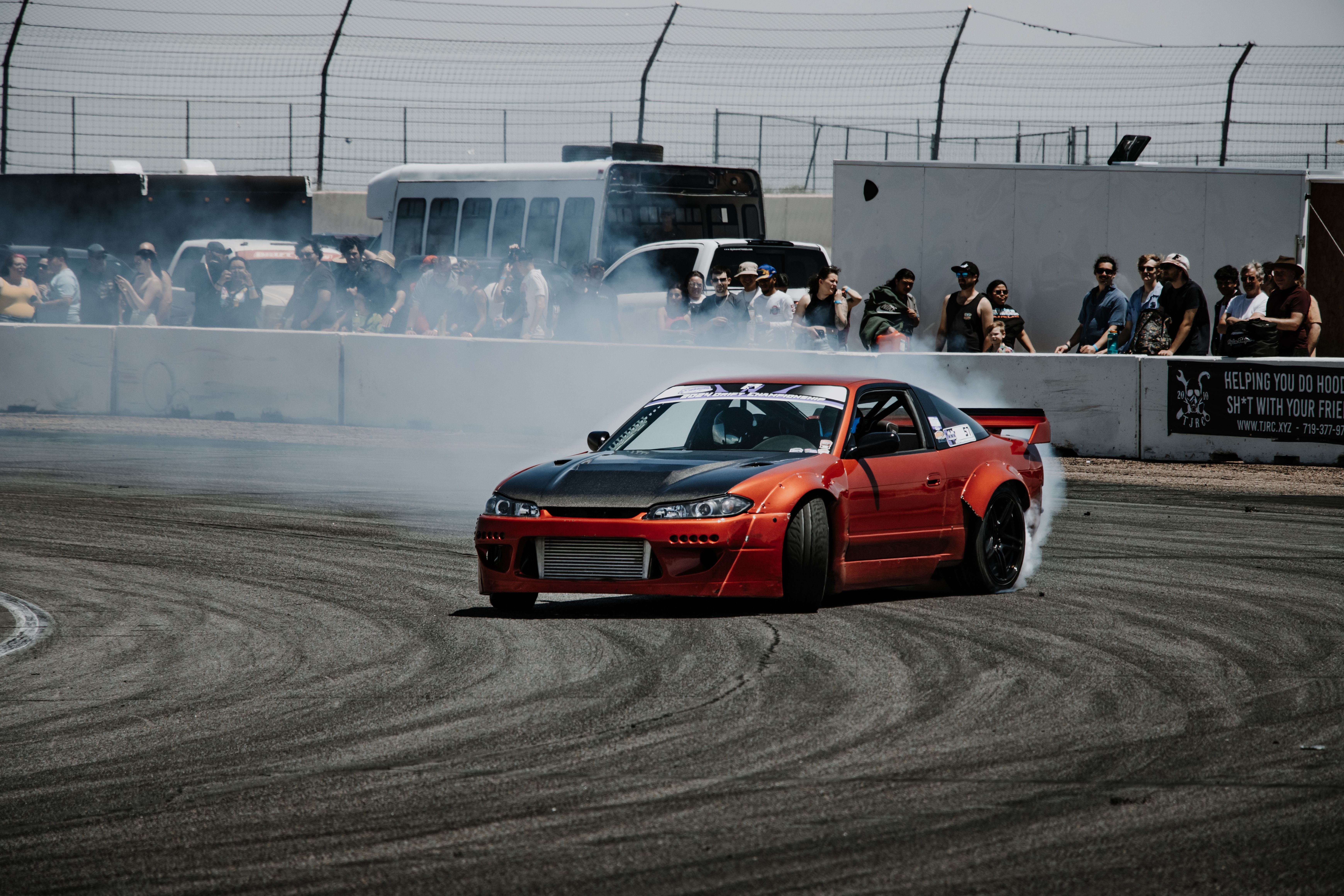
Drifting is a controlled oversteer maneuver. Oversteer happens when the rear tires lose traction before the front tires. The car begins to rotate toward the outside of the turn, while the driver points the front wheels into the slide.
A drift is not the same as simply spinning the tires. A proper drift includes:
- A planned entry into a turn
- Rear-wheel slip
- Countersteering
- Throttle control
- A safe exit or recovery
The key idea is balance. Too little throttle and the rear tires regain grip. Too much throttle and the car may spin.
Why does a car drift?
A tire can only provide a limited amount of grip. Hard acceleration, braking, and cornering all use part of that grip. If the rear tires receive more force than they can handle, they slide.
Several factors affect this balance:
- Drive layout: Rear-wheel drive is usually easiest for learning.
- Tire condition: Worn or mismatched tires lose grip more easily but may behave unpredictably.
- Surface: Wet pavement reduces grip but can make the car harder to control.
- Weight transfer: Braking or lifting off the throttle moves weight toward the front.
- Throttle input: More power usually increases rear-wheel slip.
- Electronic controls: Stability and traction systems may reduce or stop a slide.
A drift is controlled tire slip, not a complete loss of control. If you cannot stop the slide when needed, you are not controlling it.
Can Any Car Drift?
Most cars can slide under the right conditions, but they are not equally suited to drifting. A rear-wheel-drive car with a manual transmission is the most common learning platform.
| Vehicle type | Drifting suitability | Main limitation |
|---|---|---|
| Rear-wheel drive | Best starting point | Requires space and tire wear |
| Front-wheel drive | Poor for sustained power slides | Front tires steer and pull the car |
| All-wheel drive | Possible, depending on system | Different systems react in different ways |
| Automatic transmission | Possible | Less direct control in some cars |
| Electric vehicle | Model-dependent | Instant torque can make slides abrupt |
A rear-wheel-drive car does not need extreme power. A lighter car with predictable handling can be easier to learn in than a high-powered car.
Before driving, read the owner’s manual. Confirm how to disable or reduce traction control, whether the car has a limited-slip differential, and what the manufacturer says about track use. Some vehicles do not allow the driver to fully turn off stability control.
What equipment do you need?
At minimum, use:
- A legal closed course or skid pad
- A well-maintained car
- Properly inflated tires
- A certified helmet that meets the facility’s rules
- A working seat belt or approved restraint system
- A fire extinguisher mounted according to track rules
- A trained instructor or experienced spotter
- Enough runoff space
A roll cage, racing seat, harness, and other equipment may be required for some competition cars. Do not install a harness without proper mounting and restraint-system knowledge. A badly installed safety part can increase injury risk.
How Do You Drift a Car Safely?
Learn the basic controls at low speed before trying a full drift. The safest progression is to practice car control first, then initiate a short slide, and only later hold a longer drift.
1. Choose the right place
Use a closed course, drift school, skid pad, or private facility that clearly permits the activity. Follow the site’s briefing, speed limits, flag rules, noise rules, and helmet requirements.
Do not practice in:
- Public streets
- Intersections
- Parking lots open to the public
- Industrial areas
- Residential neighborhoods
- Wet roads near pedestrians or buildings
A large empty area is not automatically legal or safe. It may still contain curbs, light poles, drains, parked cars, pedestrians, or hidden traffic.
2. Inspect the car
Check the items that can affect control:
- Tire pressure and tire condition
- Wheel lug torque
- Engine oil and coolant levels
- Brake pad thickness
- Brake fluid condition
- Steering response
- Suspension parts
- Differential and transmission fluid
- Battery security
- Loose items inside the cabin
Remove loose objects from the interior and trunk. A tire that is damaged, bulged, badly worn, or underinflated should not be used for track practice.
3. Warm up the car and tires
Start with a slow sighting lap or gentle driving session. Learn where the course goes, where the runoff is, and where you can safely stop.
Do not try to warm tires by weaving on a public road. Use the facility’s approved procedure. Tire grip changes as temperature, pressure, and wear change, so the car may not behave the same way throughout a session.
4. Learn the steering response
Drive through a wide turn without trying to slide. Notice how much steering is needed and how the car reacts when you:
- Maintain steady throttle
- Lift off the throttle
- Brake in a straight line
- Accelerate out of the turn
Your goal is to understand the car before reducing rear grip.
5. Begin with a mild weight transfer
A common beginner exercise is a gentle lift-off oversteer drill on a closed skid pad. Enter the turn at a low speed, keep your hands steady, and briefly reduce throttle.
When the rear starts to rotate, look through the turn and steer smoothly in the direction the rear is moving. This is called countersteering.
Do not jerk the wheel. Sudden steering can create a snap oversteer event, where the rear grips and then breaks loose again. That can send the car into a spin.
6. Use the throttle to control the slide
Once the rear tires begin to slide, use small throttle changes:
- More throttle generally increases rear-wheel spin and drift angle.
- Less throttle generally reduces the slide.
- A smooth, steady throttle is easier to control than repeated sharp inputs.
Keep your eyes on the path you want to follow, not on the outside barrier or the spinning rear tire. Your hands should follow your vision.
7. Countersteer smoothly
Countersteering means turning the front wheels away from the original turn direction to match the car’s movement.
For example, if you turn left and the rear moves toward the right, the front wheels will need to point toward the right to help control the slide. The correct amount changes constantly.
Use your hands to maintain the intended path. Do not hold a fixed steering angle and expect the car to stay balanced.
8. End the drift early
A beginner should end the slide before the car reaches the edge of the course. To recover:
- Reduce throttle smoothly.
- Keep the steering pointed along the path of travel.
- Avoid snapping the wheel back.
- Straighten the car once the rear tires regain grip.
- Brake only when the car is aligned and stable.
If the car begins to spin, look where you want to go, release excessive throttle, and avoid stabbing the brakes. Follow the facility’s recovery instructions. If the car does not respond, prioritize avoiding people and solid objects over saving the run.

Common Ways to Start a Drift
There is no single drift technique for every car. The best method depends on the vehicle, surface, speed, and course.
Power-oversteer
Power-oversteer uses engine torque to break the rear tires loose while the car is already turning.
It works best in a rear-wheel-drive car with enough torque. The driver applies throttle while turning, then uses countersteer and throttle control to manage the slide.
Benefit: Simple concept and easy to repeat in a suitable car.
Risk: Too much power can cause a fast spin or push the car toward the outside of the turn.
Lift-off oversteer
Lift-off oversteer begins when the driver reduces throttle while turning. Weight shifts toward the front, which can reduce rear grip.
Benefit: Does not require a powerful engine.
Risk: It can happen suddenly, especially in a car with a short wheelbase, stiff suspension, or abrupt throttle response.
Clutch kick
A clutch kick briefly disengages and re-engages the clutch to create a sharp change in drivetrain force. This can help a manual-transmission car break the rear tires loose.
Benefit: Can initiate a drift without very high speed or engine power.
Risk: It adds shock to the clutch, transmission, differential, axles, and tires. Incorrect timing can unsettle the car.
Use this technique only with instruction and on a suitable surface. It is not a good first exercise for someone who has not learned basic steering and throttle control.
Handbrake initiation
A handbrake can briefly lock or slow the rear wheels and start rotation. It is used in some forms of motorsports, but it has significant risks.
Benefit: Can help rotate a car at low speed.
Risk: It can lock the rear wheels, create a spin, damage components, or make the car move in an unexpected direction.
Many modern cars use electronic parking brakes that do not behave like a traditional mechanical handbrake. Never assume the switch will safely perform a drift maneuver. Check the owner’s manual and track rules.

How Do You Know If the Drift Is Working?
A controlled beginner drift usually has these signs:
- The front wheels point into the slide.
- The car follows a predictable arc.
- The rear tires slide without violent bouncing.
- Throttle changes alter the drift gradually.
- You have room to stop or recover.
- The car remains inside the planned area.
A failed attempt may look like one of these:
| What happens | Likely cause | Safer response |
|---|---|---|
| The car keeps going straight | Not enough rear slip or too much front push | Reduce entry speed and avoid adding more steering |
| The car spins quickly | Too much throttle or too much steering | Ease off the throttle and look toward the exit |
| The rear snaps back | Abrupt throttle release or steering correction | Use smaller inputs and end the drift sooner |
| The car shudders | Tire, suspension, or drivetrain problem | Stop and inspect the car |
| The car does not rotate | Stability control intervention or low power | Check the settings and use instruction |
| The car runs wide | Excessive angle or speed | Reduce throttle and regain alignment |
Never continue a session after a loud mechanical impact, fluid leak, damaged tire, overheated brake, or warning light. Have the car inspected before driving again.
What Is the Best Car Setup for Learning?
A predictable setup is more useful than a powerful setup. Beginners should prioritize reliability and control.
Useful characteristics include:
- Rear-wheel drive
- A limited-slip differential
- Even tire sizes on the rear axle
- Fresh, matching tires
- Good brake condition
- Predictable suspension
- A moderate power level
- A seat and steering position that allow full control
A limited-slip differential helps send power to both rear wheels. An open differential may spin one tire and make sustained drifting difficult.
Do not remove safety systems or install extreme modifications just to make the car slide. Changes to alignment, suspension, tire pressure, or differential behavior can make the car less stable and harder to recover.
Tire pressure also matters, but there is no universal “drift pressure.” Use the vehicle maker’s cold-pressure guidance as a starting point, then follow the track or instructor’s procedure. Measure pressures when the tires are cold and hot, and stop if the tire shows damage or unusual wear.
Can You Drift an Automatic, Front-Wheel-Drive, or AWD Car?
Automatic cars
An automatic car can drift if its drivetrain and controls allow it. Use the correct gear range and avoid forcing the transmission into a gear that the manufacturer does not permit.
Automatic transmissions can build heat during repeated high-load runs. Watch for warning lights, delayed shifts, unusual smells, or a change in shift quality.
Front-wheel-drive cars
A front-wheel-drive car can oversteer briefly, but it cannot create a conventional sustained power drift in the same way as a rear-wheel-drive car. The front tires must both steer and deliver engine power, so the car usually pulls toward the outside of the turn or returns to understeer.
Front-wheel-drive drivers should focus on smooth cornering and recovery skills rather than trying to force a long slide.
All-wheel-drive cars
AWD behavior varies widely. Some systems send power to the rear only after front-wheel slip. Others use a fixed or adjustable torque split. Stability control may also remain active.
Read the owner’s manual before using an AWD vehicle on a track. A technique that works in one AWD car may cause understeer, drivetrain stress, or a sudden change in handling in another.

Common Beginner Mistakes
Practicing on public roads
Public roads include other drivers, cyclists, pedestrians, curbs, utility poles, and unpredictable surfaces. A drift that looks controlled can become a collision in a moment. Public-road drifting can also violate state and local traffic laws.
Starting too fast
Speed magnifies every mistake. Begin at a speed that leaves room to stop. Increase speed only when you can repeat the same line and recover calmly.
Using too much steering
Large steering movements often make the car unstable. Smooth countersteer is usually more effective than rapid sawing at the wheel.
Holding full throttle
Full throttle may create more angle, but it removes your margin for correction. Use the smallest throttle input that maintains the slide.
Looking at the obstacle
Your hands tend to follow your eyes. Look toward the open part of the course and the intended exit.
Ignoring tire and brake wear
Drifting can wear rear tires quickly and place high heat loads on brakes, clutch parts, differentials, and axles. Inspect the car after each session.
Disabling safety systems without understanding them
Traction and stability controls differ by vehicle. Some systems reduce power, apply individual brakes, or change behavior as the car rotates. Learn the controls before entering the course, and follow the instructor’s advice.

How Much Does Drifting Wear Out a Car?
Drifting can increase wear on several parts:
- Rear tires
- Clutch and flywheel
- Differential
- Driveshaft and axles
- Transmission
- Engine and transmission mounts
- Steering and suspension parts
- Brake pads and fluid
- Wheel bearings
The amount of wear depends on the surface, tire grip, engine power, drift length, and driving style. High-grip tires and hard surfaces can place more load on driveline parts. Low-grip tires may reduce some loads but can still fail or overheat.
Budget for tire replacement and post-session inspection. Never treat a tire as safe merely because its tread remains visible. Heat cycles, sidewall damage, and uneven wear also matter.
Is Drifting Legal in the United States?
Drifting on public roads is generally treated as reckless, aggressive, or exhibition-style driving under state and local laws. The exact offense and penalty differ by jurisdiction.
A closed-course event may be legal when the facility is permitted and the driver follows its rules. That does not automatically make every private lot legal or covered by insurance.
Before attending an event:
- Confirm that the venue permits drifting.
- Ask whether registration includes driver instruction.
- Check helmet and vehicle requirements.
- Review the event waiver and insurance terms.
- Ask what happens after a crash or mechanical failure.
- Follow all posted signals and marshal instructions.
A waiver does not make unsafe conduct acceptable, and regular auto insurance may exclude track damage. Read your policy and event terms rather than assuming coverage.

A Simple Beginner Practice Plan
Use a gradual plan instead of trying to hold a long drift on your first attempt.
Session 1: Car control
Practice:
- Smooth braking
- Throttle changes
- Wide turns
- Looking through corners
- Recovery from mild understeer and oversteer
Session 2: Short slides
On a skid pad or approved practice area:
- Use low speed.
- Start a small slide.
- Hold it for a moment.
- End it early.
- Stop and review what happened.
Session 3: Linking control inputs
Work on the relationship between steering, throttle, and car angle. Change only one input at a time so you know what caused the car’s response.
Session 4: Longer turns
Only after you can recover consistently should you try to hold a slide through more of a corner. Keep a large safety margin and use an instructor when possible.
The goal is not smoke, noise, or a large angle. The goal is repeatable control.
Frequently Asked Questions
Is drifting hard to learn?
The basic idea is simple, but consistent drifting takes practice. Steering and throttle must work together, and every car responds differently. A professional drift school or track instructor can shorten the learning process and reduce risk.
Is drifting bad for a car?
It can be. Drifting creates extra heat and load in the tires, clutch, differential, transmission, axles, brakes, and suspension. Regular inspections and realistic maintenance costs are part of responsible track use.
Do I need a powerful car to drift?
No. Power makes it easier to keep the rear tires spinning, but a lighter rear-wheel-drive car with predictable handling can be easier for a beginner. Too much power may make control harder.
Should I use a wet surface to learn?
A wet surface can reduce the speed needed to break traction, but it also reduces braking and cornering grip. Water depth, standing water, poor drainage, and changing conditions can create a loss-of-control hazard. Use only a facility that approves the exercise and provides instruction.
Can I drift with traction control on?
Some cars allow mild sliding with the system active, while others cut engine power or apply the brakes. Follow the vehicle manual and track instructions. Do not assume that pressing a button completely disables every stability function.
Conclusion
To drift a car, you must deliberately reduce rear-tire grip, guide the slide with countersteering, and use smooth throttle changes to control the car’s angle. Start with a maintained rear-wheel-drive car, practice at a legal closed course, and learn recovery before attempting longer slides.
The safest next step is to book an approved drift school or track day with an instructor. Learn the car’s controls, check the tires and brakes, and stop every run while you still have room to recover.
