How Much Does Car Insurance Go Up After An Accident: Why?
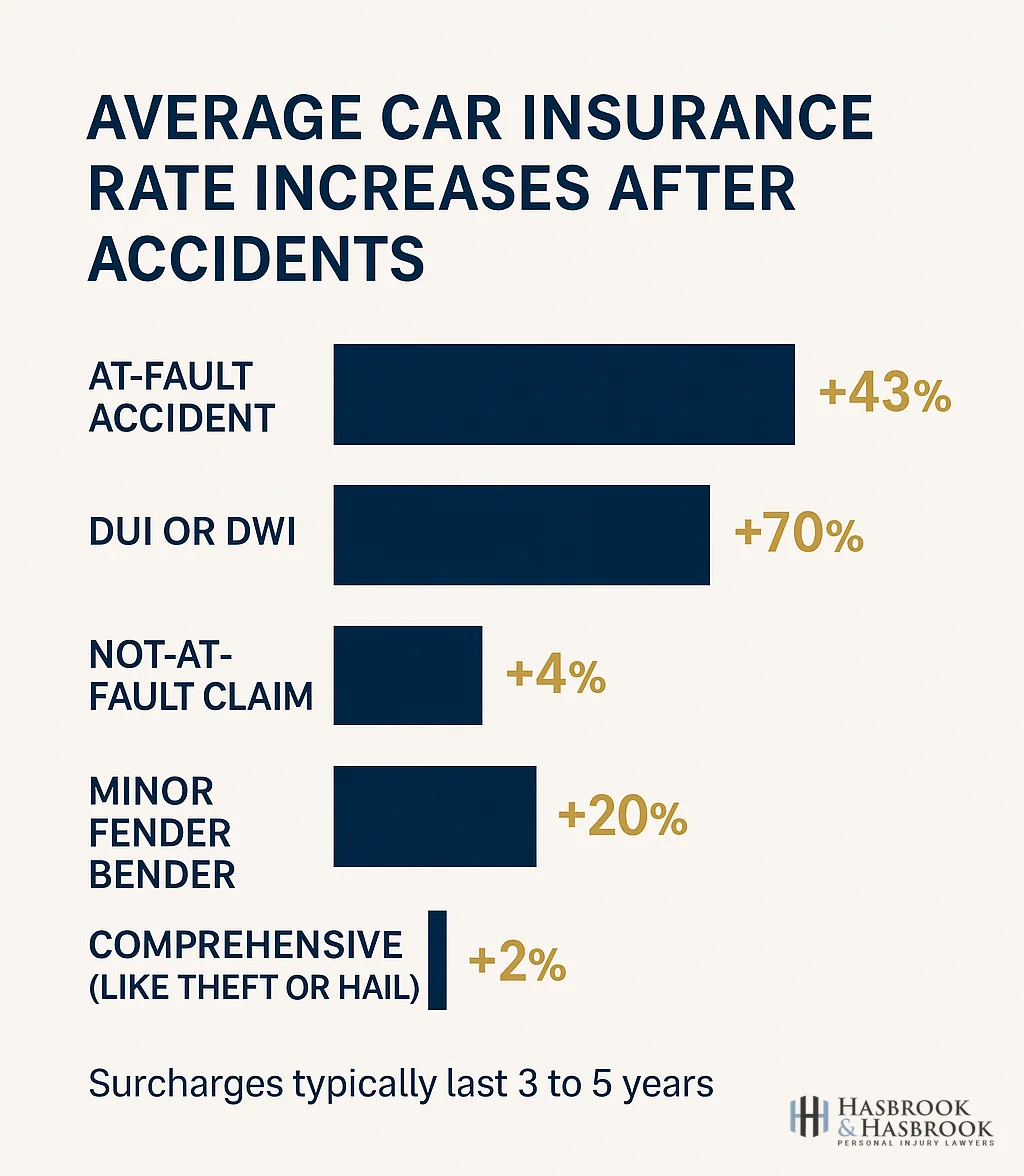
In the United States, car insurance often goes up after an at-fault accident, but there is no single national increase. A common estimate is about 20% to 50%, depending on your insurer, state, driving record, claim cost, and coverage. Some drivers see no increase, while others may pay hundreds of dollars more each year.
For example, if you pay $1,800 per year and your insurer raises your rate by 40%, your new premium would be about $2,520 per year—an increase of $720.
The increase usually begins when your insurer renews the policy, not on the day of the crash. It may last for three to five years, although the exact period depends on the insurance company and state.
How much does insurance increase after an accident?
A car insurance premium may rise by roughly 20% to 50% after one at-fault accident. The actual change can be lower or much higher.
The Insurance Information Institute explains that insurers use driving history, claims history, location, vehicle type, coverage, and other factors when setting rates. An accident can affect several of these risk factors at once.
Here is a simple example:
| Current annual premium | 20% increase | 40% increase | 50% increase |
|---|---|---|---|
| $1,200 | $1,440 | $1,680 | $1,800 |
| $1,800 | $2,160 | $2,520 | $2,700 |
| $2,400 | $2,880 | $3,360 | $3,600 |
These figures are examples, not guaranteed quotes. Your insurer may use a different surcharge, or it may re-rate the entire policy after a claim.
The increase depends on the type of accident
An insurer may treat these events differently:
- At-fault accident: Usually the most likely to cause a rate increase.
- Not-at-fault accident: May not raise your premium in many cases, but some insurers still consider claim frequency.
- Single-vehicle accident: Often treated as at-fault unless another cause, such as a road defect or animal, changes the claim review.
- Hit-and-run: Coverage and rate effects depend on whether the driver is identified and which coverage pays.
- Comprehensive claim: A claim for theft, hail, flooding, or falling objects often does not trigger the same surcharge as a collision claim.
- Minor accident: May have little effect if repair costs are close to the deductible, but reporting rules and state law matter.
The key question is not only, “Was there an accident?” It is also, “Who was responsible, what coverage paid, and how serious was the loss?”
Why one accident can cost more than another
Insurers may consider:
- The percentage of fault
- Bodily injury or property damage claims
- Total claim payout
- Whether you received a traffic citation
- Past accidents and tickets
- The number of claims on the policy
- Your age and driving experience
- Your location and local claim costs
- The vehicle you drive
- Your current discounts
A crash with a small bumper repair may have a different effect from a crash involving hospitalization, a totaled vehicle, or several damaged cars.
How long does an accident affect your insurance?
An accident may affect your car insurance price for three to five years. The period varies by insurer, state, and the type of violation connected to the crash.
Many insurers review your driving record when they issue or renew a policy. A surcharge may then remain for a set number of policy periods. Some insurers remove the surcharge after three years if you avoid another accident, while others use a longer period.
A traffic violation can last on your state driving record for a different amount of time than the insurance surcharge. These are separate systems:
- The state driving record is maintained by the motor vehicle agency.
- The insurance record is used by insurers to evaluate risk and price coverage.
An accident may stop affecting your premium before it disappears from your motor vehicle record. The reverse can also happen.
Example of the long-term cost
Suppose your premium rises by $600 per year after an accident. If the surcharge lasts three years, the estimated extra cost is:
$600 × 3 years = $1,800
If the increase lasts five years, the cost becomes:
$600 × 5 years = $3,000
This does not include future changes from inflation, vehicle repairs, new tickets, moving, or changes in coverage.
When does the increase appear?
The increase often appears at the next renewal after the insurer finishes reviewing the claim. In some cases, the insurer may need several weeks or months to determine fault and settle the claim.
Your renewal notice should show:
- The new premium
- The policy period
- Any change in discounts
- The reason for a surcharge, if listed
- Changes in limits, deductibles, or coverage
If the reason is unclear, ask the insurer for a written explanation. You can also contact your state insurance department for general consumer guidance.

What affects your car insurance rate after an accident?
The biggest factors are fault, claim severity, past driving history, state rules, and the insurer’s rating system.
Fault and state law
An at-fault accident is more likely to cause a surcharge. But fault rules vary across the United States.
States generally use one of three approaches:
- At-fault systems: The driver who caused the crash may be responsible for the other party’s losses.
- No-fault systems: Drivers usually turn to their own personal injury protection coverage for certain medical costs, regardless of fault.
- Comparative or contributory fault rules: State law may reduce or limit recovery based on each driver’s share of fault.
No-fault insurance does not mean that an accident can never affect your premium. It mainly changes how some injury claims are handled.
Your insurer may also assign partial fault. A driver who is 20% responsible may receive a different claim decision from a driver who is fully responsible, but the result depends on the policy and state rules.
Claim severity
A larger payout generally creates more concern for an insurer than a small property-damage claim. Severe claims may involve:
- Medical treatment
- Long-term injuries
- Multiple vehicles
- A totaled car
- Rental car costs
- Legal expenses
- Damage to buildings or other property
The insurer may not use the exact claim amount as a simple formula. Instead, it may place the accident into a rating category.
Your previous driving record
A clean record can help limit the impact of one accident. A recent ticket, prior accident, or several claims can make the increase larger.
Some insurers use a tiered system. The first accident may cause one surcharge, while a second accident within a short period may cause a larger surcharge or nonrenewal.
Your state
States regulate insurance in different ways. They may set rules for:
- When an insurer may apply a surcharge
- How fault must be determined
- Whether certain claims may affect rates
- Required notice before cancellation or nonrenewal
- Good-driver discounts
- Consumer complaint and appeal rights
For state-specific guidance, use your insurance department’s official website. The National Association of Insurance Commissioners provides links and general consumer resources, but your state regulator controls the rules for your policy.
Your insurance company
Two insurers may price the same accident differently. One company may offer accident forgiveness, while another may apply a surcharge.
Insurers also differ in how they treat:
- Not-at-fault accidents
- Comprehensive claims
- Minor claims
- Claims below a certain amount
- Young drivers
- Multiple drivers on one policy
That is why comparing quotes after an accident can be useful, even if your current insurer has not raised your rate yet.

Will every accident raise your insurance rate?
No. Some accidents do not raise your premium, and some may not need to be reported as a claim. The answer depends on the policy, state, and circumstances.
Accident forgiveness
Accident forgiveness is a policy feature that may prevent a qualifying accident from increasing your premium.
Common limits include:
- It may apply only to the first accident.
- It may require several years of safe driving.
- It may be available only after you meet an eligibility rule.
- It may not protect every driver on the policy.
- It may not prevent the accident from appearing on your driving record.
- It may not protect you from nonrenewal.
Read the policy language or ask the insurer whether forgiveness applies before assuming your rate is protected.
Not-at-fault accidents
A not-at-fault accident may not result in a surcharge. However, insurers may still review claim history when calculating risk.
Some states limit how insurers can use not-at-fault accidents. Other states may allow a claim to affect underwriting without treating it as a fault surcharge.
Ask these specific questions:
- Was I assigned fault?
- Is the accident coded as chargeable?
- Will it affect my renewal premium?
- How long will it remain in the rating record?
- Will it affect my discounts?
Claims paid under comprehensive coverage
Comprehensive coverage usually applies to damage not caused by a collision with another vehicle or object. Examples include:
- Theft
- Vandalism
- Hail
- Flooding
- Fire
- Falling objects
- Contact with an animal
These claims are often treated differently from at-fault collision claims. Still, repeated claims may affect your overall insurance price or eligibility.
Small accidents and paying out of pocket
For a very small accident, you may consider paying for repairs without filing a claim. This can sometimes avoid a claim-related rate increase, but it carries risks.
Do not make a private payment agreement when:
- Someone reports pain or injury
- Damage may be hidden
- More than one vehicle is involved
- The other driver refuses to provide written proof
- The repair estimate is uncertain
- You may be legally required to report the crash
- The other driver may file a claim later
State reporting rules and policy terms can require prompt notice. Contact your insurer before deciding not to report a collision. Failing to report a claim may create coverage problems later.

How to calculate your possible insurance increase
You can estimate the financial effect with three steps.
Step 1: Find your current premium
Use the total amount you pay for six or 12 months. Do not use only the monthly payment if it excludes fees or policy changes.
Example:
- Current six-month premium: $900
- Current annual premium: $1,800
Step 2: Apply a possible increase
Use a range rather than one exact number because the final surcharge is unknown.
For a $1,800 annual premium:
- At 20%: $1,800 × 1.20 = $2,160
- At 40%: $1,800 × 1.40 = $2,520
- At 50%: $1,800 × 1.50 = $2,700
Step 3: Multiply the annual difference by the expected period
If the new annual premium is $2,520:
- New annual premium: $2,520
- Old annual premium: $1,800
- Annual difference: $720
If the increase lasts three years:
$720 × 3 = $2,160
This is only a planning estimate. Your renewal may also change because of inflation, repair costs, new state rules, credit-based insurance scoring where permitted, or changes to your policy.
A better way to estimate your real cost
Ask your insurer for these details:
- The surcharge percentage or dollar amount
- The number of years it will apply
- Whether discounts were removed
- Whether the accident is considered chargeable
- Whether the claim affects renewal eligibility
Then obtain quotes from several insurers using the same:
- Liability limits
- Collision and comprehensive deductibles
- Medical payments or personal injury protection
- Uninsured motorist coverage
- Rental reimbursement
- Vehicle and driver information
A cheaper quote is not useful if it provides much less coverage.
Should you switch car insurance after an accident?
You can usually shop for another insurer after an accident. A new insurer may still find the accident through your driving record or claims history, so switching does not erase the event.
Compare insurers when:
- Your renewal increase is large
- Your accident forgiveness ended or was unavailable
- Another company offers stronger pricing for your driving profile
- Your insurer removed a discount
- You want to change deductibles or coverage limits
Do not cancel your current policy until the new policy is active. A gap in coverage can create legal and financial problems and may lead to higher future rates.
Compare more than the monthly price
Review:
- Liability limits
- Collision and comprehensive coverage
- Deductibles
- Uninsured and underinsured motorist coverage
- Medical payments or personal injury protection
- Rental car coverage
- Claims service
- Cancellation fees
- Payment fees
- Financial strength and complaint information
The Consumer Insurance Search tool from the NAIC can help consumers find insurance department and insurer information. State regulators may also publish complaint data and consumer guides.
Ways to reduce the cost after an accident
You may be able to lower the premium by:
- Comparing quotes from several insurers
- Raising a deductible only if you can afford it
- Removing optional coverage from an older vehicle after reviewing the risk
- Asking about safe-driving or defensive-driving discounts
- Bundling auto and home or renters insurance
- Reviewing annual mileage
- Removing drivers who no longer use the vehicle
- Keeping continuous coverage
- Improving your credit-based insurance profile where state law permits its use
Do not reduce liability limits solely to lower the bill without understanding the risk. If you cause a serious crash, low limits may leave you personally responsible for costs above the policy limit.
Common mistakes after an accident
Several mistakes can make the financial result worse.
Assuming the first quote is the final rate
An insurer may give an initial quote and then change it after reviewing the driving record, claims database, or accident details. Ask whether the price is based on a completed underwriting review.
Confusing a deductible with a surcharge
A deductible is the amount you pay toward a covered loss. A surcharge is a premium increase based on risk.
For example, a $1,000 collision deductible does not mean your insurance will rise by $1,000. The deductible affects the claim payment. The surcharge affects future premiums.
Ignoring liability coverage
The cheapest policy may provide limits that are too low for your assets and risk. Review coverage with a licensed insurance professional if you are unsure.
Failing to document the accident
Keep:
- Photos and videos
- Police reports
- Witness information
- Repair estimates
- Medical records
- Insurer messages
- Claim numbers
- Settlement documents
Good records can help correct an inaccurate fault decision or billing error.
Believing an accident disappears immediately
Even after the surcharge period ends, the accident may remain on certain records for longer. Ask the insurer when it will stop affecting your price and check your motor vehicle record for errors.

Frequently asked questions
How much does insurance go up after a minor accident?
A minor at-fault accident may increase insurance by less than a serious injury claim, but there is no universal amount. Some insurers use a minimum claim threshold, while others apply a surcharge based mainly on fault and claim type.
How much does insurance go up after a not-at-fault accident?
It may not increase at all. However, an insurer may consider the claim as part of your overall claims history, depending on state law and company rules. Ask whether the accident is coded as chargeable.
Does a parking lot accident raise insurance?
It can. A parking lot accident may be treated as an at-fault collision if you caused the damage. Fault is not automatically assigned based on where the crash happened.
Does a hit-and-run raise insurance?
A hit-and-run claim may affect your premium depending on the coverage used, state law, and whether you were responsible. Uninsured motorist property damage, collision, or other coverage may apply in different situations.
Can an insurance company cancel you after an accident?
An insurer may be able to cancel or nonrenew a policy under specific state rules and policy terms. One accident does not always lead to cancellation, but multiple claims, serious violations, fraud, or unpaid premiums can create greater risk.
What to do next
- Check your renewal notice for the new premium and any surcharge.
- Ask your insurer whether the accident is chargeable and how long it will affect your rate.
- Compare quotes using identical coverage limits and deductibles.
- Check your state insurance department’s rules if you believe the insurer made an error.
- Keep continuous coverage while you shop.
The most useful number is not a national average. It is the difference between your current premium and the verified renewal offers available for your exact driver, vehicle, location, and coverage.
Conclusion
Car insurance often rises after an at-fault accident, commonly by about 20% to 50%, but the result varies across the United States. Fault, claim severity, state law, driving history, accident forgiveness, and insurer pricing all matter.
Use your renewal notice, ask for the surcharge details, and compare complete policy quotes. That approach gives you a clearer answer than relying on a single national average.