

Cleaning a Nuna PIPA car seat in the United States starts with one rule: follow the manual for your exact PIPA model before removing the cover or washing any part. PIPA, PIPA Lite, PIPA RX, PIPA urbn, and other versions can have different fabric, padding, buckle, and harness instructions.
For most Nuna PIPA seats, you can remove the fabric cover, wash approved fabric parts with mild detergent, wipe the shell with gentle soap and water, and spot-clean the harness. Do not use bleach, harsh chemicals, heat, or a washing machine on parts that the manual says to hand-wash or spot-clean.
What You Need Before Cleaning
Gather the following supplies before you begin:
- Mild liquid detergent
- Cool or lukewarm water
- Two soft cloths or sponges
- A soft toothbrush or small brush
- A clean towel
- A bowl or sink
- The owner’s manual for your exact Nuna PIPA model
- A phone camera for taking removal photos
Use a plain, mild soap. Avoid bleach, ammonia, disinfectant wipes, abrasive cleaners, fabric softener, and strong scents. These products may weaken materials, leave residue, or irritate a baby’s skin.
Before taking anything apart, photograph the seat from several angles. Take close photos of the harness routing, buckle area, infant insert, and canopy attachments. These photos can help you put the seat back together correctly.
Check the model name first
Look for the product label on the car seat. The model may say PIPA, PIPA lite, PIPA RX, PIPA aire, PIPA urbn, or another variation.
The model matters because:
- Cover removal points may differ.
- The infant insert may have different parts.
- Some versions use different canopy or padding designs.
- Care labels may give different washing instructions.
- A part that is removable on one model may not be removable on another.
If you cannot find the manual, use Nuna’s U.S. support pages or contact Nuna customer service before removing difficult parts.
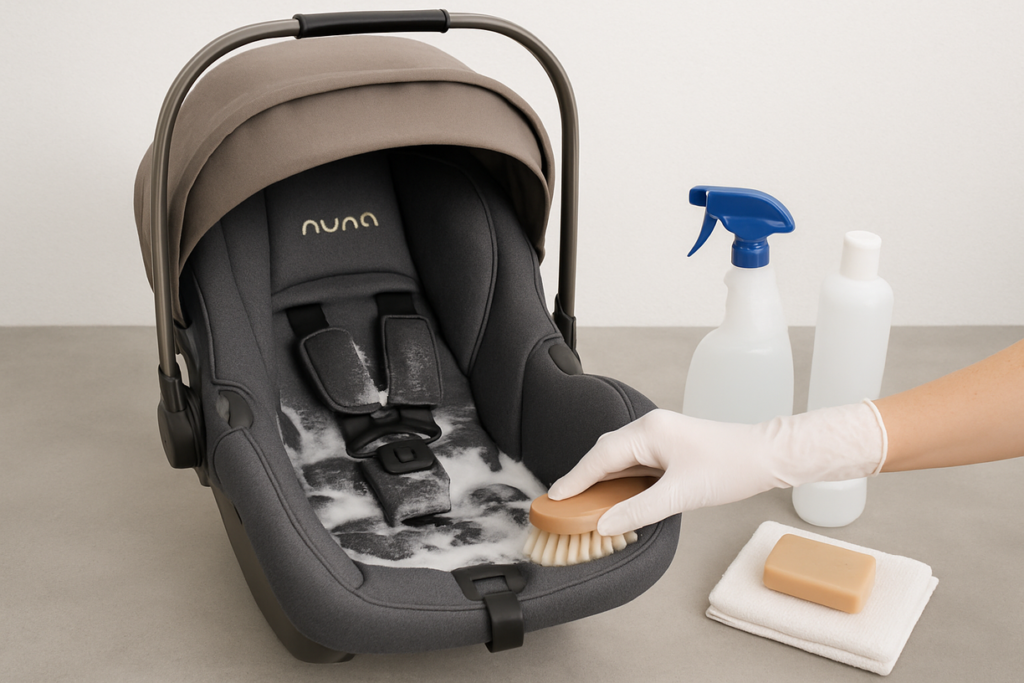
How to Clean a Nuna PIPA Car Seat Step by Step
Clean the seat in this order: remove loose debris, take off approved fabric parts, wash the cover, clean the shell, clean the harness, clean the buckle, then let everything dry fully before reassembly.
1. Remove the car seat from the vehicle
Take the PIPA out of the car before cleaning it. This gives you better access and keeps water and soap away from the vehicle upholstery.
Place the seat on a clean, dry floor or table. Keep all small parts away from children and pets.
2. Remove crumbs and loose dirt
Shake the seat gently over a trash can or use a vacuum with a soft brush attachment.
Pay attention to:
- The crease between the seat back and seat bottom
- Around the buckle
- Under the infant insert
- Along the harness slots
- Beneath the canopy edge
- Around the base connection points
Do not force a vacuum nozzle into the buckle. Strong suction or pressure may move small internal parts.
3. Remove only the parts approved by the manual
Follow the Nuna manual for your exact model. Most removable fabric pieces include some combination of:
- Main seat cover
- Infant insert
- Head support
- Harness pads
- Buckle pad
- Canopy fabric
do not cut, pry, or pull hard on a cover. If a piece does not release easily, stop and check the manual.
Do not remove the harness from the seat unless the manual specifically explains how to do so. The harness is a safety-critical part. Incorrect rethreading can change how the restraint works in a crash.
4. Wash the fabric cover
Use the care label and owner’s manual as the final authority. When machine washing is allowed, use a mild detergent and a gentle or delicate cycle with cool water.
For hand-wash-only parts:
- Fill a basin with cool or lukewarm water.
- Add a small amount of mild detergent.
- Gently press and move the fabric through the water.
- Rinse until no soap remains.
- Press out water without twisting the fabric.
- Lay the part flat or hang it as directed.
Avoid wringing the cover. Twisting can stretch fabric, distort padding, or affect the way the cover fits.
Air-dry fabric parts completely. Do not use a dryer unless the Nuna instructions for your model clearly allow it. Do not place the cover on a radiator, near a heater, or in high heat.
5. Clean the plastic shell
Mix mild soap with water. Dampen a soft cloth or sponge and wipe the shell.
Clean:
- The seat sides
- The shell under the cover
- The carry handle
- The canopy frame
- The base-contact areas
- The harness guide area
Use a soft toothbrush for dried food or dirt in small seams. Keep water away from areas where it could collect inside the buckle, harness adjuster, or other moving parts.
Wipe the shell again with a clean, damp cloth. Then dry it with a towel and allow it to air-dry.
6. Clean the harness straps carefully
The harness straps usually need spot cleaning rather than full washing.
Use this method:
- Dampen a clean cloth with cool water and a small amount of mild soap.
- Wipe the dirty section of the strap.
- Use a second damp cloth to remove soap.
- Let the straps air-dry fully.
Do not:
- Put harness straps in a washing machine.
- Soak the harness.
- Use bleach or stain remover.
- Scrub hard with a stiff brush.
- Iron or heat-dry the straps.
- Detach or rethread the harness unless the manual directs you.
If a harness strap has mold, a strong chemical smell, fraying, cuts, melted fibers, or damage that does not clean away, stop using the seat and contact Nuna. A damaged harness should not be repaired with sewing, glue, tape, or household products.
7. Clean the buckle
Food and dirt can make a buckle hard to latch or release.
First, check the manual for your model. In general, clean the buckle by removing loose debris and wiping the outside with a damp cloth. Some manufacturers allow rinsing a buckle in clean water, while others give more limited instructions.
Do not use oil, lubricant, bleach, or household spray. Never force the tongues into the buckle.
After cleaning, test the buckle:
- Insert both buckle tongues.
- Listen and feel for a clear click.
- Pull gently on each tongue.
- Press the release button.
- Confirm that the tongues release without sticking.
If the buckle does not click, releases too easily, or stays stuck after cleaning, do not use the seat. Contact Nuna for guidance or replacement parts.
8. Clean the canopy and infant insert
Wash the canopy fabric and infant insert only as directed by the manual or sewn-in care label.
Do not remove internal foam or padding unless Nuna specifically says it is removable. Foam may be part of the seat’s design and may not be safe to wash or reinstall incorrectly.
Let every piece dry completely. Damp padding can develop an odor or mold, especially when stored in a warm vehicle.
9. Reassemble the seat
Reinstall each part in the reverse order of removal. Use your photos and the manual to check:
- The cover sits flat.
- No fabric blocks the harness path.
- The infant insert is facing the correct way.
- Harness pads are in the correct position.
- The buckle is accessible.
- The canopy moves normally.
- No strap is twisted.
- The harness tongues are routed correctly.
The seat should look and function as it did before cleaning. If a cover does not fit or a strap seems too short, do not force it. Remove the part and check the instructions again.

What You Can Wash, Wipe, or Spot-Clean
The safest cleaning method depends on the part. Use this table as a general guide, then confirm the instruction in your model’s manual.
| Car seat part | Usual cleaning method | Avoid |
|---|---|---|
| Fabric cover | Machine wash or hand wash only if the manual allows it | Bleach, fabric softener, high heat |
| Infant insert | Follow the model’s care label | Removing or washing hidden foam without approval |
| Plastic shell | Wipe with mild soap and water | Harsh chemicals, abrasive pads |
| Harness straps | Spot-clean with a damp cloth | Soaking, bleach, machine washing |
| Buckle | Remove debris and clean only as the manual allows | Oil, forced tools, harsh spray |
| Canopy fabric | Wash as directed by the care label | High heat and aggressive scrubbing |
| Harness pads | Wash only if approved for your model | Assuming all pads are removable |
| Carry handle | Wipe with mild soap and water | Solvents and abrasive cleaners |
The key distinction is between removable fabric and safety parts. Fabric is often washable. Harnesses, buckles, foam, and structural components need more limited care.

How to Remove Milk, Formula, Vomit, or Food Smells
Clean spills as soon as you can. Dried milk and formula can leave a sour smell and may attract mold.
For a fabric spill:
- Remove any solid material with a paper towel or spoon.
- Blot the area with cool water.
- Wash the approved fabric part according to the manual.
- Rinse well so detergent does not remain.
- Air-dry completely in a well-ventilated place.
For the plastic shell, wipe the area with mild soap and water. Rinse the cloth and wipe again to remove soap.
Do not spray air freshener, perfume, disinfectant, or deodorizer onto the harness or seat fabric. These products may hide an odor without removing the source and may leave chemicals where the child’s skin touches.
If the smell remains after proper washing and drying, inspect seams, padding, and the underside of the cover. If you find mold, soaked foam, or an odor inside a non-removable part, contact Nuna before using the seat.
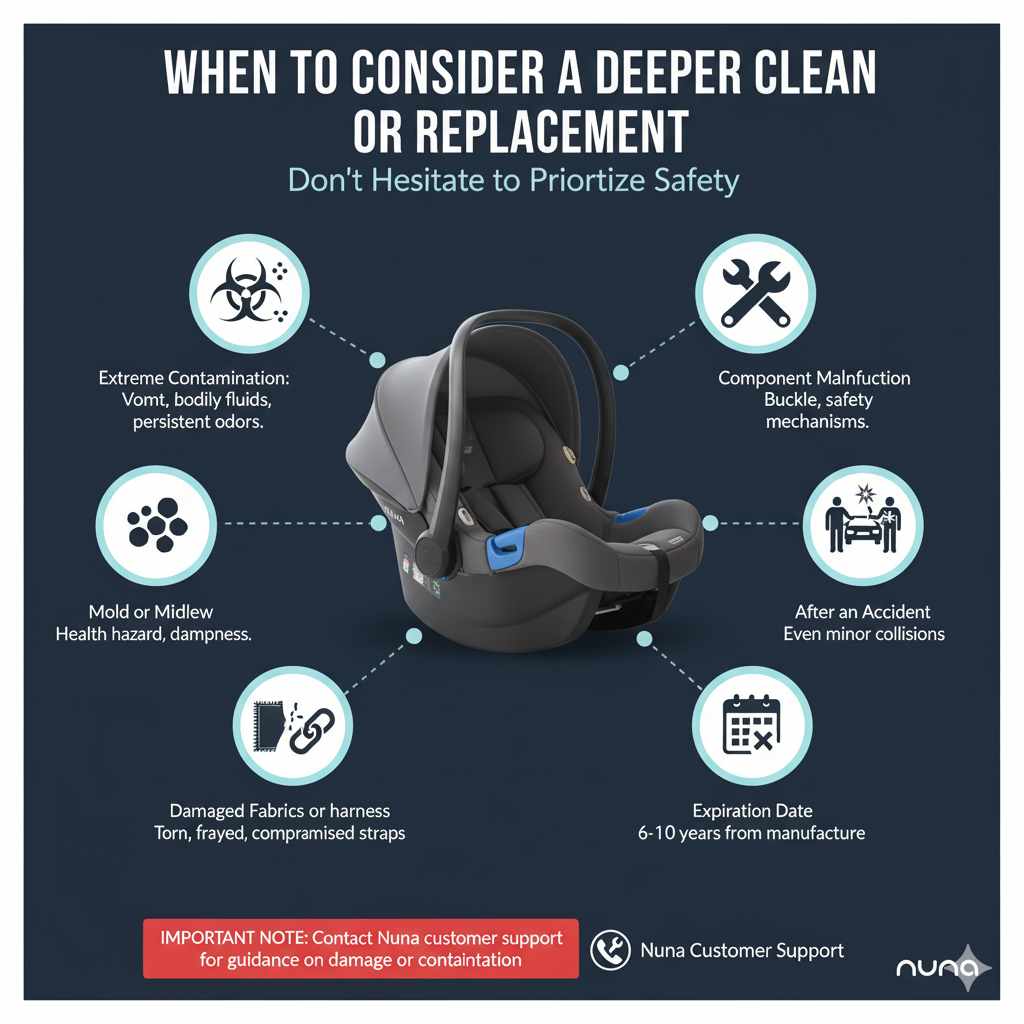
What Not to Do When Cleaning a Nuna PIPA
Avoid these common mistakes:
Do not use bleach
Bleach can damage fibers and may weaken or discolor the harness and cover. It can also leave residue that irritates skin.
Do not pressure-wash the seat
A strong stream of water can drive moisture into the buckle, harness adjuster, foam, or shell joints.
Do not use a dryer or hair dryer unless approved
Heat may shrink the cover, damage foam, or change the fit of the fabric. Air-drying is the safer default when the manual does not give another method.
Do not lubricate the buckle
Oil and spray lubricants can attract dirt and may affect the buckle’s operation.
Do not alter the harness
Never sew, cut, knot, tape, or replace harness parts with generic webbing. Use Nuna-approved replacement parts only.
Do not reinstall a wet cover
A cover that feels dry on the outside may still be damp inside. Moisture can lead to mildew and odor.
Do not use the seat if it was in a crash
Cleaning does not restore a car seat after a crash. Follow Nuna’s crash-replacement guidance and your insurance or vehicle safety guidance.
Do not use a seat with serious damage
Replace or stop using the seat if you see:
- Cracks in the shell
- Melted plastic
- Frayed harness webbing
- Broken buckle parts
- Missing padding
- Damaged attachment points
- Mold that cannot be fully removed
- A cover that no longer fits correctly

How to Check the Seat After Cleaning
A clean seat is not ready for use until you complete a safety check.
Harness check
Confirm that:
- The straps are flat.
- The straps are not twisted.
- The harness moves through the correct slots.
- The chest clip, if present, moves correctly.
- The adjuster works smoothly.
- No soap or moisture remains.
Buckle check
Insert and release the buckle tongues several times. Each side should click securely and release when you press the button.
Cover and padding check
Make sure:
- The cover is fully attached.
- No elastic is loose.
- Padding is in its original position.
- No fabric blocks the harness or buckle.
- No foam is folded or missing.
Installation check
Place the car seat back in the vehicle according to the Nuna manual. Check the installation each time the seat is reinstalled, especially if you removed it for cleaning.
For help with installation, a certified child passenger safety technician can inspect the setup. The National Highway Traffic Safety Administration provides information about finding car seat inspection help in the United States.

How Often Should You Clean a Nuna PIPA?
Clean small spills and visible dirt right away. A deeper clean is useful when the cover is visibly dirty, after a large spill, or before storing the seat.
A practical schedule is:
- After a fresh spill: Blot and spot-clean as soon as possible.
- After vomiting or a diaper leak: Remove and wash approved fabric parts promptly.
- After frequent daily use: Inspect the buckle, harness, and seams often.
- Before passing the seat to another child: Clean and inspect every part.
- Before storage: Wash approved fabric, dry everything fully, and store the seat in a dry place.
The need for cleaning depends on use. A seat used for daily travel may need more care than one used only for occasional trips.

What to Do If the Cover Will Not Come Off
Stop if the cover resists removal. Do not pull harder or use a sharp tool.
Try this sequence:
- Check the exact model name.
- Find the cover-removal section in the owner’s manual.
- Look for hidden elastic loops, snaps, or tabs.
- Take photos before releasing each attachment point.
- Contact Nuna if the manual and the seat do not match.
Some PIPA versions have covers that appear similar but attach in different ways. A video for another PIPA model may show a different procedure and should not replace the manual.
If you removed the cover but cannot reinstall it, do not use the seat until the cover and padding are correctly positioned.

Frequently Asked Questions
Can I put the Nuna PIPA cover in the washing machine?
Only if the manual or care label for your exact PIPA model permits machine washing. Use a gentle cycle, cool water, and mild detergent when allowed. Air-dry the cover unless Nuna gives different instructions.
Can I wash Nuna PIPA harness straps?
Usually, harness straps should be spot-cleaned rather than machine-washed or soaked. Use a damp cloth and mild soap, then remove soap with a clean damp cloth. Check your model’s manual before doing anything more.
Can I use disinfectant wipes on a Nuna PIPA?
Avoid disinfectant wipes unless Nuna specifically approves them for that part. Many wipes contain chemicals that may damage fabric, webbing, plastic, or padding. Mild soap and water are the safer general choice.
How do I get vomit smell out of a Nuna PIPA?
Wash approved fabric parts as soon as possible with mild detergent, rinse well, and air-dry completely. Wipe the shell with mild soap and water. Do not spray perfume or deodorizer on the harness. If the smell remains in non-removable padding, contact Nuna.
How do I clean mold from a Nuna PIPA?
Do not use the seat until you identify and remove the cause. Clean only the parts that the manual permits you to wash. If mold reaches foam, the harness, or a non-removable area, contact Nuna about replacement or safe disposal.
Can I use a generic replacement cover?
Use only a Nuna-approved cover or part made for your exact model. A generic cover may change the fit, block the harness, or interfere with the seat’s design.
When should I replace a Nuna PIPA instead of cleaning it?
Replace or stop using the seat after a crash, serious shell damage, harness damage, buckle failure, missing parts, or mold that cannot be fully removed. Contact Nuna if you are unsure whether a part is safe.
Final Checklist
Before placing your child in the cleaned Nuna PIPA, confirm that:
- The cover is clean and completely dry.
- The cover and padding are correctly fitted.
- The harness is flat and untwisted.
- The buckle clicks and releases normally.
- No cleaning product remains.
- No part is cracked, frayed, warped, or missing.
- The seat is installed according to the current manual.
For the safest result, use the official instructions for your exact PIPA version rather than relying on a general cleaning video. Clean gently, keep moisture away from safety parts, and replace any component that no longer works as designed.
