

For families in the United States, the safest time to turn a child’s car seat forward-facing is after the child outgrows the seat’s rear-facing height or weight limit. Do not turn the seat based on age alone. The American Academy of Pediatrics and the National Highway Traffic Safety Administration advise keeping children rear-facing as long as the seat allows.
A child who still fits within the rear-facing limits should usually remain rear-facing, even if the child is older than 2. When the rear-facing limit is reached, install the seat forward-facing with its internal harness and top tether, following the seat and vehicle manuals.
The short answer: When should a child face forward?
A child is ready to face forward when all three conditions are met:
- The child has outgrown the rear-facing limits of the car seat.
- The child meets the forward-facing minimums in the car seat manual.
- The forward-facing seat can be installed correctly in the vehicle.


The first condition matters most. A child may be 2, 3, or 4 years old and still fit safely rear-facing. Another child may reach the rear-facing height or weight limit sooner.
Most convertible car seats allow a child to remain rear-facing until at least 2 years old, and many allow rear-facing use beyond age 2. The exact limit depends on the model. Check the labels on the seat and the current manual.
The NHTSA recommends keeping children rear-facing for as long as possible, up to the top height or weight limit allowed by the seat. The American Academy of Pediatrics gives similar guidance.
Age is not the only test
Age can provide context, but it does not decide the transition by itself. A 2-year-old is not automatically ready to face forward. A 4-year-old who still fits within the rear-facing limits does not have to turn forward simply because of age.
Look at these limits:
- Rear-facing weight limit: The highest child weight allowed when the seat faces the rear.
- Rear-facing height limit: Often based on standing height or the space above the child’s head.
- Forward-facing minimums: The lowest age, weight, or height allowed for forward-facing use.
- Seat instructions: The manufacturer’s manual may define how the child must fit and how the seat must be installed.
If the child has not reached the rear-facing limit, there is usually no safety benefit to turning the seat forward early.
Why rear-facing is safer for young children
Rear-facing seats support a young child’s head, neck, and back during a crash. In a frontal crash, the child moves toward the front of the vehicle while the seat carries the force across the child’s back.
Young children have larger heads and less developed necks than adults. Their bones and muscles also continue to develop during the early years. A rear-facing seat helps spread crash forces over more of the body instead of placing more strain on the neck.
A forward-facing seat still offers important protection when used correctly. Its harness holds the child in place, while the top tether limits how far the child’s head moves forward. However, forward-facing seats do not support the back and head in the same way during a frontal crash.
Rear-facing does not mean the child must keep their legs straight. Bent legs, crossed legs, or feet touching the vehicle seat are common. These positions are not, by themselves, a reason to turn the seat around.
What about a child’s legs touching the vehicle seat?
Leg contact is usually not a safety reason to turn forward-facing. Children often sit with bent knees when rear-facing. They may also rest their feet on the vehicle seat back.


The key concerns are whether the child remains within the seat’s limits and whether the seat is installed as directed. If you are worried about leg position, check the manufacturer’s instructions or consult a certified child passenger safety technician.

How to know if your child has outgrown rear-facing
Check the car seat itself, not a general chart or another parent’s experience. The rear-facing limit is printed on the seat label and listed in the manual.
Your child may have outgrown rear-facing when one of these limits is reached:
- The child exceeds the stated rear-facing weight limit.
- The child exceeds the stated rear-facing height limit.
- The child’s head is too close to the top of the seat under the manufacturer’s rule.
- The child no longer fits within the seat’s required harness position.
- The seat has another rear-facing fit rule that the manual says has been reached.
Do not rely on a single rule from a different brand. Some seats use a specific head-clearance rule. Others list a standing-height limit. The manual controls.
A simple decision table
| Situation | What to do |
|---|---|
| Child is below the rear-facing limits | Keep the seat rear-facing if it is installed correctly. |
| Child reaches the rear-facing weight limit | Change to forward-facing only if the seat allows it and the child meets its forward-facing minimums. |
| Child reaches the rear-facing height limit | Change to forward-facing only if the seat allows it and the child meets its forward-facing minimums. |
| Child is uncomfortable but still fits | Check harness fit, recline angle, clothing, and leg position before turning the seat. |
| Child meets the forward-facing limits but still fits rear-facing | Rear-facing is generally the safer position for continued use. |
| The seat is expired, damaged, or recalled | Replace it before making the transition. |
Do not confuse standing height with seated height
Car seat labels may use different types of height measurements. A standing-height limit means the child’s full height. A seated-height limit measures from the child’s bottom to the top of the head.
Use the measurement method named by the manufacturer. If the label is unclear, contact the manufacturer or ask a certified technician to check the fit.
How to turn a convertible car seat forward-facing
Once your child has outgrown rear-facing and meets the forward-facing requirements, follow this sequence.
1. Read both manuals
Read the car seat manual and the vehicle owner’s manual. The car seat manual explains the seat’s forward-facing limits, belt paths, recline settings, harness rules, and tether use.
The vehicle manual explains approved seating positions, lower-anchor locations, tether anchors, seat belt rules, and any limits on using a car seat in a specific position.
Never assume that the same installation method works in every seating position.
2. Choose an approved seating position
Use a rear seating position whenever possible. A forward-facing child should not ride in front of an active passenger air bag unless the vehicle and restraint instructions specifically allow it under a safe configuration.
The center seat is not automatically the safest. It is useful only when the car seat can be installed tightly and the vehicle manual permits that position.
3. Set the seat to the correct forward-facing angle
Convertible seats often use a different recline position when forward-facing. Set the recline according to the manual.
Do not select an angle only because it looks comfortable. An incorrect angle can affect the seat’s performance or prevent a tight installation.


4. Install the seat with the correct method
A forward-facing seat may use:
- The vehicle seat belt
- Lower anchors, if permitted for the child’s size and the seat
- A seat belt plus the top tether
- Another method listed by the manufacturer
Do not use lower anchors and a seat belt together unless both the car seat manufacturer and vehicle manufacturer expressly allow it.
For many forward-facing installations, the top tether is a key part of the setup. It helps reduce forward movement of the child’s head in a crash. Connect it only to the vehicle’s designated tether anchor, not to a cargo hook or another nearby piece of hardware.
5. Tighten the installation
After installation, hold the car seat near the belt path and try to move it from side to side and front to back. It should not move more than 1 inch in any direction at the belt path.
This check does not mean the entire top of the seat cannot move. Some movement away from the belt path can be normal. The important test is at the point where the seat is attached.
6. Set the harness correctly
For a forward-facing child:
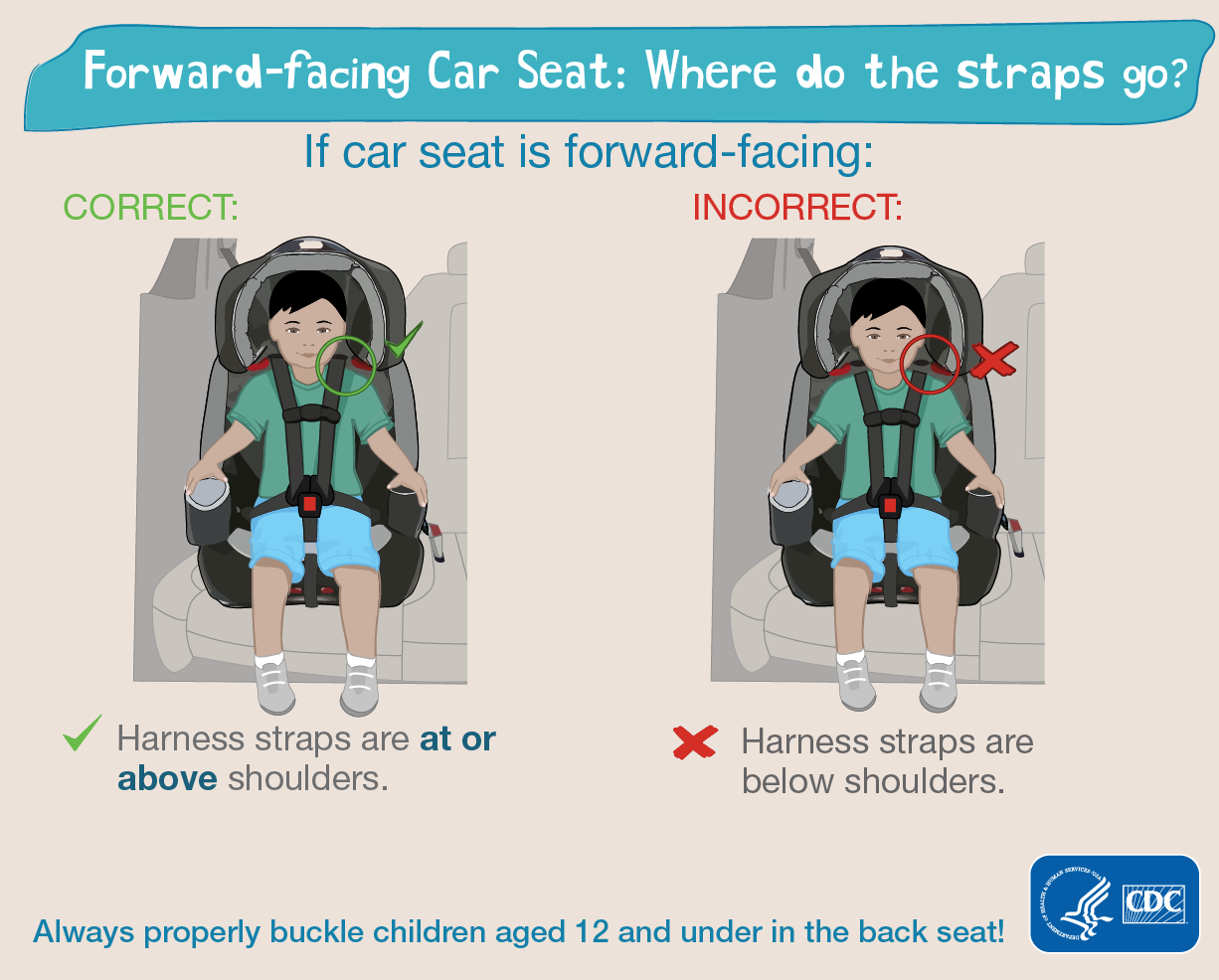
- Harness straps generally come from at or above the child’s shoulders.
- The harness should pass through the correct slots listed in the manual.
- The chest clip should sit at armpit level.
- The harness should lie flat and snug.
- Bulky coats should not go under the harness.
- The child should not wear extra padding beneath the harness unless the manufacturer approves it.
You should not be able to pinch extra webbing at the child’s shoulder after tightening the harness.

Forward-facing installation mistakes to avoid
A correct transition can fail if the seat is installed or used incorrectly. These are common problems in U.S. vehicles.
Forgetting the top tether
Some caregivers install the lower part of the seat but do not connect the top tether. For a forward-facing seat, that can leave out an important part of the restraint system.
Find the tether anchor in the vehicle manual. It may be behind the seat, on the rear shelf, on the cargo floor, or in another marked location. Do not confuse a tether anchor with a luggage hook.
Using both lower anchors and the seat belt without permission
Using both systems may seem stronger, but it is not automatically allowed. Car seats and vehicles have different rules. Follow the specific instructions for your seat and vehicle.
Placing the seat in the wrong belt path
Convertible seats usually have separate belt paths for rear-facing and forward-facing use. Thread the belt through the path marked for the direction of travel.
A belt routed through the wrong path can leave the seat loose or change how it responds in a crash.


Leaving slack in the harness
The harness must be snug each time the child rides. A thick jacket, loose strap, or twisted webbing can reduce its effectiveness.
Place the child’s back and bottom against the seat. Buckle the harness, position the chest clip at armpit level, and tighten the harness until it is snug.
Adding unapproved accessories
Head supports, strap covers, seat liners, and toys can affect the fit or performance of a car seat. Use only accessories supplied with the seat or approved in writing by the manufacturer.
Never add aftermarket padding behind the child unless the manual permits it.
Turning the seat forward because the child dislikes rear-facing
A child may complain about rear-facing because the view is different or the legs feel cramped. Try adjusting the approved recline setting, improving comfort without added padding, or using safe entertainment options allowed by the manufacturer.
Discomfort alone does not mean the child has outgrown the seat.
When should a forward-facing child move to a booster seat?
A child should remain in a forward-facing seat with a harness until the child reaches the seat’s forward-facing height or weight limit. Do not move to a booster just because the child is tired of the harness or has reached a certain birthday.
A booster seat does not restrain the child by itself. It raises the child so the vehicle’s lap and shoulder belt fit correctly. A child must also be mature enough to sit upright for the entire ride without leaning, slouching, putting the shoulder belt behind the back, or placing the lap belt on the stomach.
The exact booster timing depends on:
- The forward-facing harness limits
- The child’s size
- The child’s behavior and maturity
- The vehicle belt fit
- State law
- The booster and vehicle manuals
A child is ready to stop using a booster only when the adult seat belt fits correctly. The NHTSA seat belt fit test includes these checks:
- The lap belt lies low across the upper thighs, not the stomach.
- The shoulder belt crosses the center of the chest and shoulder.
- The child’s back rests against the vehicle seat.
- The child’s knees bend naturally at the edge of the seat.
- The child can sit properly for the full trip.
Many children need a booster until somewhere between 8 and 12 years old, but size and belt fit matter more than a single age.

What U.S. car seat laws require
Car seat laws vary by state. They may set minimum ages, weights, or requirements for rear-facing seats, forward-facing seats, booster seats, and seat belts.
State law is the legal minimum. It may not be the same as the safest practice recommended by pediatric and transportation safety organizations. Check your state’s child passenger safety law through the Governors Highway Safety Association or your state’s highway safety agency.


Federal motor vehicle standards apply to car seat manufacturers, but the federal government does not set one nationwide age for turning every child forward-facing. The correct decision still depends on the car seat’s limits, the child’s fit, the vehicle, and the applicable state law.
If a law and the seat manual seem to conflict, do not guess. Contact the manufacturer or a child passenger safety professional.
Get an in-person car seat check
A certified Child Passenger Safety Technician, often called a CPST, can help check:
- Whether the child still fits rear-facing
- Whether the seat is installed tightly
- Whether the top tether is connected correctly
- Whether the harness is at the right height
- Whether the seat is compatible with the vehicle
- Whether the forward-facing setup follows the manual
You can search for a technician through NHTSA’s child passenger safety resources.
A technician can identify installation problems, but the car seat manufacturer remains the best source for model-specific limits and instructions.
What to do if your child is already forward-facing too soon
If you turned the seat forward before your child reached the rear-facing limit, you can usually turn it back if the seat still allows rear-facing use and the child remains within its limits.
Before changing the direction:
- Check the seat’s expiration date.
- Confirm that the seat has not been in a crash or been damaged.
- Read the rear-facing installation section again.
- Use the correct rear-facing belt path and recline angle.
- Check the harness position and fit.
- Confirm that the vehicle allows the chosen seating position.
If the child has exceeded the rear-facing limit, do not force the seat to remain rear-facing. Move to a properly installed forward-facing configuration.
A seat involved in a moderate or serious crash should be replaced. NHTSA advises replacing a seat after a crash unless all five of its listed minor-crash conditions are met. When in doubt, contact the manufacturer.

Frequently asked questions
Is age 2 the required age to turn a car seat forward-facing?
No. Age 2 is not a universal nationwide requirement for turning a child forward-facing. The child should remain rear-facing until reaching the seat’s rear-facing height or weight limit, if the seat and child continue to fit safely.
Some states have specific rear-facing laws. Check your state rules as well as the seat manual.
Can a 3-year-old remain rear-facing?
Yes. A 3-year-old can remain rear-facing if the child is within the seat’s rear-facing limits and the seat is installed correctly. Continued rear-facing use is generally recommended until the child outgrows that position.
Can a child’s feet touch the back of the vehicle seat?
Yes. Feet touching the vehicle seat back is common for rear-facing children. Bent legs or crossed legs are also normal. Foot position alone does not show that the child is unsafe or has outgrown the seat.
Should the car seat go behind the driver or passenger?
Either rear seating position can work if the seat fits and installs correctly. The best position is usually the one that provides a secure installation and allows the caregiver to use the seat correctly every time.


Can a forward-facing car seat use lower anchors?
It depends on the seat and the child’s weight. Lower-anchor limits can differ from the overall forward-facing harness limit. Check both the car seat manual and vehicle manual, and use the top tether when required or recommended by the instructions.
Key takeaways
- Keep a child rear-facing until the child reaches the car seat’s rear-facing height or weight limit.
- Do not turn the seat forward based on age alone.
- Follow the exact car seat and vehicle manuals.
- Use the forward-facing belt path, correct harness position, and top tether.
- Keep the child in the harness until reaching the forward-facing limits.
- Check your state’s law, but remember that legal minimums may not be the safest practice.
- Have a certified Child Passenger Safety Technician check the installation if you are unsure.
Conclusion
The best time to forward-face a car seat is usually when the child outgrows the rear-facing limits of the specific seat, not when the child reaches a certain birthday. Rear-facing protects the child’s head, neck, and back for as long as the seat allows.
When the transition is needed, install the seat forward-facing with the correct belt path, snug harness, and top tether. Read both manuals, check the state law, and seek an in-person car seat check if anything is unclear.
