

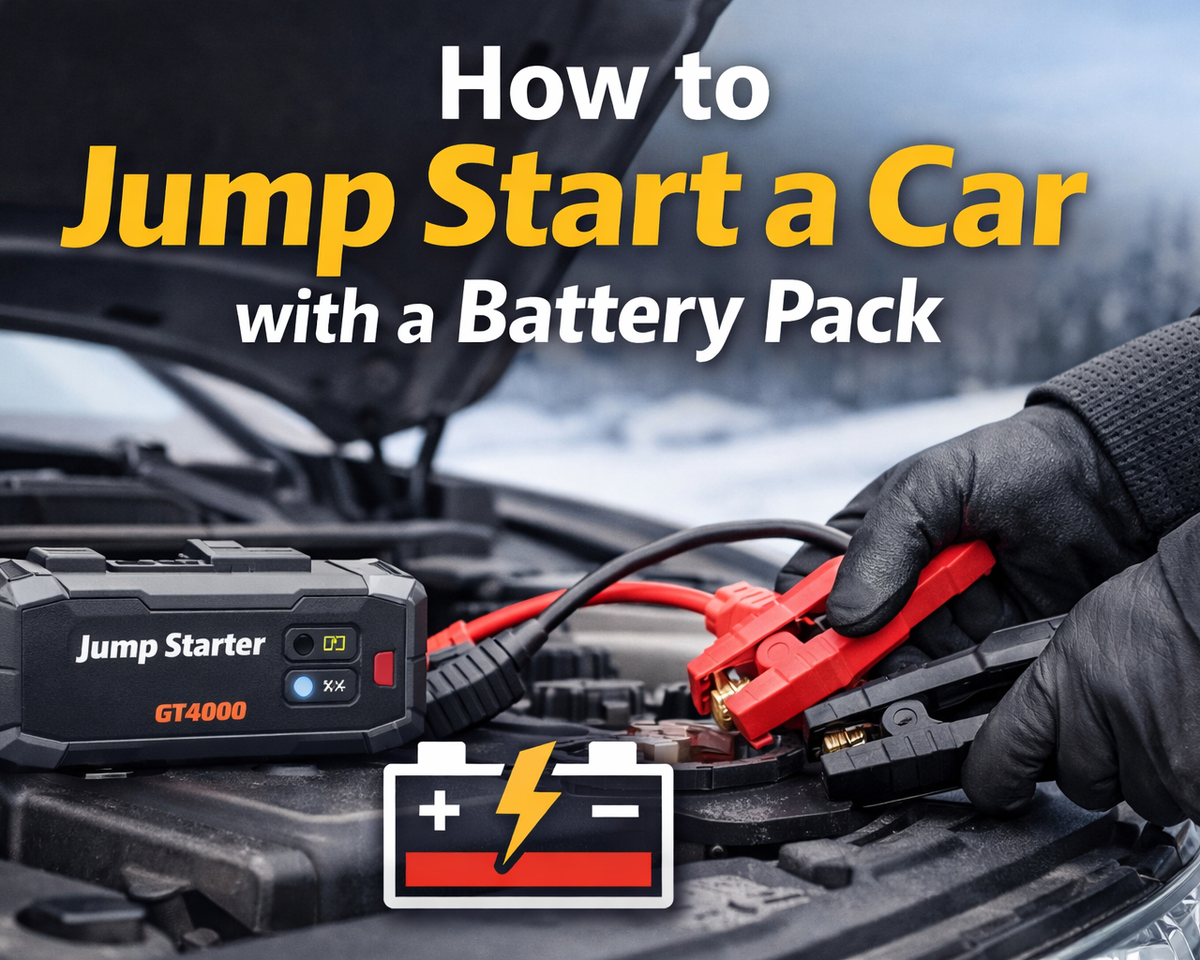
If your car will not start, a portable battery pack—also called a jump starter—can often start the engine without another vehicle. Turn off the car, check that the battery is safe to use, connect the red clamp to positive and the black clamp to a safe ground, then start the car. Always follow the instructions for your specific battery pack and vehicle.
This guide applies to common 12-volt cars, trucks, and SUVs in the United States. It does not explain how to service a high-voltage electric vehicle battery.

What You Need Before You Start
You need a charged 12-volt jump starter, access to the car battery or its approved jump points, and the vehicle owner’s manual. The jump starter should be rated for your vehicle’s engine size and battery type.
Most gas-powered passenger cars use a 12-volt starting system. Larger engines, diesel engines, heavy-duty trucks, and vehicles with high electrical loads may need a stronger pack. Check the pack maker’s rating before you connect it.


Check the jump starter
Before use, confirm that:
- The pack has enough charge for a start.
- The cables and clamps have no cuts, melted spots, or loose parts.
- The pack is made for a 12-volt vehicle system.
- Its instructions allow use with your vehicle type.
- The pack is not wet, swollen, cracked, or unusually hot.
Do not use a damaged lithium-ion jump starter. Stop if it smells like burned plastic, makes a hissing sound, or becomes hot without a clear reason.
Check the car battery
Do not try to jump-start a battery that is:
- Cracked or leaking
- Bulging or badly swollen
- Frozen
- Hot to the touch
- Giving off heavy fumes
- Covered in severe damage
A frozen or damaged battery can rupture or explode when electrical power is applied. If the battery looks unsafe, call roadside assistance or a qualified mechanic.
Park safely
Park the car on a stable surface away from traffic. Set the parking brake. Put the transmission in Park on an automatic vehicle or Neutral on a manual vehicle. Turn off the ignition, lights, radio, climate controls, and other accessories.
Keep cigarettes, flames, and sparks away from the battery. Work outdoors or in a well-ventilated area. Do not place the jump starter on a hot engine.

How to Jump-Start a Car With a Battery Pack
The safest general method is to connect the positive side first, then the negative side to a proper ground. Some vehicles use remote jump points instead of direct battery terminals, so check the owner’s manual before connecting anything.
1. Turn off the jump starter
Keep the battery pack switched off while you attach the clamps. This helps prevent accidental sparks and reduces the chance of a connection error.
Open the hood and find the battery. If you cannot see it, look for marked positive and negative jump points. Some cars place the battery in the trunk, under a seat, or behind a cover.


2. Find the positive terminal
Look for the plus sign (+) or a red cover. The positive terminal may have a red cable attached to it.
Remove only the cover needed to reach the approved jump point. Do not force a cover or connect to an unmarked metal part.
3. Connect the red clamp
Attach the red clamp to the car’s positive terminal or positive jump point. Make sure the clamp grips clean metal and cannot slip off.
Do not let the red clamp touch the car body, engine, or any other metal part.
4. Connect the black clamp
Attach the black clamp to a clean, unpainted metal part of the engine block or chassis. This is usually safer than connecting directly to the negative battery terminal because it places the final connection away from the battery.
Use a solid metal point that is not near belts, fans, fuel lines, or moving engine parts. Do not connect the black clamp to painted metal, plastic, thin sheet metal, or a random bolt.
Some vehicles specify a negative battery post or a special ground point. If the owner’s manual gives a different instruction, follow the manual.
5. Turn on the battery pack
Switch on the jump starter only after both clamps are connected. Some packs have a “ready,” “boost,” or “reverse polarity” indicator. Wait for the ready signal if the instructions call for one.
If the pack reports reversed polarity, turn it off and remove the clamps. Check the positive and negative connections. Never ignore a warning light or alarm.
6. Start the car
Sit in the driver’s seat and start the engine. Do not hold the key or push the start button for a long time.
Try for about three to five seconds, unless the vehicle manual says otherwise. If the engine does not start, stop and wait at least 30 seconds before trying again. Repeated long cranking can overheat the starter and drain the jump pack.
If the engine turns slowly, the pack may not have enough power, the clamps may have a poor connection, or the car may have a deeper fault.
7. Disconnect the clamps in reverse order
Once the engine starts, leave it running unless the vehicle or jump starter instructions say otherwise. Turn off the jump starter, if required.
Remove the clamps in this order:
- Black clamp from the engine or chassis ground
- Red clamp from the car’s positive terminal
- Black and red clamps from the jump starter, as directed by its manual
Keep the clamps from touching each other or any metal part while they are connected to the pack.


8. Let the vehicle run or drive as directed
A successful jump-start does not fully recharge a weak battery. The alternator may restore some charge while the engine runs, but the result depends on the battery’s condition, the vehicle, and the length of the drive.
Follow the owner’s manual. If the car is safe to drive, a normal drive may help recharge the battery. Do not rely on idling for a set amount of time as a guaranteed fix. Have the battery and charging system tested soon after the jump.

Correct Clamp Order and Connection Table
Use the table below as a quick reference. Your vehicle manual and jump starter manual take priority if they give different instructions.
| Order | Connection | Why it matters |
|---|---|---|
| 1 | Red clamp to car positive (+) |
Connects the positive side |
| 2 | Black clamp to clean engine or chassis ground | Keeps the final connection away from the battery |
| 3 | Turn on the jump starter | Supplies power after the clamps are in place |
| 4 | Start the car | Limits the time under heavy load |
| 5 | Turn off the pack, if required | Stops power before removal |
| 6 | Remove black clamp | Breaks the ground connection first |
| 7 | Remove red clamp | Removes the positive connection last |
The most common serious mistake is reversing the polarity. Connecting positive to negative can damage the jump starter, vehicle electronics, battery, or cables. It can also create sparks and heat.
A jump starter’s reverse-polarity protection may reduce the risk, but it does not make an incorrect connection safe. Check the symbols yourself before switching on the pack.
Why ground the black clamp away from the battery?
A lead-acid battery can release flammable hydrogen gas during charging or heavy electrical use. Placing the final connection on a solid engine or chassis ground can help keep any small connection spark away from the battery.
This does not remove all risk. The ground point must be approved or suitable for the vehicle, and the area must still be free of flames and sparks.

What to Do If the Car Will Not Start
A failed jump-start does not always mean the battery pack is defective. Check the symptoms before trying again.
The engine does not turn at all
Possible causes include:
- The clamps are loose or on the wrong points.
- The jump starter is not turned on.
- The pack has too little charge.
- The vehicle has a blown fuse, bad starter, or failed ignition switch.
- The car battery has an internal failure.
- The battery terminals are badly corroded.
Turn off the pack and inspect each connection. Clean, solid contact matters. Do not scrape aggressively or handle severe corrosion without eye protection.
If the car has power but only clicks once, the starter, battery connection, or battery may be at fault. If there is no dash power at all, the battery may be fully discharged or disconnected.
The engine cranks but does not start
If the engine turns at normal speed but does not run, the problem may not be the battery. Possible causes include:
- No fuel or a fuel delivery problem
- A failed fuel pump
- An ignition or spark problem
- A security system issue
- A sensor or engine control fault
- A flooded engine on some older vehicles
Do not keep cranking the engine again and again. It can drain the pack and overheat the starter. Check the fuel level and dashboard warnings, then consult the vehicle manual or call for service.


The car starts but dies again
The alternator may not be charging the battery. A loose battery cable, worn serpentine belt, or failing battery can cause the same symptom.
Turn off unnecessary electrical loads. If the battery warning light remains on, the engine temperature rises, or the vehicle begins to lose power, stop in a safe place and arrange service.
The jump starter shuts off
Many packs shut down when they detect low voltage, a poor connection, reverse polarity, or excessive temperature. Turn it off, wait as directed, and check the clamps.
A pack that is too small for the engine may also shut down under load. Diesel engines and large engines often require more starting power than small gas engines.

Common Mistakes to Avoid
Avoid these errors when using a portable jump starter:
- Using a 24-volt pack on a 12-volt car. This can cause severe electrical damage.
- Connecting the clamps by color alone. Confirm the plus and minus symbols.
- Putting the black clamp on painted metal. Paint can block a reliable electrical connection.
- Clamping near moving parts. Belts, fans, and pulleys can catch cables.
- Starting with accessories on. Lights, heaters, and audio systems add electrical load.
- Trying to jump a damaged battery. A cracked, leaking, swollen, or frozen battery needs service.
- Cranking for too long. Short attempts protect the starter and pack.
- Leaving the pack in extreme heat. Store it according to the maker’s temperature guidance.
- Assuming the battery is fixed. A jump-start only supplies temporary starting power.
- Using the method on the wrong system. High-voltage EV and hybrid systems need their own procedures.
Do not jump-start a vehicle if you are unsure where the approved terminals are. A vehicle may have sensitive electronics, a separate 12-volt battery, or a special procedure. The owner’s manual is the best source for that vehicle.

Battery Pack Maintenance and Replacement
Recharge the jump starter after use, even if it still shows some charge. A pack left empty for a long time may not be ready during the next emergency.
Store it in a dry place and follow the maker’s storage instructions. Do not leave a lithium-ion pack in a hot vehicle for long periods. Extreme heat can shorten battery life and create a safety risk.
Check the pack from time to time. Replace it if the case swells, the cables become damaged, the unit becomes unusually hot, or it will not hold a charge.
A portable jump starter is useful for emergencies, but it is not a substitute for regular battery service. Have the car battery tested if it is more than a few years old, repeatedly needs a jump, or loses charge after short periods of normal use. Battery life varies with climate, vehicle use, storage, and battery design.

Can You Jump-Start a Hybrid or Electric Vehicle?
You may be able to use a 12-volt jump pack on the low-voltage system of some hybrids and electric vehicles, but the procedure varies by model. You must not use a portable pack to jump the high-voltage traction battery.
Some EVs have a 12-volt battery that powers computers, locks, displays, and contactors. If that small battery is discharged, the vehicle may not start or may not enter its normal drive mode. Use only the manufacturer-approved jump points and procedure.
Read the owner’s manual before connecting a pack to a hybrid or EV. If the manual does not provide a clear procedure, call the automaker or roadside assistance.
Key Takeaways
- Use a charged jump starter made for a 12-volt vehicle.
- Check the battery for cracks, leaks, swelling, heat, or freezing before you begin.
- Connect red to positive and black to a proper engine or chassis ground.
- Turn on the pack only after the clamps are attached.
- Try short cranks, with rest time between attempts.
- Remove the black clamp first after the engine starts.
- Have the battery and charging system tested if the problem returns.
- Follow the vehicle manual for hybrids, EVs, remote terminals, and unusual battery locations.


Frequently Asked Questions
Can I connect the black clamp directly to the negative battery terminal?
Sometimes, but a clean engine or chassis ground is often preferred. The vehicle manual may require a specific ground point. Follow that instruction instead of choosing a random metal part.
How long should I leave a jump starter connected?
Usually, the pack only needs to supply power while you start the car. Some models advise waiting briefly after connection, while others do not. Use the pack’s instructions, and avoid long cranking or unnecessary connection time.
Will a jump starter charge a dead car battery?
A jump starter supplies a temporary burst of current. It may help the engine start, but it does not replace a proper battery charger and does not repair a worn-out battery.
Can I use a jump starter in the rain?
Avoid using electrical equipment in wet conditions unless the product instructions specifically allow it and the connections can stay dry. Water, exposed metal, and electrical current create added risk. Wait for safer conditions or call for help.
What if I connect the clamps backward?
Turn off the pack immediately if it is safe to do so, and remove the clamps. Do not start the car. Inspect the pack and vehicle for heat, smoke, damage, or warning lights. If there is any sign of damage, stop and seek professional help.
Conclusion
A battery pack can start many disabled 12-volt vehicles without another car. The key steps are simple: verify the system, inspect the battery, connect the red clamp to positive, connect the black clamp to a safe ground, and use short starting attempts.
If the vehicle will not start after a careful attempt, or if it starts and dies again, treat that as a possible mechanical or charging-system problem. Disconnect the pack, move to a safe location, and contact roadside assistance or a qualified mechanic.
