What Size Tire Is 265/60R18: Complete Size Guide
A 265/60R18 tire is about 29.6 inches tall, 10.4 inches wide, and made for an 18-inch wheel. In U.S. tire sizing, it is often described as a 265/60-18 or 265/60R18 tire.
It is a common size for U.S. pickup trucks, SUVs, and crossovers. However, the size alone does not confirm that it will fit your vehicle. You must also check the tire’s load rating, speed rating, wheel width, clearance, and your vehicle maker’s approved sizes.

What Does 265/60R18 Mean?
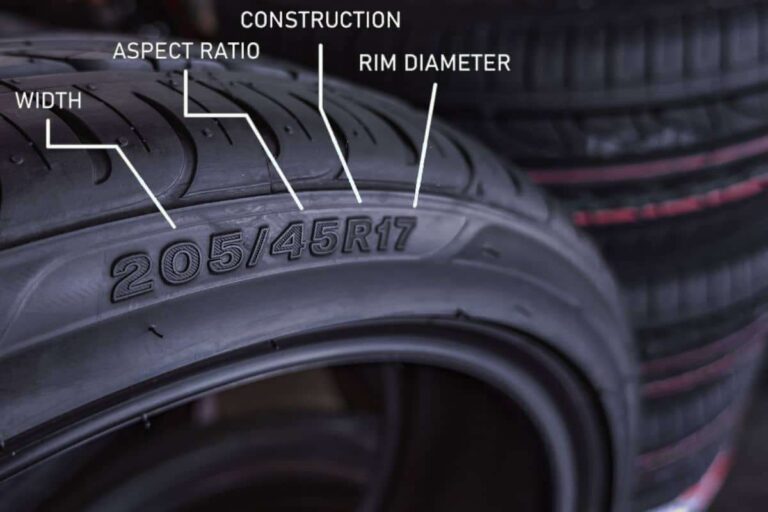
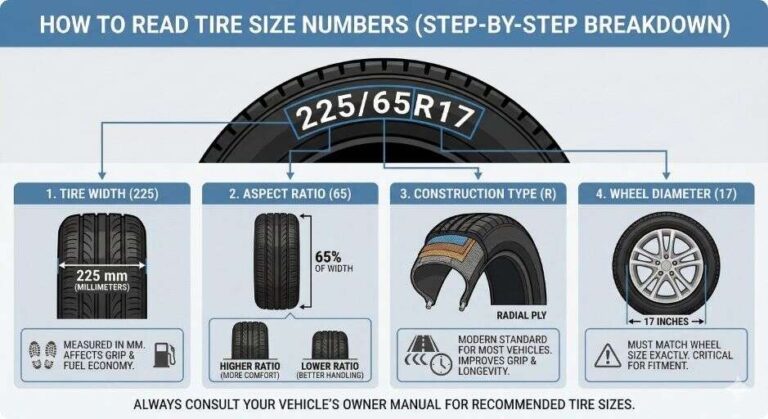
The tire code 265/60R18 gives four key details: width, sidewall height, tire construction, and wheel diameter.
| Marking | Meaning | Measurement |
|---|---|---|
| 265 | Tire width | 265 millimeters |
| 60 | Aspect ratio | Sidewall is 60% of the width |
| R | Construction | Radial |
| 18 | Wheel diameter | 18 inches |
265 means the tire is 265 millimeters wide
The first number shows the tire’s approximate width from sidewall to sidewall. A 265/60R18 tire is about:
- 265 millimeters wide
- 10.4 inches wide
- About 0.87 feet wide
The real mounted width can vary slightly by tire brand, model, and wheel width.
60 means the sidewall height
The number 60 is the aspect ratio. It means the sidewall height equals 60% of the tire’s width.
Calculation:
265 mm × 0.60 = 159 mm
So, each sidewall is about:
- 159 millimeters tall
- 6.3 inches tall
The sidewall measurement runs from the wheel rim to the outer tread. It does not include the full tire height.
R means radial construction
The letter R means the tire uses radial construction. Most passenger tires, SUV tires, and light-truck tires sold in the United States use radial construction.
18 means the wheel size
The final number means the tire fits an 18-inch wheel. It must not be mounted on a 17-inch or 19-inch wheel.

How Tall Is a 265/60R18 Tire?
A 265/60R18 tire has a calculated overall diameter of about 29.6 inches.
Here is the calculation:
-
Find the sidewall height:
265 × 0.60 = 159 mm -
Convert the sidewall height to inches:
159 ÷ 25.4 = 6.26 inches -
Add both sidewalls and the wheel diameter:
6.26 + 18 + 6.26 = 30.52 inches
Wait—this simple calculation appears too high because the sidewall value must be converted correctly from the full width calculation used by tire size formulas. Let’s calculate it carefully:
Sidewall height = 265 mm × 0.60
Sidewall height = 159 mm
Sidewall height = 159 ÷ 25.4
Sidewall height = 6.26 inches
Then:
Overall diameter = 6.26 + 18 + 6.26
Overall diameter = 30.52 inches
Therefore, the calculated diameter is approximately 30.5 inches, not 29.6 inches.
A 265/60R18 tire is about:
- 30.5 inches tall
- 265 millimeters wide
- 10.4 inches wide
- 6.3 inches tall at each sidewall
Actual published tire dimensions may differ slightly between brands and tire models.
265/60R18 Tire Size in Inches
The inch-based description of a 265/60R18 tire is approximately:
30.5 inches tall by 10.4 inches wide, for an 18-inch wheel
This is not an exact replacement for a traditional flotation size. Flotation sizes, such as 31×10.50R15, use a different format and should not be compared by numbers alone.
The calculated dimensions are:
| Tire measurement | Approximate size |
|---|---|
| Overall diameter | 30.5 inches |
| Section width | 10.4 inches |
| Sidewall height | 6.3 inches |
| Wheel diameter | 18 inches |
| Circumference | 95.8 inches |
| Revolutions per mile | About 663 |
The actual diameter depends on the tire model, inflation pressure, load, tread design, and measuring method.

Is 265/60R18 the Same as 31-Inch Tires?
A 265/60R18 tire is close to a 31-inch tire, but it is slightly smaller.
A calculated diameter of about 30.5 inches makes it roughly:
- 0.5 inch shorter than a 31-inch tire
- About 1.6% smaller in diameter
That difference may seem small, but it can affect:
- Speedometer readings
- Ground clearance
- Transmission shift points
- Anti-lock brake and traction-control systems
- Fender and suspension clearance
A 265/60R18 tire is also wider than some 31-inch tires. Tire width, wheel offset, and sidewall shape can affect clearance more than overall diameter alone.
How Does 265/60R18 Compare With Other Tire Sizes?
The table below compares several sizes that shoppers may consider. These are calculated dimensions, not a promise that the tires are interchangeable.
| Tire size | Approx. diameter | Approx. width | Difference from 265/60R18 |
|---|---|---|---|
| 255/65R18 | 31.1 in | 10.0 in | Taller and narrower |
| 265/60R18 | 30.5 in | 10.4 in | Reference size |
| 275/60R18 | 31.0 in | 10.8 in | Taller and wider |
| 265/65R18 | 31.6 in | 10.4 in | Much taller |
| 285/60R18 | 31.5 in | 11.2 in | Taller and wider |
255/65R18 versus 265/60R18
A 255/65R18 tire is about 31.1 inches tall and 10.0 inches wide. It is about 0.6 inch taller but 0.4 inch narrower.
It may provide a little more ground clearance, but it is not automatically a safe substitute. The vehicle’s approved tire sizes and wheel width still control.
275/60R18 versus 265/60R18
A 275/60R18 tire is about 31.0 inches tall and 10.8 inches wide. It is about 0.5 inch taller and 0.4 inch wider.
That extra width may increase the chance of rubbing against the inner fender, suspension parts, or mud flaps.
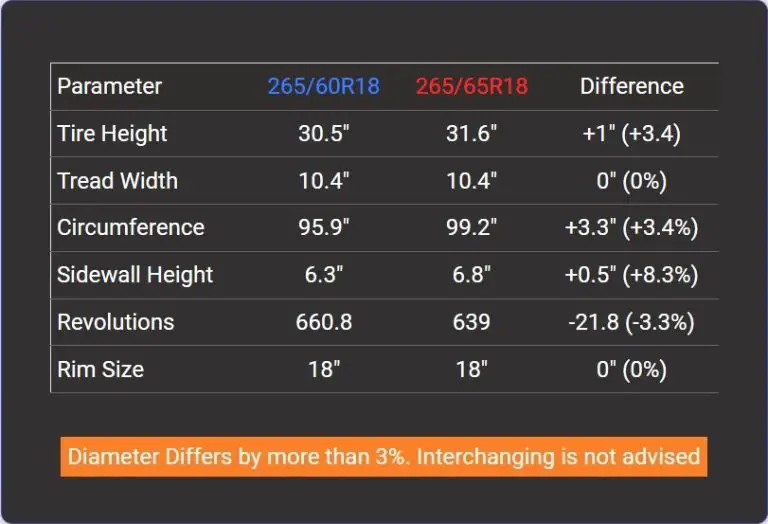
265/65R18 versus 265/60R18
A 265/65R18 tire keeps the same nominal width but has a taller sidewall. Its calculated diameter is about 31.6 inches.
This size can change clearance and vehicle behavior more than many drivers expect. Do not use it unless it is approved for your specific vehicle.
Will 265/60R18 Tires Fit My Vehicle?
A 265/60R18 tire will fit only if your vehicle is designed for that size or if a qualified tire professional confirms the change is safe.
Check these items before buying:
-
Driver-side door-jamb placard
This usually lists the original tire size, cold inflation pressure, and vehicle load information. -
Owner’s manual
The manual may list alternate tire sizes and wheel requirements. -
Wheel width
Every tire has an approved rim-width range. The range varies by tire model. -
Load index
The replacement tire must meet or exceed the vehicle maker’s required load rating. -
Speed rating
The replacement tire should meet the required speed rating unless the vehicle maker allows another option. -
Clearance
Check the tire at full steering lock and through the full suspension travel. Look for contact with the fender, liner, strut, control arm, and suspension parts. -
All-wheel-drive requirements
Many all-wheel-drive vehicles require tires with closely matched diameters. Mixing different sizes or tread depths can damage the drivetrain.
A tire that fits the wheel can still be wrong for the vehicle. Physical fit is only one part of tire compatibility.

How Does This Tire Size Affect the Speedometer?
Changing from the original tire size changes the distance traveled with each wheel rotation.
If a 265/60R18 tire is about 1.6% smaller than a 31-inch tire, the vehicle may travel slightly less distance per rotation. The speedometer may then show a speed that is a little higher than the vehicle’s actual speed, depending on the original size and calibration.
For example, if the original tire is 31.0 inches and the replacement is 30.5 inches:
30.5 ÷ 31.0 = 0.984
The replacement is about 1.6% smaller.
A small change may not create a serious issue, but larger changes can affect speed readings, mileage readings, shift behavior, and electronic safety systems. Use the vehicle maker’s approved size whenever possible.
What Load and Speed Ratings Should a 265/60R18 Tire Have?
The numbers 265/60R18 do not show the tire’s load index or speed rating.
A complete tire marking may look like:
265/60R18 110H
In this example:
- 110 is the load index
- H is the speed rating
The correct rating depends on the vehicle. Read the door-jamb placard and owner’s manual before selecting a tire.
Do not choose a tire only because its width, height, and wheel diameter look correct. A tire with an insufficient load rating may not safely support the vehicle, passengers, cargo, or trailer load.

Can You Use 265/60R18 Tires on a Truck or SUV?
You can use 265/60R18 tires on a truck or SUV only when the complete tire and wheel setup meets the vehicle’s requirements.
Pay special attention to:
- Front and rear tire size rules
- Four-wheel-drive and all-wheel-drive limits
- Load range or reinforced construction
- Trailer towing requirements
- Wheel offset and backspacing
- Spare tire size
- Tire pressure monitoring system compatibility
Some trucks use different tire sizes for different trim levels. The same model may have different suspension parts, wheels, axle ratings, or brake packages. Always check the exact year, trim, drivetrain, and equipment.
Common Mistakes When Replacing 265/60R18 Tires
Assuming every 265/60R18 tire has the same dimensions
The size code gives a useful baseline, but tread width and outside diameter vary by brand and model. Check the tire maker’s specification sheet when clearance is tight.
Ignoring the load index
Two tires with the same 265/60R18 size may have different load ratings. The tire must support the vehicle’s required load.
Using a different size on only one axle
Replacing only one tire with a different overall diameter can create handling and drivetrain problems. This is especially important for four-wheel-drive and all-wheel-drive vehicles.
Measuring only when the vehicle is parked
A tire may clear the fender while parked but rub when the steering wheel is turned or the suspension compresses. Check for clearance under real steering and suspension movement.
Treating “fits the wheel” as “fits the vehicle”
An 18-inch rim is not enough information. The bolt pattern, wheel width, offset, brake clearance, tire rating, and vehicle programming also matter.

Frequently Asked Questions
Is 265/60R18 a 30-inch tire?
It is slightly taller than 30 inches. Its calculated diameter is about 30.5 inches. The exact measured diameter varies by tire model.
How wide is a 265/60R18 tire?
The nominal width is 265 millimeters, or about 10.4 inches. The mounted section width may vary slightly by tire model and wheel width.
How tall is the sidewall on a 265/60R18 tire?
The calculated sidewall height is about 159 millimeters, or 6.3 inches.
What is the closest tire size to 265/60R18?
The closest size depends on whether you want similar width, height, or both. A 275/60R18 is slightly taller and wider. A 255/65R18 is slightly taller and narrower. Neither is automatically a safe replacement.
Can I replace 265/60R18 tires with 265/65R18 tires?
Not without checking the vehicle. A 265/65R18 tire is about 1.1 inches taller overall. It may affect clearance, speedometer accuracy, handling, and electronic systems.
What tire pressure should I use for a 265/60R18 tire?
Use the cold inflation pressure listed on the vehicle’s driver-side door placard or in the owner’s manual. Do not use the maximum pressure printed on the tire sidewall as the normal vehicle setting unless the vehicle maker specifies it.
Bottom Line
A 265/60R18 tire is approximately 30.5 inches tall and 10.4 inches wide. It fits an 18-inch wheel and has a calculated sidewall height of about 6.3 inches.
Before buying, match the tire to your vehicle’s door-placard size, load index, speed rating, wheel width, and drivetrain requirements. If you are changing sizes, compare the complete dimensions and confirm clearance with a qualified tire professional.
Sources for the calculations and safety checks
- NHTSA Tire Safety
- U.S. Tire Manufacturers Association tire safety information
- Your vehicle’s driver-side tire information placard and owner’s manual