How Many Catalytic Converters Does A Car Have: Quick Guide
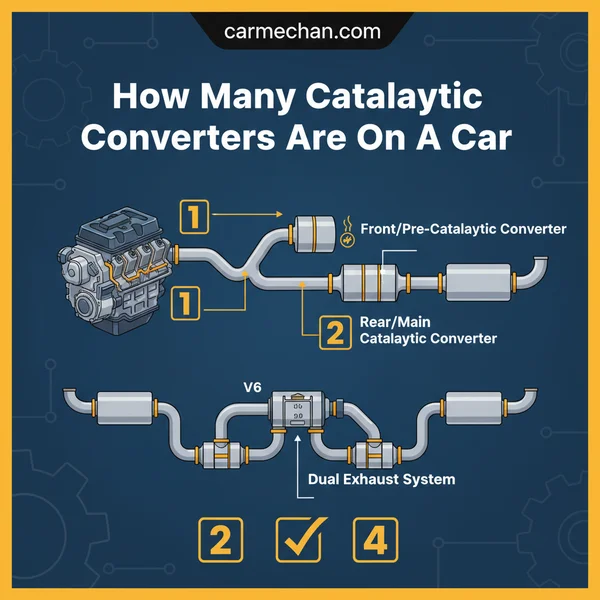
Most cars in the United States have one or two catalytic converters. A four-cylinder car often has one. A V6 or V8 commonly has two, with one serving each engine bank. Some vehicles have three or more separate catalytic converter sections, while a few older or unusual models may have none.
The exact number depends on the engine layout, emissions system, model year, fuel type, and federal or California emissions equipment. The number of exhaust tips does not tell you how many catalytic converters the car has.
What Does a Catalytic Converter Do?
A catalytic converter is an emissions-control device in a vehicle’s exhaust system. It uses coated metals to change harmful exhaust gases into less harmful compounds before they leave the tailpipe.
A typical gasoline catalytic converter helps reduce:
- Carbon monoxide, or CO
- Unburned hydrocarbons, or HC
- Nitrogen oxides, or NOx
The converter does not remove every pollutant. It works as part of a larger emissions system that also includes oxygen sensors, fuel controls, exhaust components, and the vehicle’s computer.
Most modern gasoline cars use a three-way catalytic converter. “Three-way” means it controls three main pollutant groups: carbon monoxide, hydrocarbons, and nitrogen oxides.
Catalytic converter location
A converter may be installed:
- Directly on or near the exhaust manifold
- Close to the engine as a “close-coupled” converter
- Under the vehicle farther along the exhaust pipe
- In more than one location on the same exhaust bank
Many vehicles use both a small converter near the engine and a larger converter farther below the vehicle. These may be counted as separate converters or as part of a combined converter assembly, depending on the design and parts catalog.
How Many Catalytic Converters Are in Common Vehicle Types?
The table below gives common layouts, not a rule for every vehicle.
| Vehicle or engine type | Common number of catalytic converters | Why |
|---|---|---|
| Small four-cylinder car | 1 | One engine bank usually feeds one exhaust path |
| Four-cylinder car with multiple converter stages | 2 or more | Some models use close-coupled and underfloor converters |
| Inline-six engine | 1 or 2 | The exhaust may use one path or split into two |
| V6 engine | 2 | Each cylinder bank often has its own converter |
| V8 engine | 2 or 4 | Each bank may use one or more converter stages |
| Hybrid gasoline vehicle | Usually 1 or 2 | The engine and emissions design determine the count |
| Diesel vehicle | Varies | It may use an oxidation catalyst, diesel particulate filter, and SCR catalyst |
| Electric vehicle | 0 | It has no internal combustion engine or tailpipe |
These figures are broad patterns. The service information for the exact year, make, model, engine, and emissions version is the reliable way to confirm the count.
Four-cylinder cars
A typical inline-four engine has one cylinder bank. Its exhaust gases often flow into one catalytic converter.
Some four-cylinder cars use more than one converter. For example, a vehicle may have:
- A converter built into the exhaust manifold
- A second converter under the vehicle
3. A separate converter for a divided exhaust path
So, “four-cylinder” does not always mean “one catalytic converter.”
V6 and V8 cars
V6 and V8 engines have two cylinder banks. Each bank often has its own exhaust manifold and catalytic converter.
That is why a V6 commonly has two converters. A V8 may also have two, but some vehicles use two converter stages on each bank and therefore have four distinct converter units.
A V-shaped engine does not automatically have four converters. The manufacturer may combine several functions in one assembly or use a shared exhaust layout.
Cars with dual exhaust
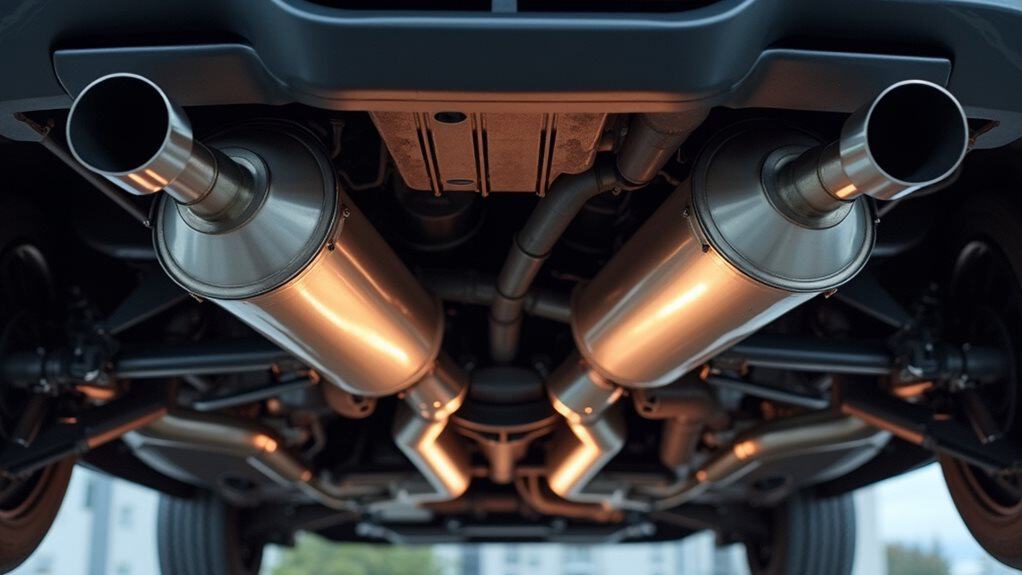
Two tailpipes do not always mean two catalytic converters.
A vehicle can have:
- One converter feeding a split exhaust
- Two converters feeding two tailpipes
- Two converters that merge into one muffler
- Four converters with only two visible tailpipes
The tailpipe count shows how the exhaust exits the car. It does not show the number of catalytic converters upstream.
Why Does the Number of Catalytic Converters Vary?
The number changes because automakers design the emissions system around engine shape, exhaust routing, operating temperature, packaging, and emissions rules.
Engine layout
An inline engine usually sends exhaust gases through one main bank. A V6 or V8 has two banks, which often leads to two separate exhaust paths.
This is the most common reason a V6 or V8 has more than one converter.
Emissions targets
Modern vehicles must control emissions during many conditions, including:
- Cold starts
- Idling
- Heavy acceleration
- Highway driving
- Stop-and-go traffic
A converter placed close to the engine heats up quickly after startup. A second converter farther downstream can provide more treatment capacity once the exhaust reaches normal temperature.
Exhaust system design
Some vehicles use a single large converter. Others use several smaller units. A manufacturer may use multiple converters to fit the exhaust system into a tight space or to meet emissions limits across a wider range of driving conditions.
Federal and California emissions versions
Vehicles sold in the United States may have different emissions equipment depending on the certification version.
The Environmental Protection Agency regulates federal vehicle emissions. California has its own emissions program through the California Air Resources Board, commonly called CARB. Other states may follow California emissions rules for some vehicles.
A California-emissions version may use a different converter, additional emissions parts, or different sensor locations than a federal version of the same model. Always match a replacement converter to the vehicle’s emissions certification.
Model year
Older cars often have simpler exhaust systems. Newer cars may use more closely monitored converter sections and extra oxygen sensors.
The number of converters is not determined by age alone, though. A newer four-cylinder car may have two converter assemblies, while an older V8 may have only two.
How to Find the Exact Number on Your Car
The safest way to identify the count is to check the exact vehicle configuration and then confirm the physical exhaust layout.
1. Record the vehicle details
Write down:
- Model year
- Make and model
- Engine size
- Number of cylinders
- Drivetrain, if relevant
- Federal or California emissions version
- Vehicle identification number, or VIN
The engine size alone is not enough. The same model may use different converters for different engines or emissions packages.
2. Check the owner’s or service manual
The service manual may label the parts as:
- Bank 1 catalytic converter
- Bank 2 catalytic converter
- Front catalytic converter
- Rear catalytic converter
- Manifold converter
- Underfloor converter
- Converter assembly
A parts catalog tied to the VIN can also show the correct emissions components. Generic online listings may show only one of several possible configurations.
3. Trace the exhaust from the engine
Only inspect the exhaust when the vehicle is completely cold. A catalytic converter can become extremely hot during normal use.
Starting near the engine, look for metal converter housings in the exhaust pipe. They often look like enlarged sections of pipe or metal shells. A typical system may include:
- Exhaust manifold or header
- Close-coupled converter
- Oxygen sensor
- Underbody converter
- Muffler
- Tailpipe
Do not confuse an oxygen sensor with a catalytic converter. An oxygen sensor is a small electronic sensor threaded into the exhaust. It measures oxygen levels; it does not treat exhaust gases.
4. Count the converter housings, not the tailpipes
Follow each exhaust branch from the engine. Count each separate catalytic converter housing.
Some converter parts are joined into one large assembly. In that case, the manufacturer’s parts diagram is more reliable than a visual count.
5. Use scan data only as supporting information
A diagnostic scan tool may show codes such as:
- P0420: Catalyst system efficiency below threshold, Bank 1
- P0430: Catalyst system efficiency below threshold, Bank 2
These codes can suggest that the vehicle monitors two engine banks. They do not always prove that the car has exactly two separate physical converters.
A code may result from an exhaust leak, faulty oxygen sensor, engine misfire, fuel-control problem, or damaged converter. Do not replace a converter based on the code alone.

Does Every Exhaust Bank Need Its Own Catalytic Converter?
No. Many V-shaped engines use one converter per bank, but the exhaust can be designed in other ways.
A manufacturer may use:
- One converter for a single inline engine
- One converter on each bank of a V6
- Multiple converter stages on each bank
- A shared converter after the exhaust banks merge
- A combined manifold-and-converter assembly
The key question is how the exhaust gases are routed. The cylinder-bank layout gives a useful clue, but it does not replace the vehicle’s emissions diagram.
Do Hybrid Cars Have Catalytic Converters?
Most gasoline-electric hybrid cars have at least one catalytic converter because they still use a gasoline engine.
A hybrid may shut its engine off often, then restart it during acceleration, battery charging, or higher-speed driving. The converter must still control emissions during those engine cycles. Hybrid systems may use special temperature and fuel-control strategies to keep the converter effective.
A plug-in hybrid also usually has a catalytic converter if it includes a gasoline engine. It may travel on electric power without using the converter, but the converter remains part of the gasoline engine’s exhaust system.
A fully electric vehicle has zero catalytic converters because it has no combustion engine and no tailpipe exhaust.
Do Diesel Vehicles Have Catalytic Converters?
Diesel vehicles can have catalytic exhaust parts, but their systems may not match the gasoline design.
A diesel exhaust system may include:
- Diesel oxidation catalyst, or DOC
- Diesel particulate filter, or DPF
- Selective catalytic reduction catalyst, or SCR catalyst
- Ammonia slip catalyst, or ASC
- Exhaust gas sensors and dosing equipment
A DOC helps control carbon monoxide and hydrocarbons. An SCR catalyst helps reduce nitrogen oxides by using diesel exhaust fluid, commonly known as DEF, in systems that require it.
When someone asks how many catalytic converters a diesel has, clarify which components they want counted. A parts catalog may list several catalyst-related units that perform different jobs.
How Many Catalytic Converters Does a Car Need to Run?
A car may continue to run with a damaged or missing converter, but that does not make the vehicle legal, safe, or suitable to drive.
A missing converter can cause:
- Excessive emissions
- A check-engine light
- Loud exhaust noise
- Exhaust leaks
- Poor engine performance
- Fumes entering the passenger area
- Failed emissions inspection
- Damage to other emissions components
Removing or disabling a catalytic converter is generally prohibited under federal law when the vehicle is used on public roads. The EPA identifies catalytic converters as emissions-control devices, and tampering with or removing required emissions equipment can lead to enforcement or penalties.
State rules also matter. California and states that follow California emissions standards may require a specific CARB-approved replacement converter. Ask a qualified repair shop to verify the legal part for your location and vehicle.
Can a car run with one converter removed?
It may start and drive, especially if the removed converter is not blocking exhaust flow. However, the vehicle may have an exhaust leak, unsafe fumes, poor noise control, and an emissions fault.
Do not drive a vehicle with an open exhaust near the engine or passenger compartment. Carbon monoxide is colorless and odorless, and exhaust leaks can create a serious hazard.

How Much Does It Cost to Replace a Catalytic Converter?
There is no single standard price because the cost depends on the vehicle and the failed part.
The total may include:
- One or more converter units
- Gaskets and hardware
- Oxygen sensors
- Exhaust repair
- Diagnostic testing
- Labor
- Emissions certification requirements
A converter built into an exhaust manifold can cost more to replace than an easily accessed underbody unit. A vehicle with two or four converters may also have a higher total repair cost than a vehicle with one.
Before approving a repair, ask the shop:
- Which converter failed?
- What test supports that diagnosis?
- Is the issue a converter, sensor, exhaust leak, or engine problem?
- Is the replacement federal- or CARB-certified?
- Does the part match the vehicle’s exact emissions label?
- Are there other faults that could damage the replacement?
A cheap universal converter may not be legal or suitable for a modern vehicle. The replacement must meet the emissions requirements for the vehicle and the state where it is registered.
Common Catalytic Converter Problems
A catalytic converter can fail for more than one reason. The converter may be the victim of another engine problem rather than the original cause.
A clogged converter
A melted or blocked converter can restrict exhaust flow. Possible signs include:
- Loss of power, especially at higher speed
- Poor acceleration
- Excessive heat under the vehicle
- Hard starting
- A rattling or collapsing internal substrate
A backpressure test, vacuum test, temperature comparison, or other professional diagnostic method may help confirm a restriction. One symptom alone does not prove that the converter is clogged.
A converter with low efficiency
A vehicle computer may compare oxygen sensor signals before and after the converter. If the signals suggest that the converter is not storing oxygen or treating gases as expected, the computer may set a catalyst-efficiency code.
Possible causes include:
- Normal converter wear
- Exhaust leaks
- Faulty oxygen sensors
- Engine misfires
- Rich or lean fuel operation
- Oil burning
- Coolant entering the combustion chamber
Replacing the converter without correcting the cause can lead to another failure.
A stolen converter
Catalytic converters contain valuable metals, including platinum-group metals. Some vehicles are more attractive to thieves because the converters are easy to reach or contain larger amounts of these metals.
Signs of theft may include:
- A sudden, very loud exhaust
- A visible cut section in the exhaust pipe
- A check-engine light
- Missing heat shields or exhaust hardware
- Fumes or unusual noise under the vehicle
Do not crawl under an unsupported car to inspect it. Use a qualified shop or a secure lift.
What Is the Difference Between a Catalytic Converter and a Muffler?
A catalytic converter reduces harmful pollutants. A muffler reduces exhaust noise.
They are separate parts, though some exhaust assemblies combine several components in one unit. A muffler does not replace a catalytic converter, and a catalytic converter does not perform the same noise-control job as a muffler.
A resonator is another exhaust part that changes sound and airflow. It also is not a catalytic converter.
Mistakes to Avoid When Counting Catalytic Converters
Several quick methods can produce the wrong answer.
Counting tailpipes
Tailpipes show the final exhaust outlets, not the number of converters. One converter can feed two outlets, and several converters can feed one outlet.
Assuming a V8 has four converters
A V8 often has two converters, one per bank. Some models have four, but the engine cylinder count does not settle the question.
Counting oxygen sensors
A vehicle may have several oxygen or air-fuel sensors around one converter. Sensor count and converter count are different.
Trusting a generic parts listing
A parts website may combine several years, engines, or emissions versions under one model name. Use the VIN and emissions label where possible.
Replacing a converter without fixing the cause
Misfires, oil consumption, coolant leaks, and incorrect fuel mixture can quickly damage a new converter. Diagnose the whole emissions system first.
Working under a hot car
Converters can remain hot long after the engine stops. Let the exhaust cool fully, use proper support stands, and avoid touching the converter or nearby shields.

Quick Answer by Engine Layout
- Inline-four: Usually one, but sometimes two or more
- Inline-six: Usually one, but the exhaust may split
- V6: Commonly two
- V8: Commonly two, sometimes four
- Hybrid: Usually one or two if it has a gasoline engine
- Diesel: Several catalyst-related parts may be present
- Fully electric vehicle: None
The most accurate answer always comes from the exact vehicle’s service information and emissions configuration.
Frequently Asked Questions
Does a car with two exhaust pipes have two catalytic converters?
No. Two exhaust pipes do not prove that the car has two converters. The exhaust may split after one converter, or two converter branches may merge before the tailpipes.
Does a V6 always have two catalytic converters?
No. A V6 often has one converter for each cylinder bank, but some designs use shared or multiple converter assemblies. Confirm the layout for the exact model and engine.
Can a catalytic converter be repaired?
In most cases, a converter with melted, broken, or contaminated internal material is replaced rather than repaired. An exhaust leak, loose heat shield, sensor fault, or mounting problem may be repairable without replacing the converter.
How do I know which catalytic converter is bad?
A diagnostic code may identify Bank 1 or Bank 2, but it does not always identify the failed physical unit. A technician should check for exhaust leaks, sensor faults, misfires, fuel problems, and converter performance before replacement.
Can I drive with a bad catalytic converter?
A short trip may be possible in some cases, but continued driving can worsen damage or create a fire and exhaust-fume risk. Stop driving and seek prompt service if the car has severe power loss, glowing exhaust parts, a strong exhaust smell, misfires, or fumes inside the cabin.
Are catalytic converters required by law in the United States?
Required emissions equipment must remain in place on vehicles certified for public-road use. Federal anti-tampering rules apply, and state inspection laws may add requirements. Use a legally approved replacement that matches the vehicle’s emissions certification.
Conclusion
Most cars in the United States have one or two catalytic converters. A four-cylinder car often has one, while a V6 or V8 frequently has two. Some vehicles use several converter stages, so engine size, tailpipe count, and oxygen-sensor count cannot provide a certain answer by themselves.
For an exact count, identify the vehicle’s year, engine, VIN, and emissions version. Then check the service manual or trace the exhaust from the engine while the vehicle is cold. If you are diagnosing a fault or buying a replacement, have a qualified technician confirm the failed part and the correct federal or CARB-compliant converter before work begins.