

Introduction
Sleeping in your car is not automatically illegal in the United States. The law depends on where you park, how long you stay, local parking rules, private-property policies, and whether you are impaired or creating a safety risk.
A quiet night in a legally parked car may be allowed. The same act may lead to a ticket or removal if you park on a restricted street, stay at a rest area after the posted limit, camp on public land, or remain on private property without permission.
This guide explains the main U.S. rules, common exceptions, safety concerns, and the best way to check the law before you sleep in your vehicle. It is general information, not legal advice for a specific location.

Is sleeping in your car illegal in the United States?
There is no single federal law that makes sleeping in every parked car illegal. Instead, several types of rules may apply:


- Parking laws: These control where and when you may leave a vehicle.
- Overnight parking rules: Some cities and agencies ban sleeping, camping, or vehicle habitation.
- Trespass laws: Private property owners can restrict access or ask you to leave.
- Public land rules: Parks, forests, and recreation areas may limit overnight stays.
- Rest-area rules: Many states allow short rest stops but ban camping or extended stays.
- Driving-under-the-influence laws: Sleeping in a car does not always prevent an impaired-driving charge.
- Noise, litter, and public-order laws: Conduct around the vehicle may create a separate violation.
The key point is simple: the legality usually turns on the parking location and the surrounding conduct, not just the fact that you are asleep.
A person who pulls into a legal parking space for a short rest may be treated differently from someone who sets up bedding, blocks a roadway, stays for several days, or ignores a posted order to leave.
The same conduct can be legal in one place and illegal in another
A city may prohibit overnight vehicle habitation on public streets. A private business may allow customers to park overnight but remove vehicles that remain after closing. A state rest area may permit a few hours of rest but prohibit camping.
Even neighboring cities may use different rules. A county, city, transit agency, park service, or private owner may control the location.
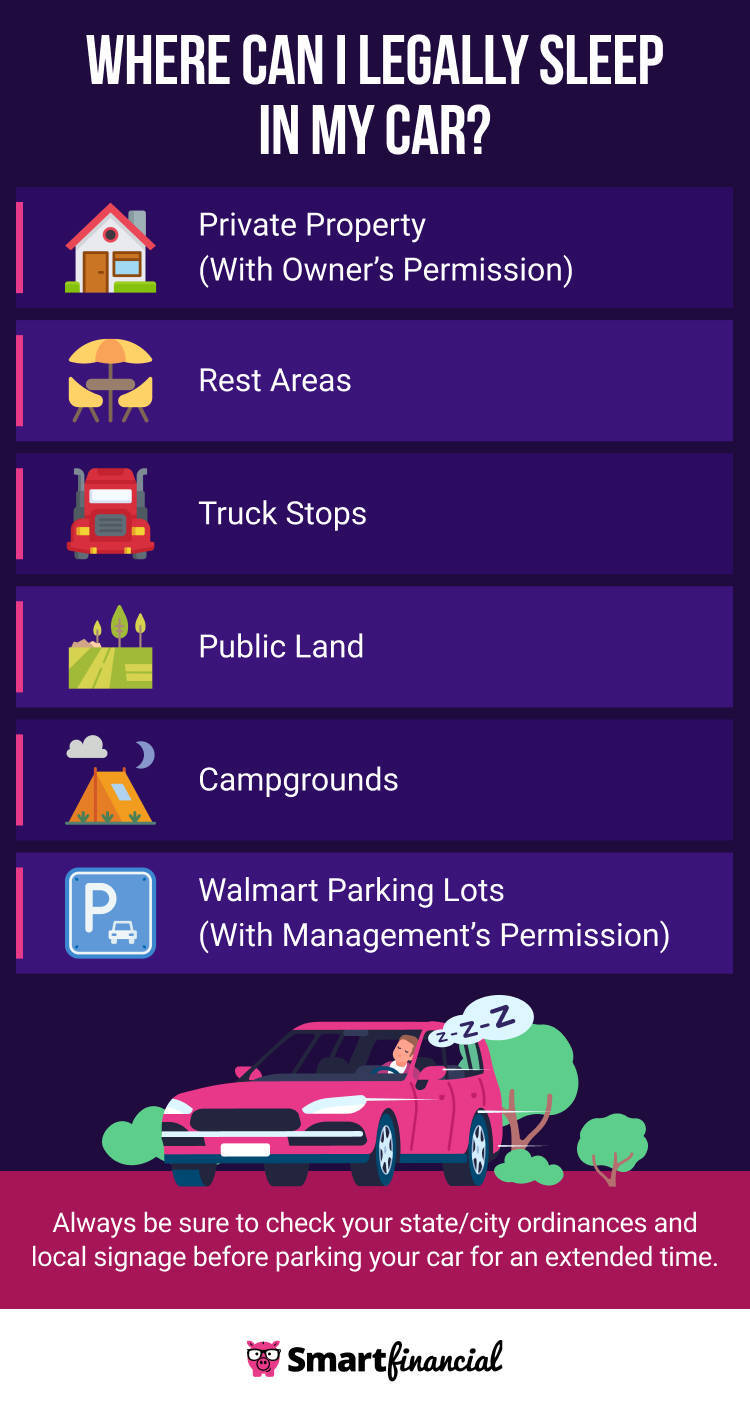
Where can you legally sleep in your car?
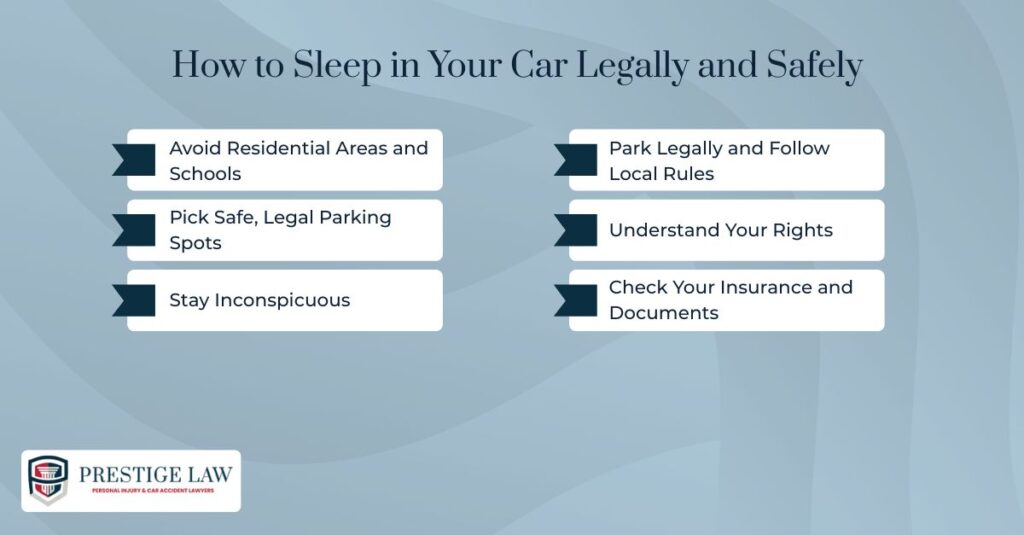
You are most likely to avoid legal trouble when you have permission to park, follow posted rules, and keep the stay short and unobtrusive.
Private property with permission
Private property is often the clearest option when the owner or operator allows overnight parking. Examples may include:
- A friend’s driveway
- Your own property
- A private campground
- A hotel or motel lot with approval
- A business that expressly permits overnight parking
- A designated safe-parking program
Permission matters because a parking lot that looks open may still be private property. A store can close its lot at night, limit parking to customers, or prohibit sleeping in vehicles.
If an employee, owner, security guard, or police officer tells you to leave, do not assume that you may stay because the vehicle was parked legally earlier. refusing to leave private property can create a trespass issue.
Designated campgrounds
A campground or overnight parking site is usually safer from a legal standpoint because it is designed for stays. Follow the site’s rules about:


- Check-in and checkout times
- Vehicle size
- Quiet hours
- Fires and cooking
- Waste disposal
- Maximum stay limits
- Whether sleeping inside a vehicle is allowed
A campsite may permit a vehicle but still ban sleeping in a car outside the designated site. The written rules control.
Public land
Federal public land is not governed by one nationwide overnight-parking rule. Agencies and individual sites may set different limits.
For example, the National Park Service regulates camping and overnight use through federal rules and park-specific policies. National forests and Bureau of Land Management areas may allow dispersed camping in some locations, while other areas require a permit or prohibit overnight stays.
Check the official rules for the exact property:
- National Park Service camping information
- Bureau of Land Management camping information
- U.S. Forest Service camping information
Do not assume that public land means unrestricted land. A gate, sign, ranger instruction, fire restriction, permit rule, or local closure may change the answer.
Rest areas and welcome centers
Rest areas exist partly to help tired drivers stop safely. However, a rest area is not automatically a legal place to camp or stay indefinitely.
State rules may limit:
- The number of hours you may remain
- Whether overnight parking is allowed
- Whether you may sleep in a vehicle
- Whether commercial vehicles have separate rules
- Whether you may use a rest area for shelter rather than travel
Look for posted signs and check the state department of transportation website. If no clear rule is posted, ask an employee or law-enforcement officer for the site’s policy.
Do not park on an entrance or exit ramp, shoulder, travel lane, or other unsafe area. A vehicle stopped in a dangerous location may be towed even if the driver is trying to rest.

What laws can make sleeping in a car illegal?
Local anti-camping or vehicle-habitation rules
Some cities and counties restrict sleeping, camping, or living in vehicles on public streets. The rule may apply all day or only during certain hours.
A law may define prohibited conduct broadly. It could cover:
- Using a vehicle as a residence
- Storing personal belongings outside the vehicle
- Extending awnings or using outdoor furniture
- Cooking beside the vehicle
- Remaining in one location beyond a time limit
- Blocking sidewalks or public access
A short nap may not meet the legal definition of camping. But a person who stays in the same place night after night may face a different rule.


No-parking and time-limit violations
Even if sleeping itself is not banned, ordinary parking rules still apply. You can receive a citation for:
- Parking during street-sweeping hours
- Exceeding a posted time limit
- Parking in a permit-only zone
- Parking near a fire hydrant
- Blocking a driveway
- Parking in a loading zone
- Leaving a vehicle on the street during restricted hours
- Parking in a tow-away area
A covered window or quiet behavior does not cancel a parking restriction.
Trespass on private property
Trespass rules generally become relevant when you knowingly remain on property without permission after being told to leave. The exact elements vary by state.
A business may also use signs, gates, lot attendants, or posted terms to limit overnight parking. If you want to stay, ask first and follow the answer.
Public intoxication and disorderly conduct
Sleeping in a car does not protect you from other criminal laws. Conduct that may cause problems includes:
- Fighting or threatening people
- Creating loud noise
- Leaving trash or bodily waste
- Exposing yourself
- Blocking traffic
- Harassing customers or residents
- Possessing illegal substances
The safest approach is to keep the vehicle secure, quiet, and fully within a lawful parking space.
Driving under the influence
Do not assume that being asleep means you cannot be charged with DUI or DWI. State laws differ on what counts as “operating” or being in “actual physical control” of a vehicle.
Risk may increase if:
- The engine is running
- The keys are in the ignition
- You are sitting in the driver’s seat
- The vehicle is on a public road
- The vehicle could be moved easily
- You recently drove while impaired
- You admit that you planned to drive
If you have been drinking or using drugs, do not drive. The safest legal choice is to arrange a sober ride, use a licensed lodging option, or ask a sober person to help. Do not treat a nap as a guaranteed defense to an impaired-driving charge.
The National Highway Traffic Safety Administration provides information on impaired driving at NHTSA.gov.
Can you sleep in your car at a Walmart, truck stop, or hotel lot?
Sometimes, but the property owner’s policy and local law decide the issue.
Walmart and other retail lots
Some stores allow overnight parking at selected locations. Others prohibit it because of city rules, landlord requirements, insurance concerns, or local enforcement.
Ask the store manager before settling in. Do not rely only on an online list, an old social-media post, or what another driver told you. Policies can change by location.


Truck stops and travel centers
Truck stops often provide overnight parking, but spaces may be reserved for commercial vehicles or subject to fees and time limits. Follow signs and ask staff where passenger vehicles may park.
Never occupy a truck-only space if doing so blocks a commercial driver from resting safely.
Hotel parking lots
A hotel lot may appear public but is usually private property. Ask the hotel before parking overnight. A paid room is not always required, but permission may be limited to registered guests.
Apartment and office lots
These lots commonly use permits, towing rules, or private patrols. An unlocked gate does not necessarily mean that overnight parking is allowed.
How to check whether sleeping in your car is legal
Use this short process before you stop for the night.
1. Identify who controls the property
Ask whether the location is controlled by:
- A city or county
- A state transportation agency
- A national park
- The Bureau of Land Management
- The U.S. Forest Service
- A private business
- A campground operator
- A homeowners’ association
The controlling authority usually determines where to find the rule.
2. Read every sign near the parking space
Look for terms such as:
- No overnight parking
- No camping
- No sleeping in vehicles
- Permit required
- Two-hour limit
- Tow-away zone
- Closed after hours
- Area closed between sunset and sunrise
Take a photo of the sign for your records, but do not assume that a missing sign makes every action legal. Some rules apply by ordinance even when signs are limited.
3. Search the official local source
Use the city, county, state, park, or agency website. Helpful searches include:
- “[City] overnight parking ordinance”
- “[County] sleeping in vehicle law”
- “[State] rest area overnight parking”
- “[Park name] vehicle camping rules”
- “[Agency] camping and parking regulations”
Give more weight to an official code, agency page, or posted policy than to a commercial blog or forum comment.
4. Ask before you sleep
If the property is private, ask the owner or manager. If it is a public facility, ask the agency or on-site staff.


Keep the question specific: “Is overnight parking and sleeping inside a passenger vehicle allowed here, and is there a time limit?”
5. Leave if an authorized person tells you to leave
Do not argue at the location. Move to a lawful alternative, and note the agency or business name so you can check the rule later.
If you receive a citation or are arrested, follow the instructions on the paperwork and contact a licensed attorney or local legal-aid office.
Is it safe to sleep in your car?
Legal permission does not guarantee physical safety. A vehicle can become dangerously hot or cold, and carbon monoxide can kill people without warning.
Follow these basic precautions:
- Park on level ground, away from traffic.
- Lock doors and keep valuables out of sight.
- Keep windows clear enough to see outside.
- Do not sleep in a travel lane or on a narrow shoulder.
- Never run a gasoline engine in an enclosed garage or enclosed structure.
- Do not use a camp stove, charcoal grill, heater, or fuel-burning device inside the vehicle.
- Avoid leaving the engine running for long periods.
- Check weather alerts before stopping.
- Keep a charged phone and enough water.
- Tell a trusted person where you are.
- Leave immediately if you feel threatened, ill, confused, or overheated.
In extreme heat or cold, a vehicle may become unsafe quickly. Use a public shelter, hotel, campground, emergency service, or other safe indoor option when available.
If you are in immediate danger, call 911. For shelter or housing support in the United States, call 211 or visit 211.org. Availability varies by area.
Common mistakes that lead to tickets or removal
People often get into trouble because they confuse a quiet stop with a legal overnight stay.
Mistake 1: Assuming a legal parking space permits sleeping
A space may allow parking but prohibit camping or vehicle habitation. Check both the parking rule and the overnight-use rule.
Mistake 2: Trusting an old online list
A business may have changed its policy. A city may have adopted a new ordinance. Verify the location directly.
Mistake 3: Staying after permission ends
Permission may apply only to customers, one night, or a marked section of the lot. Ask about limits.
Mistake 4: Setting up camp outside the vehicle
Chairs, tarps, food, clothing, and personal items can make the stay look like camping. They may also violate site rules even when sleeping in the vehicle is allowed.
Mistake 5: Parking in an unsafe place
A shoulder, ramp, median, or traffic lane is not a safe substitute for a legal parking space. Police may move or tow a vehicle that creates a hazard.
Mistake 6: Keeping the keys in a risky DUI situation
A person who is impaired should not drive or place themselves where law enforcement may view them as ready to operate the vehicle. State law varies, so use a sober ride or seek qualified legal advice.

What should you do if police or security approach you?
Stay calm and keep your hands visible. Provide your driver’s license, registration, and insurance when the law requires it.


Ask, in a respectful way:
- “Am I being detained?”
- “Is this a parking violation or another issue?”
- “Where may I legally park?”
- “Am I free to leave?”
Do not consent to a vehicle search if you do not want one, but do not physically resist. You can say, “I do not consent to a search,” and follow lawful instructions.
If you receive a ticket, photograph it and read the deadline. Missing a court date or payment deadline can create additional problems. For a DUI allegation, arrest, search, or serious charge, contact a criminal-defense lawyer promptly.

Key takeaways
- Sleeping in your car is not automatically illegal in the U.S.
- The main factors are location, permission, posted signs, time limits, and local ordinances.
- Private property usually requires the owner’s permission.
- Rest areas may allow rest but prohibit camping or extended stays.
- Public parks and federal lands have site-specific rules.
- Sleeping in a vehicle does not guarantee protection from a DUI charge.
- Never use a fuel-burning device inside a vehicle or enclosed space.
- If you are told to leave, move safely and check the rule later.
Frequently asked questions
Can I sleep in my car on a public street?
Maybe. It depends on city and county rules, parking limits, permit requirements, and whether the vehicle is being used as a residence. A legal parking space does not always permit overnight sleeping.
Can police arrest me for sleeping in my car?
They may be able to act if you are violating a parking, trespass, camping, public-order, or impaired-driving law. In many situations, the first response may be a warning, citation, or order to leave, but the outcome depends on local law and the facts.
Is it legal to sleep in your car at a rest stop?
Rules vary by state and location. Some rest areas allow drivers to stop and sleep briefly for safety. Others limit the length of stay or ban overnight parking and camping. Read the signs and check the state transportation agency’s rules.
Can I sleep in my car if I am homeless?
A person’s housing status does not automatically make every parking location legal. Local vehicle-habitation and parking rules may still apply. If you need a safe place to stay, call 211 for local shelter, outreach, and housing resources.
Is it safer legally to sleep in the back seat?
Not necessarily. Moving to the back seat may reduce the appearance that you are ready to drive, but it does not override local parking laws or guarantee protection from a DUI charge. The vehicle must still be parked legally, and state rules differ.
Can I sleep in my car after drinking if the engine is off?
Do not assume that an engine being off makes the situation legal. Some states focus on whether you had actual physical control of the vehicle. If you have been drinking, arrange a sober ride or use a lawful place to stay rather than relying on a legal technicality.
Conclusion
Sleeping in your car can be legal in the United States, but there is no nationwide yes-or-no rule. Park only where overnight stays are allowed, obtain permission on private property, follow signs and time limits, and avoid any conduct that creates a safety or DUI risk.
Before you settle in, identify the property owner, check the official rule, and choose a safe location. If you face a citation, arrest, eviction from private property, or impaired-driving allegation, speak with a lawyer familiar with the law in that state or municipality.
