

Yes, you may be able to file bankruptcy and keep your car. The result usually depends on four things: your car’s value, your loan balance, your state’s exemption rules, and whether you stay current on the loan.
Bankruptcy does not always mean giving up your vehicle. In Chapter 7, you may keep a car with enough exemption protection and by continuing required loan payments. In Chapter 13, you may often keep the car through a court-approved repayment plan, even when Chapter 7 would put it at risk.
The rules differ by state and by case. This guide explains the main U.S. bankruptcy rules, but it is not a substitute for advice from a bankruptcy attorney in your state.

How Bankruptcy Affects Your Car
Bankruptcy separates your car into two legal interests:
- Your ownership interest, which is the car’s value after subtracting the loan balance.
- The lender’s lien, which gives the lender rights if you stop paying the auto loan.
Filing bankruptcy may protect you from collection calls, lawsuits, repossession, and some other collection actions through the automatic stay. The stay usually begins when you file the bankruptcy petition.
However, the stay does not erase the lender’s lien. If you do not make payments, the lender may later ask the court for permission to repossess the vehicle. A lender may also have rights that survive bankruptcy because liens are generally not removed unless a specific legal process applies.
What happens to the car loan?
Bankruptcy can remove your personal responsibility for some debts. It usually does not remove a valid lien on your car.
This means you may have three choices:
- Keep the car and continue paying.
- Keep the car under new terms or through a Chapter 13 plan.
- Return the car and discharge any qualifying unpaid balance.
The best choice depends on the loan terms, the car’s value, your income, and your need for transportation.
What is the automatic stay?
The automatic stay is a federal protection that generally stops many collection actions when a bankruptcy case begins. It may temporarily stop:
- Repossession efforts
- Collection lawsuits
- Wage garnishment for many debts
- Creditor calls and letters
- Some foreclosure and eviction actions
The stay has limits. It may not apply in the same way if you had a recent bankruptcy case dismissed, and a creditor can ask the bankruptcy court to lift the stay. The stay also does not make future car payments optional.

Can I Keep My Car in Chapter 7?
You may keep your car in Chapter 7 if the vehicle has enough exemption protection and you meet the lender’s requirements.
Chapter 7 is often called a liquidation case. A bankruptcy trustee reviews your property. The trustee can sell nonexempt assets and use the proceeds to pay creditors.
Many Chapter 7 cases are “no-asset” cases. This means the debtor has no property that the trustee can sell after applying available exemptions. A car can often be protected in this way, but the answer depends on state law and your specific facts.
Step 1: Find your car’s current value
Use a reasonable market value, not the amount you paid for the car. You may review:
- Recent private-sale listings for similar vehicles
- Dealer trade-in estimates
- Vehicle valuation guides
- The car’s mileage, condition, options, and accident history
A trustee may focus on the car’s fair market value. A loan statement does not prove the car’s value.
Step 2: Calculate your equity
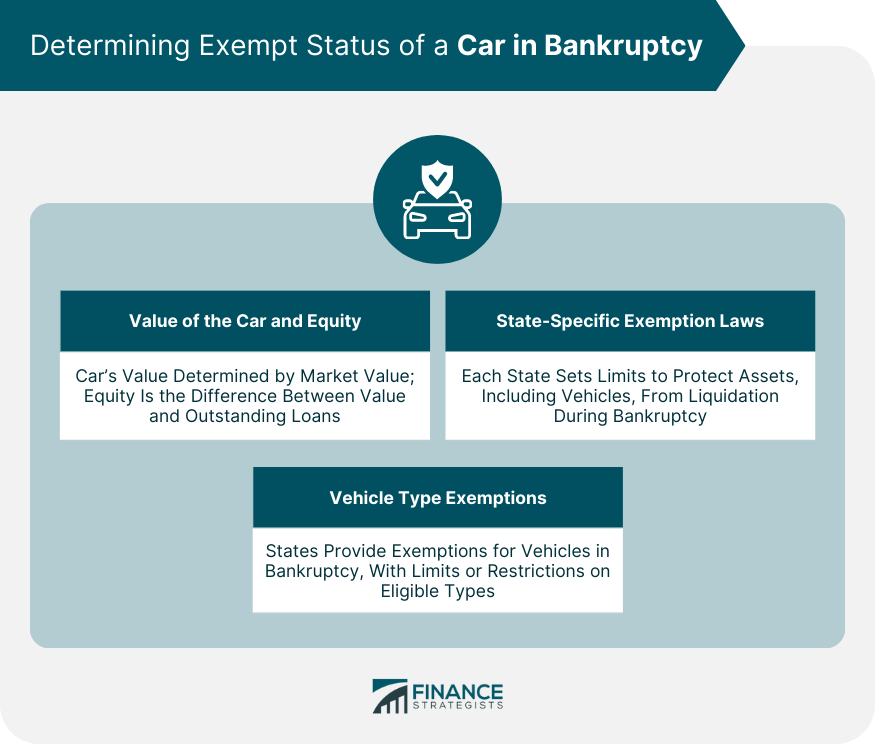
Your approximate equity is:
Fair market value − loan payoff amount = estimated equity
Use the lender’s current payoff amount when possible. The payoff amount may differ from the balance shown on a monthly statement because of interest, fees, or other charges.
Hypothetical example
Assume:
- Car value: $18,000
- Loan payoff: $14,500
- Estimated equity: $3,500
You would then compare the $3,500 equity with the exemption available to you. If the exemption covers the equity, the trustee may have no economic reason to sell the car.
This is only a simplified example. Other property, liens, co-ownership, recent transfers, and local rules can change the result.
Step 3: Identify the exemption that protects the car
A motor vehicle exemption may protect some equity in one vehicle. You may also have access to a wildcard exemption that protects other property.
Bankruptcy exemption rules are not the same in every state. Some states require residents to use state exemptions. Other rules may allow certain debtors to use the federal bankruptcy exemptions under 11 U.S.C. § 522. Eligibility can depend on your residence history.
Do not assume that the federal exemption is available just because you are filing in a federal bankruptcy court. Ask a local attorney or approved legal aid provider which exemption system applies.
Step 4: Keep making required payments
Even if your car is exempt, you still must deal with the loan. If you fall behind, the lender may seek relief from the automatic stay and repossess the car.
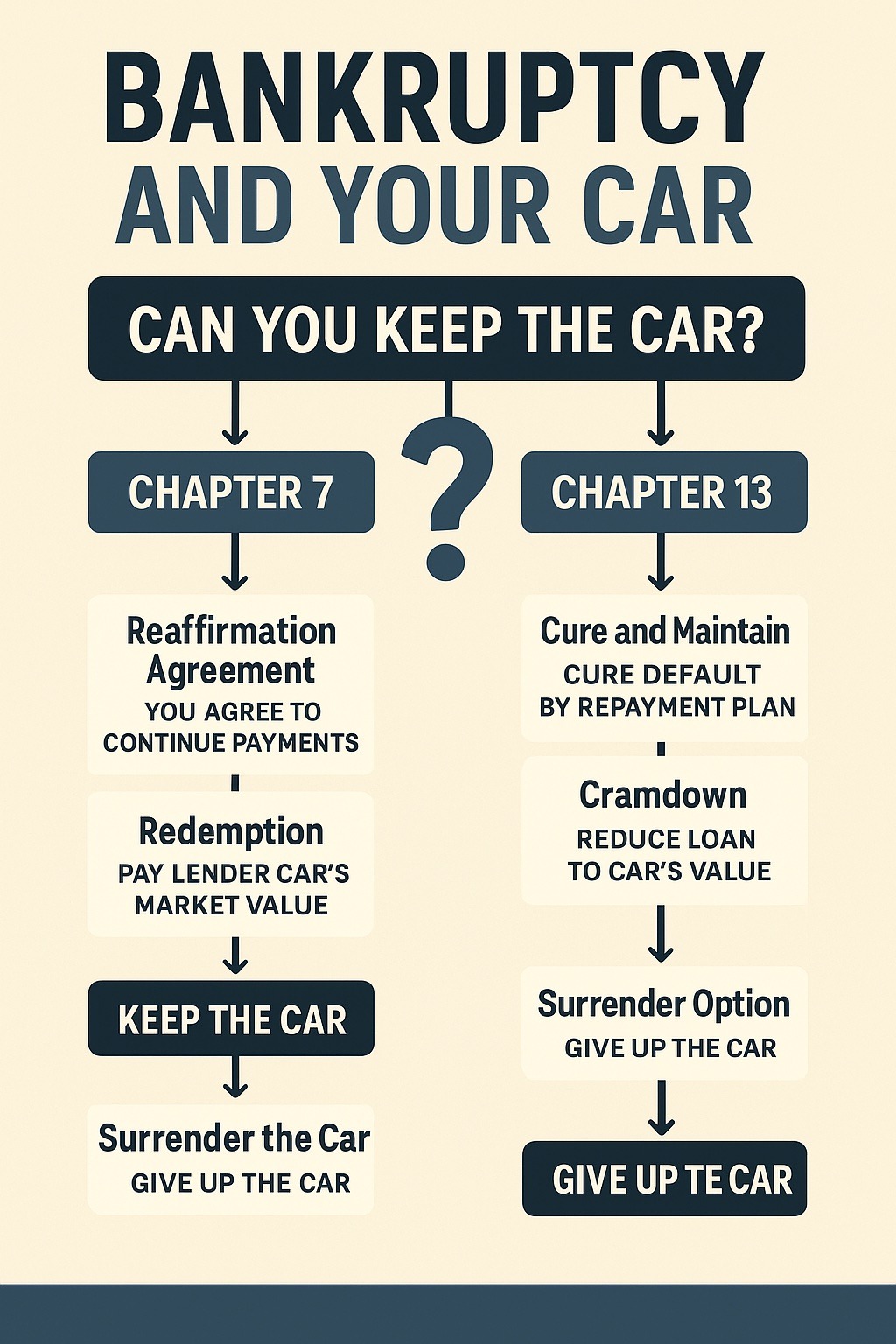
Some lenders ask Chapter 7 debtors to sign a reaffirmation agreement. This agreement keeps the debt outside the bankruptcy discharge. You remain personally liable for the loan after bankruptcy.
A reaffirmation can help you keep a car, but it also creates risk. If you later default and the lender repossesses the vehicle, you may still owe a deficiency balance, depending on state law and the agreement.
Step 5: Choose among the Chapter 7 options
Chapter 7 debtors commonly consider these options:
| Option | What it means | Main risk or limit |
|---|---|---|
| Reaffirmation | You agree to remain liable for the car loan | You may owe a deficiency after a later repossession |
| Redemption | You pay the car’s current value in one payment | You need access to enough money or qualifying financing |
| Surrender | You return the car to the lender | You lose the vehicle, though qualifying remaining debt may be discharged |
| Continue payments without reaffirming | You keep paying under some lenders’ policies | The lender’s policy and court rules may affect this choice |
Redemption can be useful when the car is worth less than the loan balance. For example, if the car is worth $12,000 but the loan payoff is $18,000, redemption may allow you to pay the vehicle’s current value instead of the full loan balance. You must meet strict legal and timing requirements, and many people need separate financing.
When Chapter 7 may put the car at risk
Your car may be at greater risk if:
- Its equity exceeds available exemptions.
- You own more than one vehicle and the exemptions do not cover them.
- You are behind on payments.
- The vehicle is worth far more than you need for basic transportation.
- You transferred the title before filing.
- You have nonexempt property the trustee may administer.
- You do not disclose the vehicle accurately.
A trustee’s review covers more than the car alone. The overall value of your property matters.
Can I Keep My Car in Chapter 13?
Chapter 13 often gives people more flexibility to keep a car because it uses a repayment plan instead of immediate liquidation.
Chapter 13 may help if:
- You have regular income.
- You are behind on car payments.
- Your car has too much equity for Chapter 7 exemptions.
- You need time to address other secured debts.
- You want to protect a necessary vehicle while repaying creditors under court supervision.
A Chapter 13 plan usually lasts three to five years. The plan must meet legal requirements and receive court approval.
Catching up on missed payments
If you are behind on your car loan, a Chapter 13 plan may let you pay the overdue amount over time. You generally must also keep up with required payments that come due after filing, unless the plan provides another lawful arrangement.
Do not stop paying simply because you filed Chapter 13. Check your plan, court orders, and lender instructions.
Paying the car loan through the plan
Your plan may address the car loan in several ways. The treatment can depend on:
- When you bought the vehicle
- The loan balance
- The car’s value
- The loan’s interest rate
- Whether the loan is older than 910 days
- Whether you are behind on payments
- Your state’s law and the bankruptcy court’s local procedures
The 910-day rule may affect whether a Chapter 13 debtor can use the vehicle’s value rather than the full loan balance for some plan purposes. The rule is technical. It does not automatically make every car loan eligible for a reduced balance.
Chapter 13 can protect a high-equity car, but it costs more
A Chapter 13 plan does not make a high-value car exempt. Instead, it may let you keep the vehicle if the plan pays creditors at least what they would have received in a Chapter 7 case.
Your plan payment may rise if you own valuable nonexempt property. Your income, expenses, priority debts, and unsecured debt also affect the payment.
A Chapter 13 case can fail if you miss plan payments or fail to make required post-filing car payments. If the case is dismissed, the automatic stay may end and creditors may resume collection.

Which Bankruptcy Chapter Is Better for Keeping a Car?
There is no universal answer. The right chapter depends on your income, equity, arrears, debt type, and ability to make payments.
| Situation | Chapter 7 may fit when | Chapter 13 may fit when |
|---|---|---|
| Car equity | Exemptions fully protect the equity | Equity exceeds exemptions |
| Loan status | Payments are current | You need time to catch up |
| Income | You qualify under the means test or otherwise meet Chapter 7 rules | You have regular income for a plan |
| Debt relief | You need a faster discharge of qualifying debt | You need structured repayment or broader protection |
| Vehicle value | The car has modest equity | The car is valuable but necessary |
| Payment ability | You can manage the loan after filing | You can manage a plan and ongoing car costs |
The means test is a set of bankruptcy rules used in many Chapter 7 cases to evaluate income and expenses. Passing or failing one part of the means test does not always decide the case by itself.
A bankruptcy attorney can compare both chapters using your actual figures. An approved nonprofit credit counseling agency may also help you review alternatives, although it cannot provide the same legal advice as a bankruptcy lawyer.

What If I Am Behind on My Car Payments?
Being behind does not always prevent you from keeping the car, but it makes timing and payment planning more important.
Before filing, gather:
- The current loan statement
- The exact payoff amount
- The amount past due
- Any repossession notices
- The lender’s contact information
- Proof of insurance
- The car title or registration
- A realistic monthly transportation budget
If repossession is scheduled, act quickly. Filing bankruptcy may trigger the automatic stay, but it does not guarantee that the car will be returned if it was already repossessed. State law and the timing of the repossession may matter.
After filing:
- Confirm that the lender received notice of the case.
- Ask how post-filing payments should be made.
- Review the reaffirmation or Chapter 13 plan documents.
- Keep insurance active.
- Save payment records.
- Contact your attorney at once if the lender seeks to lift the stay.
Never hide a missed payment or a repossession notice from your attorney. A small delay can affect your options.

How Much Car Equity Can Bankruptcy Protect?
The answer depends on the exemption system available in your case. Exemption amounts can change, and state rules may differ from federal rules.
Use this worksheet:
| Item | Amount |
|---|---|
| Current fair market value | $_____ |
| Minus loan payoff | $_____ |
| Estimated equity | $_____ |
| Minus available vehicle exemption | $_____ |
| Equity not covered by that exemption | $_____ |
| Add applicable wildcard or other exemption | $_____ |
| Possible unprotected equity | $_____ |
This worksheet is only a starting point. It does not account for jointly owned property, other exemptions, trustee costs, liens, or disputes about value.
Example with a wildcard exemption
Assume:
- Car value: $22,000
- Loan payoff: $17,000
- Equity: $5,000
- Vehicle exemption: $4,000
- Available wildcard exemption: $2,000
In this hypothetical case, the total available protection could cover the $5,000 equity. Whether those exemptions can be combined depends on the applicable law and your eligibility.
Do not use old exemption figures from an online article without checking the relevant date and state. Exemption amounts are revised at set intervals under federal law, and state amounts may also change.

What Happens If I Own the Car Free and Clear?
A paid-off car can still be protected in bankruptcy. The key issue is its value, not whether you have a loan.
For example, a paid-off vehicle worth $6,000 may be fully protected by an applicable motor vehicle or wildcard exemption. A paid-off vehicle worth $40,000 may have substantial unprotected equity.
The trustee may review the vehicle’s condition and sale value. A high-mileage car with major repair needs may be worth less than a similar vehicle in good condition. Keep records that support unusual facts, such as repair estimates or damage.
Do not give away or sell a paid-off car for less than fair value before filing without legal advice. Transfers made before bankruptcy can create serious problems, including trustee actions and possible loss of the discharge.
Can I Keep Two Cars in Bankruptcy?
You may keep two cars if the available exemptions and bankruptcy rules protect both vehicles, but a second car can increase the equity at issue.
Calculate the equity in each vehicle. Then review:
- Whether each car is titled in your name
- Whether someone else has an ownership interest
- Whether both vehicles are reasonably necessary
- Whether either vehicle has substantial equity
- Whether your state offers one motor vehicle exemption or a broader exemption
- Whether a Chapter 13 plan must pay more because of nonexempt value
A spouse’s ownership can change the analysis. So can a jointly owned vehicle, a lease, a business-use vehicle, or a car used by a household member.
List every vehicle in your bankruptcy paperwork. Omitting a car can create problems even when the car has little value.
Can I Keep a Leased Car?
A lease is different from a car loan. You do not own the vehicle. You have a contract that gives you the right to use it.
In bankruptcy, you may be able to:
- Assume the lease and continue under its terms
- Reject the lease and return the vehicle
- Address the lease through a Chapter 13 plan when allowed
You usually must be current or meet the lease’s bankruptcy requirements. Review the lease, payment history, insurance duties, and any arrears before filing.
Because lease treatment can be technical, ask an attorney to review the contract. Do not assume that the rules for a financed car apply to a leased vehicle.
Common Mistakes That Put a Car at Risk
Avoid these mistakes:
Hiding the car
You must disclose your vehicles, even if a car is old, damaged, or used by someone else. Bankruptcy forms require complete and accurate information.
Guessing the car’s value
Using the loan balance as the car’s value can produce an incorrect equity calculation. Value and debt are separate figures.
Stopping payments without a plan
The automatic stay is not a payment holiday. Missed post-filing payments can lead to stay-relief motions, repossession, or failure of a Chapter 13 case.
Signing a reaffirmation without reviewing the risk
A reaffirmation may preserve the loan but also preserve personal liability. Compare the car’s value, loan balance, interest rate, payment, and replacement cost before signing.
Letting insurance lapse
Most auto lenders require insurance. A lapse may violate the loan contract and expose you to serious financial risk.
Transferring the title before filing
Selling or giving away a car can affect your bankruptcy case. A trustee may examine whether the transfer was for fair value and whether it occurred within a review period.
Waiting until after repossession
Your options may be narrower after a vehicle is repossessed. Contact a qualified attorney as soon as you receive a repossession notice.
A Practical Car-and-Bankruptcy Checklist
Use this checklist before making a decision:
- Get the car’s estimated fair market value.
- Request the lender’s payoff amount.
- Calculate the estimated equity.
- Identify the state where you will file.
- Check which exemption system may apply.
- List all vehicles, leases, and loans.
- Record missed payments and repossession notices.
- Review your monthly income and expenses.
- Compare Chapter 7 and Chapter 13.
- Ask about reaffirmation, redemption, and surrender.
- Confirm insurance coverage.
- Speak with a bankruptcy attorney before transferring or selling the car.
Questions to ask a bankruptcy attorney
Bring these questions to your consultation:
- Can I use state exemptions or federal exemptions?
- How much equity do I have in the car?
- Is my car loan current?
- Should I reaffirm, redeem, surrender, or continue paying?
- What happens if I am behind?
- Would Chapter 13 lower my payment or spread out arrears?
- Would a second car affect my case?
- What happens if the car is jointly owned?
- Can I keep the car without signing a reaffirmation agreement?
- What payments must I make after filing?

Frequently Asked Questions
Can I file bankruptcy if my car is worth more than I owe?
Yes. You can file, but the unprotected equity may matter. In Chapter 7, a trustee may seek to sell nonexempt equity. In Chapter 13, your plan may need to pay creditors at least the amount they would receive in a Chapter 7 case.
Will bankruptcy stop my car from being repossessed?
Filing may trigger the automatic stay and temporarily stop many collection actions. It does not permanently prevent repossession. If you miss payments, the lender may ask the court to lift the stay.
Do I have to reaffirm my car loan?
Not always. Reaffirmation is one possible way to keep a financed car in Chapter 7. The lender’s policies, court rules, and your payment history may affect whether you can keep the car without reaffirming.
Can bankruptcy lower my car payment?
Chapter 13 may change how you repay certain car debt, but it does not automatically reduce every car payment. The result depends on the loan age, vehicle value, interest rate, arrears, and plan terms.
Can I buy a car after filing bankruptcy?
Possibly. You must consider lender approval, interest rates, insurance, court or trustee requirements, and whether the new payment fits your budget. In Chapter 13, ask your attorney before taking on new debt.
What if my car was repossessed before I filed?
Your options depend on timing, state law, whether the lender sold the vehicle, and whether a deficiency balance remains. Contact a bankruptcy attorney quickly. Do not assume filing will automatically return the car.
Conclusion: Bankruptcy May Let You Keep Your Car
You may be able to file bankruptcy and keep your car. The main questions are:
- How much equity does the car have?
- Which exemptions apply in your state?
- Are you current on the loan?
- Can you afford future payments?
- Would Chapter 7 or Chapter 13 better protect your transportation?
Do not sell, transfer, hide, or surrender the car before understanding the legal effect. Gather the value and loan figures, then speak with a bankruptcy attorney or qualified legal aid provider in your state.
For primary U.S. information, review the U.S. Courts’ Bankruptcy Basics, 11 U.S.C. § 522 on exemptions, 11 U.S.C. § 362 on the automatic stay, and 11 U.S.C. § 722 on redemption.
