
Yes, you can lease a car with bad credit, but expect stricter approval rules, higher costs, and fewer vehicle choices.
If you are asking, “Can you lease a car with bad credit?” the honest answer is yes, but approval depends on more than your credit score. Lenders also review your income, debt, payment history, down payment, and recent credit activity. This guide explains how car leasing works, where bad-credit applicants can look, what you may pay, and how to avoid costly traps.
Can You Lease a Car With Bad Credit?
Yes, you can lease a car with bad credit. However, leasing companies usually view a lease as a higher risk when your credit history shows missed payments, collections, bankruptcy, or high debt.
A lease does not work like a normal rental. You agree to make monthly payments for a set term, often 24 to 48 months. At the end, you return the vehicle, buy it, or sometimes trade it for another vehicle.
Your credit score can affect:
• Whether you are approved
• The interest rate, often called the money factor
• The required security deposit
• The amount due at signing
• The vehicle price and lease terms
• Whether you need a co-signer
Many lenders prefer applicants with good or excellent credit. Still, some lenders work with borrowers who have fair or poor credit. The key is to compare several offers instead of accepting the first deal from a dealership.
How Bad Credit Affects a Car Lease
Credit scores help lenders predict how likely you are to repay debt. A low score does not automatically mean you will miss payments, but it signals more risk based on your past credit behavior.
When you apply for a lease, the lender may review:
• Your FICO or VantageScore credit score
• Recent late payments
• Charge-offs and collection accounts
• Bankruptcy records
• Current loans and credit card balances
• Your income and employment history
• Your debt-to-income ratio
• Your address and identity information
• The amount of money you want to put down
A low score may lead to a higher money factor. The money factor is similar to an interest rate, although it is written in a different format. A higher money factor increases your monthly lease payment.
For example, two people may choose the same $30,000 vehicle. One person with strong credit may qualify for a low payment with little money due at signing. Another person with poor credit may need a larger upfront payment and still pay more each month.
Keep in mind that credit score ranges vary by lender. One lender may reject an applicant with a 610 score, while another may approve that person with a higher deposit or a co-signer.

What Credit Score Do You Need to Lease a Car?
There is no single minimum credit score for every lease. Many traditional leasing programs favor scores around 680 or higher, but approval can still happen with a lower score.
A general guide looks like this:
• Excellent credit: 750 and above may qualify for the best lease offers
• Good credit: 700 to 749 often receives competitive terms
• Fair credit: 600 to 699 may require more documentation or money upfront
• Poor credit: Below 600 may need a special lender, larger deposit, or co-signer
These ranges are only estimates. Each lender sets its own rules. Your income, debt, payment history, and vehicle choice may matter as much as your score.
For instance, a person with a 590 score and steady income may have a better chance than someone with a 650 score and several recent missed payments. Lenders often care about current payment behavior, not only an old number.
Before applying, check your credit reports for errors. You can request free reports from the three major credit reporting agencies through the federally authorized website. Correcting a wrong late payment or collection account can improve your position before you visit a dealership.

How Car Leasing Works for Bad-Credit Borrowers
A car lease is based on the vehicle’s expected value at the end of the lease. This value is called the residual value. You usually pay for the vehicle’s estimated depreciation, plus rent charges, taxes, fees, and other costs.
Your payment may include:
• Depreciation charge
• Finance charge
• Sales tax
• Acquisition fee
• Registration costs
• Documentation fee
• Security deposit
• Mileage charges
• Excess wear charges
Leases also include mileage limits. Common limits are 10,000, 12,000, or 15,000 miles per year. If you exceed the limit, you may pay a fee for every extra mile.
Leasing may look cheaper than financing because you are not paying for the full vehicle price during the lease term. However, you do not own the vehicle unless you later exercise the purchase option.
Bad credit can make leasing less attractive because lenders may add fees or require a large amount at signing. You should compare the total cost, not just the monthly payment.
A low payment with $5,000 due at signing may cost more than a higher payment with only $1,000 due upfront. Always ask the dealer for the full lease worksheet.
Where to Find a Car Lease With Bad Credit
If you can lease a car with bad credit, the lender may not be the same type of lender used by a borrower with strong credit. You may need to search more widely.
Traditional Dealerships
Start with franchise dealerships that offer several lender programs. Some dealerships have relationships with lenders that serve customers with fair or poor credit.
Ask for the credit department or finance manager. Explain your situation clearly, including your income, down payment, and preferred monthly budget.
Do not allow the dealer to focus only on the monthly payment. Ask for:
• The vehicle selling price
• The money factor
• The residual value
• The total amount due at signing
• The lease term
• The annual mileage limit
• All dealer and lender fees
• The purchase option price
Credit Unions
A credit union may offer more personal service than a large bank. Membership rules apply, but many credit unions allow people to join through an employer, community, family member, or small donation.
Credit unions may also help you understand whether leasing or financing is a better choice. Getting preapproved can give you more negotiating power at the dealership.
Online Auto Lenders
Online lenders may work with borrowers across a wider range of credit scores. Review the lender’s requirements before submitting an application.
Use caution with websites that promise guaranteed approval. No legitimate lender can guarantee approval without reviewing your income, identity, and credit information.
Lease Transfer Services
A lease transfer allows another driver to take over an existing lease, subject to approval by the original leasing company. This may offer a shorter lease term and lower upfront costs.
However, you still need to qualify. You should also review the remaining mileage, vehicle condition, transfer fee, and possible obligations if the next driver misses payments.

Steps to Improve Your Chances of Approval
You can improve your odds before applying. A few weeks of preparation may save you hundreds or even thousands of dollars.
1. Check Your Credit Reports
Look for incorrect balances, duplicate accounts, outdated debts, and payments marked late by mistake. Dispute errors with the credit reporting agency and the company that supplied the information.
2. Pay Down Credit Card Balances
Credit utilization is the percentage of your available credit that you are using. Lower balances can help your score and may make your application look safer.
Do not close old credit cards without understanding the effect. Closing an account may reduce your available credit and raise your utilization ratio.
3. Save a Reasonable Down Payment
A larger upfront payment may reduce your monthly bill. Still, avoid putting too much money down on a lease.
If the vehicle is stolen or totaled early in the lease, you may not recover all of that upfront money. Ask whether gap coverage applies and understand what it covers.
4. Gather Proof of Income
Bring recent pay stubs, bank statements, tax returns, or proof of benefits. Stable income can help offset a low credit score.
Self-employed applicants may need more records. Prepare several months of bank statements and recent tax documents.
5. Apply With a Co-Signer
A co-signer with strong credit may help you qualify. However, that person becomes responsible for the lease if you do not pay.
A missed payment could damage both credit profiles. Discuss the risks openly before asking someone to co-sign.
6. Choose a Less Expensive Vehicle
A modest vehicle creates less risk for the lender and may be easier to approve. It also reduces your payment, insurance cost, and potential repair expense.

How Much Does a Bad-Credit Car Lease Cost?
The cost depends on the vehicle, lease term, credit profile, location, mileage limit, and lender. Bad credit can increase the monthly payment, but the biggest cost may come from fees and money due at signing.
Consider this simplified example:
• Vehicle price: $26,000
• Lease term: 36 months
• Annual mileage: 12,000 miles
• Amount due at signing: $2,500
• Monthly payment: $480
• Total scheduled payments: $17,280
The total cash cost would be about $19,780 before possible taxes, registration, insurance, and end-of-lease fees. This does not mean the vehicle costs only $19,780. You may still have a purchase option at the end, and you do not automatically build ownership through normal lease payments.
Ask the dealer for the lease’s capitalized cost. This is the amount used to calculate the lease. Negotiating this price can reduce your payment, just as it can when buying a car.
Also ask whether the quote includes:
• Sales tax
• Acquisition fees
• Dealer fees
• Registration
• Security deposit
• Gap coverage
• Maintenance
• Wear protection
• Disposition fee
Never judge a lease by the payment alone. A dealer can make the payment look low by extending the term, requiring more money upfront, or limiting mileage.

Leasing Versus Financing With Bad Credit
The better choice depends on your budget, driving habits, and long-term goals.
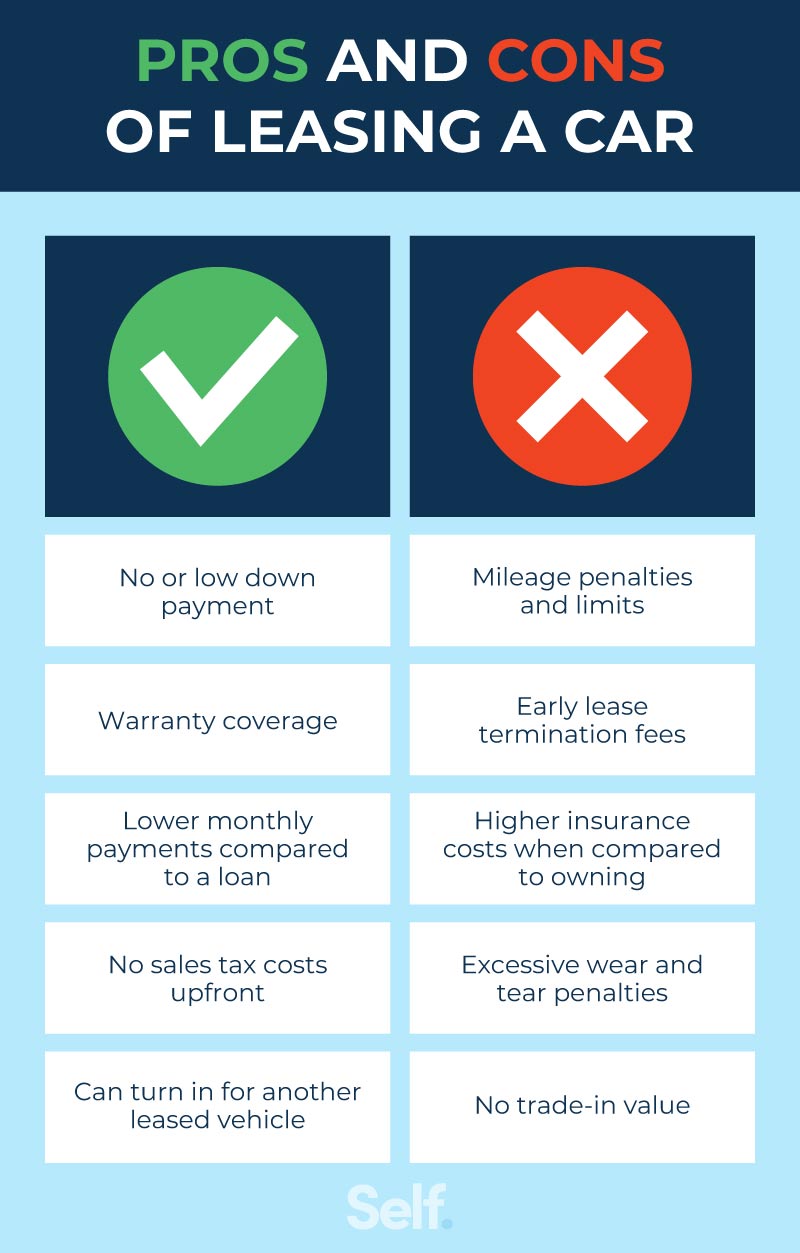
Benefits of Leasing
• Lower payments may be possible on some vehicles
• You can drive a newer vehicle with current safety features
• Warranty coverage may handle many repairs
• You can return the vehicle after the lease term
• You may avoid selling or trading the vehicle yourself
Limitations of Leasing
• You do not own the vehicle during the lease
• Mileage limits can create extra charges
• Damage beyond normal wear may cost you
• Early termination can be expensive
• Bad credit may lead to high fees
• You may need another approval when the lease ends
Benefits of Financing
• You build equity as you pay down the loan
• You can drive unlimited miles
• You can sell the vehicle whenever you want
• You may keep the car after the loan is paid
• There are no lease return charges
Limitations of Financing
• Monthly payments may be higher
• You are responsible for repairs after the warranty ends
• A long loan can create negative equity
• Bad credit can cause a high interest rate
If you drive many miles each year or want to keep the car for a long time, financing may make more sense. If you want a newer car for a short period and can stay within the mileage limit, leasing may fit better.

Lease Scams and Red Flags to Avoid
People with bad credit are often targeted by misleading auto offers. Be careful when a company promises a luxury vehicle, no credit check, and a tiny monthly payment.
Watch for these red flags:
• Guaranteed approval before reviewing your information
• Pressure to sign immediately
• A demand for payment by gift card or wire transfer
• No written lease agreement
• A dealer who refuses to show the total cost
• A payment that changes after you arrive
• A very large fee for a “credit repair” service
• No clear explanation of mileage or return charges
• A request to falsify income or employment information
Do not lie on a credit application. False information can lead to a denied application, contract problems, or legal trouble.
Read every document before signing. Confirm that the vehicle identification number, payment, mileage limit, term, and amount due at signing match the advertisement.
You can also check whether the dealership is licensed in your state and review complaints with your state attorney general or consumer protection office.
A Practical Plan for Leasing With Bad Credit
If you decide to pursue a lease, use a slow and organized process.
- Review your credit reports and score.
- Set a firm monthly budget that includes insurance and fuel.
- Estimate your yearly mileage.
- Save money for taxes, fees, and the initial payment.
- Compare at least three lenders or dealerships.
- Get written quotes before visiting the finance office.
- Negotiate the vehicle price separately from the lease payment.
- Review the money factor and residual value.
- Calculate the total cost over the full lease term.
- Walk away if the numbers do not make sense.
A useful budget test is to add the lease payment, insurance, fuel, maintenance, parking, and registration. Your real transportation cost is much higher than the advertised payment.
In my experience reviewing auto finance questions, the most common mistake is choosing a vehicle based on the payment alone. A buyer sees $399 per month, but the contract may include $4,000 due upfront, a short mileage limit, and expensive return charges.
A better approach is to treat the lease like a full meal, not a menu price. Look at every cost before deciding whether it fits your life.
When You Should Wait Before Leasing
Sometimes the best answer to “Can you lease a car with bad credit?” is “Yes, but not yet.” Waiting may help if your credit problems are recent or your budget is too tight.
Consider waiting when:
• You have several recent late payments
• Your income is not stable
• You have no emergency savings
• You need to put nearly all your savings down
• The monthly payment leaves no room for repairs or emergencies
• You are already behind on other bills
• You cannot afford the required insurance
• The lease requires more miles than the contract allows
Use the waiting period to make on-time payments, lower credit card balances, save cash, and compare less expensive vehicles. A few months of positive payment history may improve your approval options.
If you need transportation immediately, consider a reliable used vehicle with a manageable loan. Ask a trusted mechanic to inspect it before purchase. A basic car that fits your budget is often safer than an expensive lease that creates financial stress.
Frequently Asked Questions About Leasing With Bad Credit
Can you lease a car with a 500 credit score?
You may be able to lease a car with a 500 credit score, but traditional lenders may decline the application. You may need a co-signer, a larger deposit, proof of strong income, or a specialized lender.
Is leasing easier than buying a car with bad credit?
Leasing is not always easier than buying because the lender still takes a risk and must approve the contract. Financing may offer more vehicle choices, while leasing can have stricter credit and mileage rules.
Does a down payment guarantee lease approval?
No, a down payment does not guarantee approval. It may reduce the lender’s risk, but the lender still checks your income, credit history, debt, and ability to make future payments.
Can a co-signer help me lease a car with bad credit?
Yes, a co-signer with stronger credit may improve your approval odds and lease terms. The co-signer is responsible for the payments if you fail to pay, and missed payments can hurt both people.
Can leasing a car improve my credit score?
A lease may help your credit if the leasing company reports payments and you pay on time. Late payments, repossession, or early default can seriously damage your credit.
Can I lease a used car with bad credit?
Used-car leases are less common than new-car leases, but some lenders and dealers offer them. Review the warranty, maintenance responsibility, mileage rules, and total cost carefully before signing.
What happens if I return a leased car early?
Early lease termination can be expensive. You may owe remaining payments, an early termination fee, unpaid taxes, and charges for excess wear or mileage.
Conclusion
So, can you lease a car with bad credit? Yes, but approval may come with a higher money factor, more fees, a larger upfront payment, or a co-signer requirement. Your best protection is to compare offers, check the full lease cost, choose a realistic vehicle, and avoid deals built around a low payment alone.
Review your credit, set a complete transportation budget, and ask for every term in writing. If the numbers feel tight, waiting and improving your credit may lead to a safer deal. Use this guide to compare your options, and explore trusted local lenders before signing a lease.