

Introduction
A light scuff on your car often looks worse than it is. In many cases, the mark sits on the clear coat or comes from paint, rubber, or plastic rubbing onto the surface. You can often remove it at home with car soap, a clean microfiber towel, and a mild polish.
The key is to find out how deep the damage goes before you rub it. Surface marks need cleaning or light polishing. Deep scratches that cut through the paint need touch-up paint or professional repair. This guide explains how to tell the difference and how to remove car scuffs without making the damage worse.
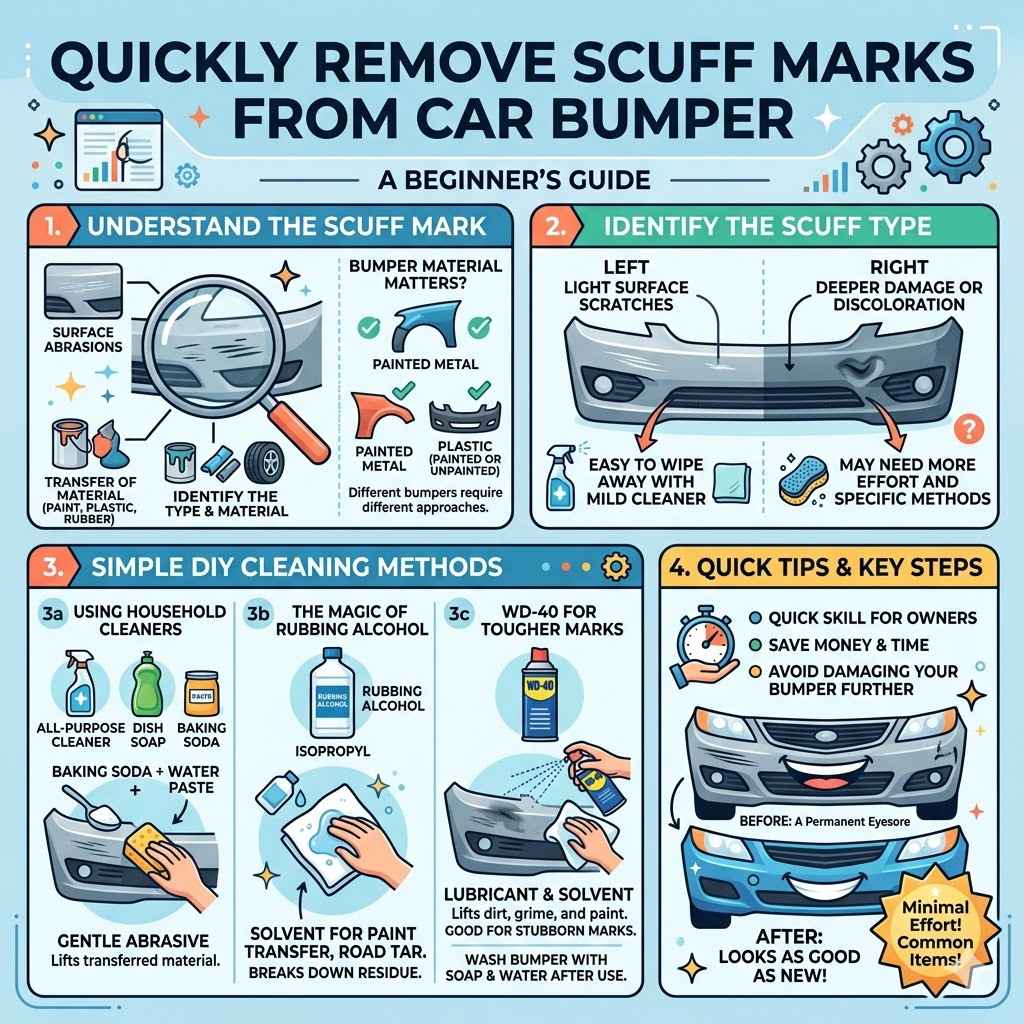
What Is a Scuff on a Car?
A scuff is a surface mark caused by contact with another object. It may come from a shopping cart, a garage wall, a bumper, a tire, a plastic item, or another vehicle.


A scuff may contain transferred material rather than damage to your car’s paint. For example, a black mark on a white bumper may be rubber or plastic left behind by contact. A white mark on a dark car may be paint transfer from another object.
Modern vehicles usually have several finish layers:
- Metal or plastic body panel
- Primer
- Color coat
- Clear coat
The clear coat is the outer protective layer. Light scuffs may affect only this layer. A deeper scratch may pass through the clear coat and color coat into the primer or bare metal.
Scuff, scratch, and paint transfer
These terms describe different problems:
- Scuff: A surface mark caused by rubbing or contact.
- Paint transfer: Material from another object left on your vehicle.
- Scratch: A cut or groove in your car’s finish.
- Chip: A small area where paint has broken away.
- Etching: A mark caused by chemicals, bird droppings, tree sap, or another substance reacting with the finish.
The repair method depends on the cause. Cleaning may remove paint transfer. Polishing may reduce a clear-coat scratch. Touch-up paint may be needed for exposed primer or metal.
The fingernail test
After washing and drying the area, lightly run your clean fingernail across the mark.
- If your nail does not catch, the mark is likely on or near the surface.
- If your nail catches slightly, the clear coat may be scratched.
- If your nail catches deeply, the damage may have reached the color coat or primer.
This test is only a guide. Do not press hard, and do not use it on a dirty panel because grit can cause more scratches.

What You Need to Remove a Car Scuff
Gather the right supplies before you begin. Clean tools matter as much as the cleaning product because trapped grit can scratch the paint.


Basic supplies
- Automotive car wash soap
- Two buckets, if available
- A hose or clean water source
- Several clean microfiber towels
- A soft wash mitt
- Automotive clay bar or synthetic clay towel, if needed
- Automotive cleaning polish
- Foam or microfiber applicator pad
- Painter’s tape
- Nitrile gloves
- Bright but indirect lighting
Use products made for automotive paint. Household cleaners may contain solvents, abrasives, or strong chemicals that can dull the finish.
optional supplies for deeper marks
- Dual-action polisher
- Foam polishing pad
- Automotive compound
- Automotive touch-up paint matched to the vehicle
- Clear-coat touch-up product
- Fine finishing polish
A machine polisher can remove defects faster, but it can also remove clear coat or create haze when used incorrectly. If you have never used one, start by hand or ask an experienced detailer for help.
Before you start
Check your vehicle owner’s manual for paint-care warnings. Some vehicles have matte, satin, ceramic-coated, or vinyl-wrapped surfaces. These finishes need different care.
Do not work in direct, intense sunlight. A hot panel can dry soap and polish too fast. Work in a shaded area with good airflow, and keep the panel cool to the touch.

How to Remove Light Scuffs From Car Paint
The safest method is to move from gentle cleaning to mild polishing. Stop as soon as the mark improves. More pressure is not always better.
Step 1: Wash the area
Rinse the panel to remove loose dust and sand. Wash it with automotive car soap and a clean microfiber mitt.
Use straight motions rather than pressing in circles. Rinse the mitt often so it does not carry grit back onto the paint.
Dry the panel with a clean microfiber towel. Do not let water spots dry on the surface.
Step 2: Inspect the scuff
Look at the clean, dry panel under good light. Check whether the mark is:
- Loose dirt
- Rubber or plastic transfer
- Paint transfer
- A dull surface rub
- A groove that catches your fingernail
- A chip or area of missing paint
If the mark disappears when wet but returns when dry, the surface may have a shallow scratch or dull spot. If you can see a different color sitting on top of the paint, it may be transferred material.
Step 3: Try gentle wiping
Dampen a clean microfiber towel with water or a paint-safe detailing spray. Wipe the scuff with light pressure.
Fold the towel into clean sections as you work. Stop and inspect the area often. If the mark lifts, wipe the area once more with a clean side of the towel and dry it.


Do not use a dry, rough towel. Dry rubbing can create new fine scratches.
Step 4: Use a clay bar for bonded transfer
If washing does not remove the mark, a clay bar may lift particles bonded to the paint. Clay is useful for overspray, fine industrial fallout, and some types of paint transfer.
Use plenty of clay lubricant. Knead the clay when the working face becomes dirty. If you drop the clay on the ground, discard it because embedded grit can scratch the paint.
Clay removes bonded surface material, but it does not repair a scratch. If the mark remains after claying, move to a mild polish.
Step 5: Polish by hand
Apply a small amount of automotive polish to a foam or microfiber applicator. Work on a small area, such as 12 by 12 inches.
Use light to moderate pressure and short, overlapping passes. Follow the product directions. Allow the polish to haze only if the label says to do so, then wipe it away with a clean microfiber towel.
Inspect the panel after one or two passes. A mild polish removes or smooths a very small amount of clear coat. It does not fill a deep scratch permanently.
Step 6: Protect the repaired area
Once the scuff is reduced, apply a compatible wax, sealant, or paint-protection product. Protection can improve gloss and help reduce future contamination.
Follow the product label for curing time. Avoid applying a product that the vehicle maker or coating maker says is unsuitable for your finish.

How to Remove Paint Transfer From a Car
Paint transfer often looks like a scratch, but the foreign paint may be sitting on top of your clear coat. Start with the least aggressive method.
- Wash and dry the area.
- Wipe gently with a clean microfiber towel and automotive detailing spray.
- If the transfer remains, try a clay bar with proper lubricant.
- Use a mild automotive polish by hand.
- Inspect the area before repeating any step.
Do not scrape the transfer with a razor, knife, credit card, or metal tool. These tools can cut the clear coat or leave a sharp scratch.
Avoid gasoline, nail-polish remover, acetone, and paint thinner. Some solvents can soften automotive finishes, damage plastic trim, or stain rubber seals. A product that removes transferred paint may also remove your car’s finish.
If the transferred material covers a large area or came from a road accident, a professional detailer or body shop can assess the panel more safely.

How to Remove Scuffs From Plastic Bumpers and Trim
Plastic bumpers can show black marks, white rubs, and dull patches after contact. The same cleaning steps apply, but unpainted plastic needs extra care.


Painted plastic bumpers
Treat a painted bumper like a painted metal panel:
- Wash it first.
- Try gentle wiping.
- Use clay only when appropriate.
- Polish lightly.
- Stop if the mark reaches missing paint or exposed plastic.
A painted plastic bumper can have flexible paint layers. Aggressive polishing or heat may cause damage.
Unpainted black plastic trim
Unpainted trim is not the same as clear-coated paint. Do not polish it with a paint compound unless the product specifically says it is safe for that material.
Clean the trim with car soap and a soft towel. For a white or gray rub mark, use a plastic-safe cleaner. Test it in a hidden spot first.
Some trim products darken plastic but do not remove damage. If the plastic has been gouged, melted, or turned permanently white, replacement may be the best repair.
Textured plastic
Textured bumper trim can hold dirt in its small grooves. Use a soft brush and mild car soap. Avoid stiff brushes and heavy pressure, which can flatten or mark the texture.

How to Tell Whether a Scuff Needs Touch-Up Paint
A scuff needs more than cleaning or polishing when the original finish is missing.
Look for these signs:
- You can see white, gray, black, or bare metal under the body color.
- The scratch catches your fingernail clearly.
- The edge feels sharp or raised.
- The panel has a chip rather than a surface rub.
- Polishing makes the area cleaner but does not restore its color.
- Rust begins to appear on an exposed metal panel.
For a small chip or scratch, touch-up paint may slow further damage and improve its appearance. Match the paint code listed on the vehicle identification label, owner’s documents, or manufacturer parts system. The color name alone may not be enough.
Touch-up paint works best on small defects. It may look uneven when viewed close up, especially on metallic or pearl finishes. A body shop is usually the better choice when the damage is large, deep, near a panel edge, or visible across multiple body panels.

A Simple Decision Guide
Use this table to choose the least aggressive suitable method.
| What you see | Likely cause | First method to try | Likely result |
|---|---|---|---|
| Dirt or road film | Surface contamination | Wash with car soap | Usually removes it |
| Different-color material on top | Paint, rubber, or plastic transfer | Wash, clay, then mild polish | Often improves or removes it |
| Dull rub with no deep groove | Clear-coat scuff | Mild polish by hand | Often improves it |
| Nail catches slightly | Clear-coat scratch | Fine polish or professional correction | May reduce it, not always remove it |
| Nail catches deeply | Deep scratch | Touch-up paint or body repair | Cleaning will not fix it |
| Exposed primer or metal | Missing paint | Touch-up or body-shop repair | Requires new paint |
| White or gray unpainted plastic | Plastic damage | Plastic-safe cleaner or trim repair | May not fully restore it |
| Cracked, dented, or loose bumper | Structural or panel damage | Body-shop inspection | Requires repair assessment |
The main trade-off is simple: stronger methods may work faster, but they also carry a greater risk of removing clear coat or changing the surface gloss.

Common Mistakes That Make Scuffs Worse
Rubbing before washing
Dust contains hard particles. Rubbing a dirty panel can drag those particles across the finish and create more scratches.
Using household cleaners
Glass cleaner, kitchen degreaser, alcohol, and solvent-based products may damage paint, trim, wax, or protective coatings. Use a product labeled for automotive surfaces.


Using a magic eraser
Melamine foam works like a fine abrasive. It can dull glossy paint and leave a noticeable haze. It may be suitable for some hard interior surfaces, but it is a poor first choice for exterior paint.
Applying too much compound
Compound removes more material than a mild polish. Excess use can thin the clear coat and leave hazing. Begin with a mild product and use a small test area.
Working with dirty towels
A microfiber towel can trap grit. Set aside any towel that falls on the ground or becomes visibly dirty.
Using a rotary polisher without training
A rotary machine can create swirl marks, burn-through, or uneven gloss. A dual-action polisher is generally more forgiving, but it still requires proper pad choice, product control, and frequent inspection.
Ignoring the panel material
Painted metal, painted plastic, matte paint, vinyl wrap, and ceramic-coated paint do not all respond the same way. When unsure, test a hidden area or seek professional advice.

When to Call a Professional Detailer or Body Shop
A professional is the safer choice when:
- The scratch reaches bare metal.
- The bumper is cracked, dented, or misaligned.
- The damaged area is larger than a small hand-sized spot.
- Several panels have paint transfer.
- The vehicle has matte paint or a specialty finish.
- You are unsure whether the surface has a ceramic coating or film.
- A machine polisher is needed but you lack experience.
- The mark remains after careful cleaning and light polishing.
Choose a detailer for surface cleaning, decontamination, polishing, and paint correction. Choose a body shop for missing paint, dents, cracked plastic, exposed metal, or panel alignment problems.
Take clear photos before repair if the scuff may relate to a collision, insurance claim, lease return, or parking-lot incident.

How to Prevent New Car Scuffs
Prevention is easier than paint correction.
- Keep a safe distance from garage walls and posts.
- Use protective padding in tight parking spaces.
- Park away from crowded cart areas when practical.
- Keep microfiber towels clean and separate from household towels.
- Wash from the top of the vehicle downward.
- Rinse dirt from the panel before touching it.
- Remove bird droppings and tree sap soon with a paint-safe product.
- Inspect door edges, bumper corners, and loading areas often.
- Use a paint sealant, wax, or compatible coating as directed.
No protectant makes paint scratch-proof. It can make cleaning easier, but physical contact can still damage the finish.

FAQs About Removing Car Scuffs
Can toothpaste remove scuffs from car paint?
Toothpaste may act as a mild abrasive, but it is not made or tested for automotive clear coat. It can leave residue or uneven gloss. A mild automotive polish is a safer and more predictable option.
Can WD-40 remove paint transfer?
Some people use petroleum-based products to loosen transfer, but they can leave an oily film and may not be suitable for every finish. Use a product designed for automotive paint, and test any cleaner in a hidden area first.
Will rubbing alcohol remove a car scuff?
Diluted isopropyl alcohol may remove some residue, but it can also strip wax or affect certain coatings and plastics. Do not use it as a first step. Check the surface-care instructions and test cautiously.


How many times can I polish a car scuff?
There is no universal number. Each polishing pass removes some clear coat, depending on the product, pad, pressure, and machine. Stop when the mark is acceptable rather than chasing complete removal of a deep scratch.
Can a car wash remove scuff marks?
A car wash may remove dirt and loose residue. It usually will not remove bonded paint transfer or a true scratch. Touchless washing reduces contact, but it cannot repair damaged paint.
Should I use wax before removing the scuff?
No. Wash and correct the scuff first. Wax can hide the mark briefly and make it harder to judge your progress. Apply protection after the surface is clean and repaired as far as practical.
Conclusion
To remove a scuff from a car, start with a careful wash and inspection. Try gentle wiping first, then use clay for bonded surface material and a mild automotive polish for light clear-coat marks. Stop if the scratch catches your fingernail deeply, exposes another layer, or affects unpainted plastic.
The safest rule is to use the least aggressive method that works. If the paint is missing, the bumper is damaged, or the finish is specialized, touch-up paint or professional repair will give a better result than stronger household cleaners or heavy scrubbing.
