

Introduction
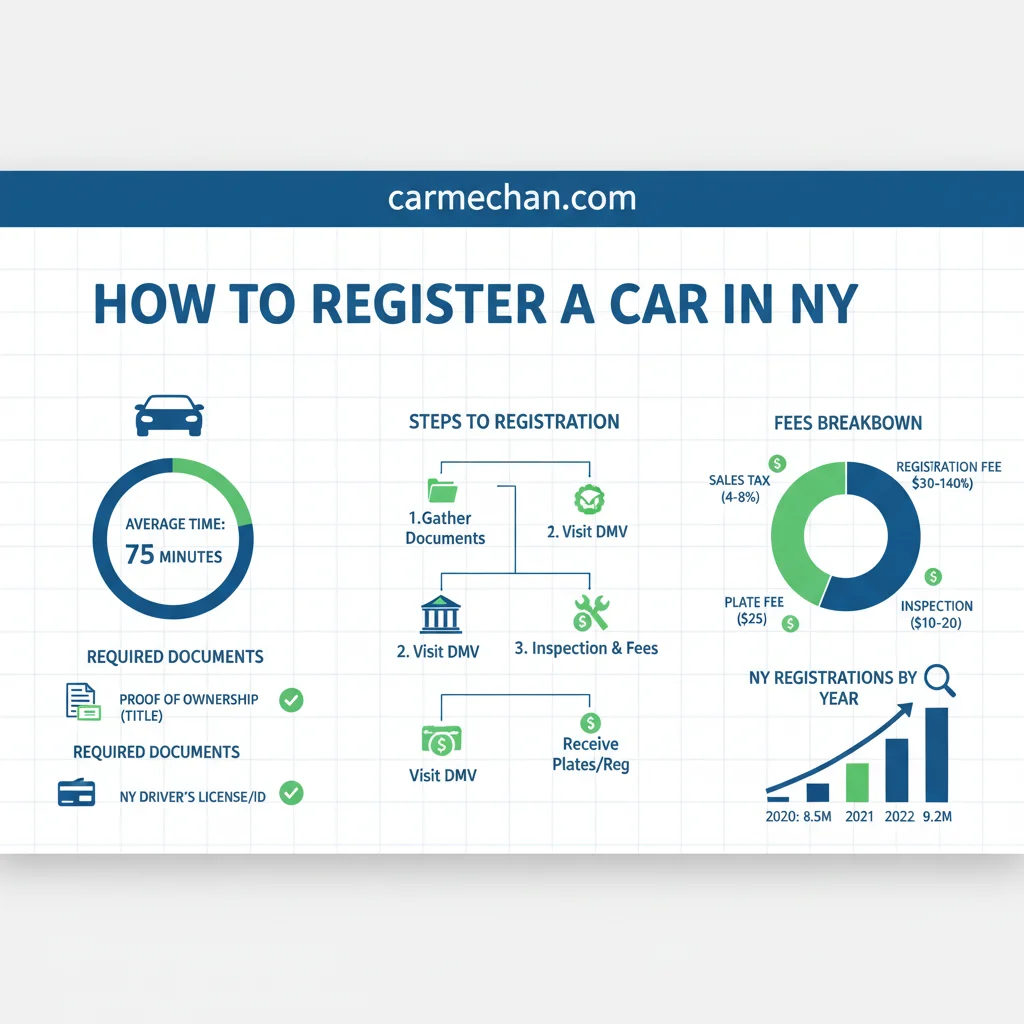
The cost to register a car in New York depends on the vehicle’s weight, where you live, whether you need new plates, and whether you are registering the car for the first time. A basic registration may cost about $50 to $150 or more, but the full amount can be much higher when you add sales tax, a title fee, plate fees, and local charges.
For an exact amount, use the New York DMV registration fee calculator. The calculator is more accurate than a simple flat estimate because New York does not charge one registration price for every car.

What determines the cost of car registration in New York?
New York uses several charges to calculate your registration total. The main factors are:
- The car’s weight
- Whether you need new license plates
- Whether you are registering the car for the first time in New York
- The county where you live
- Whether you live in the Metropolitan Commuter Transportation District
- The vehicle’s purchase price
- Whether sales tax has already been paid
- Whether you are transferring plates from another vehicle
Main New York registration costs
| Charge | When it applies | General rule |
|---|---|---|
| Registration fee | Every registration | Based mainly on vehicle weight |
| Title certificate fee | Usually when you first title the car in New York | Commonly $50 |
| License plate fee | When new plates are issued | Commonly $25 for standard plates |
| Sales tax | When tax has not already been paid | Based on the taxable purchase price and local rate |
| Metropolitan Commuter Transportation District fee | For residents in certain counties | Usually charged for a two-year registration |
| County or local fees | In some cases | Depends on location and transaction |
| Electric vehicle surcharge | For qualifying electric vehicles | May apply in addition to normal charges |
The registration fee itself is not the same as the total cost of putting a car on the road. A person renewing an existing registration may pay only the registration and local fees. Someone moving to New York with a recently purchased car may also pay title charges, sales tax, and plate fees.
New York DMV lists official fees and requirements on its vehicle registration and title pages.

How much does New York car registration cost?
A typical New York passenger-car registration often falls into these broad ranges:
- Renewing an existing registration: often about $50 to $150, depending on weight and location
- Registering a used car bought in New York: often $100 to $300 before or including some taxes and fees
- Registering a recently purchased car from another state: may cost several hundred dollars after sales tax, title, plates, and registration
- Registering a heavier vehicle: usually costs more because New York uses vehicle weight in its fee system
- Registering in the MCTD: costs more because of the transportation district charge
These are planning ranges, not guaranteed prices. The final amount can change sharply based on the car’s taxable value and your county.
Example: renewing a passenger car
Assume a New York resident renews a standard passenger-car registration. The final bill may include:
- A weight-based registration fee
- A Metropolitan Commuter Transportation District fee, if applicable
- County or local charges
- An electric vehicle fee, if the car qualifies
If the owner does not need new plates and is only renewing, there is usually no new title fee or new-plate fee.
Example: registering a newly purchased used car
A buyer may need to pay:
- Registration fee
- Title certificate fee
- New plate fee, unless plates are transferred
- New York sales tax, unless it was already paid and properly documented
- MCTD fee, if applicable
- County or other local charges
The sales tax is often the largest part of the bill. For example, a $20,000 taxable purchase at a combined 8% sales tax rate would produce $1,600 in sales tax. That is a hypothetical calculation. Your actual rate depends on the location and transaction.
How New York calculates the registration fee
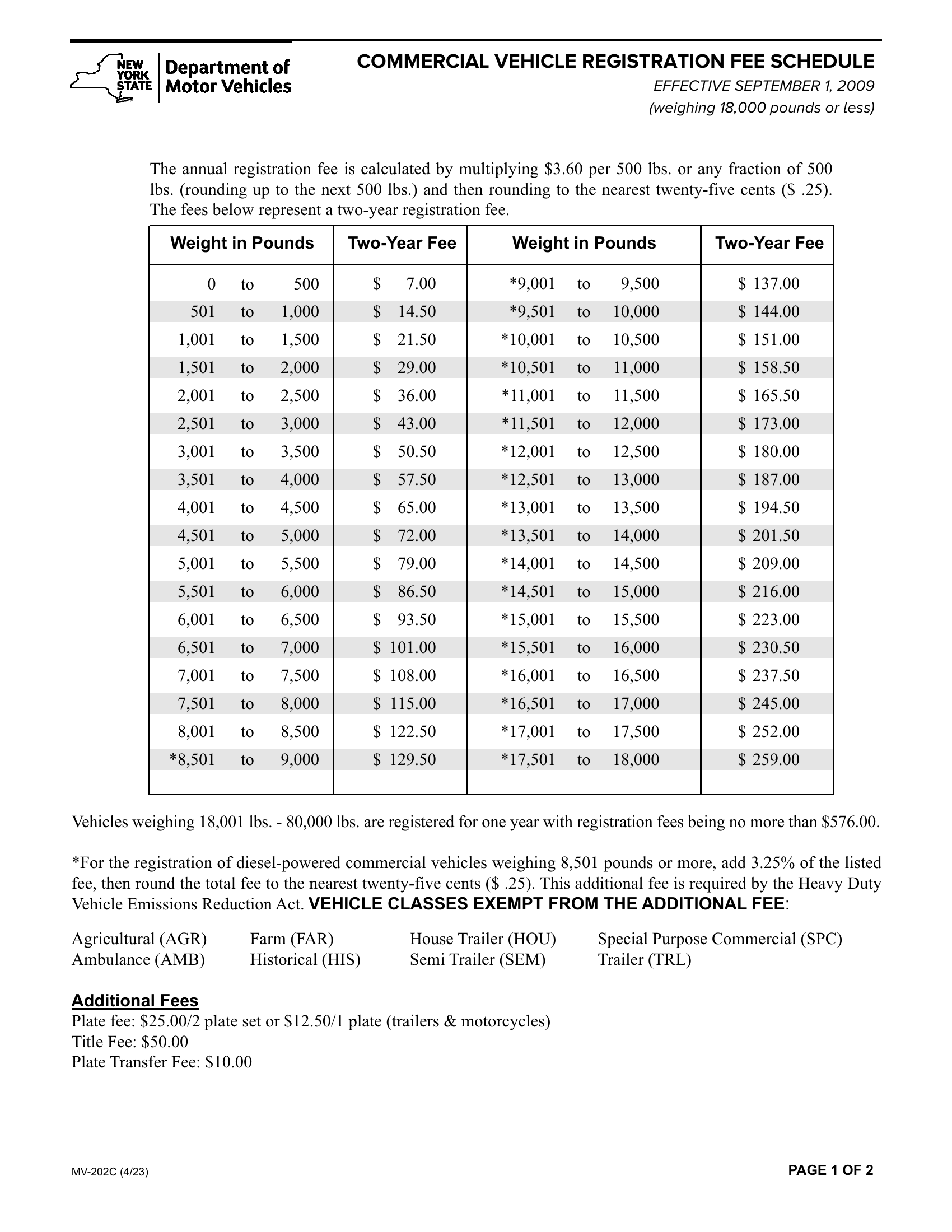
New York bases passenger-vehicle registration fees mainly on the vehicle’s weight. Heavier vehicles generally cost more to register.
The DMV may use the vehicle’s:
- Unloaded weight
- Manufacturer weight data
- Weight shown on the title or registration record
- Vehicle class
The exact fee schedule can change. Some vehicles also have special rules, including:
- Electric vehicles
- Motorcycles
- Commercial vehicles
- Trailers
- Campers
- Taxis
- Historic vehicles
- Vehicles with special or custom plates
Do not estimate a commercial vehicle’s cost by using a passenger-car fee. Commercial registration uses different rules and may depend on weight, use, and business type.
Why online estimates can be wrong
A search result may show only a registration charge. It may leave out:
- Sales tax
- The title certificate
- Plate issuance
- County fees
- MCTD charges
- Plate transfer costs
- Special plate charges
That is why two people with similar cars may receive different totals. The vehicle and the owner’s location both affect the bill.

Does New York charge a title fee?
Yes. A New York title certificate generally costs $50 when a title is required for the transaction.
The title fee usually matters when you:
- Buy a car
- Bring a car into New York from another state
- Transfer ownership
- Replace or correct a title document
A title fee is different from a registration fee. Renewal of an existing registration may not create a new title charge unless the ownership or title record also changes.
If you bought the car from a dealer, the dealer may collect the title and registration charges as part of the closing paperwork. Review the itemized contract so you can see which amount is a DMV fee, a tax, or a dealer charge.
How much are New York license plates?
Standard New York license plates commonly cost $25 when new plates are issued. The amount may differ for:
- Custom plates
- Personalized plates
- Specialty plates
- Replacement plates
- Plate transfers
- Certain military or organizational plates
You may be able to transfer your current New York plates to another vehicle if you meet DMV rules. A plate transfer can reduce the cost compared with ordering a new set.
If your plates are lost, stolen, damaged, or unreadable, use the DMV replacement process. Do not drive with an unreadable plate. A police officer or toll system may not be able to identify it correctly.

Is there an extra registration fee in New York City and nearby counties?
Yes. New York charges a Metropolitan Commuter Transportation District, or MCTD, fee for vehicles registered in certain counties.
The MCTD includes:
- New York City’s five boroughs
- Nassau County
- Suffolk County
- Westchester County
- Rockland County
- Putnam County
- Orange County
- Dutchess County
The fee is commonly charged as part of a two-year passenger-vehicle registration. The amount can change, so confirm it with the current DMV fee schedule.
This is one reason a car registered in Buffalo, Rochester, or Albany may cost less than the same car registered in Brooklyn, Queens, or Nassau County.

Do you pay sales tax when registering a car in New York?
You may need to pay sales tax when you register a car in New York. The tax generally depends on the vehicle’s taxable purchase price and the combined state and local rate.
You may owe tax when you:
- Buy from a private seller
- Buy from an out-of-state seller
- Bring a recently purchased car into New York
- Cannot prove that sales tax was paid
- Receive a taxable transfer
You may not owe New York sales tax again if you have acceptable proof that it was already paid. The DMV may require a bill of sale, dealer paperwork, tax receipt, or other approved document.
Private-party sale example
Suppose you buy a used car from a private seller for $15,000. If the combined sales tax rate is 8%, the tax would be:
$15,000 × 0.08 = $1,200
This does not include the registration fee, title fee, plate fee, or any local charge.
Do not assume that the price written on a bill of sale will always determine the tax. New York may review the transaction and require additional documentation in some situations.
What do you need to register a car in New York?
Before you go to the DMV or submit an online request, gather the documents that match your situation.
You will commonly need:
- Proof of identity
- Proof of New York residency
- The vehicle title or acceptable ownership document
- A bill of sale
- Proof of insurance
- A completed vehicle registration application
- Proof of sales tax payment or an exemption document
- An odometer disclosure when required
- Payment for the fees
New York requires insurance from an insurer authorized to do business in New York. The insurance record must match the vehicle and owner information used for registration.
For a dealer purchase, the dealer may submit much of the paperwork. For a private sale, the buyer normally handles the registration and title work.
A basic registration process
- Confirm that you have New York insurance.
- Check the title and bill of sale for matching names and vehicle identification numbers.
- Complete the required DMV forms.
- Calculate or estimate the registration, title, plate, and tax charges.
- Submit the documents and payment through the correct DMV process.
- Keep the receipt until the registration, plates, and title are complete.
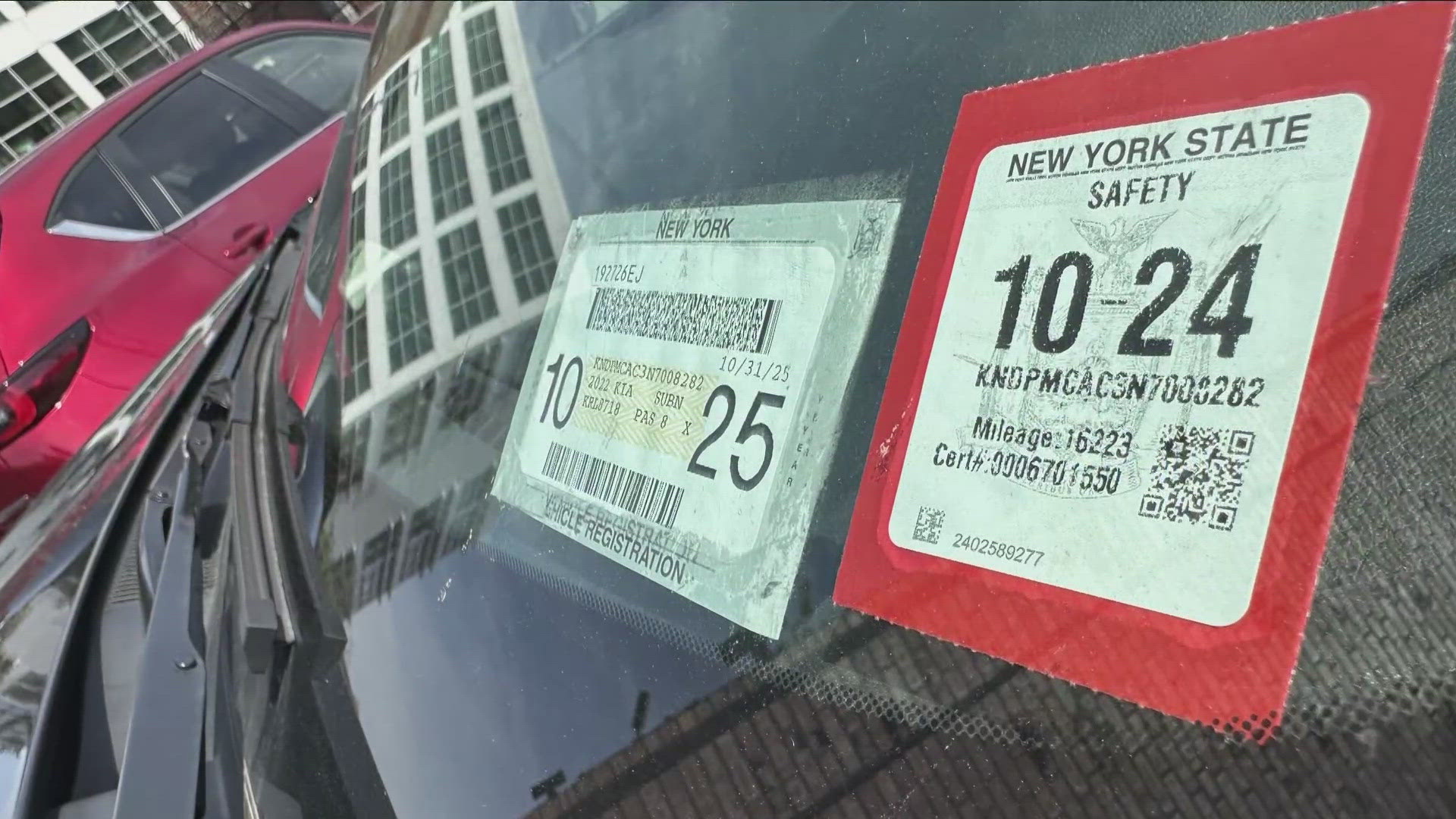
- Arrange the required New York inspection after registration.
New York generally requires a newly registered vehicle to receive a safety and emissions inspection within 10 days after registration. Check the current DMV inspection guidance because requirements can vary by vehicle type and model year.
Can you register a car in New York without New York insurance?
Usually, no. New York requires proof of New York auto insurance before you register a vehicle.
Out-of-state insurance is generally not enough for a vehicle registered in New York. The insurance must meet New York requirements and be connected to the vehicle record.
If you cancel your New York insurance while the vehicle still has New York plates, you may face penalties. In many cases, you should surrender the plates before canceling insurance unless the DMV confirms another permitted option.
Do not drive the car until it is properly registered, insured, and legally permitted to operate.

How much does it cost to renew car registration in New York?
A renewal usually costs less than first-time registration because you may not need to pay a new title fee or new plate fee.
Your renewal total can still include:
- Weight-based registration charges
- MCTD charges
- County fees
- Electric vehicle charges
- Special plate fees
- Late fees, if applicable
New York DMV normally sends a renewal notice before the registration expires. You can renew through the DMV online system, by mail, or in person when eligible.
Renew before the expiration date. Driving with an expired registration can lead to tickets, fines, towing, or insurance problems.

How much does it cost to register an electric car in New York?
An electric vehicle may have an extra registration charge in addition to the normal registration fee. The amount and application rules can change.
Electric vehicles may also have different inspection, charging, or tax considerations. A plug-in hybrid may not be treated exactly like a fully electric vehicle.
When estimating the cost, check the DMV rules for the vehicle’s exact fuel type. Do not rely only on the model name, because similar vehicles may have different classifications.

New York registration cost by situation
| Situation | Costs that may apply |
|---|---|
| Renewing your current registration | Registration fee, MCTD fee, local fees |
| Buying from a New York dealer | Registration, title, plates, sales tax, dealer processing charges |
| Buying from a private seller | Registration, title, plates, sales tax, bill-of-sale review |
| Moving to New York with your car | Registration, title, plates, possible sales or use tax |
| Transferring existing plates | Registration and transfer charges; possibly no new plate fee |
| Registering an electric vehicle | Standard charges plus any applicable EV fee |
| Registering a commercial vehicle | Commercial registration charges based on vehicle and use |
| Registering a motorcycle or trailer | Separate vehicle-class fee schedule |
The best estimate comes from identifying the transaction first. “How much is car registration in New York?” has a different answer for a renewal than for a newly purchased vehicle.

Common mistakes that increase the cost or delay registration
Forgetting sales tax
A buyer may budget for the DMV fee but forget the tax on the purchase price. Sales tax can be much larger than the registration charge.
Bringing the wrong ownership documents
A title with a missing signature, incorrect VIN, or unresolved lien can delay registration. Check every document before visiting the DMV.
Using out-of-state insurance
New York generally requires New York insurance for a New York registration. Ask your insurer to confirm that the electronic insurance record is active.
Assuming every DMV office accepts every transaction
Some offices require appointments or limit certain services. Check the New York DMV instructions before traveling.
Waiting until after the registration expires
A late renewal can create fines and may leave you unable to drive legally. Renew early when possible.
Paying a dealer fee without reviewing it
Dealer processing fees are not always the same as government registration fees. Ask for an itemized purchase agreement.
Using the wrong weight or vehicle class
A commercial truck, trailer, motorcycle, or heavy vehicle may use a different fee schedule. Confirm the classification before estimating the cost.

How to get the exact New York registration price
Use this short process:
- Find the vehicle identification number, year, make, model, and weight.
- Determine whether this is a renewal, plate transfer, new registration, or out-of-state registration.
- Confirm the county where the vehicle will be registered.
- Check whether the car is electric or uses a special vehicle classification.
- Add the purchase price if sales tax may be due.
- Use the current New York DMV fee information.
- Keep a small extra amount available for local, plate, or document charges.
The DMV’s current calculator and fee pages should control over older articles, dealership estimates, or informal online calculators.

Key takeaways
- New York does not have one flat car registration price.
- The registration fee is mainly based on vehicle weight.
- First-time registration may also include a $50 title fee and a $25 standard plate fee.
- Sales tax can make the total much higher than the registration charge alone.
- MCTD fees apply in New York City and several nearby counties.
- Electric vehicles, commercial vehicles, motorcycles, trailers, and specialty plates may use different rules.
- Check the current New York DMV fee schedule for the exact total.
FAQs
Is New York car registration expensive?
It can be, especially when sales tax, title, plates, and local charges are included. A simple renewal is usually much less than registering a newly purchased vehicle.
How much is a two-year registration in New York?
The amount depends on the vehicle’s weight, county, vehicle type, and applicable extra charges. Use the current DMV fee calculator for the exact two-year total.
Can I transfer my old New York plates to my new car?
Often, yes, if you meet DMV requirements and the plates are eligible. A transfer may cost less than ordering new plates.
Do I pay sales tax when I buy a car from a private seller?
You may owe New York sales tax when you register the car unless you have valid proof that the tax was already paid or the transaction qualifies for an exemption.
How soon must I inspect a newly registered car?
Newly registered vehicles generally must receive a New York inspection within 10 days after registration. Confirm the current rule for your vehicle type with the New York DMV.
Conclusion
The answer to “how much is car registration in New York?” depends on more than the registration fee. Start with the vehicle’s weight, then check whether you need plates, a title, sales tax, an MCTD charge, or a special vehicle fee.
For the most accurate number, use the current New York DMV calculator and prepare your insurance, ownership, tax, and identity documents before you apply.
