

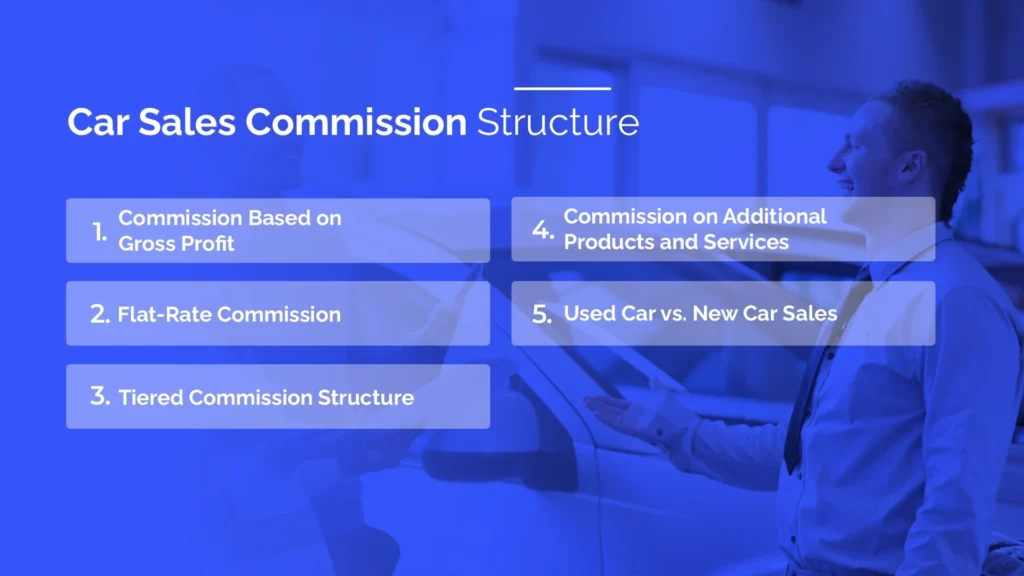
A car salesperson in the United States often earns about 20% to 30% of a dealership’s front-end gross profit on a vehicle sale. Many dealerships also pay small flat amounts, volume bonuses, or bonuses for meeting monthly targets.
That means one salesperson may earn $100 on one car and $900 or more on another. Pay depends on the vehicle’s profit, the dealership’s pay plan, sales volume, customer satisfaction scores, and whether the salesperson receives part of the finance or warranty income.
There is no single national commission rate. New-car franchises, used-car stores, luxury dealers, and “no-haggle” dealerships can all use different plans.
How car salesperson commission works
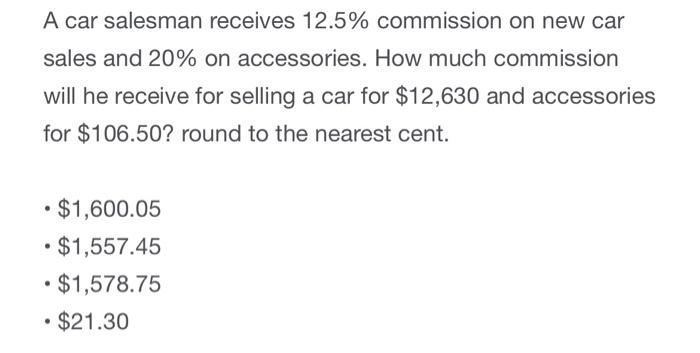
Most U.S. dealerships calculate commission from gross profit, not from the vehicle’s selling price.
Gross profit is the difference between the amount the dealership receives for the vehicle and its adjusted cost. A dealership may subtract items such as:
- The vehicle’s invoice or acquisition cost
- Dealer discounts
- Trade-in losses
- Advertising or inventory charges
- A “pack” amount set by the dealership
The salesperson usually does not receive a percentage of the full sale price.
A simple example
Suppose a new vehicle sells for $35,000. After the dealership accounts for its cost and other deductions, the deal shows $2,000 in commissionable gross profit.
If the salesperson’s rate is 25%:
$2,000 × 25% = $500 commission
The customer paid $35,000, but the salesperson’s pay came from the $2,000 gross profit figure.
Some dealerships also pay a flat commission, often called a “mini,” when the deal produces little or no gross profit. A mini may be around $100 to $300, but the exact amount depends on the employer.
Common parts of a dealership pay plan
| Pay element | How it may work |
|---|---|
| Front-end commission | A percentage of vehicle gross profit |
| Mini commission | A set amount on a low-profit or loss deal |
| Volume bonus | Extra pay after reaching a unit target |
| Model or brand bonus | Incentive for selling certain vehicles |
| Customer-service bonus | Pay based on surveys or reviews |
| Finance and warranty bonus | A share of eligible products or referrals |
| Draw | An advance against future commission |
| Chargeback | Commission returned when a deal cancels or unwinds |
A pay plan may include several of these parts at once. The written plan matters more than a general industry average.
What is the average car salesman salary in the United States?
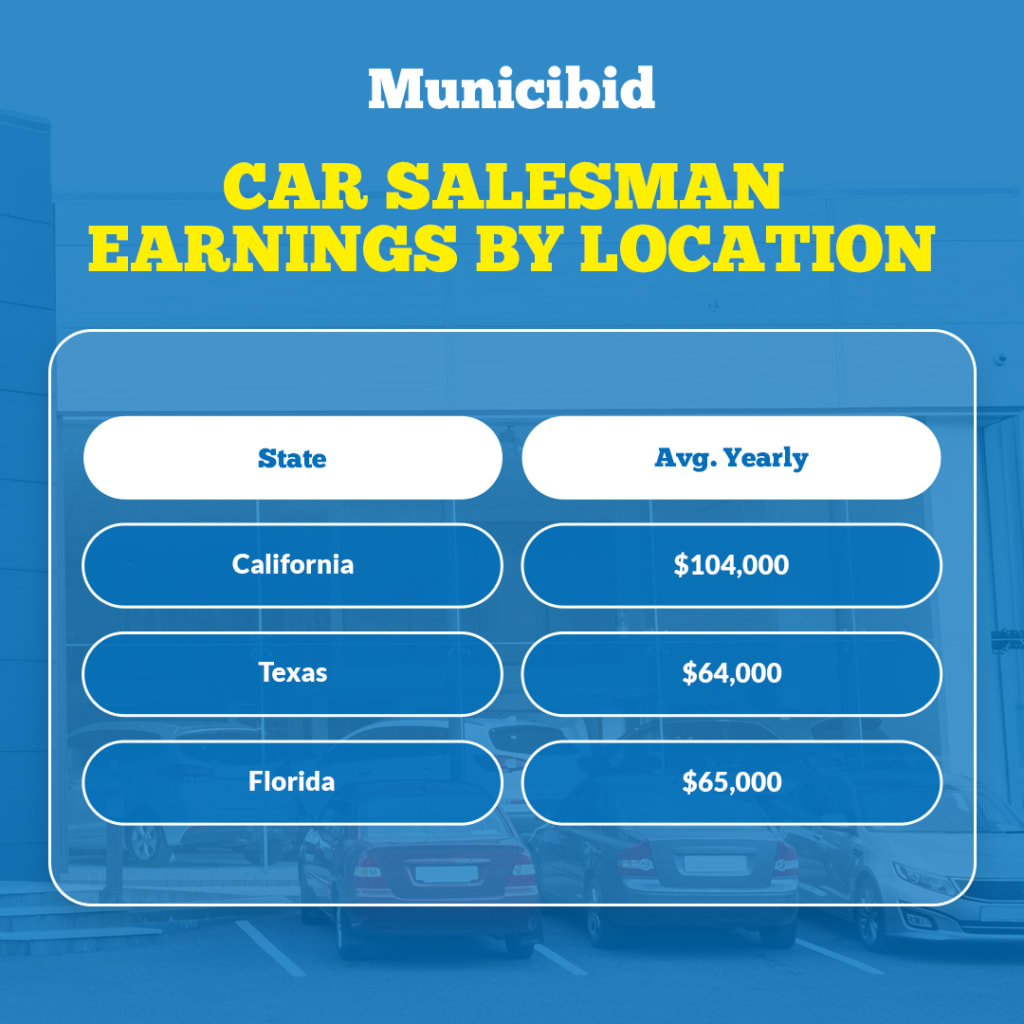
A realistic answer is that U.S. car salesperson income can range from roughly $30,000 to more than $100,000 per year, with the middle of that range depending heavily on location, dealership type, experience, and sales volume.
Some salespeople earn less than $40,000, especially during a slow start or in a low-volume store. Strong performers at busy dealerships can earn $70,000 to $100,000 or more. A small group at high-volume or luxury dealerships may earn well above that.
Public wage data has limits here. The U.S. Bureau of Labor Statistics groups many retail sales jobs together, rather than publishing one precise national figure for franchise car sales consultants. Industry reports also vary because they may include bonuses, benefits, overtime, or only certain dealership employees.
The National Automobile Dealers Association (NADA) publishes dealership workforce and compensation information, but dealership pay still varies by market and job role. A sales consultant’s total compensation should not be confused with the pay of a finance manager, general sales manager, or dealer principal.
Estimated income by role and experience
| Career stage or role | Common annual income pattern |
|---|---|
| New salesperson | About $30,000–$50,000 |
| Established salesperson | About $50,000–$80,000 |
| Strong salesperson at a busy store | About $80,000–$120,000+ |
| Finance and insurance manager | Often higher, but uses a different pay plan |
| Sales manager | Commonly salary plus bonuses, not standard salesperson commission |
These are broad planning ranges, not official salary guarantees. A salesperson should ask whether the figure includes benefits, bonuses, overtime, draw payments, and manufacturer incentives.
Why online salary numbers often conflict
Salary websites may report different numbers because they use different methods:
- Voluntary employee submissions
- Job-posting data
- Employer surveys
- Estimated bonuses
- Different job titles
- Different cities and dealership types
A reported $75,000 average may describe total compensation, while another source may show only base wages. Neither number automatically describes what a new salesperson will earn.

How much does a salesperson make on each car?
A salesperson may earn $100 to $1,000 or more per vehicle, but most deals fall somewhere between a small flat payment and a percentage of the gross profit.
The main factor is the commissionable profit on the deal.
Hypothetical commission examples
| Deal type | Commissionable gross | Pay plan | Salesperson commission |
|---|---|---|---|
| Low-profit new car | $400 | $200 mini | $200 |
| Normal new-car deal | $1,500 | 25% | $375 |
| Used-car deal | $3,000 | 25% | $750 |
| High-profit used car | $4,500 | 30% | $1,350 |
These examples do not include bonuses or chargebacks. They also assume the dealership uses the stated gross figure without other deductions.
A used vehicle can produce more gross profit than a new vehicle, but that is not always true. Used cars may also carry higher repair, reconditioning, transportation, and warranty costs.
Does the car price determine commission?
Not directly.
A $60,000 vehicle can produce less commission than a $25,000 vehicle if the expensive vehicle has a very small margin. For example:
- $60,000 sale with $800 gross at 25% = $200
- $25,000 sale with $3,000 gross at 25% = $750
The sale price is only one part of the calculation. The dealership’s cost and the final negotiated price matter more.
Do salespeople earn commission on the trade-in?
Usually, the trade-in affects the overall deal profit rather than creating a separate commission.
If a dealership overvalues a trade, the deal may lose money even if the new vehicle has a margin. Some dealerships calculate commission on the combined deal. Others use a separate rule for trade losses, wholesale gains, or appraisal adjustments.
Ask whether the pay plan uses:
- Vehicle gross only
- Combined vehicle and trade gross
- Front-end gross after pack
- A fixed amount per unit
- A mixture of these methods

Do car salesmen get commission from financing and warranties?
Sometimes, but the salesperson often does not receive the same finance income as the finance and insurance manager.
After the salesperson reaches an agreement with the customer, the deal usually moves to the F&I office. The finance manager may arrange a loan and offer products such as:
- Extended service contracts
- Guaranteed asset protection, often called GAP
- Maintenance plans
- Tire and wheel coverage
- Payment protection products
The finance manager may receive a bonus or commission based on eligible product sales or finance performance. The salesperson may receive a smaller referral or product bonus, or no additional pay at all.
The exact arrangement depends on the dealership. Customers should review each product separately and ask for the total price, cancellation rules, exclusions, and whether the product is required. A lender or dealer generally cannot make an optional product a condition of getting a loan unless the contract clearly makes it part of the agreement.
The Consumer Financial Protection Bureau explains that dealers may arrange financing and may have discretion in how a lender’s interest rate is presented. Customers can compare the dealer’s offer with a bank or credit union before signing.
A salesperson’s commission does not by itself prove that a price or finance offer is unfair. It does mean the buyer should focus on the written out-the-door price and loan terms rather than on verbal claims about “dealer cost.”

What affects a car salesperson’s commission?
Several factors can change the amount earned on each deal and the total income for the month.
Dealership type
A high-volume mainstream franchise may offer many chances to sell, but each deal may produce modest gross profit. A luxury store may have fewer customers and higher gross profit per vehicle. A large used-car group may use fixed commissions instead of traditional negotiation-based pay.
New versus used vehicles
New-car margins can be narrow, especially when customers receive discounts or manufacturer incentives. Used cars may have more flexible pricing, but the dealership must account for reconditioning and market value.
Neither category guarantees higher pay.
Monthly sales volume
Some pay plans reward a salesperson after a threshold:
- 10 units: additional $500
- 15 units: additional $1,000
- 20 units: additional $2,000
The actual structure varies. A volume bonus can make a major difference, especially when a salesperson is close to a target at month-end.
Location and local demand
Pay opportunities may be higher in large metro areas, but the cost of living and competition may also be higher. A dealership in a smaller market may have lower sales volume but less competition for customers.
Experience and lead access
A new salesperson may receive fewer internet leads or may work more floor traffic while learning the process. Experienced staff may receive repeat customers, referrals, and higher-quality leads.
Customer surveys and chargebacks
Some dealerships tie bonuses to customer satisfaction surveys. A salesperson may also lose commission if:
- A deal is canceled
- A lender rejects the contract
- A vehicle is returned under a dealership policy
- A product is canceled
- A customer chargeback applies
The pay plan should explain these rules in writing.

How to calculate a car salesperson’s expected monthly income
You can estimate monthly income with four basic inputs:
- Number of cars sold
- Average commission per car
- Bonuses
- Base pay, draw, or deductions
Hypothetical monthly calculation
Assume a salesperson:
- Sells 14 vehicles
- Earns an average of $425 per vehicle
- Receives a $1,000 volume bonus
- Earns $2,000 in hourly or base pay
Calculation:
- 14 × $425 = $5,950 in vehicle commissions
- $5,950 + $1,000 = $6,950
- $6,950 + $2,000 = $8,950 gross monthly pay
Annualized, that would equal $107,400 before taxes if the same result occurred every month. In practice, sales usually rise and fall by season, inventory, market demand, and personal performance.
A draw changes the calculation. If a salesperson receives a $2,500 monthly draw and earns $4,000 in commissions, the employer may pay only the difference, depending on whether the draw is recoverable. A recoverable draw is an advance that can create a balance when commissions fall below the draw.
Before accepting a job, ask for a sample pay statement. It should show:
- Gross profit
- Pack or deductions
- Commission rate
- Minis
- Bonuses
- Draw amount
- Chargebacks
- Pay date
- Employee or independent-contractor status
- Benefits and paid time off

How to compare car dealership pay plans
The highest commission rate is not always the best offer. Compare the full plan with expected sales volume and lead access.
| Question to ask | Why it matters |
|---|---|
| What percentage of gross profit is paid? | Shows the basic commission rate |
| Is there a pack? | A pack can reduce commissionable profit |
| What is the mini? | Protects income on low-profit deals |
| Are bonuses based on units or gross? | Determines how volume affects pay |
| Are internet leads split? | Multiple salespeople may share one deal |
| Are chargebacks common? | Reduces real take-home pay |
| Is there a draw? | Shows whether early pay is an advance |
| Who gets finance-product bonuses? | Clarifies additional earning potential |
| What are the average monthly units per salesperson? | Helps estimate realistic opportunity |
| What happens during training? | New hires may have lower early income |
| Are benefits included? | Salary comparisons should include total compensation |
Ask for the rules in writing. A verbal promise such as “top people make six figures” does not tell you how many salespeople reach that level or how long it takes.
A useful comparison formula
Use this rough formula:
Expected monthly pay = average commission per car × realistic monthly sales + bonuses + base pay − chargebacks
Use a conservative sales estimate. If a manager says the store sells 200 vehicles each month but employs 25 salespeople, the average is eight vehicles per salesperson before considering lead distribution, experience, and uneven performance.
That average does not predict your result, but it gives you a better starting point than a top-performer story.
Is car sales commission paid before or after taxes?
Commission is generally taxable income. The dealership may withhold federal income tax, Social Security tax, Medicare tax, and applicable state or local taxes from an employee’s paycheck.
A large commission check does not equal take-home pay. The final amount depends on:
- Federal withholding
- State and local tax rules
- Filing status
- Benefits
- Retirement contributions
- Wage deductions allowed by law
- Whether the person is an employee or contractor
Commissioned employees still have wage protections under federal and state law. The U.S. Department of Labor provides general wage guidance, but state rules can add protections. Because pay-plan laws differ, a salesperson with a disputed paycheck should keep pay statements and the signed plan and contact the relevant state labor agency or an employment attorney.
Dealership workers should also confirm whether the plan complies with local minimum-wage and overtime rules. A commission arrangement cannot automatically remove every wage protection.

Do car salesmen make more money at new or used car dealerships?
Neither type is always more profitable for the salesperson.
Used-car dealerships may offer higher commissions because used vehicles can have more pricing flexibility. However, used inventory can also carry more repair risk and may sell with a fixed commission.
New-car dealerships may have stronger manufacturer incentives, more structured training, and steady customer traffic. Their margins may be narrower, which can reduce commission per vehicle.
The best choice depends on the whole pay plan:
- Average units sold per salesperson
- Average commission per deal
- Percentage of internet leads
- Used-car reconditioning policy
- Bonus thresholds
- Chargeback rules
- Benefits and schedule
- Manager support
A lower rate on a high-volume plan may produce more income than a high rate at a store with weak traffic.
Common mistakes when estimating car salesperson pay
The most common mistake is multiplying the vehicle price by a commission percentage. Dealership commission usually applies to gross profit, not the selling price.
Other mistakes include:
- Treating a top performer’s income as typical
- Ignoring the dealership’s pack
- Counting a draw as permanent salary
- Forgetting chargebacks
- Including benefits in one salary figure but not another
- Assuming every salesperson receives finance income
- Comparing a luxury store with a high-volume economy store
- Ignoring slow months
- Assuming bonuses are guaranteed
- Confusing gross pay with take-home pay
A careful estimate uses the written pay plan, average sales per salesperson, average commission per deal, and actual bonus rules.

Frequently asked questions
Do car salesmen get paid hourly?
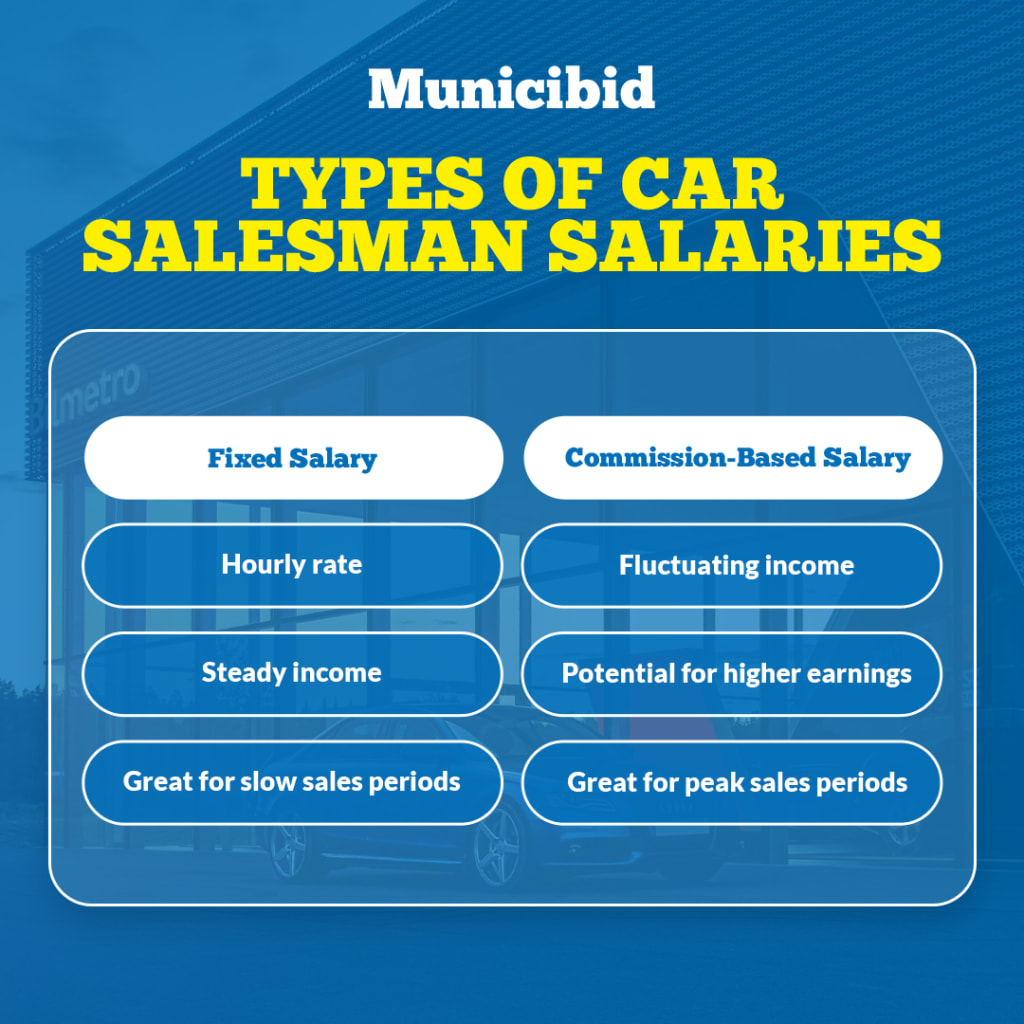
Some dealerships pay a small hourly wage, salary, draw, or training wage. Others rely mainly on commission. The arrangement may change after training. Ask whether the draw is recoverable and whether the dealership guarantees minimum pay under applicable law.
What is a “mini” in car sales?
A mini is a fixed commission paid when a deal produces little or no commissionable gross profit. It protects the salesperson from earning nothing on a completed deal, but the amount varies by dealership.
Can a car salesperson make six figures?
Yes, some do, especially at high-volume, luxury, or high-gross dealerships. Six-figure income is not typical for every salesperson. Ask how many current employees reach that level and whether the number includes bonuses or benefits.
Do car salespeople earn commission on leases?
Usually, a lease can generate commission under the dealership’s normal vehicle pay plan. The amount depends on the lease structure, gross profit, manufacturer rules, and the store’s written policy.
Are car salespeople paid on the full down payment?
Usually not. A down payment reduces the amount financed, but it does not automatically become dealership profit. The commission normally comes from the deal’s eligible gross profit or a set flat amount.

Key takeaways
- A U.S. car salesperson often earns 20% to 30% of commissionable front-end gross profit, but rates vary.
- A typical commission may range from about $100 to $1,000 or more per vehicle.
- New-car, used-car, luxury, and no-haggle dealerships may use very different plans.
- Monthly bonuses, finance referrals, draws, and chargebacks can significantly change total pay.
- Annual income can range from under $40,000 to more than $100,000, depending on performance and the store.
- The written pay plan is more useful than a broad online salary average.
Conclusion
Car salespeople in the United States are usually paid through a mix of gross-profit commission, flat commissions, bonuses, and sometimes a draw or base wage. The commission is generally based on the dealership’s profit on the deal, not the car’s full selling price.
For a realistic estimate, review the written pay plan and calculate expected pay from conservative monthly sales numbers. Compare the mini, gross-profit deductions, bonus thresholds, chargebacks, lead access, and benefits before judging whether a dealership job offers strong earning potential.
If you are considering a sales position, ask the manager for a sample paycheck and the average number of vehicles sold per salesperson. Those two details often reveal more than the advertised commission percentage.