How To Know When A Ball Joint Is Bad: Warning Signs
A bad ball joint can cause loose steering, uneven tire wear, clunking, and poor vehicle control. The safest way to confirm the problem is to inspect the joint for play while the suspension is supported in the correct way for your vehicle. A shop can then verify the result with a pry bar, dial indicator, or factory test method.
Do not rely on noise alone. A worn ball joint can sound like a bad tie-rod end, wheel bearing, sway bar link, or control-arm bushing. Some ball joints also wear with little or no noise.
This guide explains how ball joints work, which signs matter, how to check them safely, and when you should stop driving.

What Is a Ball Joint?
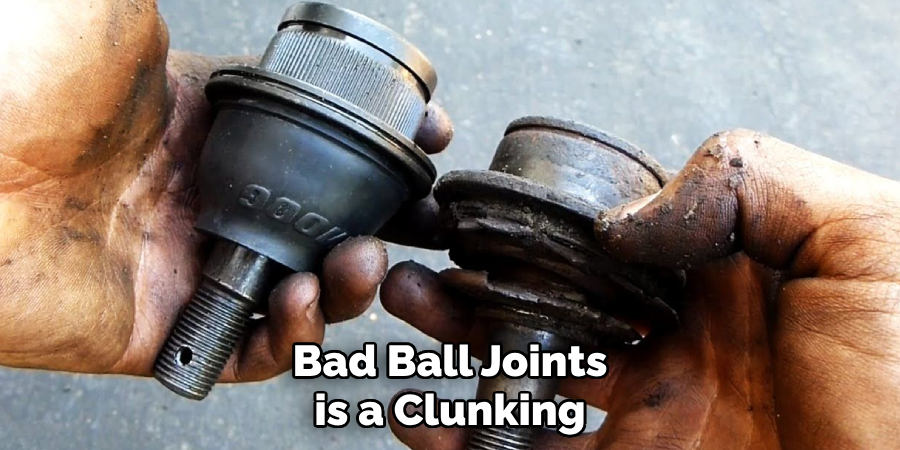
A ball joint is a pivot that connects a suspension control arm to the steering knuckle. It lets the wheel move up and down with the suspension while still turning left and right.
Most vehicles use one or more of these designs:
- Upper ball joints, found on many trucks and older vehicles with upper and lower control arms.
- Lower ball joints, common on cars, SUVs, and trucks.
- Load-carrying ball joints, which support part of the vehicle’s weight.
- Follower ball joints, which guide movement but carry less suspension load.
- Sealed ball joints, which have no service grease fitting.
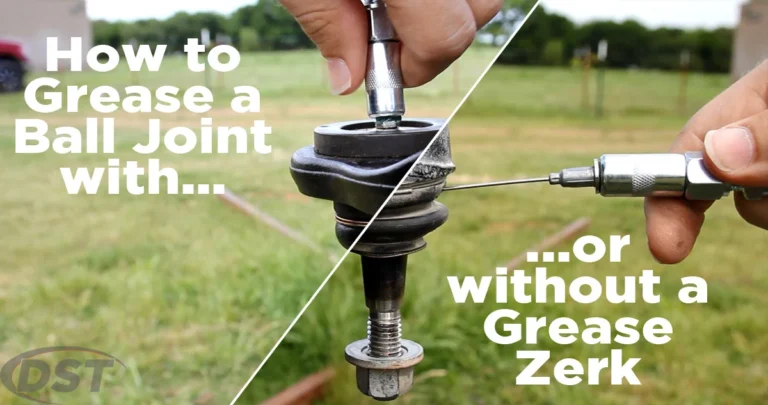
- Greaseable ball joints, which use a fitting for scheduled lubrication.
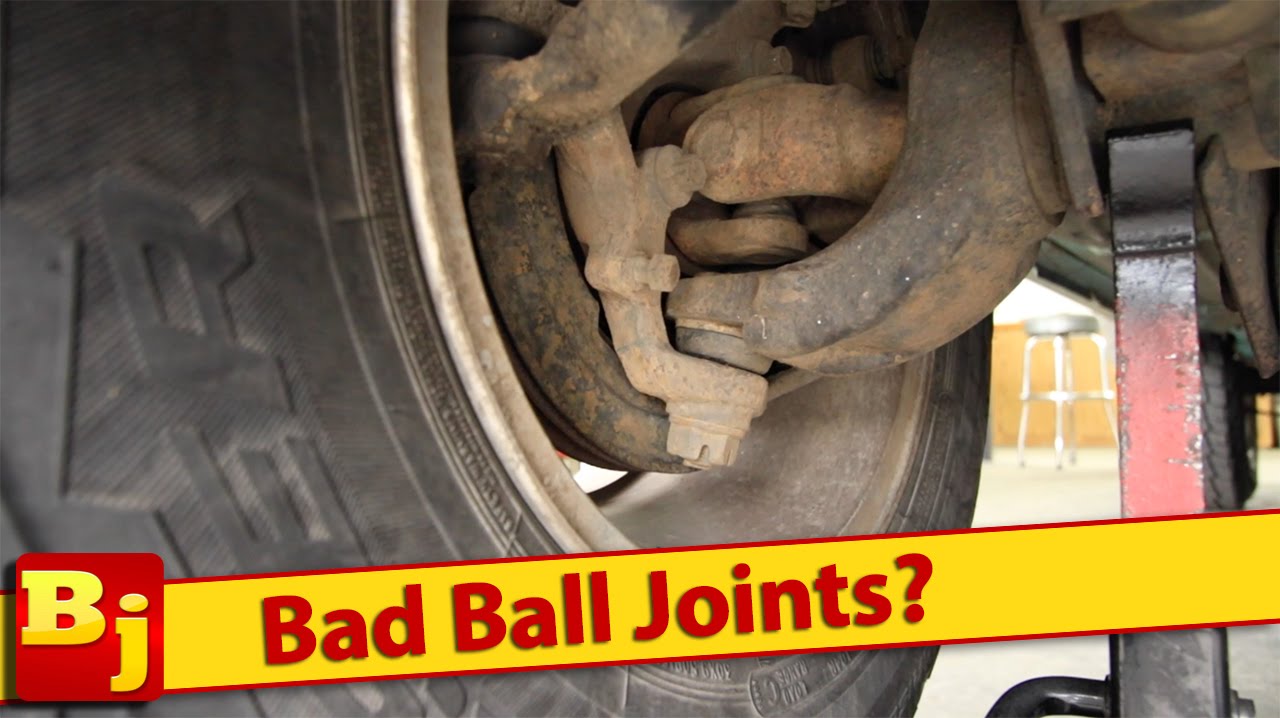
A ball joint contains a ball-and-socket connection. A protective rubber boot keeps dirt and water away from the contact surfaces. When the boot tears, grease can escape and road grit can enter. That can speed up wear.
Ball joints do not have one universal replacement interval. Their life depends on vehicle design, road salt, potholes, dirt, towing, heavy loads, lubrication, and driving distance.

The Most Common Signs of a Bad Ball Joint
The clearest signs are excess movement at the joint, steering looseness, and damage to the protective boot. Noise can support the diagnosis, but noise by itself does not prove that a ball joint has failed.
1. Clunking or knocking over bumps
A worn ball joint may make a dull clunk when the vehicle travels over:
- Potholes
- Speed bumps
- Rough pavement
- Driveway entrances
- Uneven roads
The sound may come from one front corner. It may also occur when braking, accelerating, or changing direction.
A clunk can have many causes. Loose brake hardware, a sway bar link, a tie-rod end, or a control-arm bushing can make a similar sound.
2. Loose or vague steering
The vehicle may feel less precise than it once did. You may notice:
- Extra steering-wheel movement before the vehicle responds
- A need for frequent steering corrections
- Wandering on straight roads
- A delayed response during turns
- A front end that feels unstable on rough pavement
A bad ball joint is only one possible cause. Low tire pressure, worn tie rods, poor alignment, a damaged control arm, and worn steering gear can create similar symptoms.
3. The vehicle pulls or changes direction
A worn suspension joint can change wheel position under braking or cornering. This may make the vehicle pull to one side or feel as if it moves across the lane.
Pulling can also result from:
- Unequal tire pressure
– Tire damage - A brake caliper that does not release
- Wheel alignment
- A bent suspension part
- Road crown
Check the simple causes first, but do not ignore a pull that began with a new clunk or loose steering.
4. Uneven tire wear
A damaged ball joint can allow the wheel to tilt or shift. That may cause unusual wear on the inside or outside edge of a tire.
Look for:
- One front tire wearing faster than the other
- Feathered tread
- Cupping or scalloped wear
- An inner or outer shoulder that is nearly bald
- A steering wheel that no longer sits straight
Tire wear is a clue, not a diagnosis. Incorrect alignment, worn bushings, weak shocks or struts, and poor tire balance can also cause abnormal wear.
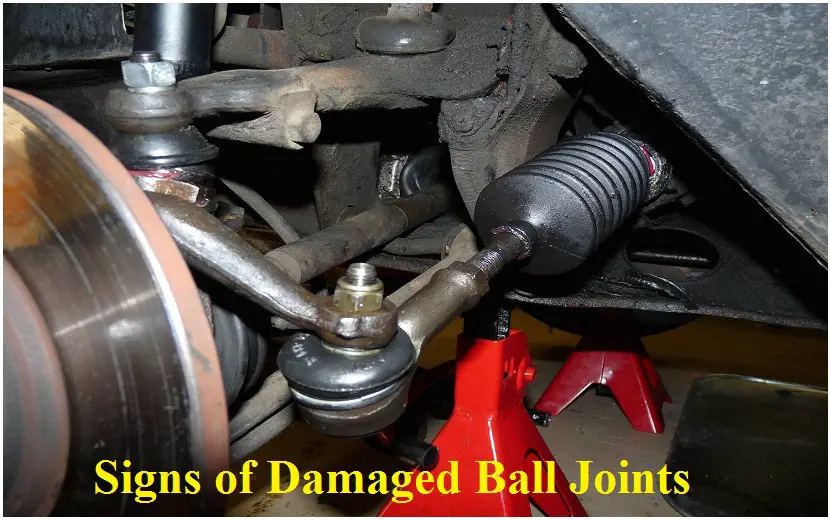
5. A torn or leaking ball-joint boot
Inspect the rubber boot if you can see it clearly. Warning signs include:
- A split or hole in the rubber
- Grease leaking from the boot
- A boot that has pulled away from its seat
- Rust or dirt around the joint
- A dry joint with damaged rubber
A torn boot does not always mean the joint has immediate looseness. However, it allows contamination inside. Many sealed ball joints must be replaced as an assembly when the boot is damaged.
Do not assume that adding grease repairs a torn boot. Grease may reduce noise for a short time, but it cannot remove grit or restore worn metal surfaces.
6. Steering-wheel vibration
A ball joint can contribute to vibration if it permits the wheel to move. Yet vibration is more often linked to:
- An unbalanced tire
- A bent wheel
- A damaged tire
- A worn wheel bearing
- A brake rotor problem
- A failing axle or CV joint
The timing matters. Vibration during braking points to a different group of problems than vibration that rises with road speed.
How to Check a Ball Joint Safely
A home inspection can find obvious looseness, but it cannot replace the vehicle maker’s service procedure. Ball-joint designs vary. The correct lifting point and test method depend on the suspension layout.
Before you start
You may need:
- A level, hard work area
- Wheel chocks
- A floor jack with enough capacity
- Jack stands rated for the vehicle
- A flashlight
- A pry bar
- A helper
- Protective gloves and eye protection
- The vehicle service manual
Never work beneath a vehicle supported only by a jack. Set the parking brake, block the wheels that stay on the ground, and place jack stands under approved support points.
If the vehicle has air suspension, active suspension, or a special lift mode, follow the manufacturer’s instructions before raising it.
Step 1: Look at the ball-joint boot
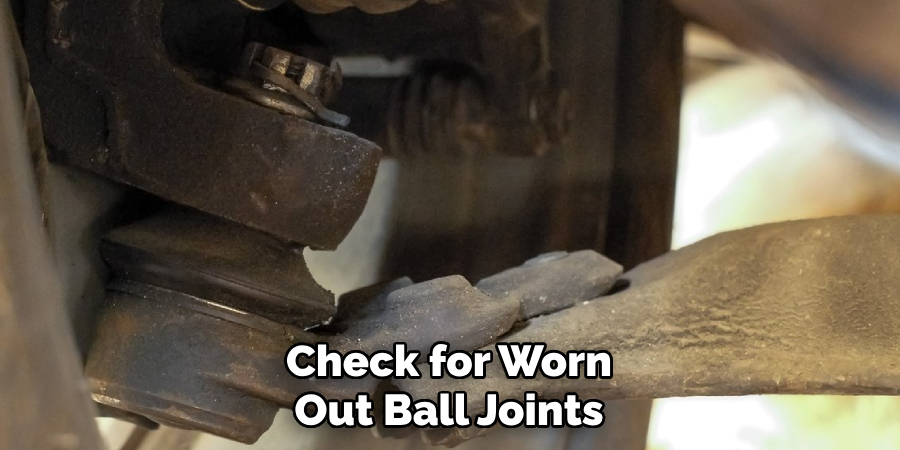
Turn the steering wheel as needed to see the front suspension. Look for a torn boot, missing boot, grease leakage, or rust.
A damaged boot raises suspicion. It does not confirm that the ball and socket have dangerous play.
Step 2: Check for wheel movement
A common basic check is to raise the front wheel and grasp the tire at the top and bottom. Rock it in and out.
Movement at the 12-and-6 o’clock positions can come from:
- A ball joint
- A wheel bearing
- A strut mount
- A control-arm bushing
- A loose wheel
This test alone cannot identify the failed part.
Some suspension layouts require the control arm to be supported or left hanging during the test. In other layouts, the joint must be checked with the suspension loaded. Using the wrong position can hide wear or create a false result.
Step 3: Check side-to-side movement
With the wheel raised, grasp it at the 3-and-9 o’clock positions and rock it.
Movement here often points to:
- An outer tie-rod end
- An inner tie rod
- Steering gear
- A wheel bearing
It is less specific for a ball joint. Use this step to separate steering looseness from suspension looseness.
Step 4: Watch the joint while a helper moves the wheel
Ask a helper to rock the tire while you watch the ball joint and nearby parts. Look for movement between the stud and the housing.
The joint should pivot. It should not show a visible shift, knock, or gap between parts that should move as one unit.
Use a flashlight. Keep your hands away from pinch points. Do not place any part of your body under an unsupported vehicle.
Step 5: Use a pry bar only if the design allows it
A shop may use a pry bar to check for movement. A home mechanic should use this method only when the service manual permits it.
Do not pry against a thin dust shield, brake line, ABS wire, or rubber boot. Excess force can damage parts and create a false result.
Step 6: Compare both sides
Compare the left and right sides of the same axle. A small difference can help reveal a problem, but one side may naturally have a different load or design.
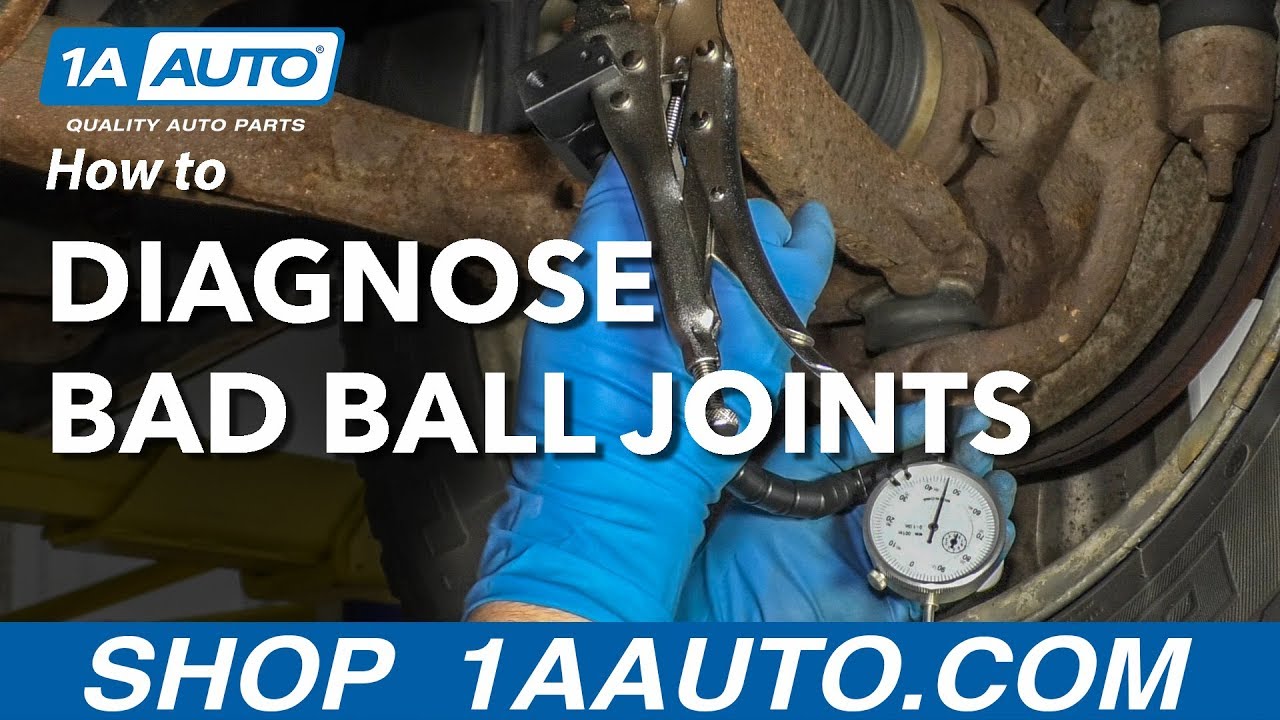
The best confirmation comes from the vehicle’s specified play limit. Some manufacturers give a movement limit measured with a dial indicator. Others specify a visual test, a force test, or replacement based on boot damage.

How to Tell a Bad Ball Joint From Similar Problems
Many front-end symptoms overlap. Use the pattern below as a starting point, not as a final diagnosis.
| Symptom or test result | Ball joint | Tie-rod end | Wheel bearing | Control-arm bushing | Sway bar link |
|---|---|---|---|---|---|
| Clunk over bumps | Possible | Possible | Less typical | Possible | Common |
| Movement at 12 and 6 o’clock | Possible | Less typical | Common | Possible | Unlikely |
| Movement at 3 and 9 o’clock | Less typical | Common | Possible | Unlikely | Unlikely |
| Humming that rises with speed | Unlikely | Unlikely | Common | Unlikely | Unlikely |
| Torn rubber boot | Common | Common | Sometimes | Rubber may crack | Common |
| Steering looseness | Possible | Common | Possible | Possible | Rare |
| Grease near a pivot | Possible | Possible | Uncommon | Uncommon | Possible |
A wheel bearing often produces a hum or growl that changes with vehicle speed and may change when the vehicle turns. A tie-rod problem more often creates side-to-side steering looseness. A sway bar link usually makes a sharp rattle over small bumps.
These patterns are not conclusive. Several worn parts can exist at the same time.

When Is a Bad Ball Joint Dangerous?
A severely worn ball joint can separate. If that happens, the wheel may move sharply out of position. The vehicle can lose steering control, and the tire or suspension can contact other parts.
Stop driving and arrange a tow if you notice:
- A wheel that sits at an unusual angle
- Sudden steering looseness
- A loud pop followed by a change in steering
- Severe clunking with visible joint movement
- A tire rubbing the suspension or fender
- A ball-joint stud that appears to be pulling out
- A vehicle that cannot track straight
- A suspension part that is bent or broken
Do not drive to a repair shop if the wheel position has changed or the joint has major play. A tow is cheaper than losing control in traffic.
A minor boot tear with no measured play still needs prompt repair planning. The risk is not the same as a joint that is already loose, but contamination can make the problem worse.
Can You Drive With a Bad Ball Joint?
It depends on the condition, but driving with confirmed ball-joint play is not a safe plan. A joint may continue to work for a time, yet wear can increase quickly after the boot fails or the joint begins to loosen.
If a mechanic finds only a damaged boot and no measurable play, ask whether the vehicle uses a replaceable boot or requires a complete joint. Follow the repair advice for that exact vehicle.
If the joint has measurable play, avoid highway speeds, heavy loads, towing, and long trips until it is repaired. Have the technician inspect the related tire, wheel, steering parts, and control arm as well.
What Does Ball-Joint Replacement Involve?
Replacement varies by vehicle. Some ball joints press into a control arm or steering knuckle. Others are bolted in. On some vehicles, the ball joint is part of a complete control-arm assembly.
A proper repair may include:
- Confirming the worn joint and checking the other side.
- Removing the wheel and related suspension parts.
- Replacing the joint, control arm, retaining hardware, or cotter pin as required.
- Tightening fasteners to the manufacturer’s torque values.
- Checking brake hoses, ABS wires, bushings, and the steering knuckle.
- Inspecting the tire and wheel for related damage.
- Performing a wheel alignment when the repair can change alignment angles.
Do not reuse a damaged cotter pin or substitute ordinary hardware for a specified suspension fastener. Suspension parts carry major loads.
After repair, the steering should feel stable, the noise should be gone, and the tire should track normally. A wheel alignment is often wise after work that changes the control-arm or steering position.
Common Mistakes When Diagnosing Ball Joints
Replacing a part based only on a noise
A clunk does not identify the source. Inspect the joint and test for play before buying parts.
Using the wrong jack point
An incorrect lift point can bend body panels or damage suspension parts. Use the owner’s manual or service information.
Confusing wheel-bearing play with ball-joint play
Both can create movement at the top and bottom of the tire. Watch the joint while the tire moves, and use the manufacturer’s test method.
Ignoring the other front-end parts
A worn ball joint may not be the only fault. Check tie rods, control-arm bushings, wheel bearings, shocks or struts, tires, and alignment.
Tightening bolts with the suspension at the wrong height
Some rubber bushings must be tightened at normal ride height. Incorrect tightening can preload the bushing and shorten its life.
Assuming grease fixes wear
Grease can protect a serviceable joint. It cannot restore a worn ball-and-socket fit.

How Much Does Ball-Joint Repair Cost?
The total price depends on the vehicle and the repair method. Main cost factors include:
- Front or rear location
- Upper or lower joint
- Press-in or bolt-in design
- Complete control-arm replacement
- Rust and seized hardware
- Alignment requirements
- Labor rates in your U.S. area
- Whether one or both sides need repair
Ask the repair shop for an itemized estimate. It should state which part is worn, whether the joint or control arm will be replaced, whether new hardware is included, and whether an alignment is recommended.
Do not choose a repair based only on the lowest price. The part must match the vehicle, and the installation must follow the correct torque and safety procedure.
Frequently Asked Questions
How long do ball joints last?
There is no fixed mileage for every vehicle. Road salt, potholes, dirt, towing, heavy loads, and boot damage can shorten service life. Inspection is more useful than a universal mileage rule.
Can a bad ball joint cause a tire to wear?
Yes. Excess movement can change wheel alignment and create inner-edge, outer-edge, feathered, or irregular tire wear. Alignment and other suspension faults can cause the same pattern.
Can a bad ball joint cause shaking?
It can, but shaking more often comes from a tire, wheel, wheel bearing, brake, axle, or other suspension problem. The speed and driving condition when the shake occurs help narrow the cause.
Should ball joints be replaced in pairs?
Not always. Replace the worn joint, but inspect the matching joint on the other side. Some repair shops recommend pairs when both parts have similar age or wear. Follow the vehicle design and inspection results.
Does a torn ball-joint boot mean the joint is bad?
A torn boot means the joint is exposed to contamination and needs attention. It does not prove that the joint already has excess play. The repair choice depends on whether the boot is separately serviceable and whether the joint remains within specification.
Conclusion: Confirm the Play Before You Replace the Part
The strongest evidence of a bad ball joint is measurable or clearly visible looseness at the joint, not noise alone. Start with a visual boot check, use the correct lift and test method for your vehicle, and compare the result with the manufacturer’s specification.
If the steering feels loose, the wheel sits at an odd angle, or the joint has major movement, do not drive the vehicle. Have it inspected or towed to a qualified repair facility. After replacement, verify fastener torque, inspect related suspension parts, and obtain an alignment when required.