

Introduction
For most drivers in the United States, the Continental TerrainContact A/T is one of the best all-terrain tires for gas mileage because it uses a mild tread design, offers low road noise, and is built mainly for paved roads with added dirt-road traction.
The best choice can change by vehicle and tire size. A light-duty crossover may save more fuel with the Falken Wildpeak A/T Trail, while a full-size pickup may suit the Yokohama Geolandar A/T G015 or BFGoodrich Trail-Terrain T/A. No all-terrain tire will match a true highway tire for fuel economy, but a road-focused A/T tire can reduce the mileage loss while still giving you useful traction on gravel, sand, mud, and snow.
The key is to choose the least aggressive tire that meets your real driving needs.

Quick answer: Which all-terrain tire gets the best gas mileage?
The Continental TerrainContact A/T is the strongest overall starting point for fuel-conscious SUV and pickup owners who drive mostly on pavement.
Consider these alternatives:
| Tire | Best for | Why it may help gas mileage | Main trade-off |
|---|---|---|---|
| Continental TerrainContact A/T | Mostly paved roads and light trails | Mild tread and road-focused design | Not the best choice for deep mud or rocky trails |
| Falken Wildpeak A/T Trail | Crossovers and unibody SUVs | Designed for highway comfort and light off-road use | Limited for heavy truck work |
| Yokohama Geolandar A/T G015 | Pickups, SUVs, and mixed driving | Balanced tread and broad size range | Fuel economy varies by size and load rating |
| BFGoodrich Trail-Terrain T/A | Daily driving with snow and gravel use | Less aggressive than many truck A/T tires | Not designed for serious mud |
| Michelin Defender LTX M/S 2 | Drivers who rarely leave pavement | Highway-style tread can reduce rolling resistance | It is a highway all-season tire, not a traditional A/T tire |
These are not fuel-economy test rankings. Tire makers do not publish one universal miles-per-gallon result for every vehicle. The recommendation is based on tread design, intended use, available sizes, road manners, and documented product specifications.
How all-terrain tires affect gas mileage
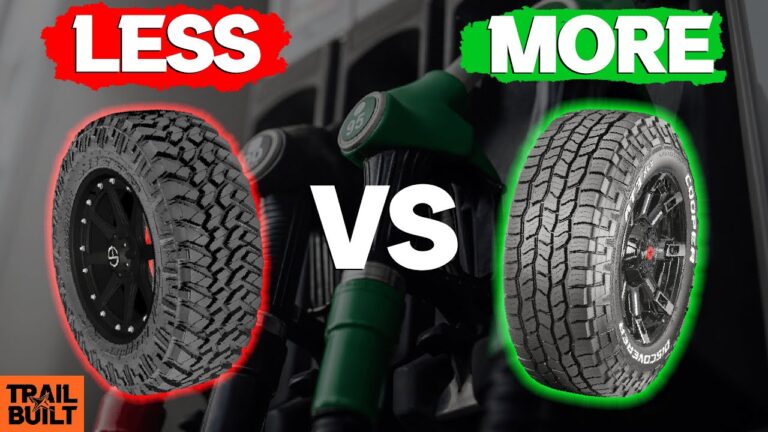
All-terrain tires can reduce fuel economy because they often weigh more, flex differently, and use deeper tread than highway tires. Their open tread blocks also create more movement and air resistance as they roll.
The main factors are:
- Rolling resistance: The energy needed to keep the tire moving.
- Tire weight: Heavier tires require more energy to accelerate.
- Tread depth: Deep, flexible tread can create more heat and movement.
- Tire width: Wider tires may increase contact with the road and air drag.
- Load range: A heavy-duty tire may weigh more and use stiffer construction.
- Inflation pressure: Low pressure increases rolling resistance and heat.
- Wheel size: A large wheel with a heavy tire can add rotating mass.
A rugged tire is like a hiking boot. It protects your foot and grips rough ground, but it takes more effort to move than a light road shoe. An all-terrain tire makes a similar trade: more traction and strength in exchange for some efficiency.
The difference is not the same for every vehicle. A compact SUV with small tires may show a smaller fuel penalty than a heavy pickup fitted with oversized, load-range-E tires.

The best all-terrain tires for fuel economy
1. Continental TerrainContact A/T: best overall choice
The Continental TerrainContact A/T is a strong fit for drivers who spend most of their time on American highways, city streets, and paved rural roads. Its tread is less aggressive than a mud-terrain tire and many traditional off-road A/T designs.
That road-focused shape can help limit tread squirm and rolling resistance. It also tends to produce less noise and vibration than a highly open tread.
Choose it if you need:
- Reliable traction on gravel and dirt roads
- Good wet-road manners
- Occasional snow capability, depending on size and vehicle
- A quieter ride than a rugged off-road tire
- One tire for commuting and light recreation
Do not choose it for frequent deep mud, severe rock crawling, or specialized off-road work. A less aggressive tread is part of why it can be more efficient.
See the manufacturer’s specifications at Continental Tire.
2. Falken Wildpeak A/T Trail: best for crossovers
The Falken Wildpeak A/T Trail is aimed at crossover SUVs and other vehicles that use car-based platforms. It is a better match for vehicles such as the Subaru Outback, Toyota RAV4, Honda Passport, and similar models when the owner wants more dirt-road ability without moving to a heavy truck tire.
Its design favors daily road use, light trails, and winter conditions. Because it is made for crossover applications, it may avoid some of the extra weight found in heavy pickup tires.
It is worth considering if you:
- Drive mostly on pavement
- Travel on gravel, forest roads, or maintained trails
- Want stronger sidewall protection than a standard touring tire
- Need snow traction in parts of the United States
- Do not tow or haul heavy loads
Always check the exact size and load rating for your vehicle. A tire that fits the wheel may still be wrong for the vehicle’s required load capacity.
Read the product details at Falken Tire.
3. Yokohama Geolandar A/T G015: best balanced truck and SUV option
The Yokohama Geolandar A/T G015 is designed for a broad range of SUVs and pickups. It offers a more traditional all-terrain look than some road-focused models, while remaining suitable for regular highway use.
Its balance makes it useful for drivers who split time between pavement, gravel, snow, and mild off-road routes. However, the exact fuel effect depends heavily on the chosen size and load range.
A standard-load version may be more efficient than a heavier LT, or Light Truck, version. Two tires with the same name can have very different weights and construction.
This tire fits drivers who need:
- A wide selection of SUV and truck sizes
- Moderate off-road traction
- Highway use with occasional trail driving
- A more durable casing than a standard highway tire
Check the exact tire weight, load range, and speed rating before buying. Product information is available from Yokohama Tire.
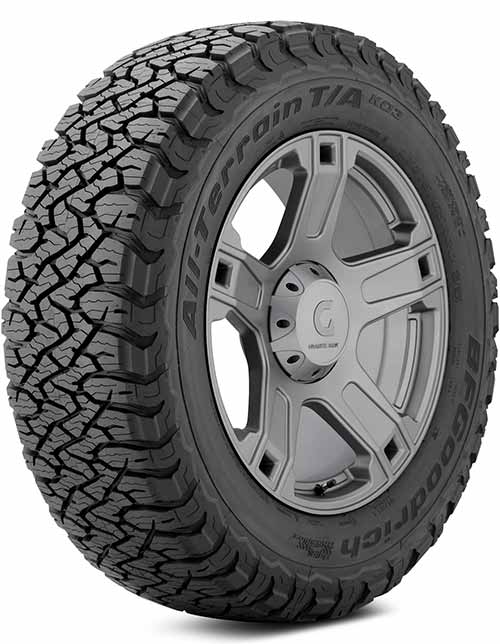
4. BFGoodrich Trail-Terrain T/A: best for pavement, gravel, and snow
The BFGoodrich Trail-Terrain T/A is a road-oriented all-terrain tire. It is less focused on mud and rock than the company’s more aggressive off-road products.
That makes it a sensible option for drivers who want an all-terrain appearance and extra traction on gravel, grass, snow, and unpaved roads without accepting the full penalty of a mud-focused tire.
It may suit you if you:
- Commute daily
- Drive on snowy roads
- Use gravel roads often
- Want a quiet ride
- Rarely face deep mud or sharp rocks
The tire may carry the Three-Peak Mountain Snowflake symbol in applicable sizes. That symbol indicates the tire passed a standardized severe-snow traction test; it does not mean the tire is equal to a dedicated winter tire in every condition.
See size and specification information at BFGoodrich.
5. Michelin Defender LTX M/S 2: best if you do not need a true A/T tire
The Michelin Defender LTX M/S 2 is not a conventional all-terrain tire. It is a highway all-season tire for many pickups and SUVs.
If your “off-road” use means paved roads, gravel driveways, maintained dirt roads, and occasional light snow, a highway tire may be the better fuel-saving choice. It generally has a smoother tread pattern than a true A/T tire.
This is the important question: Do you need an all-terrain tire, or do you only want the look and extra toughness?
A highway tire may be better when you:
- Drive almost entirely on pavement
- Do not need deep-snow or mud traction
- Want low noise and smooth handling
- Care more about fuel economy than trail grip
View the manufacturer’s specifications at Michelin.
How to choose an all-terrain tire without losing too much fuel economy
Start with your actual driving surface, not the tire’s appearance.
If you drive 90% on pavement
Choose a road-focused A/T or highway tire. The Continental TerrainContact A/T, BFGoodrich Trail-Terrain T/A, or Falken Wildpeak A/T Trail may fit better than an aggressive tire with large tread blocks.
If you drive on gravel and dirt every week
Choose a balanced A/T tire with suitable sidewall protection. The Yokohama Geolandar A/T G015 is one option to compare. Focus on the correct size and load range rather than choosing the heaviest tire available.
If you drive through deep mud or rough rock
Fuel economy should not be the main selection factor. You may need a more aggressive A/T or mud-terrain tire. Expect more noise, weight, tread wear, and fuel use.
If you drive in severe winter conditions
Look for the Three-Peak Mountain Snowflake, also called the 3PMSF symbol, when severe-snow performance matters. Even then, a dedicated winter tire can provide better cold-weather grip than an all-terrain tire.
If you tow or haul
Use the tire size, load index, and load range required by your vehicle. Do not lower the load capacity to save weight. The correct tire must safely support the vehicle, passengers, cargo, and trailer tongue weight.

Tire size matters more than the brand name
A tire model is not one single product. Its performance can change with size, construction, load range, and speed rating.
For example, a standard-load tire in a factory size may weigh much less than an LT-rated tire that fits the same truck. An oversized tire can also change the effective gearing and speedometer reading.
Before purchase, compare:
- Original equipment size
- Tire weight
- Load index
- Load range
- Speed rating
- Overall diameter
- Section width
- Approved wheel width
Use the tire information placard on the driver’s door or the owner’s manual as your starting point. The placard lists the manufacturer’s recommended size and cold inflation pressure.
Do not select a lower load rating simply because it may be lighter. A small fuel benefit is not worth reducing the vehicle’s safety margin.
Inflation pressure can protect your fuel economy
Correct inflation is one of the simplest ways to avoid unnecessary fuel loss. Underinflation increases tire flex and rolling resistance. It can also raise heat buildup and cause uneven wear.
Use the vehicle maker’s recommended cold pressure, not the maximum pressure molded into the tire sidewall. The sidewall value is generally the maximum pressure associated with the tire’s rated load, not a universal setting for your vehicle.
Check pressure:
- At least once each month
- Before a long trip
- When the tires are cold
- After major temperature changes
- When carrying a heavy load, using the vehicle maker’s instructions
The U.S. Department of Energy explains that proper tire inflation can improve fuel economy and reduce tire wear. See its guidance at FuelEconomy.gov.
A tire-pressure monitoring system can warn you when pressure is low, but it may not warn you about a small loss that still affects wear and efficiency. A hand gauge remains useful.

How much gas mileage will an all-terrain tire cost?
There is no reliable universal answer. A tire change can affect fuel economy, but the result depends on the vehicle, tire size, pressure, weather, road surface, driving speed, payload, and tire condition.
A simple way to estimate the effect is:
Fuel used per mile = 1 ÷ miles per gallon
For a hypothetical example, a vehicle that gets 24 mpg uses about 0.0417 gallons per mile. If a tire change reduces mileage to 23 mpg, fuel use rises to about 0.0435 gallons per mile. That is an increase of about 4.3% in fuel used per mile.
This example is only a calculation. It is not a claim that every A/T tire will reduce fuel economy by 4.3%.
To compare tires fairly:
- Record baseline fuel use over several tanks.
- Keep tire pressure at the correct cold setting.
- Use the same tire size.
- Compare similar routes and weather.
- Avoid comparing a winter month with a summer month.
- Reset the comparison after the tires have been broken in.
- Use fuel purchased and miles driven, not only the dashboard estimate.
A single tank is too noisy to prove a tire difference. Wind, traffic, idling, and driving style can hide the effect.

Common mistakes that hurt fuel economy
Choosing an oversized tire
A larger tire may add weight and alter gearing. It can also rub suspension parts or bodywork. Confirm fitment with the vehicle maker, tire shop, or a qualified installer.
Buying a heavy LT tire for a light-duty vehicle
LT tires can be useful for towing, hauling, and demanding work. They are not automatically better for a commuter SUV. Extra casing material can increase weight and reduce ride comfort.
Using the maximum sidewall pressure
The maximum sidewall number is not the same as the vehicle’s recommended pressure. Follow the door-placard value unless a qualified professional gives vehicle-specific instructions for a special load.
Picking the most aggressive tread
Deep, open tread can look capable but may cost fuel, create noise, and wear faster on pavement. Match the tread to the terrain you actually use.
Ignoring alignment
Bad alignment can cause uneven wear and extra rolling resistance. If the steering wheel is off-center or one tire wears faster than the others, have the vehicle inspected.
Expecting tire pressure to fix every problem
Poor fuel economy can also result from a dragging brake, bad wheel bearing, engine fault, roof cargo, low temperatures, or a change in driving pattern. Do not keep adding air to solve a mechanical issue.

Frequently asked questions
Are all-terrain tires bad for gas mileage?
No. They are usually less efficient than comparable highway tires, but the difference varies. A mild, road-focused A/T tire at the correct size and pressure may have a smaller effect than a heavy, oversized, aggressive tire.
Is a highway tire better than an all-terrain tire for fuel economy?
Usually, yes. Highway tires generally use smoother tread and lighter construction. The trade-off is less traction and protection on loose surfaces.
Does a wider tire use more gas?
It can, but width is only one factor. Tire weight, tread design, pressure, construction, and diameter also matter. Compare the complete tire specification rather than width alone.
Do all-terrain tires improve traction in rain?
Not always. Wet traction depends on rubber compound, tread design, tread depth, temperature, and road conditions. An aggressive tread does not automatically mean better wet braking.
Should I use a 3PMSF all-terrain tire instead of winter tires?
A 3PMSF-marked A/T tire meets a severe-snow traction standard, but it may not perform like a dedicated winter tire on ice or very cold pavement. Drivers in areas with frequent snow and ice should compare winter tires as well.

Final recommendation
For most U.S. drivers who want one tire for commuting, highways, gravel, and light trails, start with the Continental TerrainContact A/T. For a crossover SUV, compare it with the Falken Wildpeak A/T Trail. For a pickup or larger SUV, also check the Yokohama Geolandar A/T G015 and BFGoodrich Trail-Terrain T/A in the vehicle’s original size.
If nearly all your driving is on pavement, a highway tire such as the Michelin Defender LTX M/S 2 may save more fuel than any true all-terrain tire.
Before buying, confirm the original tire size, load rating, tire weight, cold pressure, and winter requirements. The most fuel-efficient all-terrain tire is usually not the most aggressive one. It is the lightest, least rugged tire that safely handles the roads you actually drive.
