

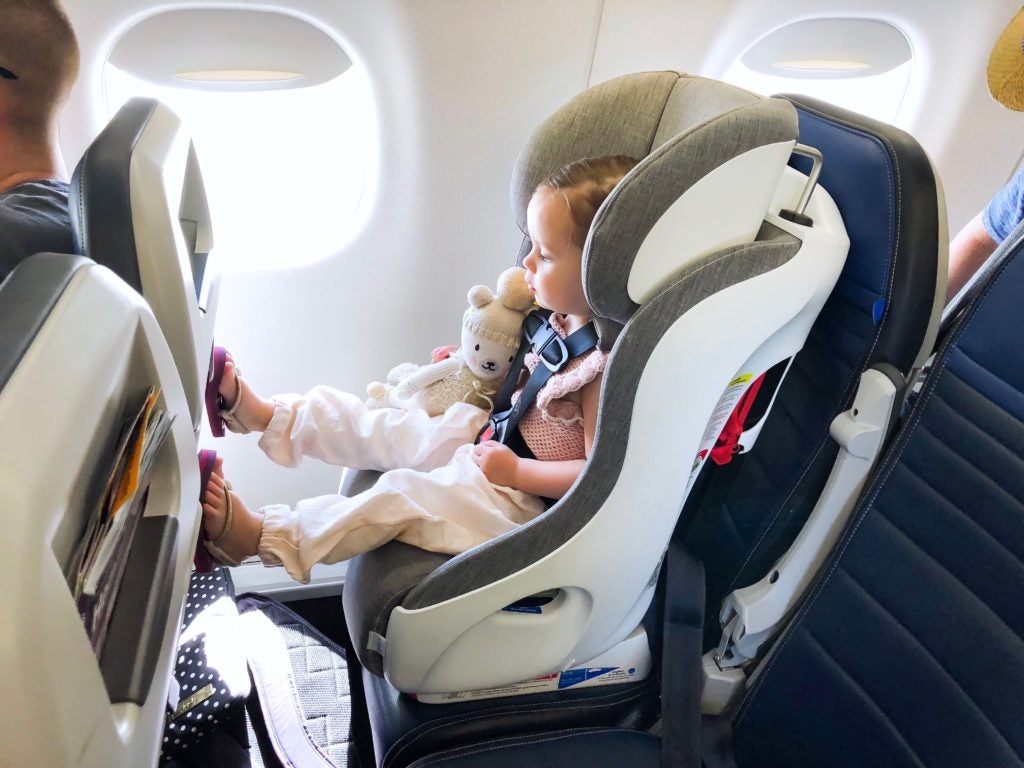
Yes. You can take a car seat on a plane in the United States, and the Federal Aviation Administration (FAA) strongly recommends using an approved child restraint system (CRS) for children who have their own seats.
Your car seat must meet FAA requirements, fit the aircraft seat, and be used according to its instructions. A child may also travel as a lap infant under age 2, but that is not the same as using a car seat on board. For the best protection during flight, the FAA recommends buying a separate seat and securing the child in an approved restraint.
What the FAA Says About Car Seats on Planes
The FAA allows an approved car seat to be used during a U.S. flight when the child has a ticketed seat. Airlines generally must permit an approved child restraint system if it meets federal requirements and fits the aircraft seat.
Look for a label on the car seat that says one of the following:
- “This restraint is certified for use in motor vehicles and aircraft.”
- “This child restraint system conforms to all applicable Federal Motor Vehicle Safety Standards.”
- A similar statement showing compliance with Federal Motor Vehicle Safety Standard 213, often called FMVSS 213.
The exact wording may vary by manufacturer. Check the label, the owner’s manual, and the manufacturer’s website before your trip.
A car seat approved for use in a vehicle is not automatically suitable for an airplane. The aircraft-use label matters because airplane seats and seat belts differ from vehicle seats.
Can a child sit in a car seat on an airplane?
Yes. A child can sit in an approved car seat on an airplane if:
- The child has a ticketed seat.
- The car seat has an aircraft-use approval label.
- The car seat fits the aircraft seat.
- The car seat is installed according to its instructions.
- The seat is not placed in an exit row.
The child should remain properly secured whenever the aircraft is moving, during takeoff and landing, and whenever the seat belt sign is on.
Does a car seat count as carry-on luggage?
Usually, no—when you use it in the child’s seat. It becomes part of the passenger’s onboard seating equipment rather than a loose carry-on bag.
If you bring a car seat but do not use it on the aircraft, the airline may count it as checked luggage or carry-on baggage. Baggage rules vary, so check your airline’s policy before leaving for the airport.
Which Car Seats Are Allowed on an Airplane?
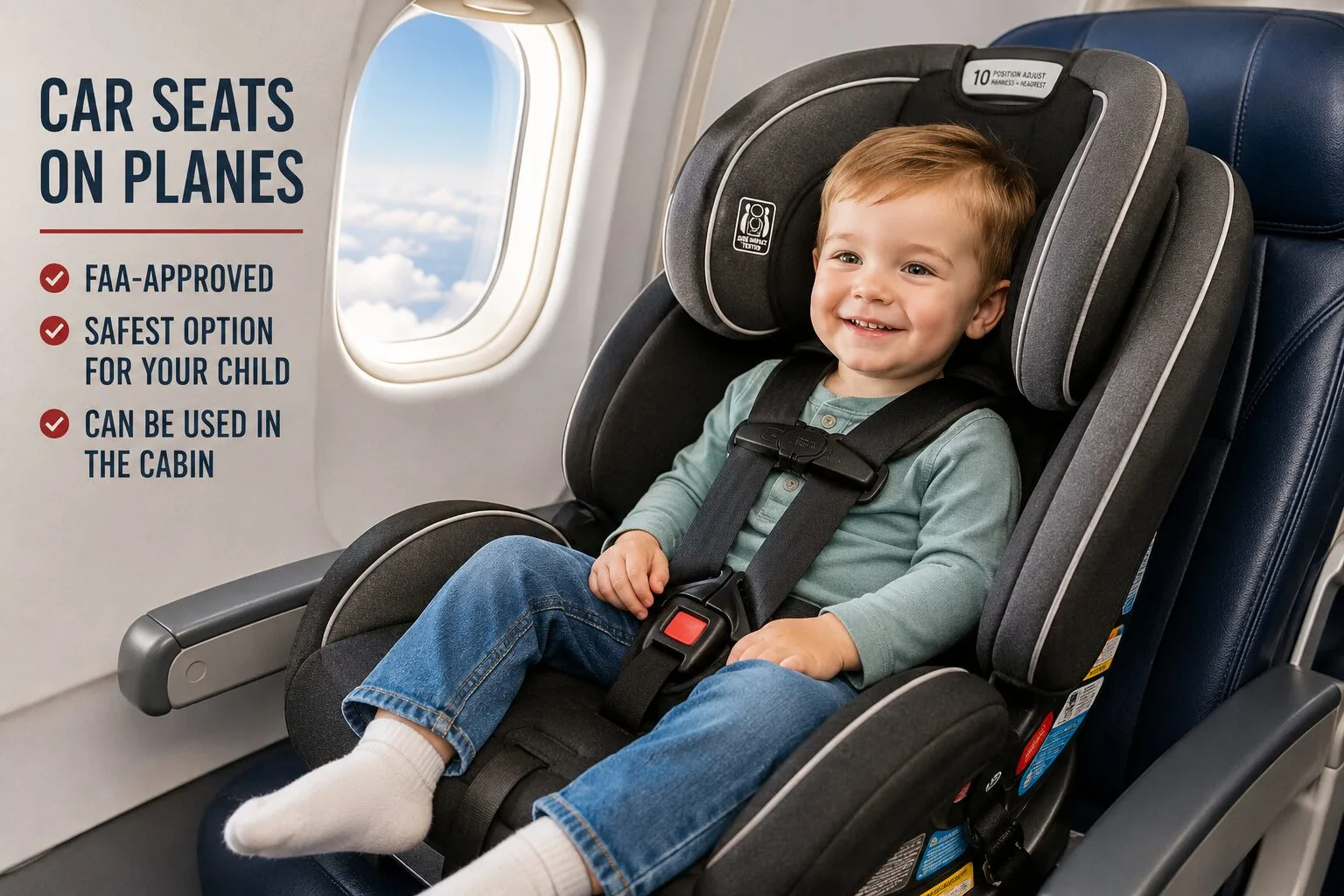
Most FAA-approved child safety seats can be used on an airplane, including many rear-facing infant seats, convertible car seats, and forward-facing harnessed seats.
The seat must be installed with the aircraft’s lap belt. Aircraft seats usually do not have the lower anchors or top tether used in many vehicles.
Car seat types and airplane use
| Car seat type | Usually allowed on a plane? | Key condition |
|---|---|---|
| Rear-facing infant seat | Yes | Must have an aircraft-use approval label and fit the seat |
| Rear-facing convertible seat | Yes | Follow the manual’s aircraft instructions |
| Forward-facing harness seat | Yes | Use the aircraft lap belt through the approved belt path |
| Combination seat with harness | Often | Use the harness if allowed; do not use booster mode onboard |
| Booster seat | Generally no for takeoff and landing | Aircraft seats do not provide the needed shoulder belt |
| Backless booster | No | Not designed for aircraft lap belts |
| FAA-approved CARES harness | Yes, for eligible children | Must meet the device’s weight and use limits |
| Travel vest or harness without FAA approval | No | Do not use it as an aircraft restraint |
A booster seat is different from a harnessed car seat. A booster raises a child so the vehicle’s shoulder belt fits correctly. Since airplane seats normally have only a lap belt, a booster does not provide the same protection and generally cannot be used during taxi, takeoff, or landing.
The FAA-approved CARES child aviation restraint is a separate product. It is designed for some children who are too large for a car seat but still need a restraint. Follow the current manufacturer instructions and weight range.
What if the car seat was made outside the United States?
The FAA may accept certain child restraints approved under the standards of another country or the United Nations. However, acceptance can depend on the specific label and approval.
If the seat does not clearly show an accepted aircraft-use certification, contact the airline before travel. A foreign car seat may be legal for use in a vehicle but still be refused for use in the aircraft cabin.

How to Install a Car Seat on a Plane
Install the car seat in the aircraft seat using the airplane’s lap belt. Do not use the vehicle’s lower anchors, top tether, or an aftermarket attachment unless the car seat manufacturer and airline specifically allow it.
Before you fly
Complete these checks before the trip:
- Read the car seat manual. Find the section about aircraft installation.
- Check the certification label. Confirm that the seat is approved for aircraft use.
- Measure the seat’s width. Compare it with the airline’s published seat width if available.
- Confirm the child’s position. Check whether the child should face the front or rear based on the seat manual.
- Ask the airline about unusual equipment. This is especially useful for wide seats, harness systems, international travel, or small aircraft.
- Practice with a lap belt. A rolled towel or similar item should not be used unless the manual permits it.
At the airport
Arrive early. Tell the gate agent that your child will use an approved car seat in a purchased seat.
If the car seat is too wide for the aircraft seat, the airline may ask you to move seats or check the car seat. This is one reason to verify the aircraft and seat details in advance.
If you are traveling with an infant car seat and stroller, ask whether the airline permits gate checking. Policies differ, and some airports require certain items to be placed in protective bags.
On the aircraft
Follow these steps:
- Place the car seat in the assigned seat.
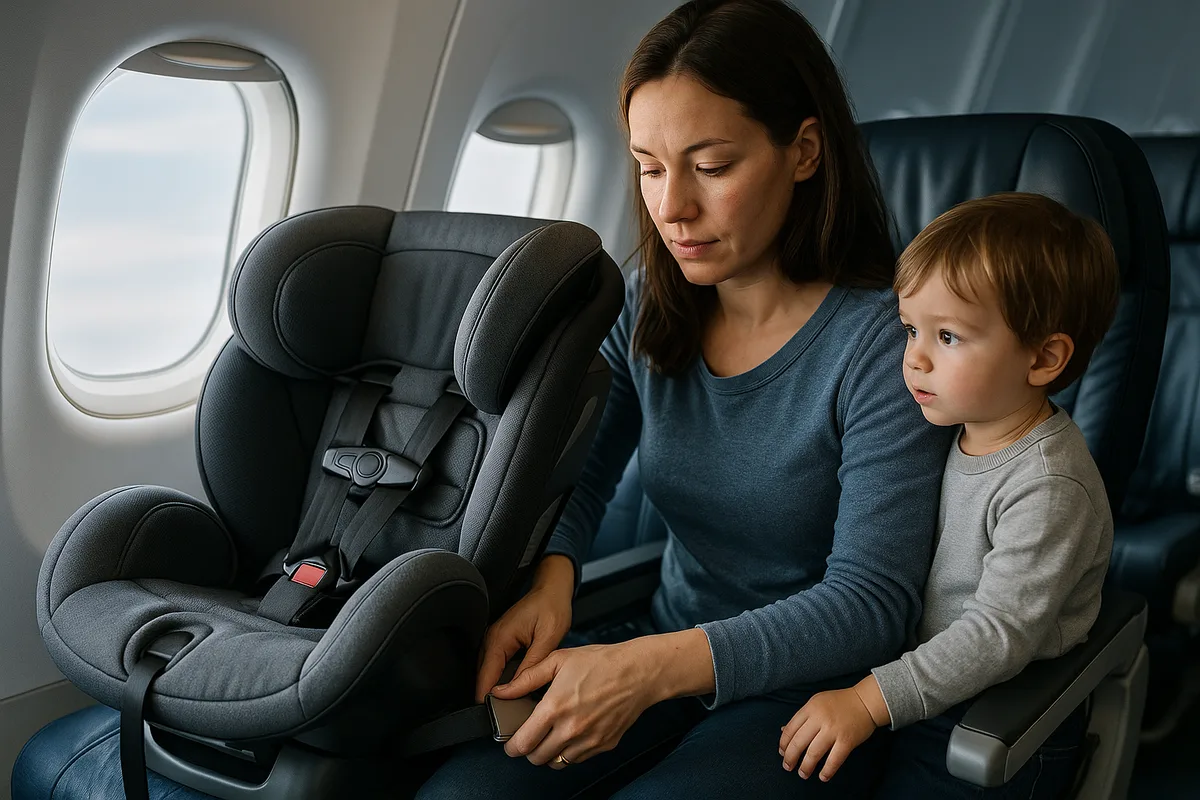
- Route the aircraft lap belt through the belt path marked in the car seat manual.
- Buckle the belt and remove slack.
- Check that the belt is not twisted.
- Confirm that the car seat sits flat and does not press against the seat in front.
- Secure the child using the car seat’s internal harness.
- Check the harness height, chest clip position, and snugness.
- Keep the car seat installed for the flight unless the crew gives a different instruction.
The aircraft seat belt must hold the car seat firmly. Do not place the aircraft belt across the child’s body instead of using the car seat harness.
How do you know the installation is secure?
A properly installed car seat should not move freely from side to side or front to back when checked at the belt path. The exact amount of movement allowed depends on the car seat manufacturer’s instructions.
If the seat shifts significantly, loosen the belt, reposition the seat, and tighten it again. Ask a flight attendant for help if you cannot achieve a secure fit. Do not improvise with blankets, clips, luggage straps, or other items.

Where Should a Car Seat Go on an Airplane?
A car seat should usually go in a window seat. This lets other passengers reach their seats without climbing over the restraint during an evacuation.
A car seat may sometimes be placed in another non-exit-row seat, depending on the airline and aircraft layout. The final decision belongs to the airline crew.
Seats to avoid
Do not place a car seat:
- In an exit row.
- In a seat directly in front of or behind an exit row if the airline prohibits it.
- Where it blocks access to the aisle.
- Where it prevents another passenger from reaching their seat.
- In a seat that is too narrow for the restraint.
- In a location restricted by the airline’s safety procedures.
A rear-facing car seat may touch or limit the recline of the seat in front. That does not automatically make it unsafe, but it can create a seating problem. A flight attendant may ask you to change seats if the setup affects another passenger or the aircraft’s operation.
Can you use a car seat in a bulkhead row?
Sometimes, but it depends on the aircraft and airline. Bulkhead seats may have fixed armrests, limited space, or special storage rules. A rear-facing car seat may not fit well in the available legroom.
Ask the airline before choosing a bulkhead seat. Do not assume a seat map accurately shows the space needed for your car seat.

Do You Have to Buy a Seat for Your Baby?
In the United States, a child under age 2 may often travel as a lap infant if the airline permits it. However, the FAA recommends buying a separate seat and using an approved child restraint.
A lap infant is not protected by an adult’s arms during severe turbulence, sudden braking, or an emergency. Holding a baby may feel secure, but an adult may not be able to keep hold during a sudden force.
Buying a seat also gives you a place to use the car seat throughout the flight. The same car seat can then be used in a rental car, taxi, or family vehicle after landing.
What is the safer choice?
For most families, the safer setup is:
- Buy a separate seat for the child.
- Bring an FAA-approved car seat.
- Install the seat according to the manual.
- Keep the child harnessed during the flight.
This setup costs more than traveling with a lap infant. The trade-off is added protection and a familiar restraint for the ground portion of the trip.
What documents might you need?
For domestic travel, airlines may ask for proof of a child’s age, especially when the child is traveling as a lap infant. Rules vary by airline.
For international travel, the child will need the travel documents required by the destination and return country. A passport is commonly required for international air travel, including for infants.
Check the airline and U.S. Department of State guidance before the trip. Do not rely only on a birth certificate for international travel.

Airline Rules Can Add Practical Limits
Federal rules and airline procedures work together. An approved car seat may be allowed in principle, but the airline can still apply reasonable seating and operational requirements.
Before travel, check the airline’s rules for:
- Seat width and aircraft type.
- Window-seat requirements.
- Exit-row restrictions.
- Lap infants.
- Gate checking.
- Strollers and car seat combinations.
- International flights.
- Regional or smaller aircraft.
- Seat changes after a schedule or aircraft change.
Why should you call the airline?
Calling is especially helpful when:
- Your car seat is wide.
- You plan to use a rear-facing convertible seat.
- You are flying on a small regional aircraft.
- You have a combination seat or special harness.
- Your itinerary includes more than one airline.
- You are traveling outside the United States.
- You want to confirm the aircraft seat width.
Ask the representative to record the question in your reservation if possible. Still, bring the car seat’s approval label and manual. Airport and cabin crews may need to inspect them.
What if a crew member challenges the car seat?
Stay calm and show the approval label. Ask the crew member to review the aircraft-use certification and the airline’s child restraint policy.
If the issue is seat location, cooperate with a move to an approved seat. If the issue is whether the car seat is certified for aircraft use, do not argue based only on the fact that it is legal in a car. The label and documentation are what matter.

Should You Check a Car Seat at the Gate?
You can usually check a car seat, but using it in the aircraft cabin is generally preferable when your child has a ticketed seat.
Checked baggage can be exposed to drops, crushing, dirt, and rough handling. A visible crack or damaged harness may not be easy to find after the trip.
If you must check the seat:
- Place it in a strong protective bag.
- Remove loose parts that the manufacturer says may be removed.
- Add your name and contact details.
- Take photographs before handing it over.
- Inspect the seat before using it again.
- Do not use it if the shell, harness, buckle, or belt path is damaged.
Contact the car seat manufacturer if you find damage. The manufacturer can tell you whether the seat should be replaced.
Can you use a car seat without the base?
Many infant car seats can be installed without their vehicle base, but the manual must allow this method. On an airplane, the seat is secured with the aircraft lap belt, not with the infant seat base.
Do not bring the base into the aircraft seat unless the manufacturer specifically permits that use. The base may be too wide or may not have an approved aircraft installation method.

Common Mistakes to Avoid
The most common problems come from confusing vehicle use with aircraft use.
Avoid these mistakes:
- Bringing a car seat without an aircraft-use label.
- Assuming every booster seat can be used on a plane.
- Using lower anchors or a top tether.
- Holding a child in a car seat on your lap.
- Installing the car seat in an exit row.
- Using a seat that is too wide for the aircraft seat.
- Routing the lap belt outside the approved belt path.
- Using a car seat after it has been damaged.
- Ignoring a manufacturer’s expiration date.
- Waiting until boarding to discover that the seat will not fit.
- Relying on a third-party strap or attachment not approved by the manufacturer.
- Removing the child from the harness during taxi, takeoff, or landing.
A car seat cannot protect a child if it is loose, damaged, incorrectly routed, or used outside its instructions.

A Simple Packing and Boarding Checklist
Use this checklist before leaving home:
Car seat
- Aircraft-use approval label is visible.
- Owner’s manual is packed or available on your phone.
- Harness and buckle work correctly.
- Seat is not expired or damaged.
- Seat width has been checked.
- Installation has been practiced with a lap belt.
Airline and airport
- Child has a ticketed seat if using the car seat onboard.
- Airline policy has been reviewed.
- Seat location is not in an exit row.
- Stroller and gate-check rules are understood.
- Travel documents are ready.
- Extra time has been allowed for boarding and installation.
During boarding
- Car seat is placed in an approved seat.
- Aircraft lap belt uses the correct belt path.
- Car seat is secure.
- Child’s harness is snug.
- Loose items are stored safely.
- Flight crew instructions are followed.
Frequently Asked Questions
Can you take a car seat on a plane for free?
Airlines often allow a car seat to be brought onboard when the child has a purchased seat, but baggage and gate-check rules vary. A car seat checked as baggage may be free on some airlines and subject to fees on others. Check the operating airline’s current policy.
Can you use a rear-facing car seat on an airplane?
Yes, if the car seat is approved for aircraft use and fits the aircraft seat. The seat may reduce the recline of the seat in front, so tell the airline or gate agent if you need help finding a suitable location.
Can a 2-year-old sit in a car seat on a plane?
Yes. A 2-year-old can use an approved car seat in a ticketed aircraft seat. The child should remain within the car seat’s height and weight limits and use the harness as directed.
Can you use a booster seat on a plane?
A traditional booster seat generally cannot be used during taxi, takeoff, or landing because an airplane seat has a lap belt but does not provide the shoulder belt a booster needs. Use an approved harnessed car seat or an FAA-approved aviation restraint instead.
Can you take a car seat on an international flight?
Often, yes, but international airlines and foreign aviation authorities may apply different rules. Check every operating airline, confirm the seat’s certification, and verify the child’s travel documents before departure.
Is a car seat safer than holding a baby on a plane?
An approved car seat in the child’s own seat provides a restraint designed to stay with the child during sudden movement. A lap infant is not secured to the aircraft. The FAA recommends using an approved child restraint in a separate seat.

Final Answer: Yes, Bring the Right Car Seat
You can take a car seat on a plane in the United States. The safest and simplest plan is to buy a seat for your child, bring an FAA-approved car seat, install it with the aircraft lap belt, and place it in a permitted seat—usually a window seat outside the exit rows.
Check the label, read the manual, confirm the airline’s rules, and practice the installation before travel. If the seat does not have clear aircraft approval or does not fit the aircraft seat, do not assume it is acceptable. Contact the airline and the car seat manufacturer before your flight.
