How Does Interest Work On A Car Loan: Simple Guide
Introduction
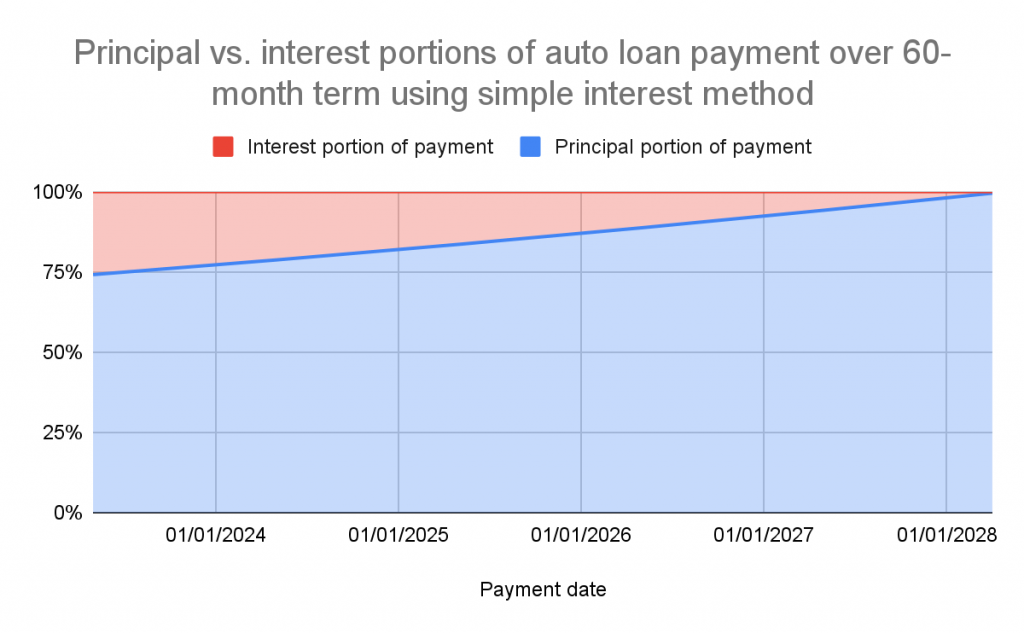
Interest on a car loan is the cost you pay to borrow money. Each month, your payment usually covers two parts: interest charged by the lender and part of the loan balance, called principal. As the principal falls, the interest charge usually falls too.
In the United States, most auto loans use simple interest with a fixed rate. The lender calculates interest on the unpaid principal balance. Your payment may stay the same each month, but the share that goes to interest and principal changes over time.
Your rate, loan term, fees, down payment, credit history, and vehicle price all affect what you pay. A longer loan may lower your monthly payment, but it often leads to more total interest.
The basic parts of a car loan
Before looking at the math, it helps to know the main terms.
- Principal: The amount you borrow.
- Interest rate: The percentage the lender charges for the loan.
- Annual percentage rate (APR): A broader measure of the loan’s yearly cost. It can include certain lender fees.
- Loan term: How long you have to repay the loan, such as 36, 48, 60, or 72 months.
- Monthly payment: The amount due each month.
- Finance charge: The total interest and certain loan charges shown in your loan disclosures.
- Total of payments: The amount you will pay over the full loan term.
The amount financed may be more than the vehicle’s advertised price. It can include items such as:
- Sales tax
- Title and registration fees
- Dealer fees
- Optional products
- A previous loan’s negative equity
- A down payment credit
A larger amount financed usually means more interest, even if the interest rate stays the same.
Interest rate versus APR
The interest rate is used to calculate interest on the loan balance. The APR is designed to show the yearly cost of borrowing, including certain finance charges.
For example, a lender might offer a loan with a 7.50% interest rate and a 7.80% APR. The difference may come from an origination fee or another finance charge.
Use the APR when comparing similar loan offers. Still, review the full disclosure because APR does not include every cost tied to buying a car. Taxes, registration, insurance, maintenance, and fuel are usually separate from the loan’s APR.

How interest is calculated on most U.S. auto loans
Most U.S. auto loans are simple-interest amortizing loans. “Amortizing” means each scheduled payment reduces the balance over time.
The lender generally calculates interest based on:
- Your current unpaid principal balance.
- Your interest rate.
- The number of days in the billing period or the lender’s stated calculation method.
A common daily interest formula is:
Daily interest = unpaid principal balance × annual interest rate ÷ 365
The exact method can vary by lender. Your contract controls the details.
A simple example
Suppose you borrow $30,000 for 60 months at a fixed 8% interest rate. Assume the loan has no added fees and payments are made on time.
The estimated monthly payment is about $608.29.
During the first month:
- Starting balance: $30,000
- Annual rate: 8%
- Approximate monthly interest: $30,000 × 8% ÷ 12 = $200
- Estimated principal paid: $608.29 − $200 = $408.29
- New balance: about $29,591.71
The next month’s interest is based on the lower balance. Using a monthly estimate:
- $29,591.71 × 8% ÷ 12 = about $197.28
More of the second payment goes toward principal. This process continues as the balance declines.
The estimated total payments are about $36,497, which means about $6,497 goes to interest over the full term.
This is a hypothetical example. Your lender may use daily interest, so the exact amount can differ based on payment dates, weekends, holidays, and the number of days in each period.
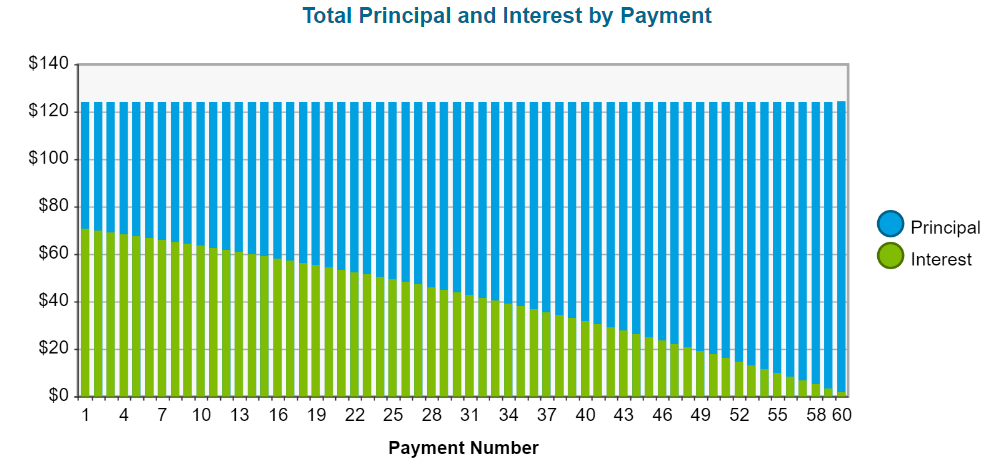
Why the payment often stays the same
A fixed-rate auto loan usually has a set payment schedule. The payment may remain close to the same amount each month, but its internal parts change.
At the start:
- More of the payment goes to interest.
- Less goes to principal.
Near the end:
- Less goes to interest.
- More goes to principal.
This does not mean the lender adds extra interest later. It means interest is being calculated on a balance that is gradually getting smaller.
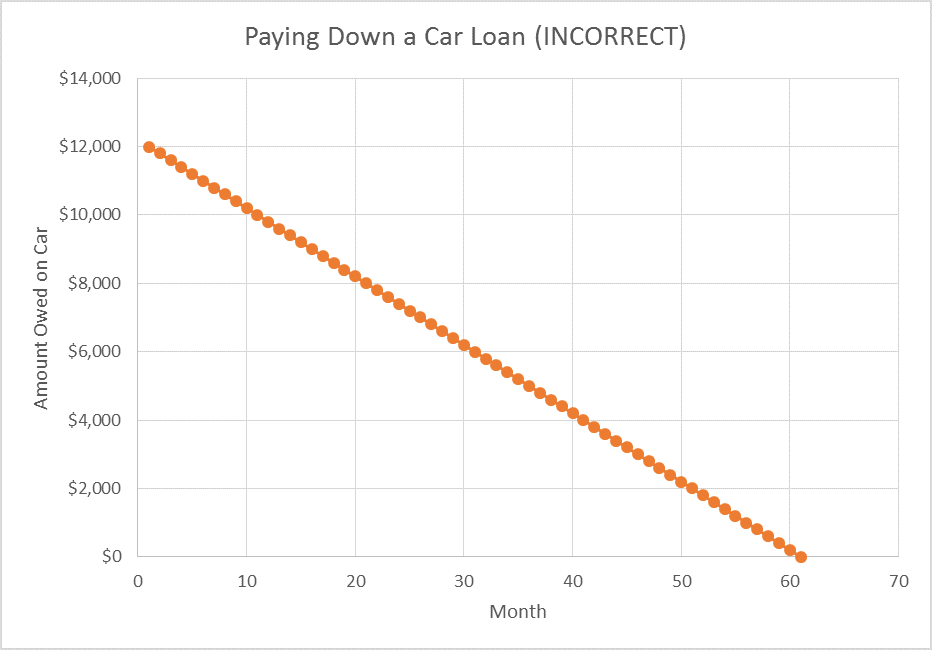
How your monthly car payment is divided
Your monthly payment may include more than principal and interest. The loan statement should show how the payment was applied.
A typical payment may be divided into:
- Interest due through the payment date.
- Principal reduction.
- Any allowed fees or past-due amounts.
If your payment is late, the lender may apply money first to unpaid charges or interest, depending on the contract and applicable law. A late payment can also lead to a late fee and credit reporting problems.
What happens when you pay extra
If your loan has no prepayment penalty, an extra payment may reduce the principal faster. That can reduce future interest because future interest is based on a smaller balance.
However, the result depends on how the lender applies the extra money. Some lenders may treat extra funds as an early payment rather than a principal-only payment.
Before sending extra money, ask:
- Will the extra amount go directly to principal?
- Is there a prepayment penalty?
- Will the due date move forward?
- Will the required monthly payment change?
- How can I label the payment?
A principal-only payment does not usually replace your next required payment unless the lender says it does. Keep making scheduled payments until the loan is paid off or the lender confirms a different arrangement.
Why the final payoff amount can surprise you
A payoff quote is not always the same as your statement balance. With daily simple interest, interest may continue to build between the statement date and the date the lender receives the payoff.
Ask the lender for a written payoff quote that includes:
- The payoff amount
- The good-through date
- Any unpaid fees
- The accepted payment method
- The lien release process
How loan term, rate, and down payment change interest
Three factors have a major effect on total interest: the amount borrowed, the rate, and the loan term.
The following hypothetical examples use a $30,000 loan at 8% APR with no fees:
| Loan term | Estimated monthly payment | Estimated total interest |
|---|---|---|
| 36 months | $939.10 | $2,847.60 |
| 48 months | $732.03 | $5,137.44 |
| 60 months | $608.29 | $6,497.40 |
| 72 months | $526.64 | $7,918.08 |
The longer loan lowers the monthly payment but raises the total interest. A 72-month loan costs about $5,070 more in interest than the 36-month loan in this example.
The effect of a larger down payment
A down payment reduces the amount you borrow. If you put $5,000 down on a $30,000 vehicle, you may finance $25,000 instead of $30,000, before taxes and other costs.
A lower balance can mean:
- Lower monthly payments
- Less total interest
- Less risk of owing more than the car is worth
- More equity in the vehicle at the start
Do not drain your emergency savings just to make a larger down payment. A smaller loan may save interest, but keeping enough cash for basic needs and repairs also matters.
The effect of your interest rate
A lower rate reduces the cost of borrowing. The rate a lender offers may depend on:
- Credit history and credit score
- Income and debt
- Loan amount
- Loan term
- Vehicle age and mileage
- New, used, or certified vehicle status
- Down payment
- Lender policies
A dealer may offer to arrange financing, but you can also apply directly with a bank or credit union. Comparing offers before visiting the dealership can give you a clear loan limit and a useful benchmark.

Dealer financing and the “buy rate”
When a dealer arranges financing, the dealer may send your application to one or more lenders. The lender may approve a particular interest rate. In some arrangements, the dealer can add a markup to the rate offered by the lender.
That markup may increase your monthly payment and total interest. Ask the dealer for:
- The name of the lender
- The approved interest rate
- The APR
- The amount financed
- The finance charge
- The total of payments
- Whether the rate includes a dealer markup
You do not have to rely only on the dealer’s financing offer. A bank or credit union may provide a direct loan offer, though approval rules and rates vary.
Compare loans by total cost
Do not compare only monthly payments. A dealer can make a payment look smaller by extending the loan term.
For example:
- Offer A: $600 per month for 60 months = $36,000 in scheduled payments
- Offer B: $500 per month for 72 months = $36,000 in scheduled payments
These two examples have the same scheduled total, but real offers may include different amounts financed, rates, fees, and taxes. The lower monthly payment alone does not prove that a loan is cheaper.
Compare these numbers side by side:
| Item | Loan offer A | Loan offer B |
|---|---|---|
| Amount financed | ||
| Interest rate | ||
| APR | ||
| Loan term | ||
| Monthly payment | ||
| Finance charge | ||
| Total of payments | ||
| Prepayment penalty |
The best comparison is based on the same amount financed and the same loan term.

What happens if you pay late?
A late payment may cause several problems:
- A late fee
- More interest before the account is brought current
- Negative credit reporting
- A higher risk of repossession if the loan becomes seriously delinquent
The contract may include a grace period, but a grace period does not always mean the payment is treated as on time for every purpose. Check the loan agreement or contact the lender.
If you may miss a payment, contact the lender before the due date. Ask about available options and get any agreement in writing. Avoid taking out a new high-cost loan to cover a payment without understanding the full cost.
What is negative equity, and why does it matter?
You have negative equity when you owe more on the car than the car is worth. This can happen when:
- You make a small down payment.
- You choose a long loan term.
- The vehicle loses value quickly.
- You roll an old loan balance into a new loan.
- The car is damaged or has high mileage.
Suppose your old loan payoff is $18,000, but the dealer offers $14,000 for the trade-in. The $4,000 difference may be added to the new loan.
You would then pay interest on the new vehicle and the old unpaid balance. This raises the amount financed and may keep you underwater for longer.
Ask for the trade-in value, old loan payoff, and negative equity as separate line items. Do not assume that a “paid-off trade” means the old balance disappeared. It may have been added to the new contract.

How to read your car loan disclosure
Before signing, review the federal Truth in Lending disclosures. The documents should show key terms such as:
- Amount financed
- Finance charge
- Annual percentage rate
- Total of payments
- Payment schedule
- Late-payment terms
- Security interest in the vehicle
- Prepayment terms, if applicable
Check that the paperwork matches the deal you agreed to. Watch for:
- A longer term than expected
- Optional products you did not request
- A higher APR than the earlier quote
- A larger amount financed
- A payment that includes rolled-in negative equity
- Fees that were not clearly explained
Do not sign blank forms. Ask for copies of every document you sign.
If the numbers do not match, pause the transaction and request an explanation. You can also contact your state attorney general, state consumer protection office, or the Consumer Financial Protection Bureau for information about complaint options.

Can you reduce the interest on a car loan?
You may reduce total interest by lowering the amount borrowed, lowering the rate, shortening the term, or paying principal sooner.
Practical steps include:
- Compare lenders before shopping. Obtain loan estimates from banks, credit unions, and other direct lenders.
- Improve your credit before applying, when practical. Pay bills on time and check credit reports for errors.
- Choose the shortest affordable term. Do not choose a payment that leaves no room for repairs or emergencies.
- Make a larger down payment if your cash position allows.
- Avoid rolling negative equity into the new loan.
- Make extra principal payments when permitted.
- Consider refinancing later. A refinance may help if your credit improves or market rates fall, but check the new term, fees, and total interest.
Refinancing to a lower payment can still increase total interest if the new loan restarts the repayment clock. Compare the new loan’s total cost with the remaining cost of your current loan.
Is refinancing always a good idea?
No. Refinancing may help when the new loan has a lower APR and reasonable fees. It may not help when:
- The new term is much longer.
- The lender charges large fees.
- Your credit has not improved.
- The vehicle is too old or has too many miles for the lender.
- You owe more than the vehicle is worth.
- The new loan has a higher rate.
Request a written payoff quote from the current lender and a complete disclosure from the new lender. Compare total remaining payments, not just the new monthly payment.

Common mistakes to avoid
Focusing only on the monthly payment
A low payment can hide a long term and a high total cost. Always review the loan term and total of payments.
Confusing APR with the interest rate
The rate and APR are related but not identical. Use both when comparing offers, and review the finance charge.
Assuming every extra payment reduces principal
Ask how the lender applies extra money. Confirm that it is credited to principal if that is your goal.
Ignoring taxes and fees
The vehicle price is not always the amount financed. Read the full buyer’s order and loan disclosure.
Skipping the payoff quote
The statement balance may not be enough to pay off a daily simple-interest loan. Get a dated payoff amount.
Buying optional products without checking the price
Service contracts, guaranteed asset protection products, credit insurance, and other add-ons can increase the amount financed. Ask whether each product is optional, what it costs, and how cancellation works.

Frequently asked questions
Does car loan interest accrue every day?
Many U.S. auto lenders calculate simple interest daily on the unpaid principal balance. The exact method is stated in your contract. Because of daily accrual, paying earlier can reduce the interest that builds between payments.
Is car loan interest front-loaded?
Interest is not usually “front-loaded” as a separate fee on a standard simple-interest loan. Early payments contain more interest because the balance is largest at the start. As the balance drops, less interest accrues.
Some loans may use different structures, such as precomputed interest. Read the contract to confirm the method.
Does paying twice a month reduce car loan interest?
It can reduce interest if the lender credits each payment when received and the extra amount reduces principal. It may not help if the lender holds partial payments or treats them only as an early payment.
Ask the lender how biweekly or split payments are handled before changing your payment schedule.
Does paying off a car loan early save money?
Often, yes. A standard simple-interest loan generally charges less future interest when the principal is paid down early. Check for a prepayment penalty and request a payoff quote first.
Can a lender change the interest rate on a fixed-rate car loan?
A fixed-rate loan normally keeps the same interest rate for the loan term. The lender may still charge permitted late fees or other contract-based amounts. Review your agreement for the rate type and any special terms.
Is a 72-month car loan a bad idea?
Not always, but it costs more interest in many cases and can increase the risk of negative equity. A 72-month term may make a vehicle fit your monthly budget, but compare the total cost and consider whether the car will remain reliable for the full term.

Conclusion
Car loan interest is usually charged on the unpaid principal balance. At the start of a fixed-rate loan, more of each payment goes to interest. As the balance falls, less interest accrues and more of the payment reduces principal.
To control the cost, compare APR and total payments, not just the monthly amount. Check the amount financed, avoid unnecessary add-ons, understand negative equity, and confirm how extra payments are applied.
Before signing, compare at least two written loan offers and review the Truth in Lending disclosures. If the contract does not match the deal, stop and ask questions before you sign.