

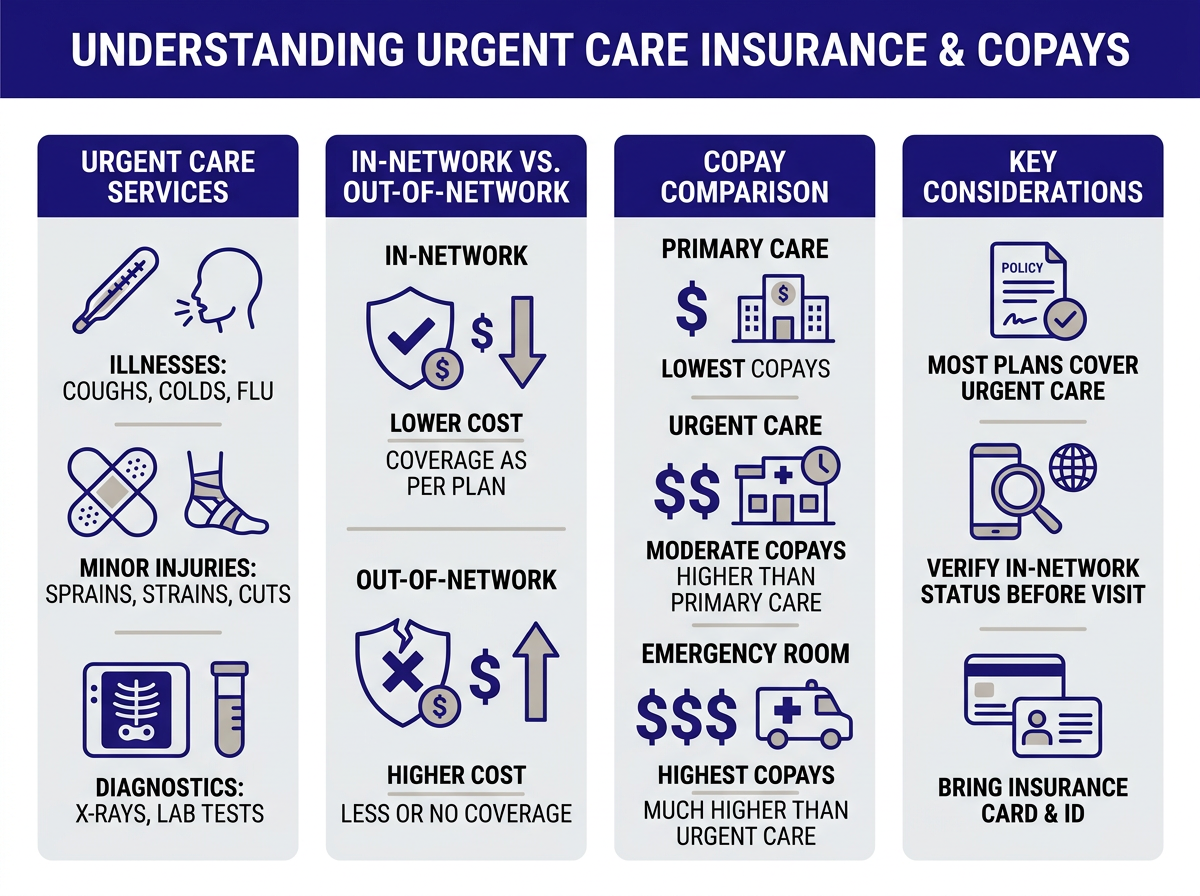
In the United States, most health insurance plans cover urgent care, but the amount you pay depends on your plan, the clinic’s network status, and the care you need. You may owe a copay, deductible, coinsurance, or the full bill if the clinic is out of network.
Before you go, check your insurance card, use your insurer’s provider directory, or call the urgent care center. Ask about the visit fee, lab work, X-rays, medicines, and network status. These extra services may have separate costs.
What does urgent care insurance cover?
Urgent care insurance usually covers treatment for health problems that need prompt attention but are not life-threatening. Common examples include:
- Minor cuts that may need stitches
- Sprains and simple fractures
- Ear infections
- Sore throats
- Fever and flu symptoms
- Mild asthma symptoms
- Urinary tract infections
- Vomiting or diarrhea without severe dehydration
- Minor burns
- Rashes and allergic reactions that are not severe
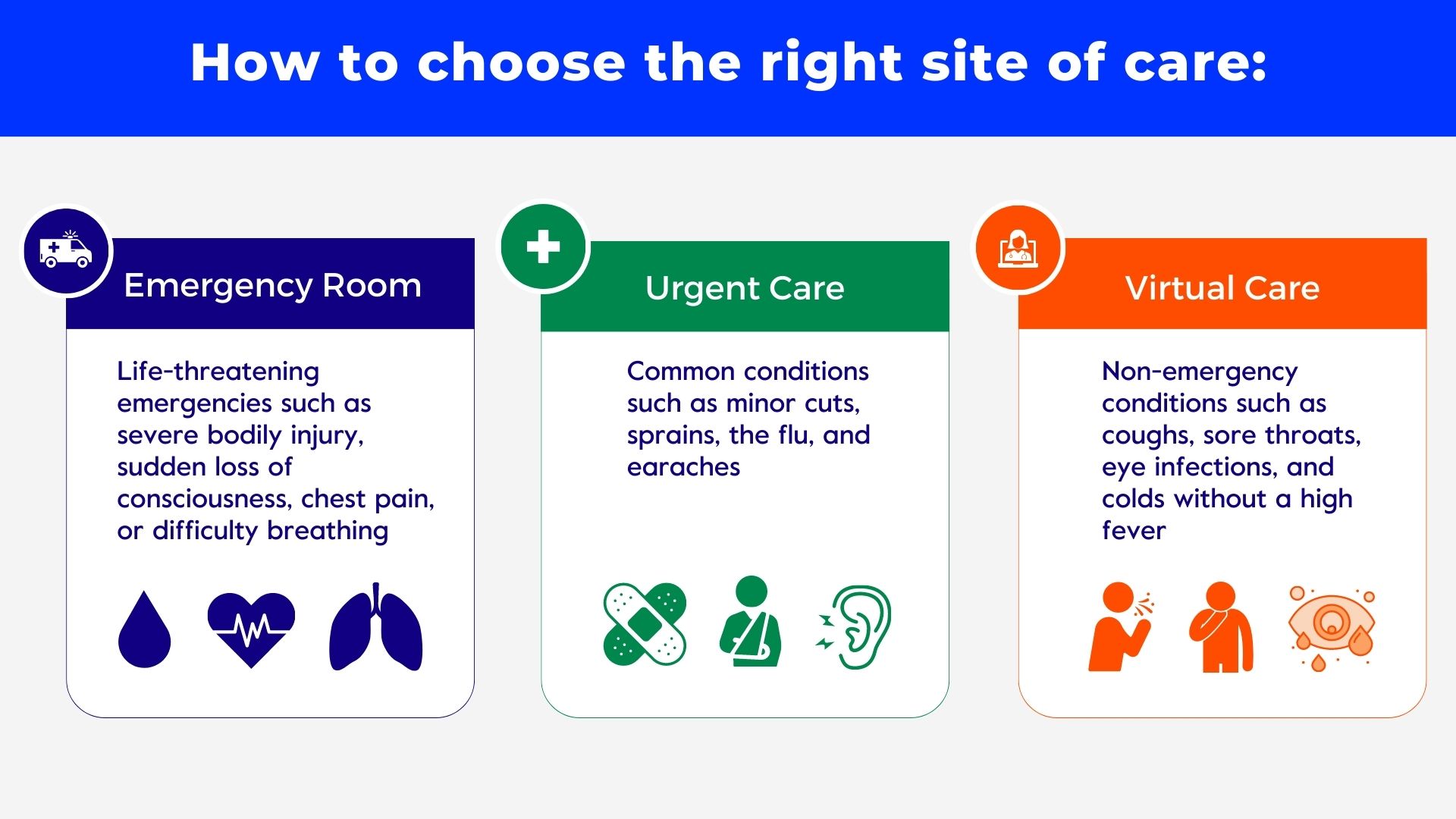
Urgent care is not a substitute for the emergency room. Go to the nearest emergency department or call 911 for signs of a serious emergency, such as chest pain, severe trouble breathing, stroke symptoms, heavy bleeding, severe burns, major injury, or loss of consciousness.
Most plans cover urgent care under their regular medical benefits. The visit may be billed as an office or outpatient service. Your plan may use a flat urgent care copay, or it may apply the visit to your deductible and coinsurance.
Coverage does not always mean the visit is free. Insurance first decides whether the service is covered. Your plan then applies its cost-sharing rules.

How much does urgent care cost with insurance?
The cost of an urgent care visit with insurance can range from a small copay to the full allowed charge. Your plan’s Summary of Benefits and Coverage gives the most reliable estimate.
Common charges include:
| Cost type | What it means |
|---|---|
| Copay | A set amount due for a covered visit |
| Deductible | The amount you pay before the plan begins to share many costs |
| Coinsurance | A percentage of the allowed cost you pay after the deductible |
| Allowed amount | The price your plan recognizes for a covered service |
| Out-of-network charge | A higher cost that may apply when the clinic does not contract with your plan |
| Balance bill | The difference between a provider’s charge and the plan’s allowed amount, when permitted |
Example: a copay plan
Suppose your plan has a $50 urgent care copay. The clinic is in network, and the visit is covered. You may pay $50 at check-in.
You could still receive another bill if the clinician orders services with separate cost rules. For example, the plan may process an X-ray, lab test, or prescription under a different benefit.
Example: a deductible plan
Suppose the allowed cost of the visit is $180 and you have not met your deductible. You may owe all or part of that $180, depending on your plan.
If your plan then applies 20% coinsurance after the deductible, you may pay 20% of the allowed amount for later covered services. The clinic’s retail charge is not always the amount used by your insurer.
Why urgent care prices differ
Your bill may change based on:
- Your insurance company
- Your specific plan
- Whether the clinic is in network
- Your remaining deductible
- Whether the visit is billed as urgent care or another outpatient service
- Lab tests, imaging, injections, or procedures
- Prescription drugs given at the clinic
- Your state’s insurance rules
A clinic’s posted self-pay price may not predict your insured cost. Ask how the clinic bills your plan and whether separate services are included.

Does insurance cover out-of-network urgent care?
Some insurance plans cover out-of-network urgent care, but usually at a higher cost. Other plans may cover little or none of the bill.
Your plan type matters:
- HMO: May require you to use network providers except in emergencies. Some HMOs cover urgent care outside the network, but you must check the plan rules.
- PPO: Often covers out-of-network care, but your deductible, coinsurance, and balance-billing risk may be higher.
- EPO: Usually requires network care except for emergencies.
- POS plan: May offer out-of-network benefits at a higher cost.
- Medicaid: Rules vary by state and managed-care plan. Use the member number on your Medicaid card to confirm coverage.
- Short-term or limited-benefit plan: Coverage may exclude some services or use different rules from ACA-compliant plans.
A clinic can be “in network” for one insurance plan and out of network for another. Confirm the exact plan name, not just the insurer’s brand.
The federal No Surprises Act protects patients from some unexpected out-of-network bills. It mainly covers emergency services and certain services received at an in-network hospital or facility. It does not mean every visit to a stand-alone urgent care clinic has the same protection.
The Centers for Medicare & Medicaid Services explains when these federal protections apply. State laws may add more protection.

How to check urgent care coverage before you go
A short check can prevent a large billing surprise. Follow these steps when your condition is safe to wait.
- Check your insurance card. Find the member services phone number and the plan name.
- Search the insurer’s provider directory. Look for urgent care centers listed for your exact plan.
- Call the clinic. Give the clinic your insurer, plan name, and member ID. Ask whether the location and treating provider are in network.
- Ask for the visit cost. Ask whether your plan uses a copay, deductible, or coinsurance.
- Ask about extra services. Confirm how the clinic bills tests, X-rays, stitches, splints, injections, and medicines.
- Ask if prior approval is needed. Most urgent care visits do not need prior authorization, but plan rules differ.
- Save your records. Keep the receipt, claim number, discharge papers, and any estimate.
Use the insurer’s directory as a starting point, but call the clinic too. Provider directories can be out of date. Ask the clinic to confirm network status for the location where you will receive care.
If you cannot verify coverage and the problem is not an emergency, ask the clinic for its self-pay price. Also ask whether it offers a written estimate or financial assistance.

What if you have Medicare?
Original Medicare generally covers medically necessary urgent care under Part B. You usually pay the Part B deductible if it applies, then 20% of the Medicare-approved amount for the service. A doctor’s office or urgent care center may also charge a facility fee in some cases.
The exact amount depends on:
- Whether the provider accepts Medicare assignment
- Whether you have met the Part B deductible
- Whether the service is medically necessary
- Whether you have Medigap or other supplemental coverage
- Whether you have Medicare Advantage instead of Original Medicare
Medicare Advantage plans must cover urgent and emergency care, but each plan sets its own network and cost-sharing rules. An Advantage plan may charge a different copay for in-network and out-of-network urgent care.
Medicare’s official urgent care coverage page can help you review the basic rules. Your plan’s member services department can give the best estimate for a specific clinic.

What if you have Medicaid?
Medicaid may cover urgent care, but the rules depend on your state and plan. Some people receive Medicaid directly through the state. Others use a managed-care organization with its own network and copay rules.
Before visiting, check:
- Whether the clinic accepts your Medicaid plan
- Whether you need to use a designated urgent care network
- Whether a copay applies
- Whether lab work and imaging are covered separately
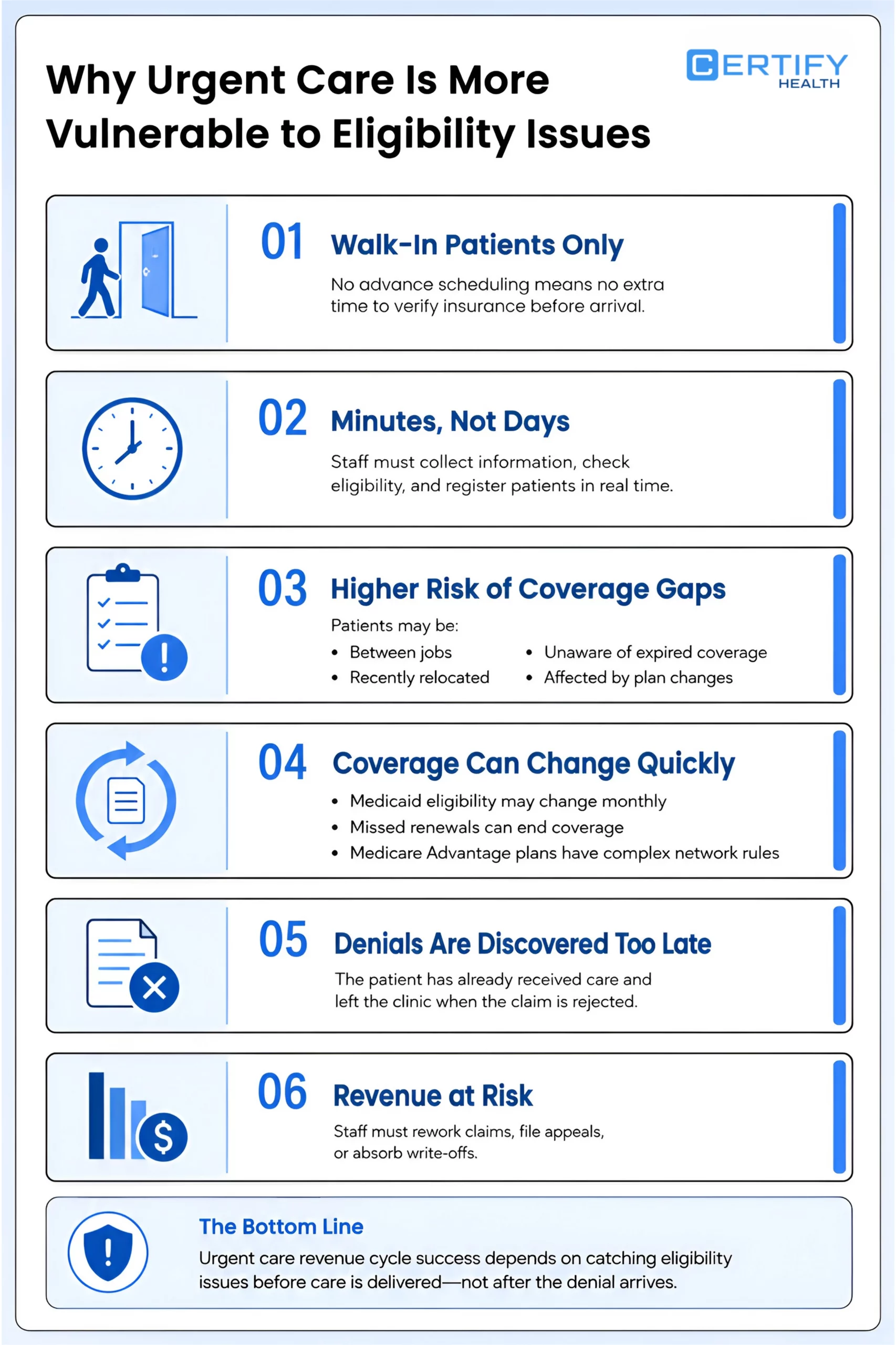
- Whether the clinic can verify eligibility on the day of care
Bring your Medicaid card and a photo ID. If the clinic cannot verify coverage, ask what happens if the claim is later denied.
You can use Medicaid.gov to find state program information. For a personal coverage answer, call the number on your plan card.

Does insurance cover urgent care without a referral?
Many insurance plans do not require a referral for urgent care. A referral may still be required by some HMO or employer plans, especially when the visit is treated as specialty care rather than basic urgent care.
A referral requirement is different from prior authorization:
- A referral is approval from another health professional, often a primary care doctor.
- Prior authorization is approval from the insurer before a service takes place.
Urgent care centers usually treat walk-in needs. However, the claim can still follow your plan’s rules. Check your member handbook or call the insurer if the visit involves a specialist, advanced imaging, or a planned procedure.
Do not delay emergency care while trying to obtain a referral. Emergency departments must evaluate emergency conditions under federal law, though the final bill can still depend on your coverage and the care provided.

Is urgent care cheaper than the emergency room?
Urgent care is often less expensive than an emergency room for a minor problem, but the final cost depends on your insurance plan and the care you need.
Urgent care is often a reasonable choice for a stable condition that needs same-day or next-day treatment. An emergency room is the safer choice when the condition may threaten life, limb, breathing, brain function, or major blood flow.
| Situation | Usual care setting |
|---|---|
| Mild fever, ear pain, or sore throat | Primary care or urgent care |
| Simple cut or minor burn | Urgent care |
| Possible broken finger with stable symptoms | Urgent care may be suitable |
| Chest pain or severe shortness of breath | Emergency department |
| Signs of a stroke | Emergency department |
| Heavy bleeding or major injury | Emergency department |
| Severe allergic reaction with trouble breathing | Emergency department or 911 |
Cost should not be the main reason to avoid emergency care. A serious condition can become more dangerous during a delay.
If you are unsure, call your doctor, your health plan’s nurse line, or 911 when symptoms may be life-threatening.
What services may cost extra at urgent care?
The visit fee may not include every service. Ask about separate billing for:
- X-rays
- Blood tests
- Urine tests
- Rapid flu, COVID-19, or strep tests
- Stitches or wound repair
- Splints, braces, or crutches
- Injections
- Prescription medicine given at the clinic
- Pathology or laboratory review
- Follow-up visits
The clinic may send some tests to an outside laboratory. That laboratory may have a different network contract from the urgent care center.
Ask these questions before treatment when possible:
- “Is the lab in network for my plan?”
- “Will this test create a separate bill?”
- “What is my estimated cost?”
- “Can I refuse a nonessential service and discuss alternatives with the clinician?”
You should not refuse a medically needed test solely because the price is unclear. Ask the clinician to explain why the test is needed and ask the billing team how it will be processed.

What to do if your urgent care claim is denied
A denied claim does not always mean you must pay the entire bill. First, read the Explanation of Benefits, or EOB. An EOB is a statement from your insurer that shows how it processed the claim. It is not usually a bill.
Look for the denial reason. Common reasons include:
- The clinic was out of network
- Your coverage was inactive on the visit date
- The claim used the wrong billing code
- The insurer needed more information
- A service was excluded
- The plan applied the cost to your deductible
- The claim was filed late
- The insurer says the service was not medically necessary
Then take these steps:
- Compare the provider bill with the EOB.
- Call the clinic’s billing office and ask it to review the claim.
- Call your insurer and request the exact denial reason.
- Ask whether the claim can be corrected and resubmitted.
- File an appeal if the denial is not correct.
- Keep copies of all letters, bills, records, and call details.
The EOB should show appeal instructions and deadlines. Follow them closely. If you have job-based coverage, you can also ask your employer’s benefits department for help.
For many employer and individual health plans, the U.S. Department of Labor and your state insurance department provide consumer information. The correct agency depends on the type of plan.

Can you use urgent care without insurance?
Yes. Urgent care centers generally treat people who do not have insurance. You will usually pay the clinic’s self-pay price.
Before treatment, ask for:
- The cash price for the visit
- The cost of likely tests
- The price of procedures, such as stitches
- Whether payment is due at check-in
- Whether a discount applies for same-day payment
- Whether a payment plan is available
The self-pay price may be lower than a listed charge, but it is not always the final amount. Outside labs, imaging centers, or prescription drugs may create separate costs.
Community health centers may offer care based on income. You can search for federally funded health centers through HRSA’s Find a Health Center tool.
Common mistakes that raise urgent care costs
Several avoidable mistakes can lead to a higher bill.
Going to a clinic that is not in your plan’s network
A clinic’s sign may display your insurer’s name without confirming your exact plan. Verify the plan before care.
Assuming the visit copay covers everything
A copay may apply only to the facility visit. Tests, equipment, and medicines can follow separate benefit rules.
Confusing an EOB with a bill
An EOB explains the insurance decision. Wait for the provider bill, then compare the two documents.
Choosing urgent care for an emergency
Urgent care may not have the equipment or staff needed for a serious emergency. Seek emergency help when symptoms are severe.
Ignoring claim deadlines
A late claim or late appeal can be harder to fix. Follow the dates listed in your plan documents.
Relying only on a directory
Provider directories can contain errors. Confirm network status with both the plan and the clinic when possible.

Quick checklist before an urgent care visit
Use this checklist if your symptoms are not an emergency:
- Confirm the clinic accepts your exact insurance plan.
- Ask for the urgent care copay or self-pay price.
- Ask whether your deductible applies.
- Ask about separate lab, imaging, and procedure charges.
- Bring your insurance card and photo ID.
- Ask how prescriptions will be handled.
- Save your receipt and visit papers.
- Review the EOB when it arrives.
- Appeal a denial if the claim appears wrong.
If you have severe symptoms, skip the cost check and seek emergency care.

Frequently asked questions
Does health insurance cover urgent care visits?
Most health insurance plans cover urgent care visits, but the amount you pay depends on your plan. You may owe a copay, deductible, or coinsurance. Out-of-network care may cost more or may not be covered.
Is urgent care covered by insurance without a copay?
Sometimes. A plan may pay the full covered cost after you meet its deductible, or it may have no copay for certain services. Many plans do charge a copay. Check your Summary of Benefits and Coverage.
Does urgent care accept Medicare?
Many urgent care centers accept Medicare, but you should confirm that the location accepts your coverage. Medicare Advantage members must also check whether the clinic is in the plan’s network.
Can urgent care bill you if the clinic says it accepts your insurance?
Yes. “Accepts” can mean the clinic will submit a claim, not that it is in network or that the service is fully covered. Ask whether the clinic is in network for your exact plan.
Will insurance cover an urgent care X-ray?
Often, but the X-ray may be billed separately from the visit. Your deductible, coinsurance, and network rules may apply. Ask whether the imaging service is performed and billed by the urgent care center or an outside provider.
Bottom line: does insurance cover urgent care?
Yes, most U.S. health insurance plans cover urgent care, but coverage is not the same as free care. Your cost depends on the plan, network status, deductible, coinsurance, and services provided.
Before you go, confirm the clinic’s network status and ask for the likely cost of the visit and any tests. If symptoms could be life-threatening, seek emergency care first and deal with the bill later.
