How Much Coolant Does My Car Need: Complete Guide
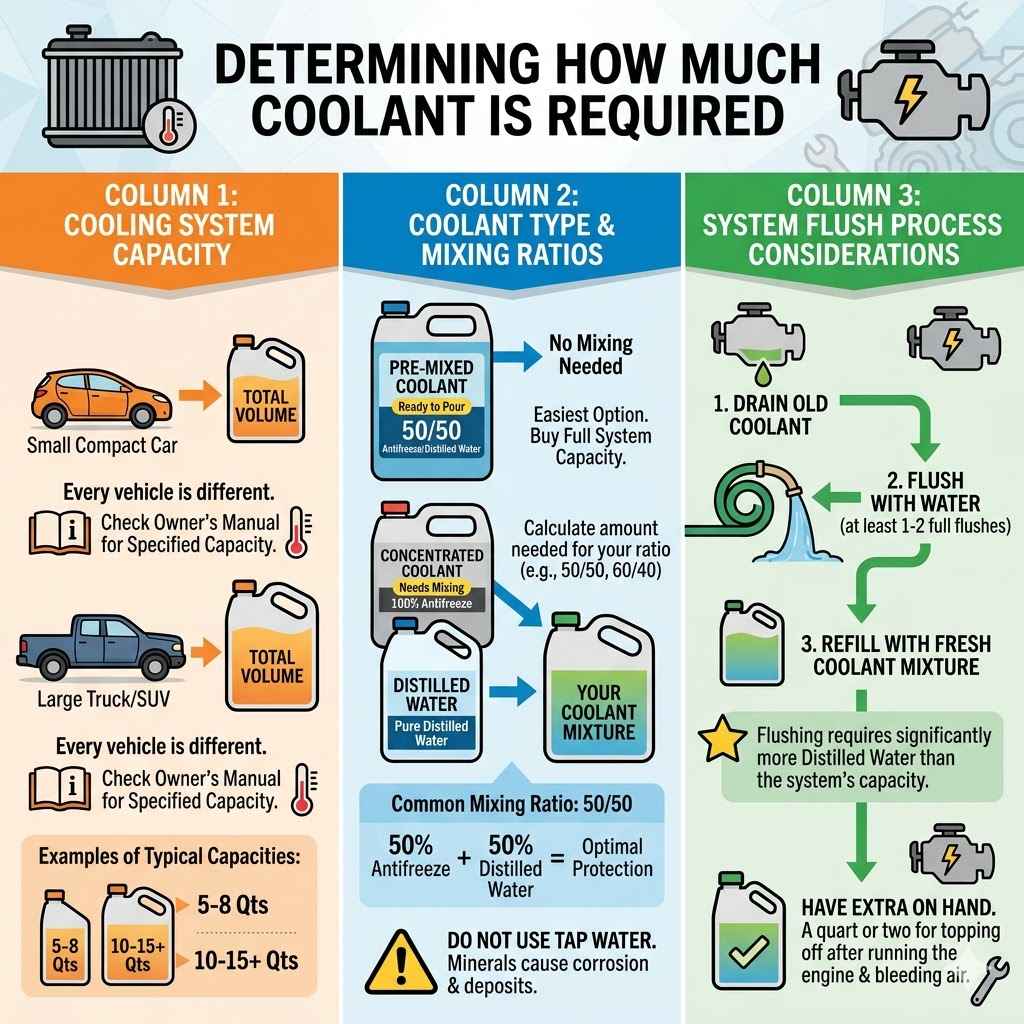
For most cars in the United States, the full cooling system holds about 1.5 to 3 gallons of coolant. Larger trucks, SUVs, vans, and some diesel vehicles may hold 3 to 5 gallons or more.
That is the full system capacity. It is not the same as the amount needed for a routine top-off. If the coolant level is only slightly low, you may need just a few ounces or a quart. If the system was drained for a repair, you must use the vehicle’s listed capacity and bleeding procedure.
The exact amount depends on your car’s year, make, model, engine, radiator, heater core, and cooling system design. Check the owner’s manual or manufacturer service information before adding coolant.
Quick answer: How much coolant should I add?
Add coolant only until the level reaches the correct mark:
- Overflow reservoir: Fill to the “COLD” or “MIN/MAX” line when the engine is cold.
- Radiator: If your vehicle has a radiator cap, fill it to the top only when the engine is completely cold.
- A drained system: Use the full capacity listed for your exact vehicle.
- A small leak or low level: Add enough to restore the correct cold level, then find and repair the leak.
Never remove a radiator or expansion-tank cap from a hot engine. Hot coolant is pressurized and can cause serious burns.
What does coolant capacity mean?
Coolant capacity is the total amount of fluid held by the engine cooling system. It includes more than the radiator.
The system may contain coolant in:
- The engine block and cylinder head
- The radiator
- The heater core
- Coolant hoses
- The expansion tank or overflow reservoir
- Additional cooling circuits on some hybrid, turbocharged, or high-performance vehicles
A vehicle’s coolant capacity may be listed in the owner’s manual, repair manual, or service information. It may appear as:
- Cooling system capacity
- Coolant capacity
- Antifreeze capacity
- Radiator capacity
- Engine coolant refill capacity
The listed amount may assume that the system is completely empty. A normal top-off requires much less.
Coolant versus antifreeze
The terms “coolant” and “antifreeze” are often used as if they mean the same thing, but they are not exactly the same.
- Antifreeze concentrate is normally mixed with water.
- Engine coolant is usually ready-to-use premixed fluid or a mixture of antifreeze and water.
- 50/50 coolant contains roughly equal parts antifreeze and water.
In most U.S. vehicles, a 50/50 mixture of the correct antifreeze and distilled water is common. Some premixed products already contain this mixture. Do not add water to premixed coolant unless the product label says to do so.
Typical coolant capacity by vehicle type
The following ranges are general estimates, not specifications for a particular vehicle.
| Vehicle type | Approximate full-system capacity |
|---|---|
| Small sedan or compact car | 1.5–2.0 gallons |
| Midsize sedan or crossover | 2.0–3.0 gallons |
| Large SUV or pickup truck | 3.0–4.0 gallons |
| Heavy-duty truck or diesel vehicle | 3.0–5.0+ gallons |
| Motorcycle or small engine | Often less than 1 gallon |
These ranges can vary widely. A small engine with a large radiator may hold more coolant than expected. A hybrid vehicle may have separate coolant loops, each with its own capacity and fluid requirement.
Use these figures only as a rough planning guide. Do not use them to fill a drained system unless the vehicle maker confirms the amount.
How much coolant is needed for a top-off?
A top-off may need:
- A few ounces if the level is just below the mark
- About 1 pint if the reservoir is noticeably low
- About 1 quart if the level has dropped substantially
- Much more if the system has a leak or was recently repaired
Do not fill by guesswork. Add a small amount at a time, wait for the fluid to settle, and recheck the level when the engine is cold.

How to check your coolant level safely
Check the coolant when the car is parked on level ground and the engine is cold. The best time is before driving or several hours after the engine has been shut off.
Follow these steps
- Park on a level surface and turn off the engine.
- Let the engine cool fully.
- Open the hood and find the coolant reservoir.
- Look for the “COLD,” “MIN,” or “MAX” marks.
- Check whether the coolant sits between the correct marks.
- If the level is low, add the correct coolant slowly.
- Replace the cap firmly.
- Check again after the next few drives.
Many modern vehicles use a translucent plastic reservoir. You can often see the coolant level without opening the cap.
Some vehicles have a pressurized expansion tank instead of a simple overflow bottle. Follow the markings and instructions in the owner’s manual. The tank may have a warning label that says not to open it while hot.
What level is correct?
The correct level depends on the tank design:
- If the reservoir has “MIN” and “MAX” marks, the cold level should usually sit between them.
- If it has a “COLD FILL” line, use that line when the engine is cold.
- If the system has a radiator cap, the radiator itself may also need to be full when cold.
- Do not fill above the maximum mark. Coolant expands as it heats.
If the coolant level keeps falling, adding more fluid is only a temporary step. A cooling system should not regularly lose coolant under normal conditions.

How to calculate the amount of coolant and water
If your vehicle uses antifreeze concentrate, you must mix it with water in the correct ratio.
A common 50/50 mixture uses:
- 1 gallon of antifreeze concentrate
- 1 gallon of distilled water
- 2 gallons of finished coolant
For a cooling system with a 2.5-gallon capacity:
- 1.25 gallons of antifreeze concentrate
- 1.25 gallons of distilled water
For a 3-gallon system:
- 1.5 gallons of antifreeze concentrate
- 1.5 gallons of distilled water
Simple formula
To calculate the amount of concentrate:
Total system capacity × antifreeze percentage = concentrate needed
For a 2.5-gallon system at a 50% mixture:
2.5 × 0.50 = 1.25 gallons of antifreeze
The remaining 1.25 gallons would be water.
Always check the product label. Some vehicles require a different ratio, and some coolants must not be mixed with other coolant types.
Why the mixture matters
Too little antifreeze can reduce freeze protection and corrosion protection. Too much antifreeze can also reduce cooling performance because concentrated antifreeze does not transfer heat as well as the correct water mixture.
For most vehicles, the practical choice is a compatible premixed 50/50 coolant. It reduces measuring errors, but it still must match the vehicle’s coolant specification.
Which coolant should you use?
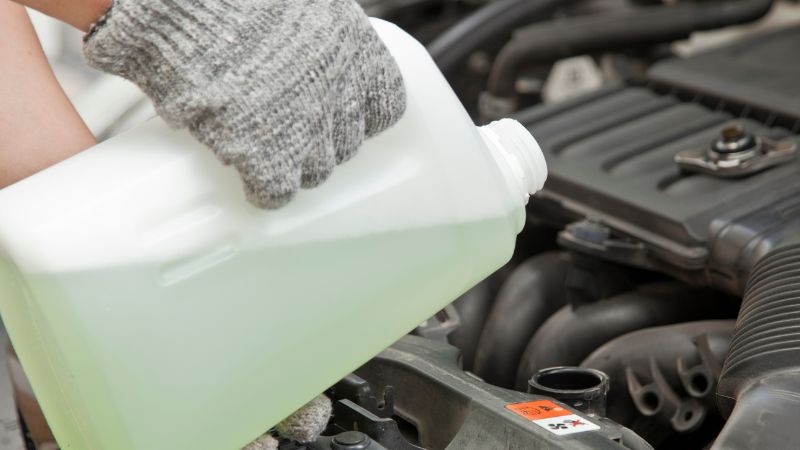
Use the coolant type specified by the vehicle manufacturer. The color is not a reliable way to identify compatibility.
Coolant colors can include:
- Green
- Orange
- Yellow
- Blue
- Pink
- Purple
Different brands may use similar colors for different formulas. Two fluids with the same color may not be compatible, while compatible fluids may have different colors.
Check:
- The owner’s manual
- The coolant specification printed on the product label
- The manufacturer’s service information
- A dealer or qualified repair shop if the specification is unclear
Do not assume that a product labeled “universal” is suitable for every vehicle. Read the product’s compatibility statement and the vehicle manufacturer’s requirements.
Can you mix different coolant types?
Mixing coolant types can reduce corrosion protection or cause deposits in some systems. It may also make it hard to know which maintenance interval applies.
If you do not know what coolant is already in the system:
- Avoid mixing large amounts of unknown coolant.
- Check the service records.
- Look up the required coolant specification.
- Have the system inspected or flushed if the fluid is contaminated or incompatible.
If the vehicle is overheating and the coolant level is dangerously low, adding clean water may help you reach a repair facility in an emergency. Once the vehicle is safe, correct the mixture as soon as possible. Water alone is not a proper long-term replacement for coolant.

How much coolant do you need after draining the system?
A completely drained cooling system usually needs close to its listed capacity, but it may not accept the full amount immediately.
Some coolant can remain trapped in:
- The engine block
- The heater core
- Hoses
- Auxiliary cooling circuits
Air pockets may also prevent the system from filling normally. After adding coolant, the engine may need a specific bleeding process. Some vehicles require a bleed screw, a vacuum filling tool, or a prescribed warm-up cycle.
General refill process
Use this as a general guide only. The vehicle’s service instructions take priority.
- Confirm the correct coolant specification.
- Let the engine cool completely.
- Drain and repair the system as required.
- Close the drain points.
- Add the correct coolant slowly.
- Open any specified bleed points.
- Fill the reservoir or radiator to the required level.
- Start the engine only if the service procedure allows it.
- Set the heater to the temperature directed by the manual.
- Watch the temperature gauge and coolant level.
- Stop if the engine overheats or coolant leaks.
- Let the engine cool and recheck the level.
Do not use the heater setting as a substitute for the manufacturer’s bleeding instructions. Vehicle designs differ.
Signs that air remains in the system
Air in the cooling system may cause:
- A gurgling sound behind the dashboard
- Weak or inconsistent cabin heat
- A fluctuating coolant level
- An overheating engine
- A temperature gauge that moves up and down
- Coolant pushed out of the reservoir
An air pocket can cause serious engine damage if it prevents proper coolant flow. Stop driving if the engine overheats, and seek professional service.
What if the coolant level keeps dropping?
A coolant level that repeatedly falls points to a leak or another cooling-system problem. Common causes include:
- A cracked hose
- A loose hose clamp
- A leaking radiator
- A damaged water pump
- A failed thermostat housing
- A leaking heater core
- A cracked expansion tank
- A head-gasket or engine problem
Look for colored drops or damp areas under the vehicle, but remember that some coolant leaks occur only when the system is hot and pressurized.
Possible warning signs include:
- A sweet smell
- Steam from the engine bay
- White exhaust smoke after warm-up
- Wet carpet near the front passenger area
- A rising temperature gauge
- Repeated low-coolant warnings
- Bubbles or heavy bubbling in the reservoir
Do not rely on the coolant warning light alone. A vehicle can overheat before the warning appears.
When should you stop driving?
Stop as soon as it is safe if:
- The temperature gauge enters the hot zone
- The engine warning light flashes with overheating symptoms
- Steam comes from under the hood
- The coolant level is empty
- The engine runs poorly after losing coolant
- You see a large leak
Turn off the engine and let it cool. Do not pour cold water into a hot engine or remove a hot pressure cap. Call roadside assistance or arrange a tow if the cause is not clear.

Common mistakes when adding coolant
Avoid these errors:
Opening the cap while the engine is hot
Pressure can release boiling coolant. Wait until the engine is fully cold.
Filling only the reservoir after major repairs
A low reservoir does not prove that the radiator and engine are full. Follow the refill and bleeding procedure.
Using color to choose coolant
Color does not reliably identify the chemical formula or vehicle compatibility.
Adding straight antifreeze
Concentrate usually needs water. Check the product label before use.
Using tap water for a long-term mixture
Minerals in tap water can contribute to deposits and corrosion. Distilled or deionized water is usually preferred when mixing concentrate.
Overfilling the reservoir
Coolant expands when hot. Filling above the maximum line can force fluid out of the system.
Ignoring a repeated low level
A top-off does not repair a leak. Repeated loss needs diagnosis.
Using stop-leak products without checking first
Stop-leak products may affect narrow passages, heater cores, or future repairs. Use one only when the vehicle or product maker specifically supports it.

Coolant capacity examples
The examples below show how the calculation works. They are hypothetical and do not replace the specification for a real vehicle.
Example 1: Small car
A small car has a listed capacity of 1.75 gallons and requires a 50/50 mixture.
- Antifreeze concentrate: 0.875 gallon
- Distilled water: 0.875 gallon
- Total finished coolant: 1.75 gallons
If the reservoir is only slightly below the cold-fill line, do not add 1.75 gallons. Add only enough to reach the correct mark.
Example 2: Pickup truck
A pickup has a 3.5-gallon capacity.
- Antifreeze concentrate: 1.75 gallons
- Distilled water: 1.75 gallons
- Total finished coolant: 3.5 gallons
The actual refill amount may be lower if some old coolant remains in the engine or heater core.
Example 3: Unknown level after a leak
You find the reservoir empty but do not know how much coolant remains in the system.
Do not assume the reservoir’s size equals the system’s capacity. Inspect for leaks, check the radiator if the vehicle has a radiator cap and is cold, and follow the manufacturer’s refill instructions.

Frequently asked questions
Can I use water instead of coolant?
Water can be used temporarily in an emergency, but it is not a proper long-term replacement. Coolant helps protect against freezing, boiling, corrosion, and deposits. Restore the correct coolant mixture as soon as possible.
How often should coolant be replaced?
The interval depends on the vehicle, coolant formula, mileage, time, and service schedule. Some newer vehicles use long-life coolant, but “long-life” does not mean permanent. Follow the maintenance schedule for your exact vehicle.
Can I drive with low coolant?
Only if the level is slightly low, the engine is not overheating, and you can safely add the correct coolant. Do not drive an overheating vehicle. Low coolant can cause severe engine damage.
Does the coolant reservoir hold the whole system’s coolant?
No. The reservoir is only one part of the cooling system. Its size and level do not show the total system capacity.
How do I know if my car needs coolant or antifreeze?
Check the vehicle manual and the product label. If the system needs a 50/50 mixture, use compatible premixed coolant or mix the correct concentrate with distilled water.
Final answer: how much coolant does your car need?
Most U.S. cars hold roughly 1.5 to 3 gallons of coolant in the full cooling system, while larger trucks and diesel vehicles may hold more. A routine top-off often needs only a small amount.
For the correct answer, look up your exact vehicle’s cooling-system capacity and coolant specification. Check the level only when the engine is cold, fill to the correct mark, and investigate any repeated coolant loss. If the system was drained or the engine overheats, use the manufacturer’s refill procedure or have a qualified technician complete the work.